 Listicle
Best Coastal Flooring for Beach Houses: 2026 Guide
Table of Contents
- Why Choosing the Best Coastal Flooring for Beach Houses Is Different
- The Top 5 Best Coastal Flooring Options for Beach Houses Ranked
- Luxury Vinyl Plank for Beach Houses: Why It Dominates the Shoreline
- Pros and Cons of Tile vs Wood in Beach Houses
- Coastal Design Aesthetics: Colors, Finishes, and Wide Plank Styles
- Subfloor Preparation and Underlayment for Coastal Environments
- How to Maintain Beach House Floors: Cleaning Protocols for Salt Air and Sand
- DIY vs. Professional Flooring Installation: A Cost-Benefit Breakdown
- Conclusion: The Right Floor for Your Beach House Starts Here
Last Updated: May 30, 2026
Choosing the best coastal flooring for beach houses is genuinely harder than most flooring guides admit. At Hamptons carpet one floor and Home, we work with Suffolk County homeowners every season who discover this the hard way: flooring that performs beautifully in a standard home can buckle, warp, or corrode within a year when exposed to the relentless combination of salt air, humidity, and sand. Below, we'll show you exactly which materials hold up, which ones fail quietly over time, and how to match the right floor to your specific situation, whether you own a primary waterfront residence or a high-turnover vacation rental.
Here's what most guides get wrong: they treat coastal flooring as a simple moisture problem. It's not. Salt air accelerates corrosion in adhesives and finishes. Sand acts as a slow-motion sandpaper on wear layers. Humidity cycles between ocean breezes and air conditioning create expansion and contraction stress that destroys poorly engineered flooring from the inside out. Understanding these three enemies is the real starting point.
Why Choosing the Best Coastal Flooring for Beach Houses Is Different
Standard residential flooring specs are designed for controlled indoor environments. A beach house is not a controlled environment.
The Real Enemies: Salt Air, Sand Infiltration, and Humidity
Salt air is the least-discussed threat. Sodium chloride particles suspended in coastal air settle on floors, penetrate microscopic surface imperfections, and attack finishes and adhesive bonds over time. This is why solid hardwood floors, which perform well inland, tend to delaminate or cup within a few seasons at a beachfront property. The salt doesn't just sit on the surface; it works its way into the structure.
Sand infiltration is a mechanical problem. Every grain of sand that tracks in from the beach functions as an abrasive particle. On a soft wear layer, this means visible scratching within months. On a harder surface with the right finish, the same traffic leaves almost no mark. Wire-brushed textures and matte finishes are not just aesthetic choices; they're practical defenses against sand damage because they hide micro-abrasions that would be obvious on a high-gloss floor.
Humidity is the third factor, and it's the most variable. Coastal homes experience significant swings between high outdoor humidity and air-conditioned interiors. Materials that expand and contract at different rates than their subfloor will eventually crack, gap, or buckle. This is why subfloor preparation matters as much as the flooring material itself.
The Top 5 Best Coastal Flooring Options for Beach Houses Ranked
The best coastal flooring options for beach houses, ranked by overall performance in salt air, humidity, and high-traffic conditions, are: luxury vinyl plank (LVP), porcelain and ceramic tile, engineered hardwood, wood-look porcelain tile, and budget LVP for rentals. Each serves a distinct use case, and the right choice depends on your priorities around aesthetics, maintenance, and budget.
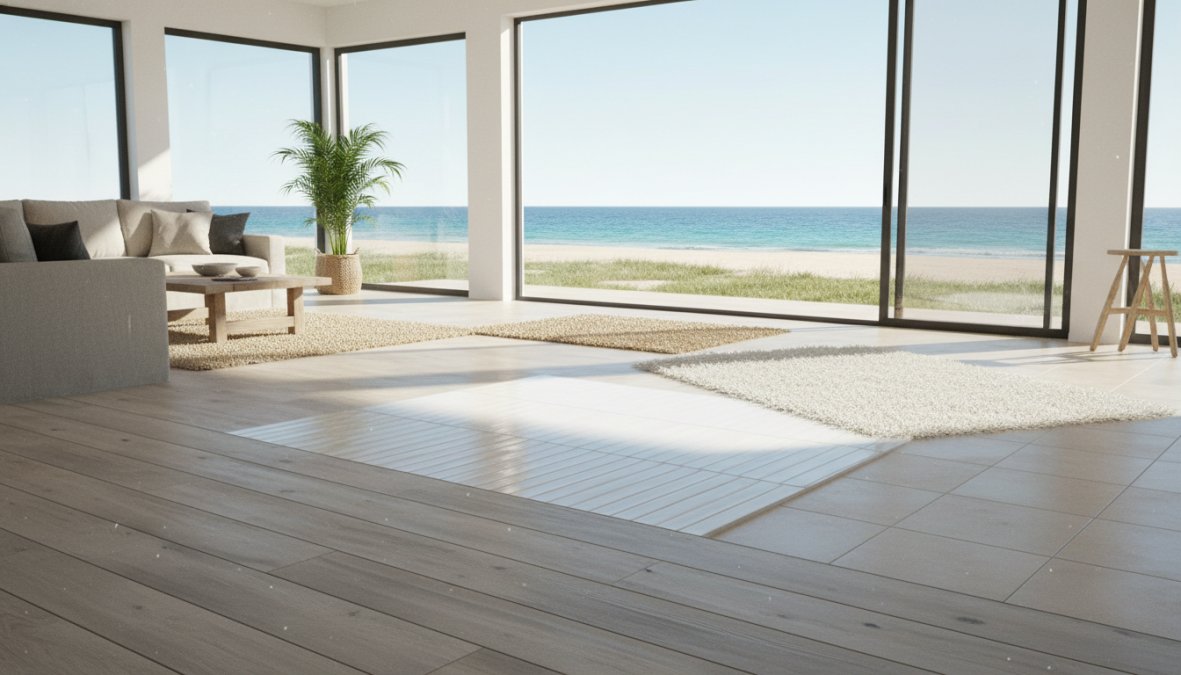
| Flooring Type | Best For | Waterproof | Price Range | Maintenance |
|---|---|---|---|---|
| Luxury Vinyl Plank (LVP) | High-traffic beach homes | Yes | Mid range | Very low |
| Porcelain Tile | Wet zones, entryways | Yes | Mid to high | Low |
| Engineered Hardwood | Primary residences | Water-resistant | High | Moderate |
| Wood-Look Porcelain | Design-focused homes | Yes | Mid to high | Low |
| Budget LVP | Vacation rentals | Yes | Low to mid | Very low |
1. Luxury Vinyl Plank (LVP), Best Overall Pick
Luxury vinyl plank is the top pick for most coastal homes because it combines 100% waterproof construction with realistic wood aesthetics and near-zero maintenance requirements. Products like Coretec LVP feature a rigid core that resists warping in humid environments, an attached cork underlayment for comfort and sound dampening, and a high-density wear layer that handles sand abrasion far better than standard vinyl.
Pros: Fully waterproof, easy to clean, scratch-resistant wear layer, comfortable underfoot, wide range of coastal color options including driftwood tones and sun-bleached oak. Cons: Higher-end products carry a premium price; cannot be refinished if deeply scratched.
2. Porcelain and Ceramic Tile, Most Durable
Porcelain tile is the most physically durable option available for coastal living. Products like Emilceramica Porcelain Stoneware feature extremely low porosity, which means salt water and humidity essentially cannot penetrate the surface. UV stability makes it suitable for sun-drenched entryways and kitchen floors that take direct light.
Pros: Virtually indestructible, salt-resistant, UV stable, allergen-free. Cons: Cold underfoot, grout lines require regular maintenance, harder on joints during long standing periods.
3. Engineered Hardwood, Best for Authentic Wood Look
Engineered hardwood offers the closest thing to the warmth and character of real wood without the vulnerability of solid planks. Malibu Wide Plank and Hartco Coastal Highway collections use wire-brushed surfaces and aluminum oxide finishes to mask everyday sand wear. The multi-layer engineered construction is significantly more stable than solid wood under humidity fluctuation.
Pros: Authentic wood aesthetic, better humidity stability than solid hardwood, can be refinished once or twice. Cons: Not suitable for bathrooms or laundry rooms, requires more care than synthetic options, higher cost.
4. Wood-Look Porcelain Tile, Best of Both Worlds
Wood-look porcelain tile delivers the visual warmth of hardwood with the durability of ceramic. The Artistic Tile Beach House Collection and The Tile Shop's Porcelain Wood-Look Tile line offer plank-sized formats with weathered, driftwood-inspired textures and matte finishes that improve traction. Pricing for The Tile Shop's range runs from around $6.00 to $30.00 per square foot, making it accessible across budgets.
Pros: Waterproof, slip-resistant matte finish, wide aesthetic range, durable porcelain construction. Cons: Grout lines need regular cleaning, installation is more complex than floating floor systems.
5. Budget LVP, Best for Vacation Rentals
For vacation rental owners who need durability at scale, budget LVP from brands like Proximity Mills delivers waterproof construction, realistic wood visuals, and click-lock installation at a competitive price. The trade-off is a thinner wear layer and fewer high-end design options, but for a property that turns over weekly, the math strongly favors this category.
Pros: Cost-effective for large renovations, DIY-friendly click-lock system, fully waterproof. Cons: Thinner wear layer means less long-term scratch resistance than premium options.
Luxury Vinyl Plank for Beach Houses: Why It Dominates the Shoreline
Most flooring categories make compromises in coastal environments. Luxury vinyl plank for beach houses makes almost none.
The rigid core construction in premium LVP products resists the dimensional changes caused by humidity cycling. Unlike traditional vinyl, which can soften and indent under furniture, rigid core LVP maintains its structure year-round. The wear layer, typically measured in mils, is the critical spec to watch: a 12-mil wear layer handles typical beach house foot traffic, while a 20-mil layer is appropriate for high-turnover vacation rentals where sand infiltration is constant.
Canopy Floors Coastal LVP is a strong example of how the category has evolved aesthetically. The collection uses light, airy color palettes specifically curated for modern coastal interiors, moving beyond the generic wood tones that dominated early LVP lines. The result is a product that doesn't just survive a beach environment; it actually looks like it belongs there.
The underlayment choice matters too. Cork underlayment, like that attached to Coretec products, provides thermal comfort on cool mornings and reduces the hollow sound underfoot that plagues cheaper floating floor installations.
Pros and Cons of Tile vs Wood in Beach Houses
The tile vs. wood decision in a beach house is not a single choice, it is a room-by-room allocation problem. The right answer in a coastal entryway is almost never the right answer in a primary bedroom, and treating the whole house as one decision leads to either over-engineered floors in low-risk spaces or under-engineered floors in high-risk ones. Here is the honest technical breakdown, including the sustainable flooring options that most guides in this category ignore entirely.
Tile: The Waterfront Workhorse, With Specific Caveats
Porcelain and ceramic tile are the only flooring materials that are genuinely impervious to everything a coastal environment throws at them. Salt water, standing moisture, direct UV, sand: none of these meaningfully degrade a properly installed tile floor over time. For entryways, mudrooms, bathrooms, laundry rooms, and kitchens in a beach house, tile is the professional recommendation without reservation.
But 'properly installed' carries significant weight in a coastal context, and this is where most guides stop short.
Grout performance in salt environments is the real variable. Standard unsanded grout in a beach house entryway that sees daily wet, sandy foot traffic will begin absorbing salt residue within the first season. Salt is mildly hygroscopic, it attracts and holds moisture, which means salt-contaminated grout stays damp longer than it should, accelerating the breakdown of the grout binder. The practical response is twofold: use an epoxy grout rather than cement-based grout in high-traffic coastal zones (epoxy grout is non-porous and salt-resistant by composition), and in areas where cement grout is already installed, seal it with a penetrating silicone or fluoropolymer sealer annually, more frequently in entryways that see direct ocean water tracking.
Large-format tiles with minimal grout joints are the other structural response. A 24x24 or 24x48 porcelain format has dramatically fewer linear feet of grout per square foot of floor than a 12x12 grid. Fewer grout lines mean less salt accumulation surface, less maintenance commitment, and a cleaner visual result.
Thermal comfort is a real limitation, not just a preference. Tile is cold underfoot on cool mornings, which matters significantly more in a primary residence used year-round than in a summer vacation property. The practical solution for primary residences is in-floor radiant heating beneath tile, a system that pairs naturally with tile's thermal mass and eliminates the comfort objection almost entirely. For vacation rentals where the infrastructure investment is harder to justify, area rugs over tile in living spaces accomplish the same result at a fraction of the cost.
Slip resistance in wet zones: Specify tile with a Dynamic Coefficient of Friction (DCOF) rating of 0.42 or higher for any wet or potentially wet area. Most porcelain tiles marketed for residential use meet this threshold, but it is worth confirming on the product spec sheet for entryways and bathrooms where wet sandy feet are the norm.
Engineered Hardwood: Coastal Charm With Honest Moisture Thresholds
Engineered hardwood is the right choice for homeowners who genuinely want the look and feel of real wood and are willing to maintain it, but the moisture threshold where it stops performing is more specific than most guides state.
Most engineered hardwood manufacturers specify a maximum acceptable subfloor moisture content of around 12 percent for wood subfloors, and maximum moisture vapor emission rates for concrete slabs that vary by product but are typically in the range of 3 to 8 pounds per 1,000 square feet per 24 hours (measured by calcium chloride test). In a coastal home, these thresholds are not theoretical, they are the line between a floor that performs for decades and one that begins cupping or gapping within two seasons. Test before you install, every time.
The wire-brushed texture on products like Malibu Wide Plank and similar coastal-oriented engineered lines does real work: it hides the minor scratches and dents that accumulate from sandy foot traffic in a way that a smooth, high-gloss finish simply cannot. The texture also reduces the visual impact of the minor color variation that occurs as engineered hardwood acclimates to seasonal humidity changes, a phenomenon that is more pronounced in coastal homes than inland ones.
The honest zone allocation for engineered hardwood in a beach house: living rooms, bedrooms, dining areas, and hallways. Not bathrooms, not laundry rooms, not mudrooms, not any space that regularly sees standing water or direct ocean water tracking. In those zones, tile or LVP is the correct specification.
The Sustainable Flooring Option Most Guides Miss: Bamboo and Cork
Neither bamboo nor cork appears in most coastal flooring guides, which is a genuine gap, because both materials have properties that make them worth serious consideration in specific coastal applications.
Bamboo is technically a grass, not a wood, and its cellular structure gives it a natural dimensional stability that outperforms many hardwood species under humidity fluctuation. Strand-woven bamboo, in particular, is compressed under high heat and pressure into a material that is harder than most domestic hardwoods by Janka rating and significantly more resistant to moisture-driven expansion and contraction. For a coastal homeowner who wants the warmth of a natural material without the vulnerability of traditional hardwood, strand-woven bamboo engineered over a proper moisture barrier is a legitimate option for living areas and bedrooms. It is also a more sustainable choice than hardwood, as bamboo reaches harvest maturity in three to five years versus decades for timber species.
The caveat: bamboo is not waterproof, and lower-quality bamboo products can be more susceptible to moisture damage than their marketing suggests. Specify strand-woven construction (not flat-pressed or vertical-grain bamboo, which are less stable), confirm the product has a proper finish system, and apply the same subfloor moisture testing protocols you would for engineered hardwood.
Cork is the other underutilized option. Cork's cellular structure, millions of air-filled cells sealed by a waxy compound called suberin, gives it natural resistance to moisture absorption, mold, and mildew. It is also inherently comfortable underfoot and provides thermal insulation, which addresses the cold-floor problem that makes tile uncomfortable in primary residences. For a beach house bedroom or home office where comfort is the priority and the moisture exposure is low, cork flooring with a proper UV-stable finish is a genuinely distinctive choice that most coastal homeowners have never considered.
Cork's limitations in a coastal context: it is not appropriate for high-traffic sandy entryways (the surface can dent and abrade under concentrated point loads), and it requires a UV-stable finish coat to prevent color shift in sun-exposed rooms. Treat it as a bedroom and low-traffic living space material, not a whole-house solution.
Room-by-Room Allocation Framework
| Room | First Choice | Second Choice | Avoid |
|---|---|---|---|
| Entryway / Mudroom | Porcelain tile (epoxy grout) | Premium LVP | Any wood product |
| Kitchen | Porcelain tile | LVP | Engineered hardwood |
| Living Room | LVP or Engineered Hardwood | Wood-look porcelain | Solid hardwood |
| Primary Bedroom | Engineered Hardwood | Cork | High-gloss LVP |
| Bathrooms | Porcelain tile | LVP | Any wood product |
| Laundry Room | Porcelain tile | LVP | Any wood product |
| Screened Porch / Sunroom | Porcelain tile | Exterior-rated LVP | Any wood product |
Coastal Design Aesthetics: Colors, Finishes, and Wide Plank Styles
Coastal design aesthetics have shifted significantly over the past few years, but the shift is more precise than most guides acknowledge. The all-white, bleached-out beach cottage look has given way to something warmer and more layered, and the practical reason matters as much as the aesthetic one: high-contrast white floors in direct coastal sunlight show every grain of sand, every salt-water footprint, and every scuff from beach gear. The design trends that have taken hold are not arbitrary; they are, in large part, responses to the real-world performance failures of the floors they replaced.
Wide Plank Formats: The Right Width and Why It Matters
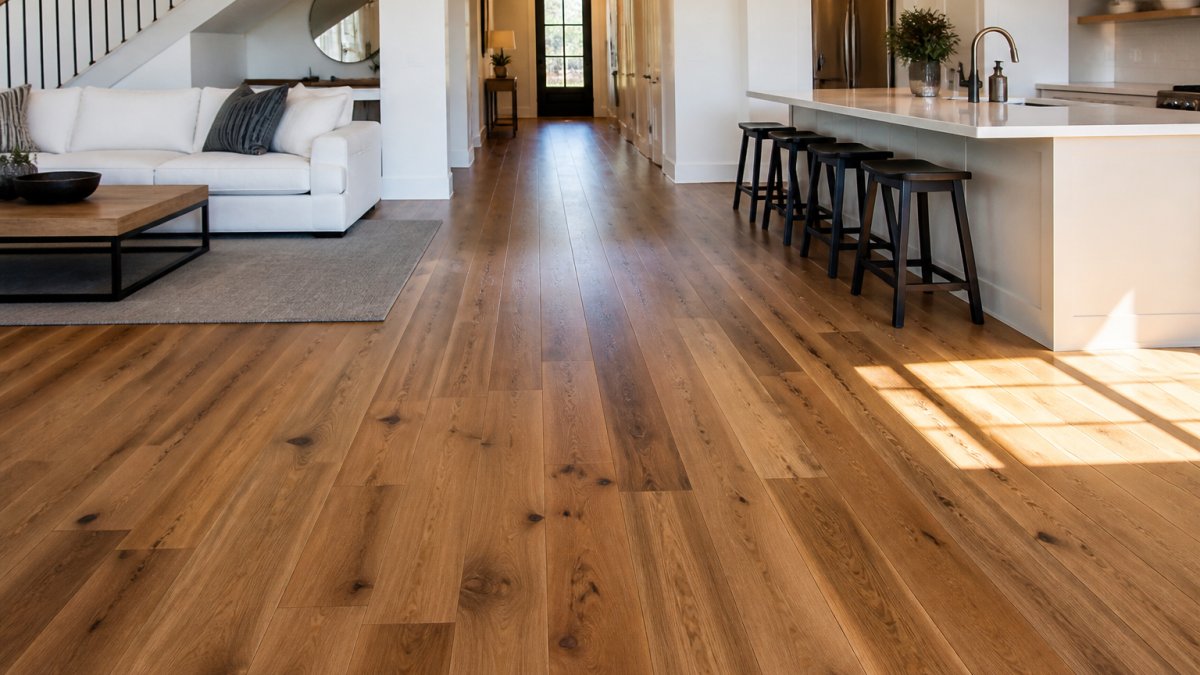
Wide planks are the defining format for coastal interiors right now, but 'wide' has a specific meaning worth pinning down. A plank width of five inches is the practical minimum for a coastal open-concept space; seven to nine inches is the current sweet spot for primary residences and design-forward vacation properties. At that width, fewer seams cross the floor, which reduces the number of edges exposed to sand infiltration and moisture wicking. Narrow strip flooring, anything under four inches, reads as dated in this context and creates more linear feet of edge exposure per square foot of floor, which is a real maintenance liability in a salt-air environment.
For LVP specifically, wide plank formats also tend to correlate with thicker core construction, which improves rigidity and reduces the hollow sound underfoot that plagues narrower, thinner products in floating installations.
UV Fading: The Coastal Variable Most Guides Ignore
Sunlight exposure is one of the most consequential and least-discussed factors in coastal flooring selection. Beach houses typically feature large windows, glass doors, and open layouts designed to maximize ocean views, which means floors receive significantly more direct UV exposure than in a standard inland home. This is not a minor consideration.
Solid hardwood and lower-grade engineered hardwood are the most vulnerable. UV radiation breaks down the lignin in wood fibers, causing color shift, typically a yellowing or graying, that is uneven across the floor wherever sunlight patterns fall. A floor that looks uniform on installation day can develop visible fade lines within two to three seasons in a south- or west-facing beach house room.
The practical hierarchy for UV resistance in coastal flooring:
- Porcelain tile, Fired ceramic pigments are essentially UV-inert. Color shift over decades of direct sun exposure is negligible. This is the strongest argument for tile in sun-drenched entryways and great rooms beyond its moisture resistance.
- Premium LVP with UV-inhibiting wear layers, Quality rigid-core LVP products use wear layers with UV stabilizers built into the compound. Look for products that explicitly list UV resistance in their technical specifications. Coretec and similar premium lines include this; budget LVP often does not.
- Engineered hardwood with aluminum oxide finish, The aluminum oxide topcoat slows UV penetration, but it does not stop it. Wire-brushed surfaces with a matte finish show color shift less dramatically than smooth, high-gloss engineered floors because the texture breaks up the visual uniformity that makes fade lines obvious.
- Unfinished or lightly finished wood, Avoid in any room with significant direct sun exposure in a coastal home.
If your beach house has a great room or living area with south- or west-facing glass, treat UV resistance as a primary specification criterion, not an afterthought.
Color Palette: Functional Logic Behind the Aesthetic
The palette that performs consistently in coastal homes runs from warm sand tones through driftwood grays to sun-bleached oak whites, but the reason these colors work is functional, not just fashionable. Mid-tone, slightly variegated finishes hide the two most common coastal floor problems: sand tracking and salt-water footprints. A uniform dark floor shows every grain of light sand. A uniform white floor shows every wet footprint and salt residue ring. The driftwood gray and warm sand tones that dominate coastal design right now occupy the middle ground where neither problem is visible between cleanings.
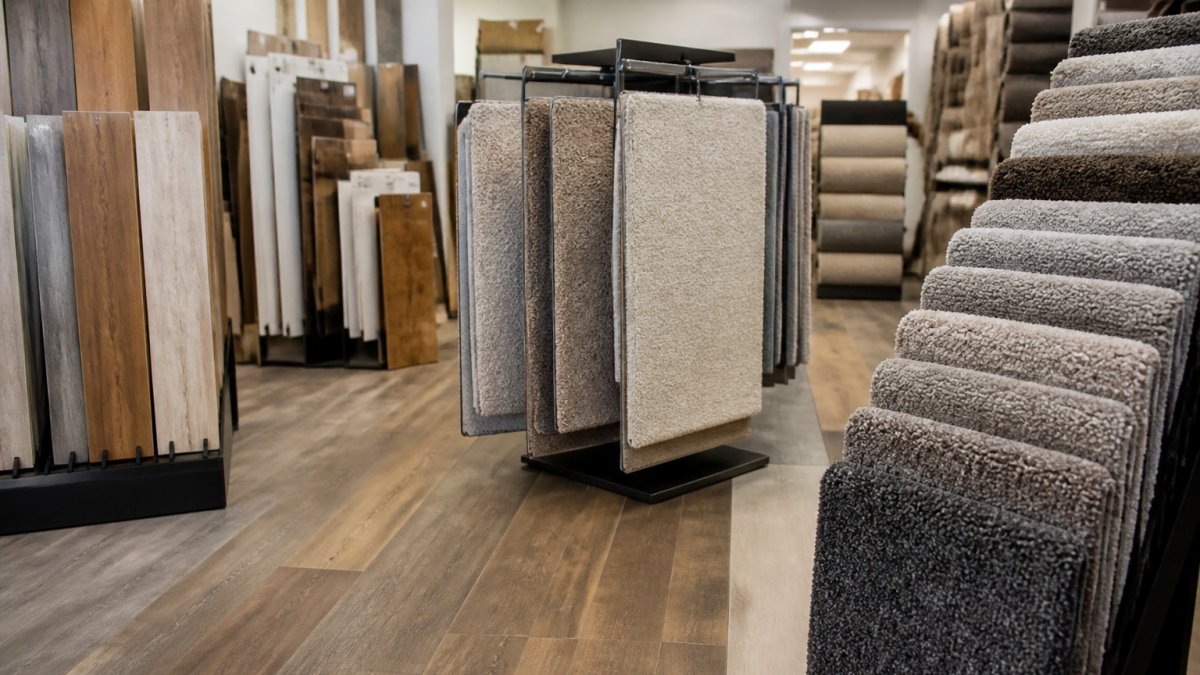
Variegation within the plank, the natural color variation that mimics real wood grain, does additional work. A floor with high color variation across planks masks localized wear and micro-scratching far better than a floor with a uniform, consistent tone. When specifying LVP or wood-look porcelain, request samples with high intra-plank variation rather than selecting from a single representative plank in a showroom display.
Finish Selection: Matte, Wire-Brushed, and the Gloss Trap
Matte and low-gloss finishes are the professional choice for coastal floors for two concrete reasons beyond aesthetics:
- Sand visibility: High-gloss surfaces reflect light in a way that makes every grain of sand and every micro-scratch immediately visible. A matte finish scatters light diffusely, making the same amount of sand and wear essentially invisible until it accumulates significantly.
- Salt residue: Evaporated salt water leaves a faint white residue on floors. On a high-gloss surface, this residue is visible as a haze or ring. On a matte surface, it is far less apparent between mopping cycles.
Wire-brushed textures add a third layer of practical defense. The mechanical texture of a wire-brushed surface, whether on engineered hardwood or wood-look porcelain, fills with the micro-scratches of sandy foot traffic uniformly, so the floor looks consistently textured rather than randomly scratched. It is one of the few cases in flooring where a surface treatment serves both an aesthetic and a durability function simultaneously.
Subfloor Preparation and Underlayment for Coastal Environments
Subfloor preparation is where coastal flooring projects most often go wrong, and it's the section most flooring guides skip entirely.
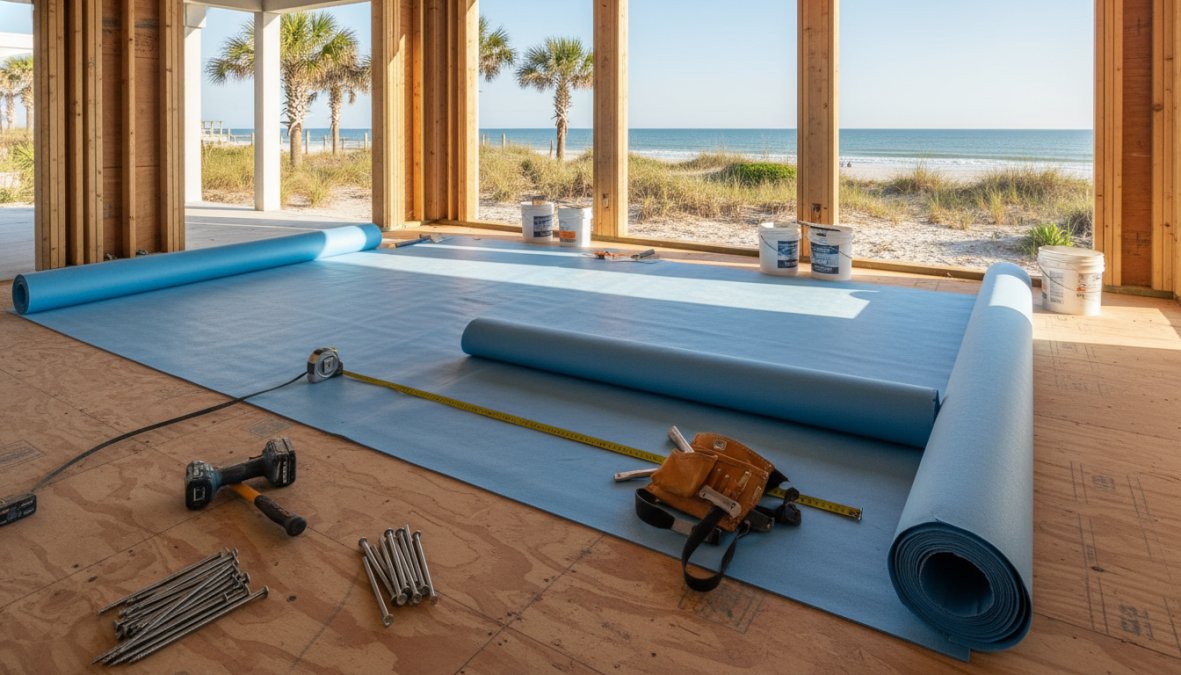
Coastal subfloors face two specific threats that inland subfloors typically don't: elevated ambient moisture vapor transmission through concrete slabs and accelerated wood subfloor degradation from persistent humidity. Before any flooring goes down, the subfloor must be tested for moisture content. Many contractors use a calcium chloride test or a relative humidity probe embedded in the slab; the acceptable threshold varies by flooring type, but most manufacturers specify maximum moisture vapor emission rates in their installation guidelines.
For concrete slab subfloors, a vapor barrier or moisture barrier underlayment is not optional in a coastal environment. It's the difference between a floor that lasts a decade and one that starts delaminating in three years. For wood subfloors, checking for soft spots, squeaks, and any signs of prior water damage before installation is essential. Any compromised sections should be replaced, not covered over.
The underlayment itself serves multiple functions: moisture management, thermal comfort, sound dampening, and minor subfloor irregularity correction. Cork underlayment, like that integrated into Coretec LVP products, handles all four. For tile installations, a cement board or uncoupling membrane like those recommended by the LATICRETE installation systems technical documentation provides the stable, moisture-resistant base that tile requires.
How to Maintain Beach House Floors: Cleaning Protocols for Salt Air and Sand
Maintaining beach house floors is a different discipline than standard floor care. The protocols need to account for salt residue and abrasive sand, not just dust and dirt.
Daily or post-beach-day protocol:
- Sweep or vacuum with a soft-bristle attachment to remove sand before it gets ground into the wear layer
- Mop LVP and tile with a pH-neutral cleaner diluted in clean water; avoid soap-based cleaners that leave residue
- Wipe engineered hardwood with a barely damp microfiber mop only; standing water is the enemy
- Check entryway mats and shake them out before they become sand reservoirs themselves
Weekly protocol:
- Mop all hard surfaces with a manufacturer-approved cleaner
- Inspect grout lines on tile floors for salt deposits and clean with a grout brush if needed
- Check transition strips and edges for any signs of moisture infiltration
Seasonal protocol:
- Re-seal grout lines on tile floors annually, more frequently in high-traffic zones
- Apply a hardwood floor refresher to engineered wood surfaces per manufacturer guidance
- Inspect the perimeter of all flooring for any gapping or separation that could indicate subfloor moisture movement
The thing nobody tells you about salt air maintenance is that the salt residue left by evaporated moisture is mildly abrasive itself. Letting it accumulate on a floor surface and then walking on it is essentially applying a fine-grit polish with every step. Regular damp mopping removes this residue before it causes damage.
DIY vs. Professional Flooring Installation: A Cost-Benefit Breakdown
The DIY vs. professional installation question is worth examining honestly, because the coastal environment changes the math compared to a standard home renovation.
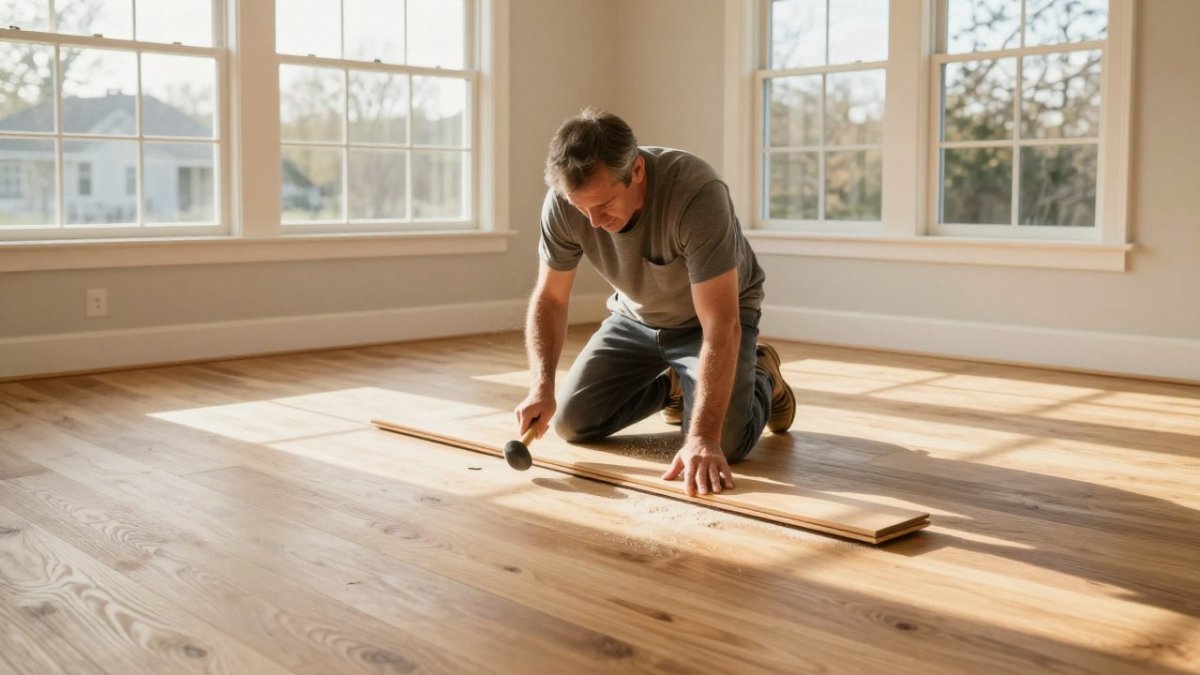
Click-lock LVP is genuinely DIY-friendly. The floating installation method requires no adhesive, no specialized tools beyond a tapping block and pull bar, and no subfloor bonding. For a vacation rental owner who wants to control costs and is comfortable with basic carpentry, budget LVP like Proximity Mills is a reasonable DIY project. The typical installation time for an experienced DIYer runs roughly 100 to 150 square feet per day.
Tile installation is a different category. Proper tile work in a coastal environment requires correct substrate preparation, appropriate moisture-resistant adhesive, and consistent grout joint sizing. A poorly tiled floor with inadequate substrate prep will crack and loosen within a season. The cost of professional tile installation is a genuine investment in longevity, not just labor convenience.
Engineered hardwood sits in the middle. Products like ADM Flooring's engineered lines explicitly recommend professional installation, particularly in coastal environments where moisture vapor management during installation is critical. A professional installer will acclimate the product correctly, prepare the subfloor to spec, and install the appropriate vapor barrier. Skipping any of these steps voids most manufacturer warranties.
As a general framework: DIY is appropriate for floating LVP installations in lower-stakes spaces. Professional installation is the right call for tile in any location, engineered hardwood throughout, and any flooring going over a concrete slab in a coastal environment. The labor cost of professional installation is typically recovered in extended floor lifespan and avoided remediation costs.
For context on typical flooring installation costs by material and region, the National Floor Covering Association's consumer resource center provides general guidance on what to expect from professional installers.
Conclusion: The Right Floor for Your Beach House Starts Here
Selecting flooring for a coastal home means solving a problem that standard residential products were not designed for. Salt air, sand infiltration, and humidity cycles will expose every weakness in a material or installation, usually within the first two seasons.
The challenge is finding flooring that genuinely performs in a Suffolk County coastal environment, not just products that look good in a showroom. Hamptons carpet one floor and Home serves homeowners across all of Suffolk County, NY, with direct knowledge of local coastal conditions and access to the product lines covered in this guide. Visit Hamptons carpet one floor and Home to get expert guidance on the best coastal flooring for beach houses and find the right material for your specific home, budget, and lifestyle.
Frequently Asked Questions
What is the most durable flooring for a beach house?
Porcelain tile is generally considered the most durable flooring for a beach house. Its extremely low porosity makes it virtually impervious to moisture, salt air, and sand abrasion. Products like Emilceramica Porcelain Stoneware are engineered with UV stability and high resistance to salt corrosion, making them ideal for coastal environments. For areas where comfort underfoot matters more, premium LVP like Coretec is a close second in terms of durability and resilience.
Is luxury vinyl plank good for beach houses?
Yes, luxury vinyl plank is one of the best coastal flooring choices for beach houses. LVP features 100% waterproof construction, scratch-resistant wear layers that stand up to sand infiltration, and realistic wood-look finishes that suit coastal aesthetics. Brands like Coretec include attached cork underlayment for added comfort. LVP is also low-maintenance and easy to clean after sandy beach days, making it a top pick for both primary residences and vacation rentals.
Can you put hardwood floors in a beach house?
Solid hardwood is generally not recommended for beach houses due to the high humidity and moisture exposure common in coastal living. However, engineered hardwood is a viable alternative. Its multi-layered construction resists expansion and contraction better than solid wood. Options like Malibu Wide Plank and Hartco Coastal Highway feature wire-brushed finishes that hide scratches from sand and low-gloss matte finishes that minimize visible wear. Keep engineered hardwood out of bathrooms and other high-moisture zones.
How do you protect beach house floors from sand and salt?
Protecting beach house floors starts with choosing scratch-resistant, moisture-resistant materials like LVP or porcelain tile. Place high-quality entry mats at all exterior doors to trap sand before it infiltrates. Sweep or vacuum frequently using a soft-bristle attachment. For salt air exposure, damp-mop hard surfaces weekly with a pH-neutral cleaner to prevent salt residue buildup. Avoid harsh chemical cleaners that can degrade finishes over time. Proper subfloor moisture barriers during installation also provide long-term protection.
What flooring is best for vacation rental beach houses?
For vacation rentals, the best coastal flooring balances durability, low-maintenance upkeep, and visual appeal for guests. Luxury vinyl plank, particularly budget-friendly options like Proximity Mills, offers waterproof construction, easy click-lock installation, and a realistic wood look that photographs well. Porcelain tile is another strong choice for high-traffic entry areas and kitchens. Both options handle heavy foot traffic, resist sand and moisture, and clean up quickly between guest stays.
This article was written using GrandRanker