 Listicle
Best Commercial Carpet Tiles for Storefronts: 2026 Guide
Table of Contents
- Why Storefronts Need Specialized Commercial Carpet Tiles
- Durable Commercial Carpet Tiles: Materials & Construction
- Top Commercial Carpet Tile Brands for Storefronts
- Commercial Carpet Tile Installation: Methods & Subfloor Prep
- Commercial Carpet Tile Cost: Pricing & Budget Planning
- ADA Compliance & Fire Safety Standards
- Maintenance, Cleaning & Modular Replacement Strategy
- Choosing the Right Carpet Tiles for Your Storefront
Best Commercial Carpet Tiles for Storefronts: 2026 Guide
Last Updated: July 21, 2026
Why Storefronts Need Specialized Commercial Carpet Tiles
Retail environments demand flooring engineered for high-traffic punishment. Hundreds of daily customers track dirt and moisture that would destroy standard residential carpet within months. Commercial-grade carpet tiles feature solution-dyed nylon fibers that resist fading and staining, backing systems designed for heavy foot traffic, and modular designs that let you replace damaged sections without tearing out your entire floor.
Storefronts face three pressures residential spaces never encounter: constant traffic, high visibility, and the need for quick repairs. A single stain or worn patch damages brand perception. A flooring failure means closing for installation. The best commercial carpet tiles solve both problems by combining durability with modularity, replace one tile, not the entire floor.
Heavy Traffic Demands & Durability Standards
Commercial carpet tiles for storefronts must withstand 500+ daily visitors. Solution-dyed nylon is the industry standard because color is integrated into the fiber itself, so stains and fading become visible only after severe neglect.
Most commercial applications use 1/2-inch to 5/8-inch pile height, the sweet spot between comfort, durability, and soil resistance. Thicker piles trap dirt; shorter piles wear visibly. The rubber or vinyl backing provides stability that prevents tiles from shifting under foot traffic.
When evaluating commercial carpet tiles, check pile density (measured in ounces per square yard). Higher density equals longer lifespan. Most commercial-grade tiles range from 40 to 60 ounces per square yard.
Design Flexibility & Customer First Impressions
Your storefront flooring communicates brand identity instantly. Modular carpet tiles offer design flexibility that broadloom cannot match, create custom patterns, blend colors, or change your look seasonally without replacing everything.
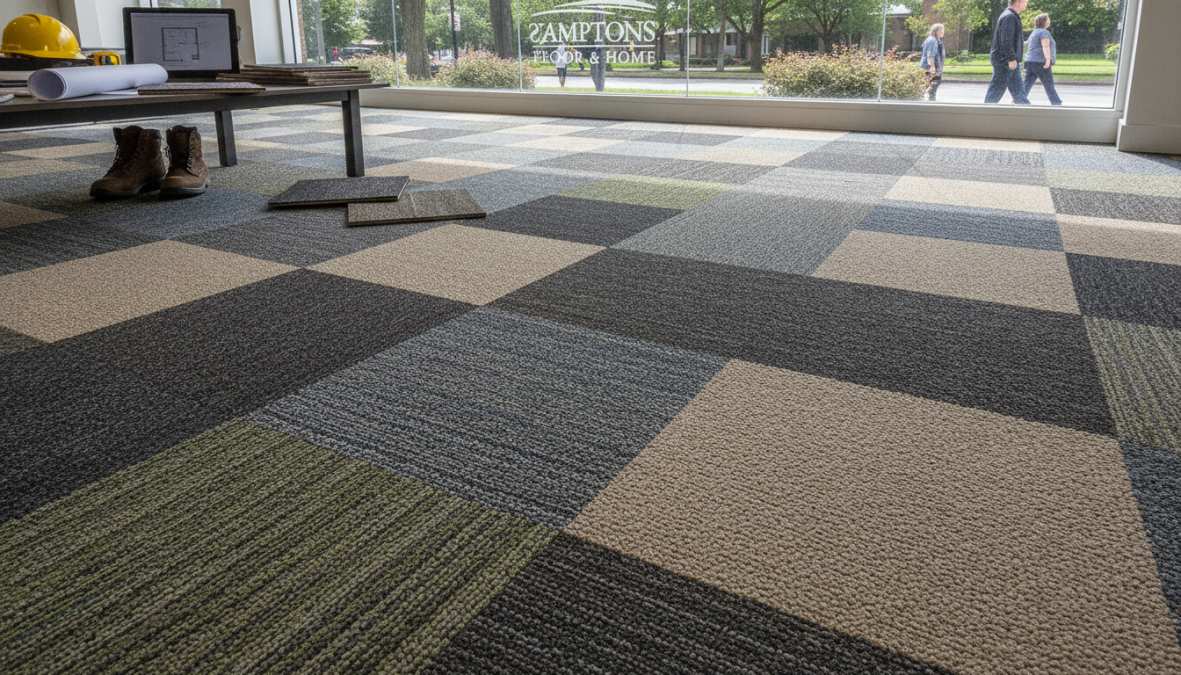
Many storefronts use two-color or multi-pattern layouts to hide dirt in high-traffic zones while maintaining visual interest elsewhere. This strategic approach extends visible lifespan and reduces replacement frequency. Interface, Shaw Contract, and Mohawk Group all offer extensive color palettes designed for retail applications.
Carpet tiles also provide acoustic performance that hard flooring lacks. They absorb sound, creating a more pleasant shopping experience and reducing customer fatigue, an important balance in retail spaces where customers spend 20-45 minutes browsing.
Durable Commercial Carpet Tiles: Materials & Construction
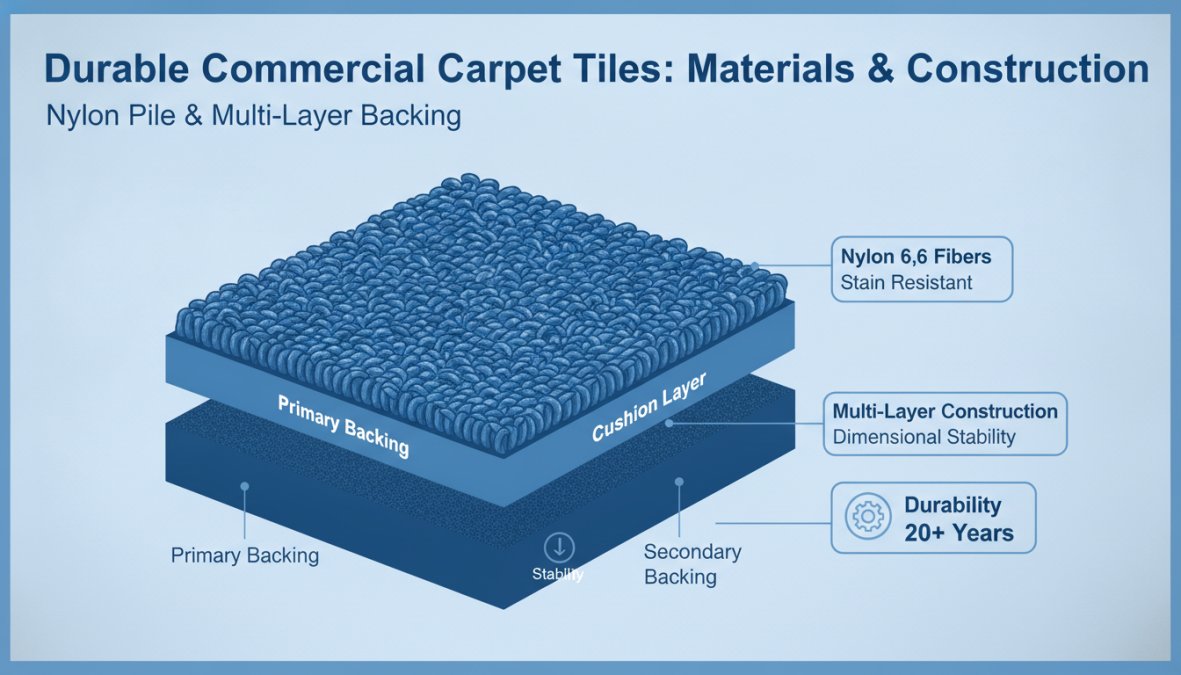
The foundation of any commercial carpet tile's performance lies in its fiber composition and backing system.
Nylon Fiber vs. Synthetic Alternatives
Solution-dyed nylon dominates commercial flooring because it outperforms every alternative in high-traffic retail environments. Nylon fiber accepts stain treatments more effectively than polyester or polypropylene, and dye integration means colors remain vibrant even after aggressive cleaning.
Polyester costs 15-25% less but shows wear faster and resists stain treatment less effectively. A nylon tile lasts 7-10 years under heavy retail traffic; polyester typically lasts 4-6 years. Eco-conscious retailers should know that most major manufacturers now offer solution-dyed nylon made with recycled content, Patcraft's Eco Solution Q fiber and Interface's recycled-content options deliver durability without environmental impact.
Backing Systems & Slip Resistance
GlasBac and Strataworx are industry-standard backing systems that provide dimensional stability, moisture resistance, and grip. Slip resistance comes from backing texture and pile construction, the fibers themselves create friction that prevents slipping. Test samples in your actual space before committing to large orders.
| Backing Type | Moisture Resistance | Stability | Best For |
|---|---|---|---|
| GlasBac | Excellent | Superior | High-traffic storefronts |
| Strataworx | Excellent | Superior | Retail with variable humidity |
| Vinyl Backing | Good | Good | Budget-conscious retailers |
| Standard Rubber | Fair | Fair | Lower-traffic areas |
Top Commercial Carpet Tile Brands for Storefronts
Interface: Sustainability Meets Heavy-Duty Performance
Interface leads the industry in combining commercial-grade durability with environmental responsibility. Their solution-dyed nylon tiles handle 500+ daily foot traffic with backing systems that provide superior dimensional stability. The Standard Quick Ship collection offers rapid delivery on popular styles, critical when storefronts need flooring fast.
Individual tiles can be replaced without disturbing adjacent sections, extending visible lifespan dramatically. Many retail managers report that strategic tile replacement every 3-5 years maintains appearance while actual flooring remains functional for 10+ years. The 100% solution-dyed nylon fiber resists fading and staining better than alternatives, with design ranges from subtle neutrals to bold patterns.
Shaw Contract: Design Variety & Stain Resistance
Shaw Contract offers one of the broadest design palettes in commercial flooring. Their Structure collection and other lines provide hundreds of color and pattern options. The solution-dyed Eco-Solution nylon fiber delivers stain resistance without compromising design.
Shaw's Strataworx backing provides stability for heavy retail traffic. The 24" x 24" modular format allows custom pattern creation. Retailers appreciate Shaw's balance of performance and aesthetics, you don't sacrifice durability for design variety.
Mohawk Group: Durability & Eco-Conscious Options
Mohawk Group positions itself as the durability leader for commercial environments. Their Elite Collection is engineered for maximum wear resistance with modular design supporting easy installation and selective replacement.
Mohawk incorporates recycled content into many collections and carries strong wear warranties reflecting confidence in durability. For storefronts prioritizing longevity, Mohawk delivers reliable performance.
Patcraft: Wear Warranty & Commercial-Grade Strength
Patcraft specializes exclusively in commercial flooring. Their Determination collection features Eco Solution Q nylon with exceptional stain resistance and lifetime warranty covering abrasive wear and static.
Patcraft tiles are certified Green Label Plus, meeting strict indoor air quality standards, important for storefronts where customers spend extended time.
Commercial Carpet Tile Installation: Methods & Subfloor Prep
Installation quality determines whether your commercial carpet tiles perform as designed.
Peel-and-Stick vs. Glue-Down Installation
Pressure-sensitive adhesive (peel-and-stick) tiles offer faster installation and easier future replacement. Installation typically takes 50-70% less time than glue-down methods. For storefronts needing quick reopening, this speed advantage is substantial.
Glue-down installation uses commercial-grade adhesive applied to the subfloor, creating a more permanent bond with superior moisture resistance. This method is preferred for storefronts in basements, near entryways with high moisture, or in climates with significant temperature fluctuations. The cost difference is minimal; labor difference is more significant.
Subfloor Preparation for Retail Spaces
Most installation failures occur during subfloor preparation. The subfloor must be clean, dry, and level, meaning variation of no more than 1/8 inch in 10 feet. Self-leveling compounds address minor unevenness; significant variations require grinding or patching.
Moisture testing is non-negotiable. Concrete subfloors must be tested for moisture vapor transmission. High moisture causes adhesive failure. Most commercial carpet tiles require subfloor moisture levels below 3 pounds per 1,000 square feet per 24 hours. Testing costs $200-400 but prevents thousands in replacement costs.
Contamination, dust, oils, residue from previous flooring, prevents adhesive bonding. Professional preparation includes vacuuming, cleaning with appropriate solutions, and allowing adequate drying time.
Minimizing Disruption During Installation
Retail storefronts cannot close for days during installation. Peel-and-stick installation supports phased approaches where you install one section at a time, keeping most of the store operational. Professional installers understand retail constraints and can coordinate installation to minimize disruption.
Commercial Carpet Tile Cost: Pricing & Budget Planning
Material costs for commercial-grade tiles vary based on quality and design. Budget options start lower; premium brands with extensive design libraries cost more. However, a tile costing 20% more may last 50% longer, improving total cost of ownership.
Installation costs depend on subfloor condition, tile type, and square footage. A 2,000-square-foot storefront might require $3,000-8,000 in installation labor. Wholesale pricing applies when ordering 5,000+ square feet, typically offering 10-20% discounts.
The hidden cost most retailers miss: maintenance. Proper maintenance extends tile lifespan dramatically. Budget for professional cleaning annually and spot treatment supplies. Storefronts that maintain their carpet properly see 30-40% longer lifespan.
ADA Compliance & Fire Safety Standards
Public storefronts must meet accessibility and safety standards, these are legal requirements affecting liability and customer experience.
Accessibility Requirements for Public Storefronts
The Americans with Disabilities Act requires flooring to meet specific standards. Commercial carpet tiles with proper backing systems typically exceed ADA slip-resistance requirements.
Floor transitions must be beveled and smooth. Abrupt height changes create tripping hazards and accessibility violations. Carpet pile height affects wheelchair accessibility, avoid tiles exceeding 3/4 inch in main traffic areas.
Fire Rating & Building Code Compliance
Commercial carpet tiles must meet fire safety standards specified in building codes. Most commercial-grade tiles carry Class I or Class II ratings, meeting standard building code requirements. Verify fire ratings before purchasing, as different jurisdictions have different requirements.
Installation method affects fire rating compliance. Adhesives and backing systems must also meet fire safety standards. Professional installers understand local building codes and ensure compliance.
Maintenance, Cleaning & Modular Replacement Strategy
The lifespan of commercial carpet tiles depends more on maintenance than initial quality. Proper cleaning extends visible life by 30-50%.
Routine Cleaning & Stain Management
Daily vacuuming removes dirt before it embeds in fibers. High-traffic spaces benefit from vacuuming twice daily. Spot treatment addresses spills immediately, most stains respond to standard carpet cleaning solutions if treated quickly.
Professional cleaning annually maintains appearance and extends lifespan. Hot-water extraction removes embedded dirt that vacuuming misses. Avoid harsh chemicals that damage fibers; use pH-neutral cleaners designed for commercial carpet.
Spot Replacement Without Full Reinstallation
This is the primary advantage of modular carpet tiles. When a section becomes worn or permanently stained, you replace individual tiles rather than the entire floor. Most tiles cost $30-80 each.
Peel-and-stick installation makes replacement simple, remove the damaged tile, clean the subfloor, and install a new tile in 10-15 minutes. Glue-down installations require slightly more effort but remain manageable. Many retailers keep spare tiles from their original order for future replacements.
Strategic replacement extends visible lifespan. High-traffic areas may need replacement every 3-5 years, while lower-traffic zones remain acceptable for 10+ years.
Choosing the Right Carpet Tiles for Your Storefront
Selecting the best commercial carpet tiles requires evaluating traffic patterns, aesthetic goals, budget, and maintenance capacity.
Assessing Your Traffic Patterns & Foot Volume
Count your daily foot traffic. Storefronts with 300+ daily visitors require maximum durability. Those with 100-200 visitors have more flexibility. Map your traffic patterns, most storefronts have concentrated wear near entrances and checkout areas. Strategic color and pattern selection in these zones extends visible lifespan.
Matching Design to Brand Identity
Your flooring communicates brand identity as clearly as signage. Premium brands typically choose neutral, sophisticated palettes. Budget retailers often use bold colors and patterns. Trendy boutiques can support more adventurous designs.
Evaluate samples in your actual space under your actual lighting. Colors appear different under natural light, fluorescent, and LED. Consider longevity in design choices, trendy patterns become dated quickly. Neutral foundations with accent tiles allow you to refresh aesthetics without replacing everything.
Frequently Asked Questions
What type of carpet is best for commercial use in high-traffic storefronts?
Nylon carpet tiles are the industry standard for storefronts because they offer superior durability, stain resistance, and resilience under heavy foot traffic. Solution-dyed nylon fibers resist color fading and soil penetration better than other synthetics. Look for commercial-grade tiles with strong backing systems like GlasBac or vinyl backing for stability and moisture resistance. Brands like Interface, Shaw Contract, and Mohawk specialize in nylon-based commercial carpet tiles engineered specifically for retail environments.
How long do durable commercial carpet tiles last in a retail storefront?
High-quality commercial carpet tiles typically last 7-10 years in busy retail settings, though this depends on traffic volume and maintenance. Nylon carpet tiles with proper backing and construction can withstand continuous foot traffic better than broadloom alternatives. Many manufacturers offer lifetime wear warranties covering abrasive wear and static. Modular design allows you to replace worn tiles selectively rather than replacing the entire floor, extending the lifespan of your investment and reducing long-term costs.
What's the difference between peel-and-stick and glue-down commercial carpet tile installation?
Peel-and-stick tiles use pressure-sensitive adhesive backing for quick, tool-free installation with minimal disruption, ideal for retail spaces that need fast turnaround. Glue-down installation requires adhesive application to the subfloor and is generally more permanent and stable for very high-traffic areas. Peel-and-stick is easier to remove or replace individual tiles, while glue-down offers stronger hold-down and better moisture resistance. Your choice depends on your storefront's traffic intensity, subfloor condition, and whether you anticipate frequent tile replacements.
How much does commercial carpet tile cost per square foot, and what affects pricing?
Commercial carpet tile pricing varies widely based on fiber type, brand, and design complexity. Budget options may start around $0.77-$1.50 per square foot, while premium nylon tiles from brands like Interface or Shaw Contract typically range from $1.79-$3.00+ per square foot. Factors affecting cost include solution-dyed nylon construction, backing system quality, design exclusivity, and wholesale volume discounts. For accurate pricing tailored to your project, contact your local floor covering retailer for a quote that accounts for square footage, installation method, and any subfloor preparation needs.
Are commercial carpet tiles easier to maintain than broadloom carpet in storefronts?
Yes, modular carpet tiles offer significant maintenance advantages over broadloom. Individual tiles can be spot-cleaned or replaced without removing the entire floor, reducing downtime and repair costs. Stain-resistant treatments on nylon fibers make routine cleaning straightforward, and soil-release properties prevent dirt from embedding. If one tile becomes damaged or heavily worn, you simply replace that tile rather than re-carpeting the entire space. This modularity is especially valuable in retail environments where foot traffic patterns create localized wear.
This article was written using GrandRanker