 Listicle
Moisture-Resistant Flooring for Basements: 7 Options
Table of Contents
- Why Moisture-Resistant Flooring Matters for Basements
- How to Test Basement Concrete for Moisture Before Installation
- Waterproof Luxury Vinyl Plank for Basements: SPC and Rigid Core Options
- Waterproof Laminate Flooring: Wood Aesthetics with Moisture Protection
- Porcelain and Ceramic Tile: The Most Durable Option
- Basement Subflooring Solutions: Vapor Barriers and Preparation
- Additional Moisture-Resistant Options: Epoxy and Carpet Tiles
- Comparison Table: Moisture-Resistant Flooring at a Glance
- Frequently Asked Questions
Last Updated: September 3, 2026
Why Moisture-Resistant Flooring Matters for Basements
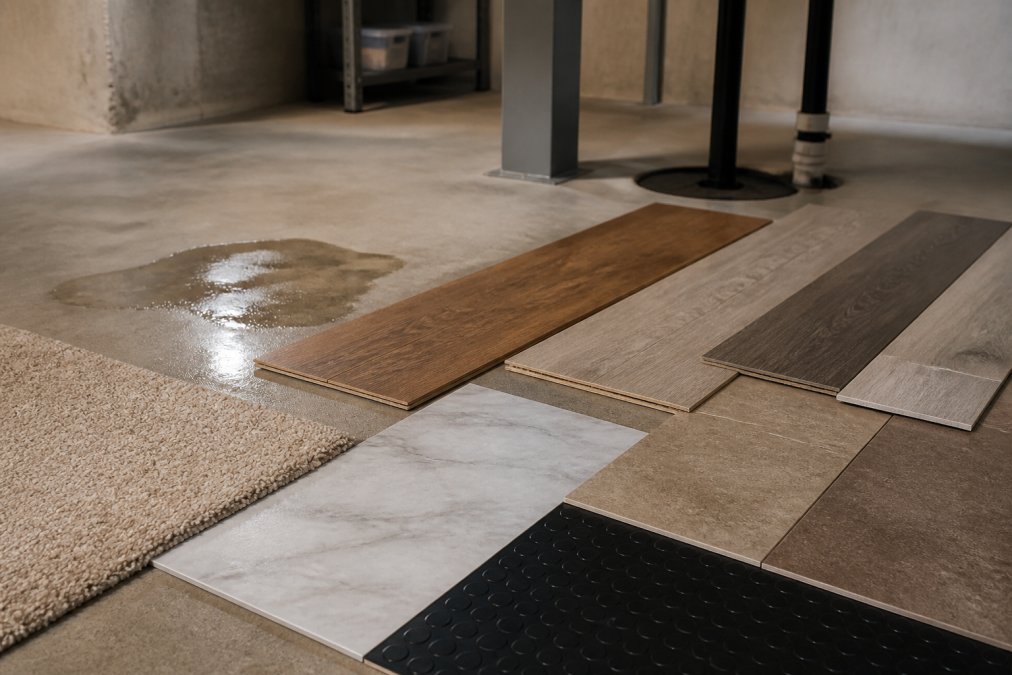
Basements face constant moisture exposure from humidity, groundwater, and condensation, making moisture-resistant flooring essential, not optional. According to SNS Insider's 2026 luxury vinyl market analysis, the U.S. luxury vinyl plank market has grown to $2.08 billion, driven primarily by demand for waterproof solutions in moisture-prone spaces like basements (snsinsider.com).
At Hamptons Carpet One Floor and Home, we've installed many basement floors and seen firsthand what happens when homeowners choose wrong: hardwood warps, standard laminate swells at seams, and carpet traps moisture and breeds mold. Moisture damage compromises structural integrity, promotes mold growth, and costs thousands in remediation. Today's moisture-resistant options deliver genuine wood and stone aesthetics without the vulnerability. This guide covers seven solutions, from waterproof luxury vinyl to porcelain tile, so you can choose with confidence.
How to Test Basement Concrete for Moisture Before Installation
Testing basement concrete for moisture is non-negotiable; it determines which flooring materials will survive in your space.
The calcium chloride method is most common: a 24-72 hour test measuring moisture vapor emission from the concrete slab. A calcium chloride salt pellet in a sealed dome absorbs moisture vapor; weight gain indicates the moisture vapor emission rate (MVER). Concrete is considered dry for most flooring when MVER is below 3 lbs per 1,000 square feet per 24 hours. Above that, you need either a vapor barrier or flooring rated for high-moisture conditions.
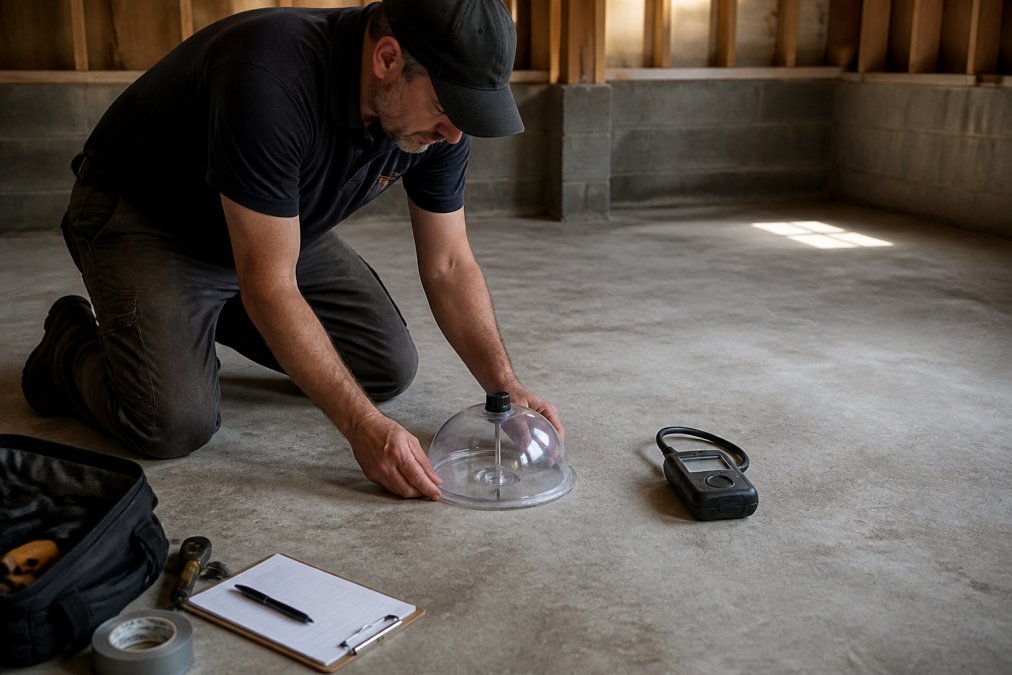
The in-situ relative humidity (RH) test is faster: drill a small hole into concrete, insert an RH probe, and get a reading in 24 hours. More expensive but faster and more accurate, many professionals prefer it.
A simple visual inspection works too: tape plastic to your concrete for 24 hours. If moisture beads up underneath, you have a problem. This isn't precise but indicates whether formal testing is needed.
Most homeowners miss this: even "dry" concrete can have hydrostatic pressure, water pushing up from below due to groundwater. If your basement has had standing water or shows seepage signs, hydrostatic pressure is almost certainly present. You'll need either a sump pump system or flooring rated for water intrusion from below.
Waterproof Luxury Vinyl Plank for Basements: SPC and Rigid Core Options
Luxury vinyl plank dominates basement flooring for good reason: it's genuinely waterproof, easy to install, and mimics real wood or stone. The key differentiator is core material, SPC (Stone Plastic Composite) and rigid core construction change the game.
SPC uses a limestone and plastic blend that's completely waterproof and dimensionally stable. Unlike traditional vinyl with foam backing, SPC won't expand or contract with humidity, eliminating buckling and gaps. It's dense enough for foot traffic yet flexible enough to install as a floating floor over imperfect concrete without underlayment.
Mordor Intelligence's 2026 vinyl flooring market report found that luxury vinyl tile accounted for 67.62% of the U.S. vinyl floor covering market in 2025, with rigid core formats driving fastest growth. LVT demand grew at 25% annually in volume from 2020 to 2022, the fastest growth rate of any flooring category.
COREtec Plus/Pro: 100% Waterproof SPC Construction
COREtec Plus and Pro are the gold standard for basement SPC. Both feature a 100% waterproof limestone core, real wood veneer or stone image, and click-lock installation over concrete, tile, or wood. Pro has a thicker wear layer for higher-traffic spaces.
COREtec's rigid core won't swell if water pools on it. This type of performance is what you're paying for.
COREtec pricing depends on quantity, dates, and delivery. For current prices, please reach out for a quote.
Shaw Floors Floorte Pro Series: Durability for High-Traffic Basements
Shaw Floorte Pro is engineered for basement needs: waterproof core, high durability, and realistic aesthetics. The rigid core provides dimensional stability like COREtec, but Shaw's wear layer is exceptionally thick for basements doubling as playrooms, gyms, or living spaces.
Shaw offers low-VOC options, important if you're sensitive to off-gassing. The click-lock system is intuitive for DIY installation, though professional installation ensures proper acclimation and subfloor prep.
Floorte Pro pricing depends on quantity, dates, and delivery. For current prices, please reach out for a quote.
Waterproof Laminate Flooring: Wood Aesthetics with Moisture Protection
Modern waterproof laminate uses proprietary core materials and edge sealing that prevent water penetration at seams, historically laminate's failure point. HydroSeal edge treatment seals all four plank edges, preventing water from wicking into the core at joints. Combined with waterproof core and tightened locking systems, new laminate handles moderate moisture exposure.
Laminate still has limits. If water pools for hours or persistent seepage exists, laminate will eventually fail. It's best for basements with good moisture control, tested stable concrete, no active seepage, and humidity below 60%.
Mohawk RevWood Plus: HydroSeal Edge Treatment
Mohawk RevWood Plus uses proprietary HydroSeal technology sealing all four plank sides. The waterproof core and tightened locking system minimize water entry at joints. RevWood Plus carries AC4 durability rating suitable for most residential applications including basements, with authentic wood grain patterns and convincing texture.
RevWood Plus isn't suitable for standing water or active seepage. If concrete moisture testing shows high MVER or hydrostatic pressure signs, choose SPC vinyl or tile instead. For stable, dry concrete with good climate control, RevWood Plus delivers wood aesthetics. Pricing depends on quantity, dates, and delivery. For current prices, please reach out for a quote.
Pergo Outlast+ Waterproof Laminate: Budget-Friendly Alternative
Pergo Outlast+ delivers genuine waterproof construction with scratch-resistant surface and click-lock installation.
Outlast+ suits basements where budget is primary concern and moisture conditions are stable. It handles everyday spills and moderate humidity without warping. For finished basements used as media rooms, offices, or guest spaces, not high-traffic or wet environments, Outlast+ offers solid value. Pricing depends on quantity, dates, and delivery. For current prices, please reach out for a quote.
Porcelain and Ceramic Tile: The Most Durable Option
Porcelain tile is the most moisture-resistant flooring available. It's non-porous, impervious to standing water, and handles flood-prone basements. Trade-offs include hardness underfoot, coldness without radiant heating, and installation complexity requiring professional help with waterproof grout and thinset.
Porcelain has absorption rates below 0.5%, absorbing almost no water. Even after days underwater, properly installed porcelain won't swell, warp, or deteriorate. Grout is the vulnerability; if unsealed or if water seeps behind tiles, mold develops in substrate. With waterproof membrane installation and sealed grout, porcelain tile is bulletproof.
Modern porcelain mimics hardwood grain convincingly, delivering tile durability with wood aesthetics. For basements handling serious moisture or serving as high-value finished spaces, porcelain is ideal.
Tile installation is labor-intensive, typically requiring professionals; DIY work often leads to cracked grout and water intrusion. Pricing depends on quantity, dates, and delivery. For current prices, please reach out for a quote.
Tile is cold and hard underfoot. Radiant heating can make the space welcoming for regular use.
Basement Subflooring Solutions: Vapor Barriers and Preparation
Flooring material is only half the equation. Subfloor preparation and vapor barrier systems determine whether moisture-resistant flooring performs.
A vapor barrier prevents moisture vapor from rising through concrete and reaching flooring undersides. Even "waterproof" flooring fails if moisture accumulates underneath, causing mold, odor, and delamination.
Sheet barriers (typically 6-mil polyethylene) are rolled out and taped at seams, inexpensive and DIY-friendly but require meticulous sealing; any gap defeats the purpose. Liquid-applied barriers (epoxy or polyurethane) are brushed onto concrete, creating seamless, fully waterproof membranes. More expensive but more reliable, especially over uneven concrete, they're worth the investment for high-moisture basements or documented hydrostatic pressure.
Subfloor preparation also matters. Concrete should be clean, dry, and relatively level. Existing mold or mildew must be remediated; ignoring it means the problem persists underneath new flooring. For uneven concrete, self-leveling underlayment creates a flat installation surface.
Allow proper acclimation time: flooring needs 48-72 hours to adjust to basement temperature and humidity before installation. Installing straight from the box causes expansion or contraction after installation, creating gaps or buckling.
Additional Moisture-Resistant Options: Epoxy and Carpet Tiles
Epoxy coatings and waterproof carpet tiles offer alternatives to traditional flooring.
Epoxy is a two-part resin system curing into hard, seamless, waterproof coating directly on concrete. Popular in garages, it's also viable for basements, creating durable, easy-to-clean, completely moisture-impervious surfaces. DIY epoxy kits like ARMORPOXY are available.
Epoxy requires meticulous surface preparation: concrete must be clean, dry, and free of sealers. Any dust affects adhesion. Application requires careful timing with limited working time before setting; temperature and humidity affect cure time. Professional epoxy application is often worthwhile.
Epoxy suits utilitarian basements, storage areas, utility rooms, or workshops, not living spaces, as it's slippery and feels industrial. For moisture resistance, epoxy is unbeatable.
Waterproof carpet tiles offer warmth and comfort in moisture-prone spaces. VEVOR and similar brands offer tiles with waterproof TPR backing, stain-resistant fibers, and mold-resistant treatment. Modular design allows replacing individual damaged tiles.
Carpet tiles aren't suitable for standing water or heavy seepage. They work best in stable-moisture basements where you want carpet comfort without traditional broadloom's mold risk. Waterproof backing protects the subfloor, though carpet fibers can still trap dust and allergens.
Comparison Table: Moisture-Resistant Flooring at a Glance
| Flooring Type | Starting Price | Best For | Moisture Resistance | Installation Difficulty | Durability |
|---|---|---|---|---|---|
| COREtec Plus/Pro SPC | Pricing varies | High-moisture basements, floating floors | Excellent (100% waterproof) | Easy (DIY-friendly) | Excellent |
| Shaw Floorte Pro | Pricing varies | High-traffic basements, active households | Excellent (100% waterproof) | Easy (DIY-friendly) | Excellent |
| Mohawk RevWood Plus | Pricing varies | Stable basements needing wood aesthetics | Very Good (waterproof core + edge seal) | Easy (DIY-friendly) | Very Good |
| Pergo Outlast+ | Pricing varies | Budget-conscious, stable moisture | Very Good (waterproof core) | Easy (DIY-friendly) | Good |
| Porcelain Tile | Pricing varies | Flood-prone basements, long-term durability | Excellent (non-porous) | Difficult (professional recommended) | Excellent |
| Epoxy Coating | Pricing varies | Utilitarian spaces, maximum moisture protection | Excellent (100% waterproof) | Moderate (DIY possible, professional better) | Excellent |
| Waterproof Carpet Tiles | Pricing varies | Comfortable living spaces, moderate moisture | Good (waterproof backing) | Very Easy (modular, no adhesive) | Good |
Choosing moisture-resistant basement flooring means matching material to your moisture conditions and intended use. Test your concrete first. Know your MVER and whether hydrostatic pressure exists. Then choose accordingly.
At Hamptons Carpet One Floor and Home, we help homeowners navigate this decision with confidence. We stock all materials covered here, perform on-site moisture testing, and our installation team understands subfloor preparation that determines whether a floor lasts 5 years or 20. Ready to transform your basement into usable, durable living space? Reach out for a consultation and let us help you choose the right solution for your home.
=== FAQ ANSWERS (audit these too, same rules) ===
[1] Q: What type of flooring is best for a moist basement? A: Waterproof luxury vinyl plank (LVP) with a rigid SPC core and porcelain tile are the top choices for moist basements. SPC planks like COREtec Plus are 100% waterproof and resist warping from humidity and standing water. Porcelain tile is virtually impervious to moisture and ideal for basements prone to flooding. Both options prevent mold resistance issues and maintain structural integrity when moisture levels fluctuate. Avoid traditional hardwood and standard laminate in consistently damp environments.
[2] Q: Does basement flooring require a vapor barrier? A: Yes, a vapor barrier is essential in most basements, especially those below grade or over concrete slabs. Vapor barriers block hydrostatic pressure and moisture from rising through the concrete, preventing damage to the subfloor and flooring material. Even with waterproof flooring like LVP or tile, installing a quality vapor barrier protects against long-term moisture accumulation. Test your concrete for moisture content first, and if readings exceed 3 pounds per 1,000 square feet per 24 hours, a vapor barrier is non-negotiable before installation.
[3] Q: How do I know if my basement concrete is too wet for flooring? A: Perform a calcium chloride or moisture meter test on your concrete slab before selecting flooring. If moisture readings exceed 3 pounds per 1,000 square feet per 24 hours, your basement is too wet for standard flooring without mitigation. You may also notice efflorescence (white powder on concrete), visible dampness, or musty odors. If moisture levels are high, address the underlying issue with proper drainage, a sump pump, or epoxy sealing before installing any flooring. Waterproof flooring alone won't solve chronic moisture problems.
[4] Q: Can I install waterproof luxury vinyl plank flooring over concrete myself? A: Yes, many waterproof LVP options like COREtec and Shaw Floorte Pro feature click-lock installation systems designed for DIY installation over concrete. The process requires a clean, level subfloor and proper vapor barrier installation. However, if your concrete has significant imperfections, uneven surfaces, or high moisture levels, professional installation may be necessary to ensure proper fit and longevity. Professional installers can address subfloor preparation issues and ensure the vapor barrier is installed correctly, reducing the risk of future problems.
[5] Q: What's the most affordable moisture-resistant flooring option for basements? A: Pergo Outlast+ Waterproof Laminate offers a budget-friendly moisture-resistant solution. ARMORPOXY epoxy floor kits are also affordable for DIYers willing to apply the coating themselves. For slightly higher durability at a mid-range price, Mohawk RevWood Plus provides excellent moisture protection with HydroSeal edge treatment. While porcelain tile costs more upfront, its longevity and durability make it a cost-effective investment over 20-30 years, especially in flood-prone basements.
Frequently Asked Questions
What type of flooring is best for a moist basement?
Waterproof luxury vinyl plank (LVP) with a rigid SPC core and porcelain tile are the top choices for moist basements. SPC planks like COREtec Plus are 100% waterproof and resist warping from humidity and standing water. Porcelain tile is virtually impervious to moisture and ideal for basements prone to flooding. Both options prevent mold resistance issues and maintain structural integrity when moisture levels fluctuate. Avoid traditional hardwood and standard laminate in consistently damp environments.
Does basement flooring require a vapor barrier?
Yes, a vapor barrier is essential in most basements, especially those below grade or over concrete slabs. Vapor barriers block hydrostatic pressure and moisture from rising through the concrete, preventing damage to the subfloor and flooring material. Even with waterproof flooring like LVP or tile, installing a quality vapor barrier protects against long-term moisture accumulation. Test your concrete for moisture content first, and if readings exceed 3 pounds per 1,000 square feet per 24 hours, a vapor barrier is non-negotiable before installation.
How do I know if my basement concrete is too wet for flooring?
Perform a calcium chloride or moisture meter test on your concrete slab before selecting flooring. If moisture readings exceed 3 pounds per 1,000 square feet per 24 hours, your basement is too wet for standard flooring without mitigation. You may also notice efflorescence (white powder on concrete), visible dampness, or musty odors. If moisture levels are high, address the underlying issue with proper drainage, a sump pump, or epoxy sealing before installing any flooring. Waterproof flooring alone won't solve chronic moisture problems.
Can I install waterproof luxury vinyl plank flooring over concrete myself?
Yes, many waterproof LVP options like COREtec and Shaw Floorte Pro feature click-lock installation systems designed for DIY installation over concrete. The process requires a clean, level subfloor and proper vapor barrier installation. However, if your concrete has significant imperfections, uneven surfaces, or high moisture levels, professional installation may be necessary to ensure proper fit and longevity. Professional installers can address subfloor preparation issues and ensure the vapor barrier is installed correctly, reducing the risk of future problems.
What's the most affordable moisture-resistant flooring option for basements?
Pergo Outlast+ Waterproof Laminate offers a budget-friendly moisture-resistant solution. ARMORPOXY epoxy floor kits are also affordable for DIYers willing to apply the coating themselves. For slightly higher durability at a mid-range price, Mohawk RevWood Plus provides excellent moisture protection with HydroSeal edge treatment. While porcelain tile costs more upfront, its longevity and durability make it a cost-effective investment over 20-30 years, especially in flood-prone basements.
This article was written using GrandRanker