 How-to
7 Ways to Improve Indoor Air Quality in Beach Homes
Last Updated: October 28, 2026
Quick Summary
Maintaining beach home air quality starts with humidity control, keeping indoor relative humidity between 30% and 50% year-round, because damp air feeds mold and mildew. From there, check HVAC filters every four to six weeks, since salt and sand clog them fast, and stop pollutants at the source.
- Run the air conditioning in summer even when you are away, since it removes moisture, not just heat.
- Inspect for mold monthly, especially behind furniture, under mats, in closets, and on window sills.
- A MERV 8 to MERV 11 filter is a sensible middle ground for most homes.
- The EPA says eliminating pollution sources is usually the most effective way to improve indoor air quality.
- After a storm or flood, dry the house out fast because mold can start within a day or two.
Table of Contents
- Why Beach Home Air Quality Needs a Different Playbook
- 1. Get Coastal Home Humidity Control Right First
- 2. Preventing Mold in Beach Houses Before It Starts
- 3. Indoor Air Quality and HVAC Filters: What Coastal Homes Need
- 4. Air Purifiers for Coastal Homes: Where They Help and Where They Don't
- 5. Stop Indoor Pollutants at the Source
- 6. Flooring, Dust, and Allergen Control in Sandy Homes
- 7. Seasonal and Storm Recovery Routines for Beach Houses
- Frequently Asked Questions
Why Beach Home Air Quality Needs a Different Playbook
Maintaining beach home air quality is a different job than keeping a suburban house breathing clean. Salt spray, blowing sand, and year-round damp air wear on a coastal house in ways inland homes never see.
Here is the core tension. Most air quality advice is written for sealed, well-insulated houses in mild climates. Beach houses leak, bake, and sit empty for months. The standard checklist does not fit.
| Priority | What to Fix | Why It Comes First | How Often |
|---|---|---|---|
| 1 | Humidity control | Damp air feeds mold and mildew | Check daily in summer |
| 2 | Mold prevention | Stops the problem before it spreads | Inspect monthly |
| 3 | HVAC filters | Salt and sand clog them fast | Check every 4-6 weeks |
| 4 | Air purifiers | Adds a second line of defense | Run during high-pollen and storm season |
| 5 | Source control | The most effective fix, per the EPA | Ongoing |
| 6 | Flooring and dust | Traps sand and allergens at the door | Vacuum weekly |
| 7 | Seasonal and storm routines | Protects an empty or flooded house | Before and after each season |
1. Get Coastal Home Humidity Control Right First
Coastal home humidity control is the foundation. Get it wrong and every other fix fights a losing battle. Damp air feeds mold, warps trim, and makes a house smell closed-up even when it is spotless.
Target 30%-50% Relative Humidity Year-Round
Aim for 30%-50% relative humidity inside the house (the EPA). That is the range most building and health guidance points to for comfort and mold prevention.
How to hold that range:
- Run the air conditioning in summer, even when you are away. It removes moisture, not just heat.
- Use a dehumidifier in basements, crawl spaces, and closed-up rooms.
- Open windows on dry, breezy days for cross-ventilation.
- Skip the habit of sealing the house tight all summer. Trapped moisture has nowhere to go.
Watch out: a house left closed with the AC off during a humid stretch is the fastest route to mildew. If you leave for weeks, keep the system running on a modest setting.
2. Preventing Mold in Beach Houses Before It Starts
Preventing mold in beach houses comes down to moisture and speed. Mold needs damp surfaces and a little time. Take away either one and it cannot get a foothold.
Where it starts in coastal homes:
- Behind furniture pushed flat against exterior walls
- Under bathroom mats and in grout lines
- Inside closets on the shaded side of the house
- On window sills where condensation collects
What works:
- Leave a gap between furniture and outside walls so air can move.
- Wipe condensation off sills and frames during humid spells.
- Fix leaks in roofs and plumbing fast. Small drips become big problems.
- Run bathroom fans during and after showers.
A common mistake is painting over a damp patch. That traps moisture and the mold returns within weeks. Find the source first.
3. Indoor Air Quality and HVAC Filters: What Coastal Homes Need
Indoor air quality and HVAC filters are where beach houses get punished. Salt air and fine sand load a filter far faster than the same filter would clog inland. A dirty filter cuts airflow, strains the system, and pushes dust back into the rooms.
Filter Ratings, Replacement Schedules, and Salt Air
Check the filter every four to six weeks during heavy-use months. Replace it when it looks gray or matted, not on a fixed calendar.
On ratings, a MERV 8 to MERV 11 filter is a sensible middle ground for most homes. Higher MERV catches more fine particles but can choke a system not built for it. Ask your HVAC tech what the unit can handle before you upgrade.
Also check:
- The return air grille for sand buildup.
- The supply plenum and ductwork for dust and moisture.
- Outdoor condenser coils, which collect salt film and lose efficiency.
Salt film on coils is a coastal problem inland guides skip. Rinse coils as part of routine maintenance.
4. Air Purifiers for Coastal Homes: Where They Help and Where They Don't
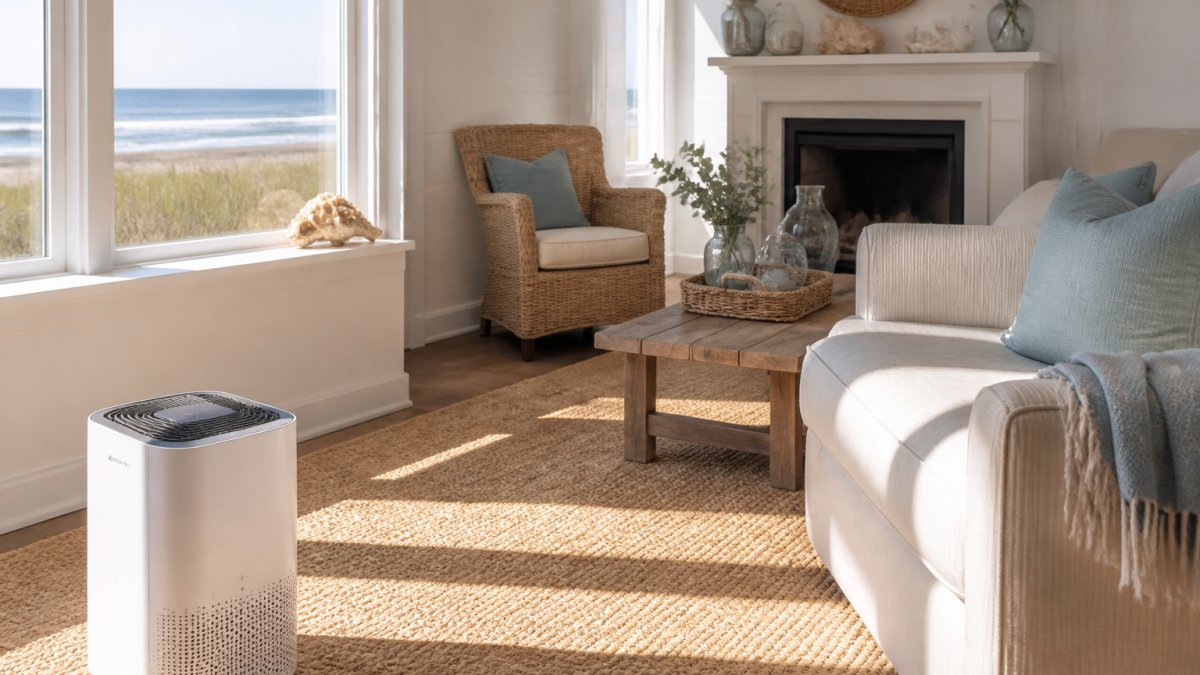
Air purifiers for coastal homes help with fine particles and allergens, but they are not a substitute for ventilation and source control. Think of a portable air filter as a supplement, not a cure.
Where a purifier earns its spot:
- Bedrooms, for people with allergies
- Rooms with no window or poor airflow
- During pollen season and after storms
Where it falls short:
- It will not fix a damp house. Moisture control comes first.
- It will not replace a clogged HVAC filter.
- It does nothing for chemical sources you have not removed.
Choose a unit sized to the room, and clean or replace its filter on schedule. A purifier with a dirty filter is just a noisy box.
5. Stop Indoor Pollutants at the Source
The EPA is direct on this point: eliminating individual pollution sources or reducing their emissions is usually the most effective way to improve indoor air quality (EPA guidance on improving indoor air quality). That beats filtration and ventilation every time.
Common indoor pollutants in a beach house:
- Volatile organic compounds from paints, adhesives, and new furniture
- Chemical pollution from harsh cleaning products
- Smoke from fireplaces and grills
- Dust and allergens tracked in from outside
What to do:
- Choose low-VOC products for paint, sealants, and finishes.
- Switch to gentler cleaning products where you can.
- Ventilate during and after any painting or renovation.
- Keep smoke outside.
Source control is cheap and it works. Start there before buying gadgets.
6. Flooring, Dust, and Allergen Control in Sandy Homes
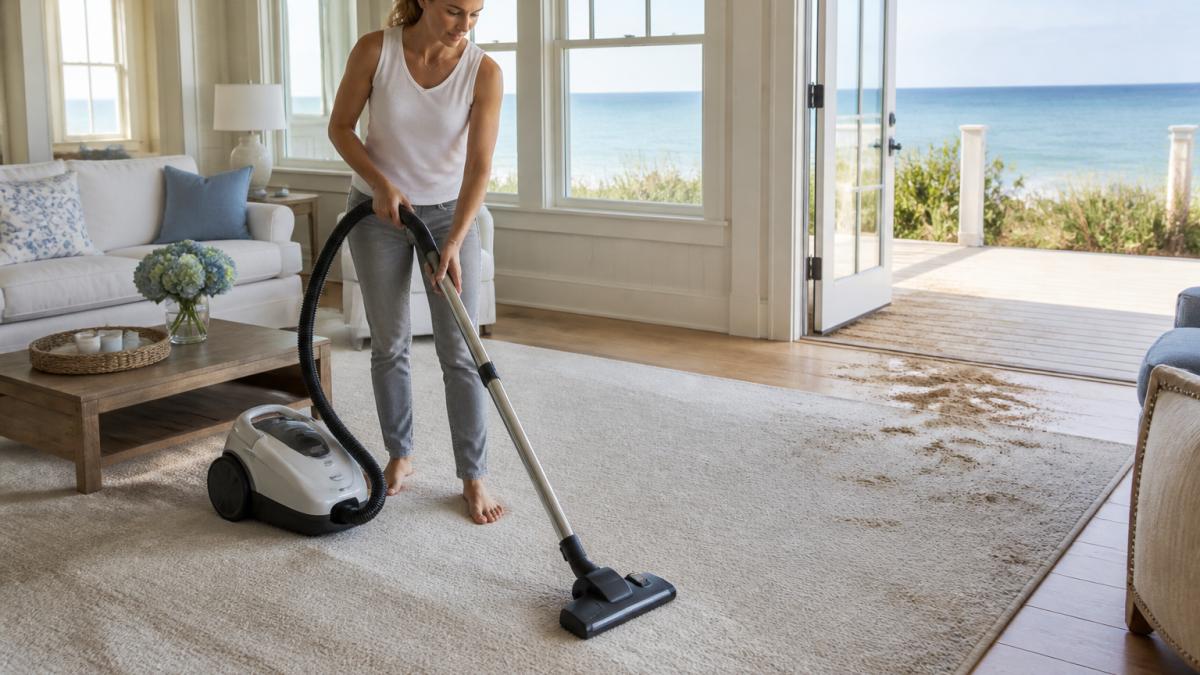
Flooring and allergen control in a sandy home is a daily fight, and the floor is where it is won or lost. Sand and dust settle, then get kicked back into the air with every step.
A practical routine:
- Vacuum high-traffic areas at least weekly, more in summer.
- Use a vacuum with a good filter so fine particles stay captured.
- Shake out and wash area rugs often.
- Wipe hard surfaces with a damp cloth instead of dry dusting, which just moves dust around.
- Put a sturdy mat at every entry to catch sand before it spreads.
7. Seasonal and Storm Recovery Routines for Beach Houses
Seasonal and storm recovery routines protect a beach house when you are not there to watch it. The two riskiest times are the empty off-season and the days after a storm.
Before you close up for the season:
- Set the thermostat and dehumidifier for the off-season.
- Clean or replace HVAC filters.
- Clear gutters and check for leaks.
- Pull furniture slightly away from exterior walls.
After a storm or flood:
- Dry the house out fast. Mold can start within a day or two.
- Remove wet carpet, padding, and rugs. Wet carpet padding is nearly impossible to save and holds moisture.
- Run fans and dehumidifiers until surfaces are dry.
- Check ducts and the HVAC system for water before turning it back on.
Water damage is the biggest air quality threat a coastal home faces. Fast, thorough drying is the whole game.
Maintaining indoor air quality in a beach home is a chain of small habits, and the floor is where many of them start. If worn carpet or moisture-damaged flooring is a concern, Hamptons carpet one floor and Home is a floor covering retailer serving Suffolk County. Get started with Hamptons carpet one floor and Home.
Frequently Asked Questions
How often should you change HVAC filters in a beach home?
Coastal homes usually need filter changes more often than inland ones. Salt air, sand, and higher humidity load filters faster, so check the filter every 30 days during heavy-use seasons and replace it when it looks gray or clogged. A pleated filter rated MERV 8 to MERV 13 captures more airborne particles without choking airflow. If the home sits empty for weeks, change the filter before you reopen it, since dust and damp air build up while the system is idle.
Can salt air affect indoor air quality?
Yes. Sea spray carries fine salt particles that settle on surfaces and get drawn into HVAC returns, and salt accelerates corrosion on coils, ducts, and metal components. The EPA points to source control as the most effective way to improve indoor air, and in a beach home that means keeping windows closed on windy days, rinsing exterior vents, and staying current on HVAC maintenance. Corroded coils also reduce airflow, which lets humidity and particulate matter build up indoors.
Do air purifiers help with indoor air quality near the beach?
A portable air purifier with a HEPA filter can capture airborne particles, dust, and some allergens that circulate indoors. It does not solve humidity, mold growth, or salt corrosion, so treat it as one layer rather than the whole plan. The CPSC notes that ventilation reduces but does not eliminate exposure to indoor pollutants. Run the purifier in bedrooms and main living areas, keep windows closed during high-wind or high-pollen days, and pair it with a dehumidifier for real results.
How do you reduce humidity in a coastal home?
Keep indoor relative humidity between 30% and 50% using a dehumidifier sized for the square footage, run exhaust fans in bathrooms and kitchens, and fix leaks before they spread. A 2024 National Association of Home Builders article sponsored by Knauf recommends effective ventilation for continuous airflow and moisture control. In beach houses, also check that crawl spaces and basements are sealed and ventilated, and avoid drying laundry indoors. High humidity feeds mold and mildew, so monitoring it is the first line of defense.