 How-to
How to Compare Flooring Contractor Estimates Side by Side
Table of Contents
- Why Flooring Estimates Look So Different on Paper
- Put Every Bid on the Same Measurements and Square Footage
- Break Each Quote Into Materials, Labor, and Prep Work
- Average Cost of Flooring Removal and Installation Compared
- Hidden Costs in Flooring Quotes to Check For
- Questions to Ask Flooring Contractors Before You Sign
- Choosing Your Contractor and Booking a Site Visit in Southampton
- Frequently Asked Questions
Last Updated: November 11, 2026
Why Flooring Estimates Look So Different on Paper
Two flooring quotes for the same room can differ by thousands of dollars, and most homeowners have no idea why. The median annual revenue per installer reached $184,000 in 2026, according to VEVVO State of Flooring 2026 Annual Industry Report, which tells you how competitive and varied this market is. Contractors price differently, measure differently and include different items.
The gap is rarely about who is honest. It is usually about what each contractor chose to include.
Here is the core problem. One bid may list the flooring material only. Another may bundle in removal, underlayment, transition strips and debris disposal. Side by side, the bottom line looks like a price war when it is really a scope difference.
Learning how to compare flooring contractor estimates starts with one habit: stop comparing totals on sight. Compare what each total actually covers, because that is the real key to learning how to compare flooring contractor estimates fairly.
Put Every Bid on the Same Measurements and Square Footage
Every estimate should start from the same measured square footage. If one contractor measures 620 square feet and another measures 540, their prices will never line up, no matter how carefully you read them.
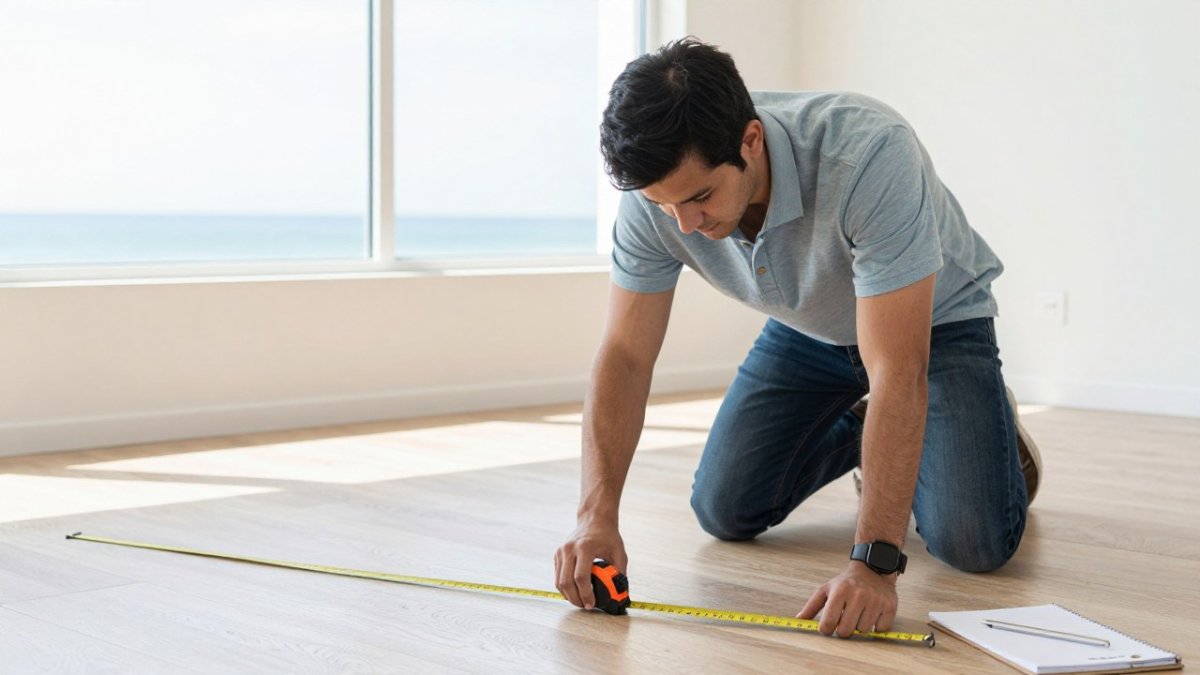
Ask each contractor to confirm the room measurements in writing. Then check the waste factor. Installers often add extra material for cuts and mistakes, and the right allowance depends on the layout and material.
A simple check works well here:
- Write down the room length and width in feet.
- Multiply to get the square footage for each room.
- Confirm each contractor used the same total.
- Note the waste percentage each one applied.
When the measurements match, you can finally see whether the price difference comes from rates or from quantity.
Break Each Quote Into Materials, Labor, and Prep Work
Split every estimate into three buckets: materials, labor and prep. Materials cover the flooring itself plus underlayment and trim. Labor covers installation time. Prep covers subfloor repair, leveling, removal of old flooring and furniture moving.
Many quotes hide prep work inside a single line. That is where the surprises come from. Ask for a separate line for each bucket so you can compare like with like.
Watch out: a low labor number often means prep is missing from the bid. Ask directly whether subfloor repair is included.
National averages give you a rough benchmark. According to EstimationPro flooring cost estimates, installed hardwood runs about $6 to $25 per square foot, luxury vinyl plank about $2 to $14, and tile about $3 to $30. Local pricing in Southampton can sit above or below these ranges, so use them only as a sanity check.
Installed flooring cost per square foot by material
Average Cost of Flooring Removal and Installation Compared
Removal and installation are often priced in different formats, and that is exactly where comparisons break down. One contractor may quote a flat removal fee. Another may fold removal into the per-square-foot installation rate. A third may price removal per square foot and installation as a day rate. Before you can compare, you have to convert every bid to the same unit.
The conversion is simple: add removal and installation together, then divide by the measured square footage to get a combined cost per square foot for each bid. When every bid is expressed on the same measured area, the price difference reflects rate and scope rather than formatting.
| Cost Item | What to Check | Common Pitfall |
|---|---|---|
| Old floor removal | Included or separate line; flat fee vs. per square foot | Missing from the bid entirely |
| Installation labor | Per square foot or flat fee; stairs and transitions excluded or included | Rate excludes stairs, landings, or transitions |
| Materials | Grade, brand, and product line named | "Equivalent" product swapped in |
| Underlayment and moisture barrier | Specified by product and thickness | Omitted or listed as "standard" |
| Disposal and hauling | Flat fee, per square foot, or dumpster pass-through | Charged later as an add-on |
| Subfloor prep | Allowance amount and per-square-foot repair rate | Open-ended "subject to site conditions" |
Use the table as a checklist when you line up quotes, and fill in a dollar figure for every row. A row left blank is a cost you have not yet compared.
Normalizing flat fees against per-square-foot rates. Suppose one bid quotes a $600 flat removal fee and another quotes $1.50 per square foot on a 600-square-foot room. The second bid's removal cost is $900. On the same measured area, the flat-fee bid is $300 cheaper for removal, but only if the flat fee truly covers the whole job. Ask whether the flat fee covers carpet, padding, tack strip, and adhesive, or only the visible flooring.
Stairs, landings, and transitions. Per-square-foot installation rates typically cover flat field flooring. Stair treads, stair nosings, thresholds, and transition strips are usually priced per piece or per step. Ask each contractor to list every transition and every stair in the home and quote them as separate lines. A bid that omits stairs is not comparable to one that includes them, even if the field rate looks lower.
Materials grade and product line. A per-square-foot materials number means nothing without the product line. Ask for the manufacturer, product name, collection, and grade on every bid. If one bid names a specific product and another says "or equivalent," treat the second as unverified until the contractor names the substitute in writing.
Local labor rates versus national averages. National averages are a sanity check, not a quote. According to EstimationPro flooring cost estimates, installed hardwood runs about $6 to $25 per square foot, luxury vinyl plank about $2 to $14, and tile about $3 to $30. Those ranges are wide because they blend labor markets across the country.
What a fair comparison looks like. When every bid is expressed as a combined cost per square foot for the same measured area, with the same product line, the same transition and stair scope, and the same disposal and prep allowances, the lowest total is the lowest total for the same job. If one bid is still lower, ask the contractor to walk you through the line items that differ. The answer usually explains the gap, and sometimes it reveals a scope item the other bids missed.
Hidden Costs in Flooring Quotes to Check For
The most common hidden costs in a flooring estimate are subfloor repair, moisture barriers and testing, transition strips and stair nosings, baseboard and shoe-mold removal and reinstallation, furniture moving, and debris disposal. Each one can add a meaningful amount to the final invoice, and each one appears on a bid in a different way.
Start with the line items that are missing rather than the ones that are present. A bid that never mentions disposal, for example, is not necessarily cheaper, it usually means hauling is billed later at the crew's discretion. Ask for a flat disposal number in writing before you compare totals.
Subfloor repair and leveling. This is the single largest source of estimate creep. A contractor cannot know the full extent of subfloor damage until the old floor comes up, so most bids include a contingency. Ask what the contingency is, what triggers it, and what the per-square-foot rate is for repair and leveling.
Moisture testing and barriers. In coastal homes, salt air and humidity can affect subfloors, and slab moisture can wick into new flooring. Ask whether moisture testing is included, what test method the contractor uses, and whether a vapor barrier or underlayment with a moisture rating is part of the materials line.
Transitions, stairs, and trim. Per-square-foot installation rates typically cover flat field flooring only. Stair treads, stair nosings, thresholds, and transition strips between rooms are usually priced per piece or per step. Ask each contractor to list every transition in the home and quote it as a separate line.
Baseboards and shoe mold. Removing and reinstalling baseboard is labor-intensive and often excluded. Ask whether the bid includes removal, storage, reinstallation, and any painting or patching required after reinstallation. If it is excluded, get a number.
Furniture moving and floor protection. Some contractors move furniture and protect adjacent surfaces as part of the job; others charge for it or exclude it. Confirm what is covered and what you are expected to clear before the crew arrives.
Debris disposal and hauling. This is the hidden cost most homeowners overlook. Old carpet, padding, tile, and hardwood are bulky and heavy, and disposal may be priced as a flat fee, a per-square-foot charge, or a pass-through cost.
Permits and inspections. Some installations, structural subfloor work, for example, may require a permit from the local building department. Ask whether permit fees and inspection coordination are included in the bid or billed separately.
Watch out: phrases like "subject to site conditions," "additional charges may apply," "excludes subfloor repair," and "disposal not included" are not automatically red flags, but they are open-ended. Ask for a number behind each one.
A practical habit: build a simple side-by-side worksheet with one column per contractor and one row for each of the categories above. Mark each cell "included," "excluded," or a dollar figure.
Questions to Ask Flooring Contractors Before You Sign
The right questions reveal more than the price does. A good contractor will answer them clearly and put the answers in writing.
Ask these before you sign:
- Is your license and liability insurance current, and can I see proof?
- Does your estimate include removal, disposal and subfloor preparation?
- What is your waste factor, and how did you calculate it?
- How are change orders priced if hidden problems appear?
- What is the payment schedule, and when is the final payment due?
- What warranty covers the materials and the installation, and for how long?
- Who handles furniture moving and the cleanup?
Pay attention to vague answers. "We'll figure it out later" is a warning sign, not a plan.
It can help to test a contractor's written agreement against the scope of work, so the scope matches the estimate line for line.
Choosing Your Contractor and Booking a Site Visit in Southampton
Once the numbers make sense, narrow your list to two or three contractors and book an on-site visit. A site inspection catches problems that no spreadsheet can. It also shows you how the crew talks about your home.
Before the visit, gather your room measurements, photos of the subfloor and any notes on moisture or uneven spots. Ask each contractor to put the final estimate in writing after the walkthrough.
Pricing depends on the room size, the material you choose and the prep the space needs, so we recommend booking a site visit for an accurate quote. Contact the team through our website to schedule a walkthrough and compare your options side by side.
Get a clear, itemized estimate from Hamptons Carpet One Floor and Home and see exactly what your flooring project covers.
Frequently Asked Questions
What should be included in a professional flooring estimate?
A professional flooring estimate should list the measured square footage, the waste factor applied, the material brand and grade, underlayment, transition strips, and baseboard removal or reinstallation. It should also state subfloor preparation, furniture moving, debris disposal, the project timeline, and the payment schedule. Each line should be itemized so you can compare it directly against other bids. Pricing depends on quantity, material choice, and site conditions, so ask each contractor for a written scope of work before deciding.
How do I know if a flooring quote is reasonable?
Start by checking that every quote covers the same square footage, materials, and prep work. Once the scopes match, compare the labor and material breakdowns line by line. A quote that is far below the others often leaves out subfloor repair, disposal, or underlayment. Ask whether the contractor holds a current license and liability insurance, and whether the warranty covers both materials and installation. Price should not be the only deciding factor.
Why do flooring estimates vary so much between contractors?
Estimates vary because contractors measure differently, add different waste factors, use different material grades, and include different amounts of prep work. Some bids also leave out debris removal or furniture moving, which shifts the total. Hourly labor rates and the crew's experience with your flooring type also affect the price. Asking each contractor to price the same written scope is the most reliable way to see the real differences.
Should I get multiple estimates for a flooring project?
Getting at least three written estimates gives you a fair baseline for comparison. Provide every contractor with the same room measurements, product choice, and site details so the bids are comparable. Use a side-by-side checklist covering square footage, materials, labor, prep, warranty, and timeline. A careful manual review of each bid works well for a single project.