 Ultimate guide
Best Flooring for High Traffic Entryways: 2026 Guide
Table of Contents
- Why Your Entryway Flooring Choice Matters More Than You Think
- Key Factors for Choosing the Best Flooring for High Traffic Entryways
- Luxury Vinyl Plank for Entryways: The Top All-Around Performer
- Porcelain Tile vs. Ceramic for Entryways: Which One Wins?
- Best Flooring for High Traffic Entryways: Full Material Comparison
- Best Flooring for Pets and High Traffic: What Actually Holds Up
- Best Flooring for Mudrooms: Moisture, Grit, and Heavy Use
- How to Maintain Entryway Flooring and Make It Last
- Conclusion
Last Updated: June 1, 2026
Your entryway takes more abuse than any other floor in your home. Every pair of boots, wet umbrella, dog paw, and rolling suitcase lands there first. Choosing the best flooring for high traffic entryways is not a decorating decision, it's a structural one, and getting it wrong means replacing your floor in three years instead of thirty. At Hamptons carpet one floor and Home, we help Suffolk County homeowners navigate exactly this choice every day, and the mistakes we see most often come from prioritizing looks over performance metrics.
Here's what most guides get wrong: they treat all durable flooring as interchangeable. It isn't. A floor that handles a dry suburban foyer will fail in a coastal Long Island entryway where salt, sand, and humidity are constants. Below, we'll cover every material worth considering, the technical ratings that actually matter, and the installation details that determine whether your floor lasts a decade or a generation.
Why Your Entryway Flooring Choice Matters More Than You Think
First Impressions, Home Value, and Daily Wear
The entryway is the first surface every guest, buyer, and family member walks across. Real estate professionals consistently note that entry condition shapes a buyer's perception of the entire home within seconds of opening the front door. A worn, scratched, or water-stained entry floor signals deferred maintenance throughout the property.
Beyond aesthetics, the practical stakes are high. Entryway flooring endures concentrated foot traffic in a small area, meaning wear accumulates far faster than it does across a large living room. Grit and debris tracked in from outside act like sandpaper against your floor's surface with every step. Moisture from rain, snow, and wet footwear creates a constant water damage risk. And in homes with pets and children, impact resistance matters as much as scratch resistance.
The throughline here is this: entryway flooring is the one area where you cannot afford to compromise on performance for the sake of price. An entry floor that fails costs you in replacement labor, subfloor repair, and lost home value, far more than the premium you'd have paid upfront for the right material.
Key Factors for Choosing the Best Flooring for High Traffic Entryways
Selecting the right material starts with understanding the technical specifications that separate a floor that survives from one that thrives. Three factors matter most: slip resistance, wear layer performance, and underlayment compatibility.
Slip Resistance Ratings (COF) Explained
Coefficient of Friction (COF) is the industry standard measure for slip resistance. It quantifies how much force is required to slide an object across a surface, the higher the number, the less slippery the floor.
According to the Americans with Disabilities Act accessibility guidelines, a static COF of 0.6 or higher is the recommended minimum for walking surfaces. For wet entryways, target a COF of 0.42 or higher under dynamic (wet) conditions. Matte-finish porcelain tile and textured luxury vinyl plank consistently achieve these ratings. High-gloss polished stone and smooth ceramic often fall below the threshold when wet, which is a serious safety issue in a space where people track in rain and snow.
Wear Layer, Abrasion Testing, and Durability Ratings
For luxury vinyl plank (LVP), the wear layer thickness is the single most important durability indicator. Measured in mils (thousandths of an inch), a wear layer below 12 mil is unsuitable for high-traffic areas. For entryways, target 20 mil or higher. COREtec's premium lines offer 20-30 mil wear layers specifically engineered for this kind of concentrated use.
For laminate, the AC rating system (AC1 through AC5) governs abrasion resistance. AC4 is rated for heavy residential use; AC5 is a commercial-grade rating. Pergo Outlast+ and Quick-Step Natrona both carry AC4/AC5 ratings, making them viable for entryways when moisture is managed carefully.
For tile, the PEI (Porcelain Enamel Institute) rating scale runs from 1 to 5. Entryways require PEI 4 at minimum. PEI 5 is appropriate for the heaviest residential use, including mudrooms and exterior-adjacent entries.
Underlayment Requirements by Flooring Type
Underlayment is where many DIY installations fail. The wrong underlayment voids warranties and causes floor failure regardless of how good the surface material is.
- LVP: Many premium products like COREtec come with attached cork underlayment. Adding a second layer on top creates excessive compression and can cause locking joints to fail.
- Laminate: Requires a moisture barrier underlayment in entryways. Without it, even water-resistant laminates will swell at edges and joints.
- Tile: Installed directly over a cement board or uncoupling membrane (like Schluter DITRA). A proper tile installation does not use foam underlayment.
- Engineered wood: Requires a moisture vapor barrier over concrete subfloors. Skipping this step is the leading cause of engineered wood cupping and delamination.
Luxury Vinyl Plank for Entryways: The Top All-Around Performer
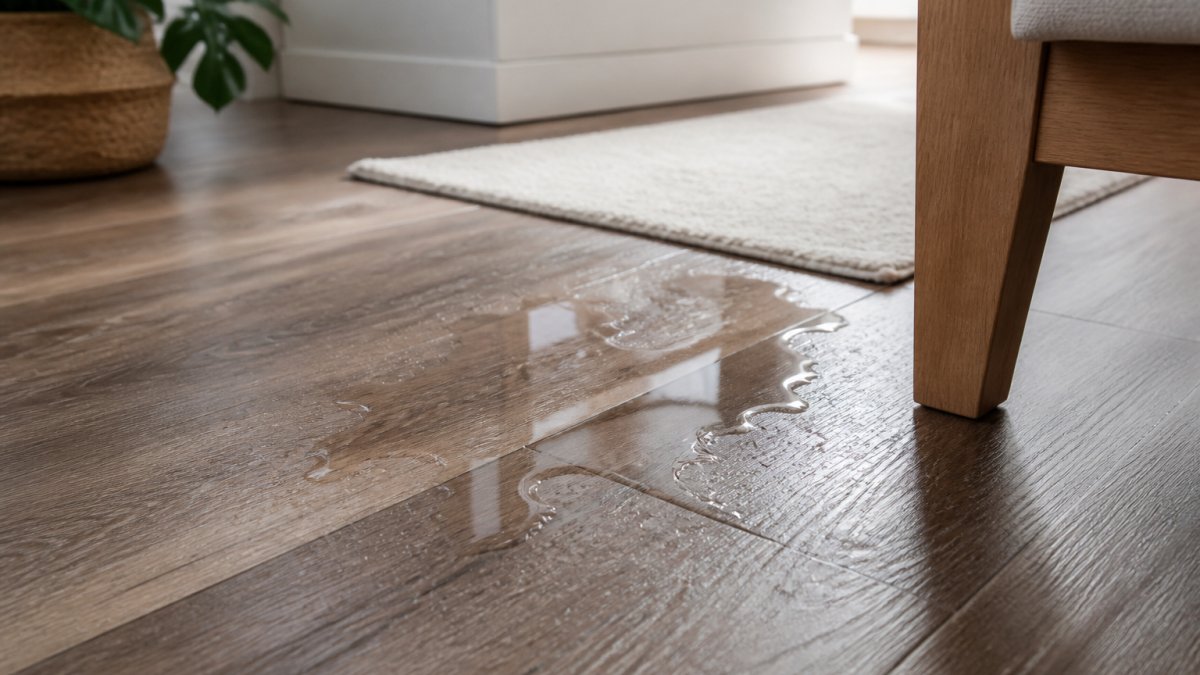
Luxury vinyl plank is the clearest answer to the question of best flooring for high traffic entryways for most residential applications. It is 100% waterproof, scratch-resistant, comfortable underfoot, and available in realistic wood and stone visuals that genuinely fool the eye at normal viewing distance.
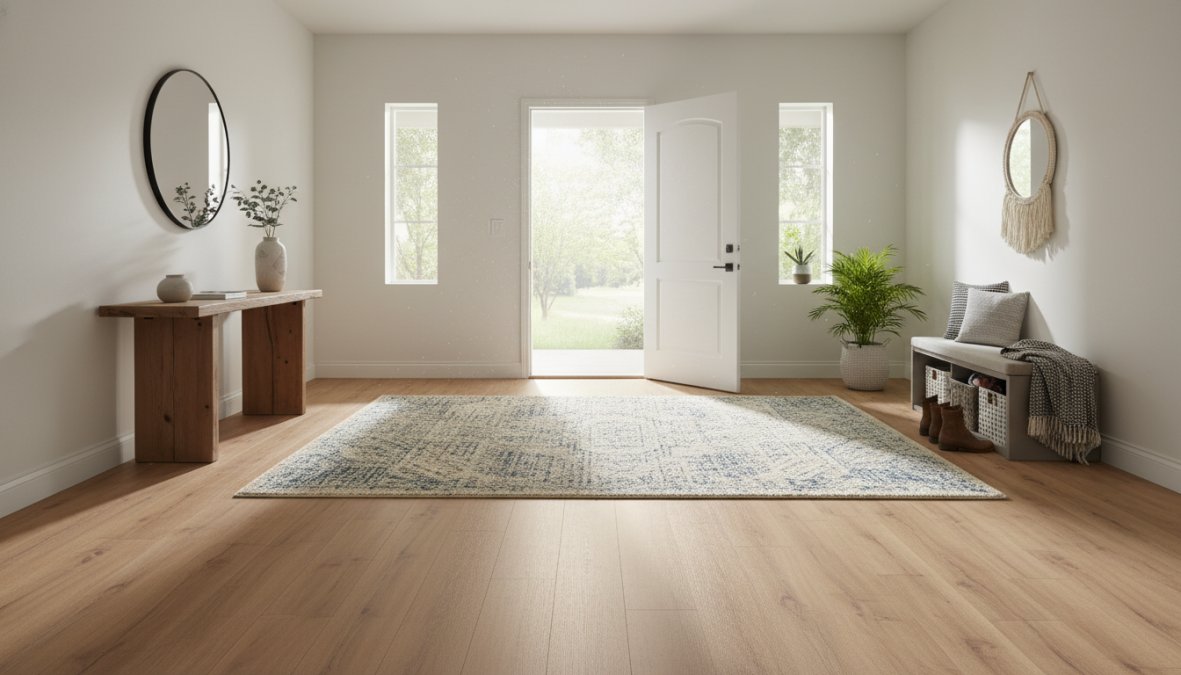
The rigid core construction in premium LVP lines (WPC and SPC formats) means the floor won't flex, dent, or telegraph subfloor imperfections under heavy loads. It handles the thermal cycling of an entry space, cold air rushing in when the door opens, humidity from wet coats, without the expansion and contraction problems that plague solid hardwood.
COREtec vs. Karastan: Which LVP Is Right for Your Entry?
Both COREtec and Karastan make excellent LVP for entryways, but they serve slightly different priorities.
COREtec is the performance benchmark. Its rigid WPC or SPC core, attached cork underlayment, and 20-30 mil wear layer make it the most technically complete option for a wet, high-use entry. The cork underlayment adds sound absorption and a warmer underfoot feel, a real advantage in a space where hard floors can feel cold and loud. Best for busy households with pets, children, or coastal exposure.
Karastan leads on aesthetics. Its GenuEdge technology creates beveled plank edges that mimic the look of real hardwood more convincingly than most competitors. The 20 mil wear layer and rigid SPC core deliver strong scratch and dent resistance. Best for homeowners who want an upscale visual without the maintenance burden of real wood.
| Feature | COREtec | Karastan |
|---|---|---|
| Wear Layer | 20-30 mil | 20 mil |
| Core Type | WPC or SPC | SPC |
| Underlayment | Attached cork | None (add separately) |
| Best For | Performance-first buyers | Aesthetics-first buyers |
| Waterproof | Yes | Yes |
The honest take: for an entryway that takes real abuse, COREtec's thicker wear layer and attached underlayment give it a practical edge. Karastan is the better choice when the entry flows into a formal living space and visual continuity matters most.
Porcelain Tile vs. Ceramic for Entryways: Which One Wins?
Porcelain wins. This isn't a close call.
Ceramic tile is made from a less refined clay body fired at lower temperatures, resulting in higher water absorption rates (often 3% or more). In an entryway where standing water, tracked-in moisture, and freeze-thaw cycles are realities, that porosity creates long-term problems: staining, cracking in cold climates, and grout deterioration.
Porcelain tile, by contrast, is fired at higher temperatures with a denser clay body. Quality porcelain from manufacturers like Daltile achieves water absorption rates below 0.5%, making it essentially impervious to moisture damage. That's the difference between a floor that lasts 10 years and one that lasts 50.
PEI Ratings, Water Absorption, and Grout Maintenance
For entryway tile, specify PEI 4 or PEI 5 rated porcelain. Daltile's commercial-grade lines are engineered specifically for this. Matte and textured finishes serve double duty: they hide the fine scratches that accumulate from grit and debris, and they achieve higher COF ratings for slip resistance.
Grout is the weak point of any tile installation. Unsanded grout in wide joints cracks under thermal movement. Epoxy grout is the most durable option for entryways, it resists staining, moisture, and cracking better than cement-based grout, though it requires more skill to install. At minimum, seal cement grout annually in an entryway application.
Best Flooring for High Traffic Entryways: Full Material Comparison
Here's the complete picture across all major flooring categories, including the environmental and indoor air quality dimension that most comparison guides omit entirely. For an entryway where the front door opens repeatedly and ventilation is variable, VOC emissions and material sourcing are not abstract concerns: they affect the air quality of the first space every person in your household breathes when they walk through the door.
Natural Stone and Engineered Wood: Pros, Cons, and Reality Checks
Natural stone (granite, slate, travertine) from suppliers like MSI is the prestige option. Granite is nearly indestructible and adds measurable home value. Slate offers natural slip resistance and a one-of-a-kind aesthetic. The reality check: stone requires periodic sealing (typically annually for travertine and limestone, less frequently for granite), professional installation over a reinforced subfloor, and careful selection for slip resistance. Polished marble in an entry is a liability, beautiful, cold, and dangerously slippery when wet. From an environmental standpoint, natural stone is a genuinely low-VOC material: it off-gasses nothing meaningful after installation, and its longevity (50+ years when properly maintained) means a low lifetime environmental footprint despite the energy cost of quarrying and transport.
Engineered wood is real wood on the surface (a 2-4mm hardwood veneer) over a plywood or HDF core. It handles humidity better than solid hardwood and can be refinished once or twice. The honest limitation: it is not waterproof. A wet entry mat left in place for a week can cause the veneer to cup and delaminate. For dry climates and low-moisture entries, it's a compelling option. For Long Island's coastal humidity and winter salt tracking, it's a risk. On the sustainability side, look for products certified by the Forest Stewardship Council, FSC certification verifies that the hardwood veneer originates from responsibly managed forests. The adhesives used in the core layers are the VOC concern: specify products that meet CARB Phase 2 formaldehyde emission standards, which are the most stringent widely available in the U.S. market.
Laminate, Rubber, and Eco-Friendly Flooring Options, With the Technical Detail Most Guides Skip
Laminate from Pergo Outlast+ or Quick-Step Natrona is the budget-smart option for scratch resistance. AC4/AC5 rated laminate handles heavy foot traffic and resists surface scratches better than many LVP products at a lower price point. The critical limitation: laminate is water-resistant, not waterproof. Edge swelling from standing water remains a real failure mode in wet entries. Use it only where moisture is well-controlled.
The VOC picture for laminate is more complex than for stone or solid wood. The HDF core is a composite material bonded with urea-formaldehyde or melamine-formaldehyde resins. Off-gassing is highest in the first weeks after installation and diminishes significantly over time, but in a small, enclosed entryway with limited ventilation, it is worth specifying products that carry GREENGUARD Gold certification (formerly GREENGUARD Children & Schools). GREENGUARD Gold sets stricter emission limits than the base GREENGUARD standard and is the most meaningful third-party VOC certification available for laminate flooring in the U.S. market.
Rubber flooring from Tarkett Johnsonite is the safety-first choice. Its inherently non-slip surface, noise-reducing properties, and chemical resistance make it ideal for mudrooms and entries with heavy use. The trade-off is aesthetic: rubber reads as commercial, and the design options are limited compared to wood-look or stone-look materials. On sustainability: recycled-content rubber flooring, made from post-consumer tire rubber, is one of the most genuinely circular flooring options available. Products in this category divert material from landfill and require no virgin petroleum inputs for the recycled-content portion. Look for recycled content percentages disclosed by the manufacturer; some products exceed 90% post-consumer recycled content.
Cork flooring deserves more than a passing mention in any sustainability-focused comparison. Cork is harvested by stripping bark from living cork oak trees, the tree is not cut down, and the bark regenerates over approximately nine years. It is one of the few flooring materials that is genuinely renewable on a human timescale. Cork is also naturally antimicrobial and provides meaningful thermal and acoustic insulation underfoot. The limitation for entryways: cork is porous and requires sealing with a quality polyurethane finish before installation in any wet or high-moisture application. Unsealed cork in an entryway will absorb water and deteriorate. Properly sealed, it performs adequately in moderate-traffic entries; it is not the right choice for a mudroom or a coastal entry with heavy moisture exposure.
The VOC and Indoor Air Quality Angle Competitors Miss
For any LVP or laminate product selected for an entryway, verify two certifications before purchase:
-
FloorScore certification, administered by the Resilient Floor Covering Institute, FloorScore tests finished flooring products against California's Section 01350 indoor air quality standard, one of the most stringent VOC emission standards applied to flooring in North America. FloorScore indoor air quality certification program for resilient flooring
-
GREENGUARD Gold certification, administered by UL, this certification applies to a broader range of flooring types including laminate and engineered wood, and sets chemical emission limits protective enough for use in schools and healthcare environments.
Why does this matter specifically for entryways? Two reasons. First, entryways are transition zones where outdoor air, carrying pollen, particulates, and humidity, mixes with indoor air every time the door opens. A flooring material that off-gasses VOCs in this zone sends those compounds directly into the home's primary air circulation. Second, entryways are often small, enclosed spaces with less natural ventilation than a living room or kitchen, which means VOC concentrations can build up more readily in the period immediately after installation.
The practical guidance: allow any new LVP or laminate installation to off-gas with windows open and the space ventilated for at least 48-72 hours before regular use. This is standard advice from most manufacturers but is rarely included in flooring selection guides.
Full Material Comparison Table
| Material | Waterproof | COF (Wet) | Refinishable | Eco/Low-VOC Options | Relative Cost |
|---|---|---|---|---|---|
| Porcelain Tile | Yes | High (matte finish) | No | Inherently low-VOC; no certification needed | Medium-High |
| Luxury Vinyl Plank | Yes | Medium-High | No | FloorScore or GREENGUARD Gold certified options available | Medium |
| Natural Stone | With sealing | Varies by finish | No | Inherently low-VOC; FSC not applicable | High |
| Engineered Wood | No | Low | Yes (1-2×) | FSC-certified; specify CARB Phase 2 compliant | Medium-High |
| Laminate | Partial | Medium | No | GREENGUARD Gold certified options available | Low-Medium |
| Rubber (recycled) | Yes | Very High | No | Up to 90%+ post-consumer recycled content | Medium |
| Cork (sealed) | With sealing | Medium | No | Renewable harvest; specify low-VOC finish | Low-Medium |
Best Flooring for Pets and High Traffic: What Actually Holds Up
Pet households add two variables that standard durability ratings don't fully capture: claw abrasion and urine penetration.
Claw abrasion is a surface scratch issue. A 20+ mil wear layer on LVP handles it well. Laminate with AC4/AC5 ratings also performs adequately, though deep gouges from large dogs are harder to avoid. Engineered wood and natural stone scratch more readily from repeated claw contact.
Urine penetration is the more serious problem. Any floor with seams, grout lines, or a porous surface is vulnerable. LVP with a watertight locking joint system is the strongest performer here, urine stays on the surface and wipes clean. Tile with epoxy grout is comparably resistant. Laminate, engineered wood, and natural stone with unsealed grout or surface cracks will absorb moisture and develop permanent odor and staining.
The practical answer for pet owners: COREtec LVP or Daltile porcelain with epoxy grout. Both handle the combined demands of claw traffic and moisture without requiring special maintenance protocols.
Best Flooring for Mudrooms: Moisture, Grit, and Heavy Use
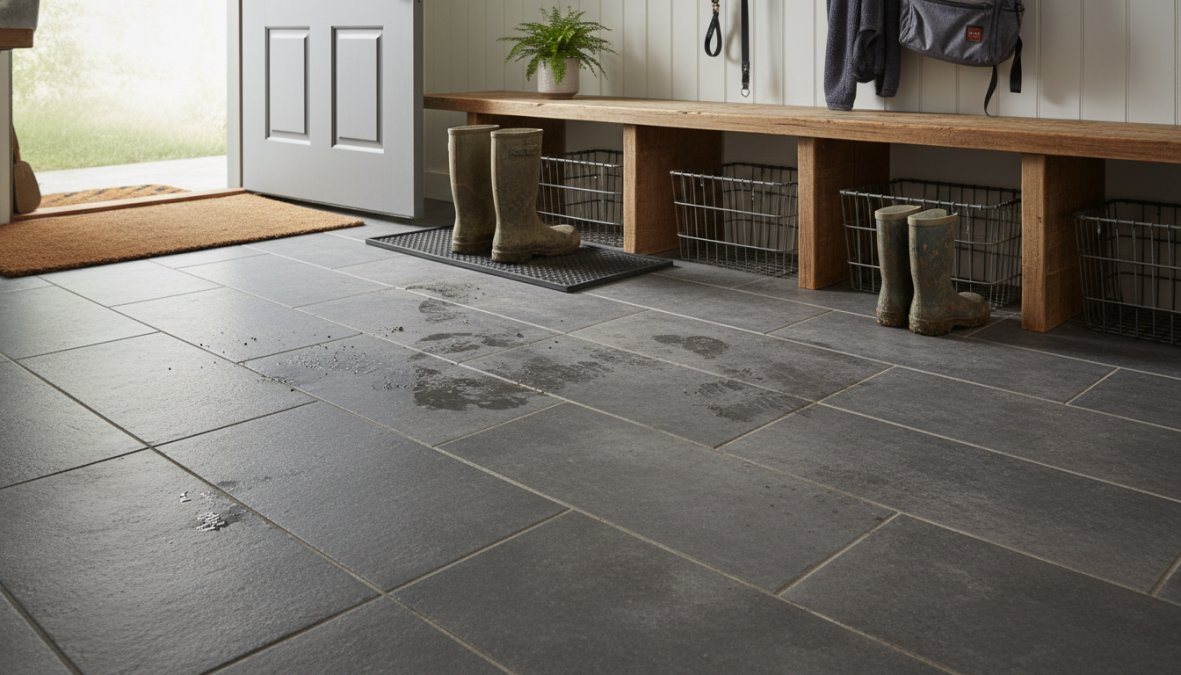
Mudrooms are the most demanding flooring environment in a residential home. They combine the moisture exposure of a bathroom with the foot traffic of an entryway and the dirt load of a garage. What makes mudroom flooring selection genuinely different from a standard entryway choice is the chemical dimension: ice-melt products containing calcium chloride, magnesium chloride, and sodium chloride are tracked in repeatedly through winter months, and not every flooring material handles that chemical exposure without degrading.
The Two Materials That Actually Survive Mudroom Conditions
Large-format matte porcelain tile (PEI 5 rated) remains the benchmark for mudroom flooring. The reasons are technical, not aesthetic:
- Water absorption below 0.5% means ice-melt brine and standing water cannot penetrate the tile body, even with repeated freeze-thaw cycling near an exterior threshold.
- Matte and textured surface finishes achieve dynamic COF ratings of 0.42 or higher when wet, meeting the threshold most flooring safety guidelines recommend for surfaces regularly exposed to water and tracked-in snow.
- Large-format sizing (24×24 inches or larger) reduces grout line density across the floor. Fewer grout lines mean fewer channels for moisture, salt, and grit to accumulate, and less grout surface to seal and maintain annually.
- Chemical resistance: Fully vitrified porcelain is inert to the chloride compounds in most ice-melt products. Laminate edges, LVP locking joints, and natural stone surfaces with micro-fissures are all more vulnerable to repeated chloride exposure than dense porcelain.
Commercial-grade rubber flooring (such as Tarkett Johnsonite or Nora Systems rubber tile) is the second-tier recommendation for mudrooms where safety and noise absorption outweigh aesthetics. Rubber's inherently high COF, often exceeding 0.6 even when wet, makes it the safest surface underfoot in a space where people enter with wet, snow-covered boots. It is also chemically resistant to ice-melt compounds and can be cleaned with most commercial disinfectants without surface degradation. The trade-off is visual: rubber reads as institutional, and the color and pattern range is narrow compared to porcelain or LVP.
Why Underlayment and Substrate Choice Are Critical in Mudrooms
According to the Tile Council of North America installation guidelines, mudroom tile installations over wood subfloors should include an uncoupling membrane, Schluter DITRA is the most widely specified product, rather than cement board alone. Here is why this matters technically:
Wood subfloors expand and contract with seasonal humidity changes. A rigid tile bonded directly to a moving wood substrate experiences shear stress at the mortar bond line. Over time, this stress causes grout cracking and, eventually, tile cracking or debonding. An uncoupling membrane breaks the bond plane between the tile and the subfloor, allowing each layer to move independently. This is not a luxury upgrade, it is the correct installation method for any tile over wood in a high-moisture, high-traffic zone.
For LVP in a mudroom application, the substrate requirement shifts: the subfloor must be flat to within 3/16 inch over 10 feet (per most manufacturer installation guides), and a moisture vapor barrier is required over concrete slabs. LVP's click-lock joints are its vulnerability in mudrooms, if the subfloor has high spots that cause the planks to flex under load, the locking tabs will eventually crack. Proper subfloor prep is not optional.
Floor Drains: The Infrastructure Investment Most Guides Ignore
For mudrooms that connect directly to an exterior door, a floor drain is the single highest-value infrastructure addition you can make before flooring is installed. Paired with a waterproof floor surface and a slight slope to drain (typically 1/8 inch per foot), a floor drain eliminates standing water entirely, removing the primary failure mechanism for every flooring material except tile and sheet vinyl.
If a floor drain is not feasible, the next best approach is a threshold transition that prevents water from migrating from the mudroom into adjacent rooms, combined with a recessed entry mat well. A recessed mat well, a shallow depression in the subfloor filled with a commercial-grade mat, captures water and grit at the point of entry before it reaches the primary floor surface. Mannington Commercial's entryway systems include transition and mat well solutions engineered for exactly this zone.
Grout Selection in Mudrooms: Why Epoxy Grout Is Worth the Effort
In a standard bathroom or kitchen, cement-based grout sealed annually is adequate. In a mudroom, it is the weakest link. Cement grout is porous, and in a mudroom environment it is exposed to:
- Repeated moisture cycling (wet to dry, multiple times daily in winter)
- Chloride compounds from ice-melt products that accelerate grout deterioration
- Grit and fine debris that abrades grout surfaces with every footstep
- Potential pet urine, which stains and odors cement grout permanently
Epoxy grout addresses all of these failure modes. It is non-porous, chemically resistant, stain-proof, and does not require sealing. The installation challenge is real, epoxy grout has a shorter working time than cement grout and requires careful mixing and cleanup, but for a mudroom application, the long-term maintenance reduction justifies the upfront installation complexity. Specify epoxy grout for any mudroom tile project where the budget allows.
If epoxy grout is outside the budget, use a polymer-modified cement grout (not standard sanded grout) and seal it with a penetrating silane-siloxane sealer at installation and annually thereafter.
Modular Options for Mudrooms That Need Flexibility
For homeowners who want a softer, warmer underfoot feel, or who anticipate changing the space's use over time, commercial-grade carpet tiles are a legitimate mudroom option. Products with a face weight of 50 ounces or higher and solution-dyed polypropylene or nylon fibers resist staining and wear adequately for residential mudroom use. The modular format is the key advantage: a single tile damaged by a bleach spill or a pet accident can be swapped out without replacing the entire floor.
The honest limitation: carpet tiles in a mudroom require a disciplined maintenance routine. Grit must be vacuumed frequently, because embedded grit cuts fiber at the base and accelerates visible wear. They are not appropriate for mudrooms with floor drains or consistent standing water.
How to Maintain Entryway Flooring and Make It Last
The right cleaning routine extends floor life dramatically. The wrong one accelerates wear even on the most durable materials.
Daily Cleaning Routines by Flooring Type
LVP: Sweep or vacuum daily (use a soft-bristle attachment, beater bars damage the wear layer). Damp mop with a pH-neutral cleaner weekly. Avoid steam mops, the heat and pressure can separate the locking joints and void warranties on most brands.
Porcelain tile: Sweep daily to remove grit before it scratches the surface. Mop with a mild, non-acidic cleaner. Acidic cleaners (vinegar-based solutions) degrade grout over time. Reseal cement grout annually.
Laminate: Dry sweep or vacuum only for daily maintenance. Damp mop sparingly, excess moisture is the enemy. Never use wet mops or steam.
Natural stone: Sweep daily. Use only stone-specific pH-neutral cleaners. Reseal per manufacturer schedule (typically annually for softer stones). Never use abrasive scrubbers.
Rubber: Sweep and damp mop with mild soap. Rubber is highly forgiving, it handles most cleaning products without damage.
A cleaning checklist for any high-traffic entry floor:
- Sweep or vacuum daily to remove grit and debris
- Use entrance mats (interior and exterior) to reduce tracked-in particles
- Mop weekly with the appropriate cleaner for your floor type
- Address spills immediately, never let standing water sit
- Inspect grout lines or seams quarterly for cracking or lifting
- Reseal stone or cement grout on schedule
- Trim pet nails regularly to minimize claw abrasion
- Replace entrance mats every 12-18 months (worn mats trap less dirt)
Installation Difficulty vs. Professional Cost: What to Budget
This is the part most guides skip, and it matters for your total cost of ownership.
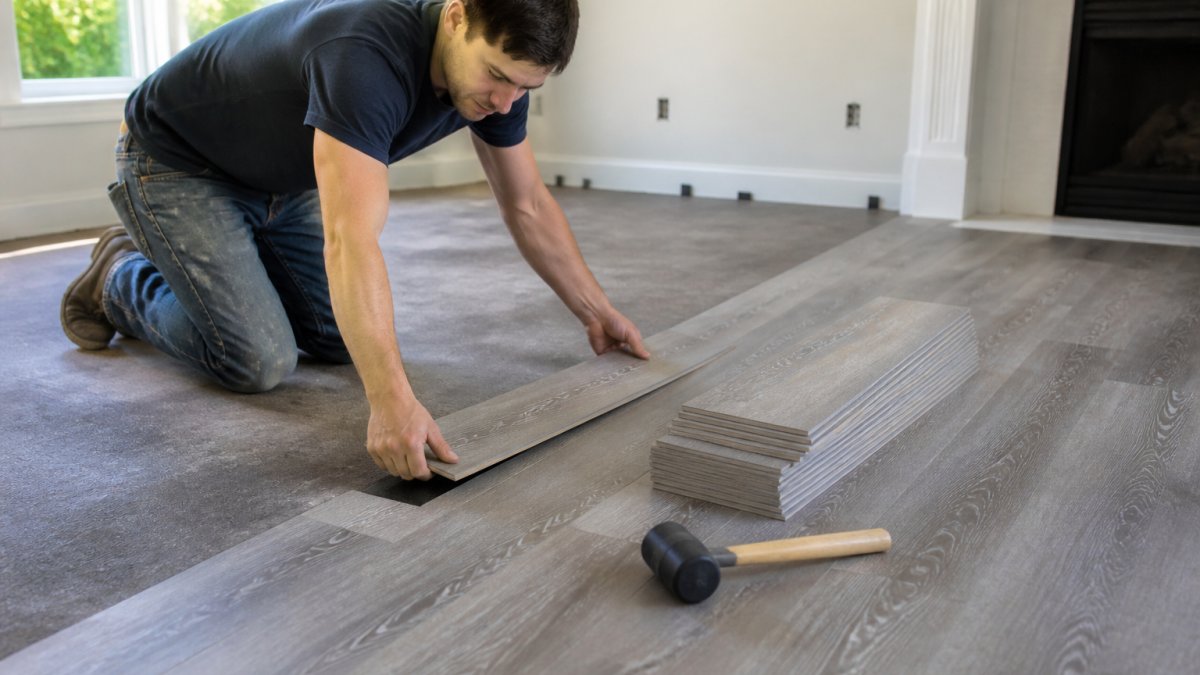
LVP is the most DIY-friendly option. Click-lock systems like those used by COREtec and Karastan require no adhesive and can be installed over most existing subfloors with minimal prep. A competent DIYer can complete a standard entry in a day. Professional installation adds labor cost but ensures proper acclimation, expansion gap placement, and subfloor leveling.
Porcelain tile requires professional installation for best results. The process involves subfloor assessment, cement board or uncoupling membrane installation, mortar setting, tile placement, and grouting, each step with its own curing time. Skipping the uncoupling membrane over a wood subfloor is the most common cause of cracked tile in residential installations.
Laminate sits between LVP and tile on installation difficulty. Click-lock systems make it accessible for DIYers, but the moisture barrier underlayment step is non-negotiable in an entryway and is frequently omitted in amateur installations.
Natural stone is the most complex and expensive to install professionally. The weight requires subfloor reinforcement assessment, and improper mortar coverage causes hollow spots that crack under point loads.
As documented in the National Wood Flooring Association's installation standards, proper subfloor flatness (no more than 3/16" variation over 10 feet for most flooring types) is a prerequisite for any floating floor installation. Ignoring this specification is the leading cause of floating floor failures regardless of material quality.
For Suffolk County homeowners budgeting a project, the general principle holds: material cost and installation cost are both real costs. A less expensive material with a difficult installation can easily exceed the total cost of a premium material with a straightforward one. Factor both into your decision.
FloorScore indoor air quality certification program for resilient flooring is worth verifying for any LVP or laminate product you select, particularly relevant for entryways where doors open frequently and ventilation varies.
Choosing the right entry floor is harder than it looks because the stakes are high and the variables are specific to your home, your climate, and how your household actually lives. Hamptons carpet one floor and Home serves Suffolk County homeowners with exactly this kind of selection guidance, helping you match the right material, rating, and installation approach to your specific entry conditions. Visit us to see the full range of LVP, porcelain tile, and specialty entryway flooring options in person, and get a recommendation grounded in real-world performance rather than a product catalog.
Frequently Asked Questions
What is the most durable flooring for a front entryway?
Porcelain tile is widely considered the most durable option for high traffic entryways. Daltile porcelain, for example, carries a PEI 4 or 5 rating and absorbs less than 0.5% water, making it virtually indestructible under normal residential use. Luxury vinyl plank with a high-density wear layer (20-30 mil) is a close second, offering excellent scratch and dent resistance with a softer feel underfoot, making it the best flooring for high traffic entryways where comfort also matters.
Is luxury vinyl plank good for high traffic entryways?
Yes, luxury vinyl plank for entryways is one of the strongest choices available. Products like COREtec and Karastan LVP feature rigid SPC or WPC cores, 100% waterproof construction, and wear layers up to 30 mil that resist scratches, scuffs, and dents from daily foot traffic. They also install over most existing subfloors with a click-lock system, reducing professional installation costs. For households with kids or pets, LVP offers the best balance of durability, aesthetics, and ease of maintenance.
What flooring is best for a mudroom with high traffic?
Mudrooms need flooring that handles moisture, grit, and debris without deteriorating. Porcelain tile with a matte, slip-resistant finish is the top choice for maximum durability and easy cleaning. Rubber flooring, such as Tarkett Johnsonite, is another strong option, it's inherently non-slip, water-resistant, and absorbs noise. For a warmer look, a waterproof luxury vinyl plank with a high mil wear layer also performs well in mudrooms, especially when paired with a proper moisture barrier underlayment.
Is tile or hardwood better for an entryway?
Tile is generally the better choice for entryways compared to solid hardwood. Hardwood is susceptible to water damage, scratching from footwear, and swelling from humidity, all common in entryways. Porcelain or ceramic tile offers far superior moisture resistance, scratch resistance, and long-term performance in high traffic areas. If you love the look of wood, engineered wood is more stable than solid hardwood, but luxury vinyl plank delivers a realistic wood aesthetic with full waterproof protection and better overall durability for entryway conditions.
How do I choose entryway flooring that hides dirt and is easy to clean?
Choose flooring with a textured or matte surface finish in mid-tone colors, these naturally camouflage grit and debris between cleanings. Porcelain tile with a slight texture and grout lines in a complementary color hides dirt well. For the easiest cleaning routine, luxury vinyl plank requires only a damp mop and mild cleaner. Avoid high-gloss finishes in entryways, they show every footprint and scuff. For mudrooms, commercial-grade carpet tiles can trap dirt effectively and individual tiles can be swapped out when worn.
This article was written using GrandRanker