 Ultimate guide
Best Flooring for Suffolk County Basements: 2026 Guide
Table of Contents
- Best Flooring for Suffolk County Basements: Top Options Compared
- 1. Luxury Vinyl Plank (LVP) & Stone Plastic Composite (SPC)
- 2. Porcelain & Ceramic Tile for Durability
- 3. Engineered Hardwood: Real Wood Without the Risk
- 4. Epoxy Coatings & Sealed Concrete
- How to Prepare Concrete Basement Floor for Flooring
- Basement Moisture Control in Suffolk County: Climate Considerations
- Cost of Basement Flooring Installation Long Island: Pricing Breakdown
Last Updated: June 21, 2026
Choosing the best flooring for Suffolk County basements is one of the most consequential decisions a Long Island homeowner can make. The wrong material in a below-grade space fails within two to three years. Below-grade concrete slabs on Long Island behave differently from slabs in drier climates, and choices that work in a Phoenix basement will fail in Smithtown or Riverhead.
Best Flooring for Suffolk County Basements: Top Options Compared
The best flooring for Suffolk County basements must resist moisture, tolerate temperature swings, and survive the humidity cycles that define Long Island's coastal climate. Four categories consistently outperform the rest: luxury vinyl plank (LVP) and stone plastic composite (SPC), porcelain and ceramic tile, engineered hardwood, and epoxy-sealed concrete.
Quick Comparison Table
| Flooring Type | Material Cost (per sq. ft.) | Moisture Resistance | Warmth Underfoot | Best Use Case |
|---|---|---|---|---|
| LVP / SPC | $4 - $9 | Excellent | Good (with underlayment) | Living spaces, home offices |
| Porcelain Tile | $3 - $12 | Excellent | Poor (cold) | Utility areas, bathrooms |
| Engineered Hardwood | $6 - $12 | Moderate | Excellent | Dry, conditioned basements |
| Epoxy Coating | $3 - $7 (installed) | Excellent | Poor | Workshops, garages, gyms |
| Interlocking Rubber Tile | Varies | Good | Good | Home gyms, playrooms |
1. Luxury Vinyl Plank (LVP) and Stone Plastic Composite (SPC)
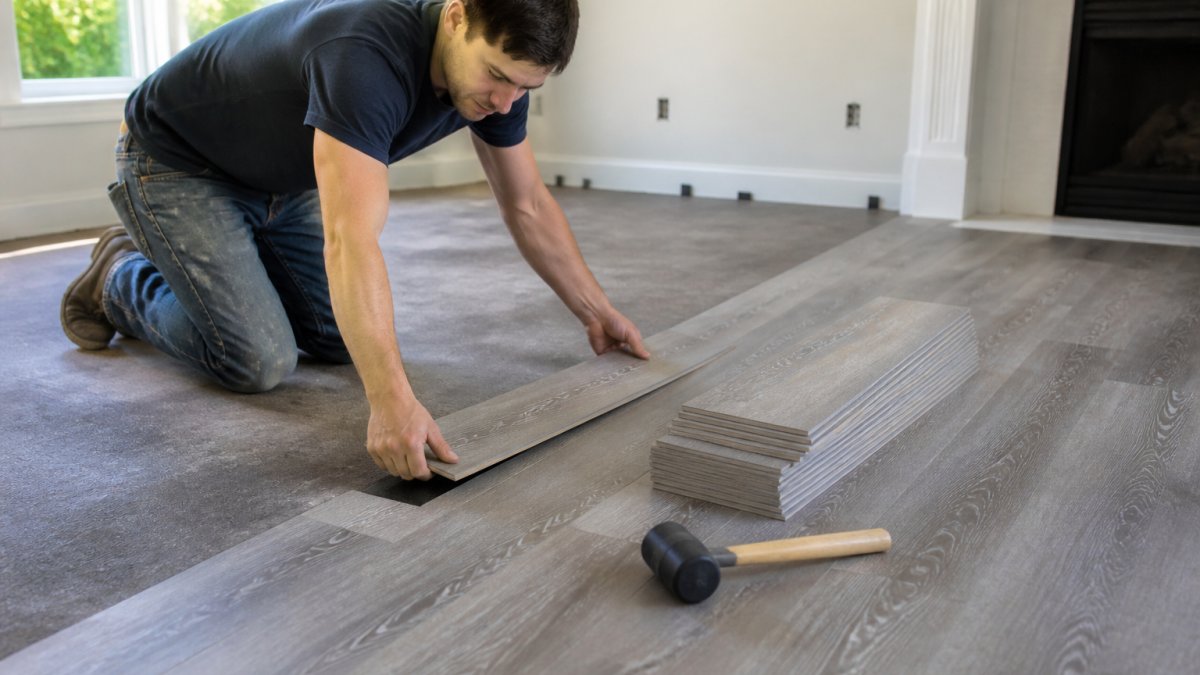
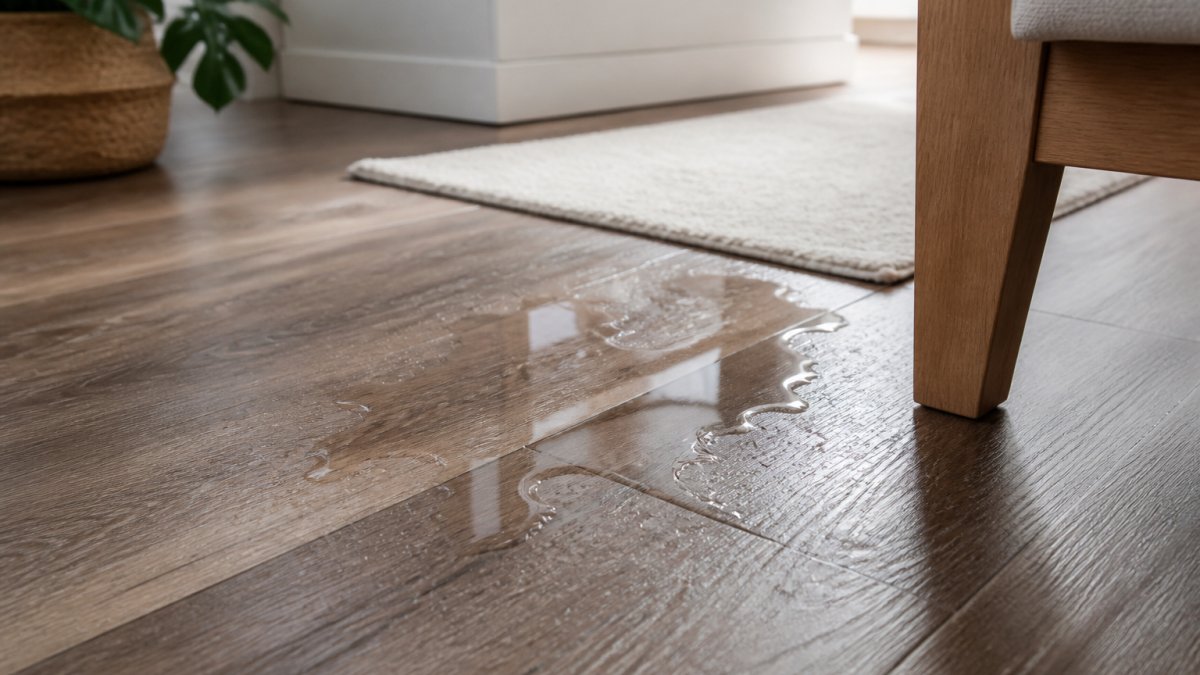
For most Suffolk County basements, LVP and SPC are the correct answer. These products are 100% waterproof at the core, handle humidity swings without buckling, and install as a floating floor over concrete without adhesive. Floating installation allows moisture vapor migrating through the slab to escape rather than trapping under a glued surface.
Stone Plastic Composite products like COREtec Plus and Pro SPC flooring use a rigid limestone-composite core that resists denting and stays dimensionally stable. The attached cork underlayment adds meaningful insulation on a concrete slab. COREtec's SPC line starts around $5 to $9 per square foot.
Shaw Floors Floorte Pro runs $4 to $7 per square foot with an attached pad for sound reduction and low-VOC options. Karndean DesignFlooring's Knight Tile collection offers glue-down and rigid core formats for basements with subfloor irregularities.
Pros:
- Fully waterproof core; standing water will not damage the plank
- Floating installation allows moisture vapor to escape
- Wide range of realistic wood and stone visuals
- Comfortable underfoot with attached underlayment
Cons:
- Higher upfront cost than laminate
- Cannot be refinished if scratched through
- Requires reasonably flat subfloor (within 3/16 inch over 10 feet)
2. Porcelain and Ceramic Tile for Durability
Porcelain tile's extremely low water absorption rate makes it functionally impervious to moisture conditions common in Suffolk County basements. Material costs range from $3 to $12 per square foot depending on format and finish.
The challenge is that concrete slabs move with temperature changes. Standard tile installed directly over a moving slab will crack at grout joints within a few years. An uncoupling membrane installed between the concrete and tile solves this problem. Schluter-DITRA uncoupling membrane system is the industry standard. DITRA's polyethylene matrix isolates the tile layer from subfloor movement while its integrated vapor management channels allow moisture to escape upward rather than building pressure under the tile.
Pros:
- Best long-term water resistance of any flooring category
- Easy to sanitize; ideal for finished basements with bathrooms
- Available in wood-look and stone-look formats
Cons:
- Cold underfoot without radiant heating
- Grout lines require periodic sealing and cleaning
- Professional installation strongly recommended
3. Engineered Hardwood: Real Wood Without the Risk
Engineered hardwood is the right choice for a fully conditioned basement year-round with no history of water intrusion and a passing calcium chloride moisture test. The multi-ply core resists warping far better than solid hardwood in environments with humidity variation.
Bruce Engineered Hardwood runs $6 to $12 per square foot for materials and supports glue-down, floating, and staple-down installation methods. The factory-applied finish is durable and does not require the acclimation period that site-finished solid wood demands, though 48 to 72 hours of acclimation in the basement space is still required before installation.
Engineered hardwood is warmer underfoot than vinyl and adds perceived quality to a finished basement. For homeowners finishing a basement as a primary living space or home office, that distinction is worth the added cost and preparation requirements.
Pros:
- Authentic wood appearance and feel
- Adds resale value to the home
- Can often be lightly sanded and refinished once
Cons:
- Less moisture-tolerant than vinyl or tile; requires a dry, conditioned slab
- Higher material cost
- Requires moisture testing before installation
4. Epoxy Coatings and Sealed Concrete
Epoxy is the most practical flooring solution for basements used as workshops, utility rooms, home gyms, or storage spaces. It transforms the existing concrete slab into a seamless, non-porous surface without adding floor height, which matters in basements with lower ceiling clearances.
The critical requirement for epoxy is surface preparation. Concrete must be mechanically ground or acid-etched to open the pores before the epoxy bonds properly. Any moisture coming through the slab must be addressed before coating; epoxy applied over a damp slab will delaminate.
For home gyms specifically, interlocking rubber tiles from American Floor Mats offer a practical alternative. They install without adhesive, absorb impact, and individual tiles can be replaced if damaged.
How to Prepare Concrete Basement Floor for Flooring
Concrete slab preparation determines whether a basement floor installation succeeds or fails. No flooring material performs correctly over a slab that is damp, uneven, or structurally compromised.
Moisture Testing and Subfloor Preparation
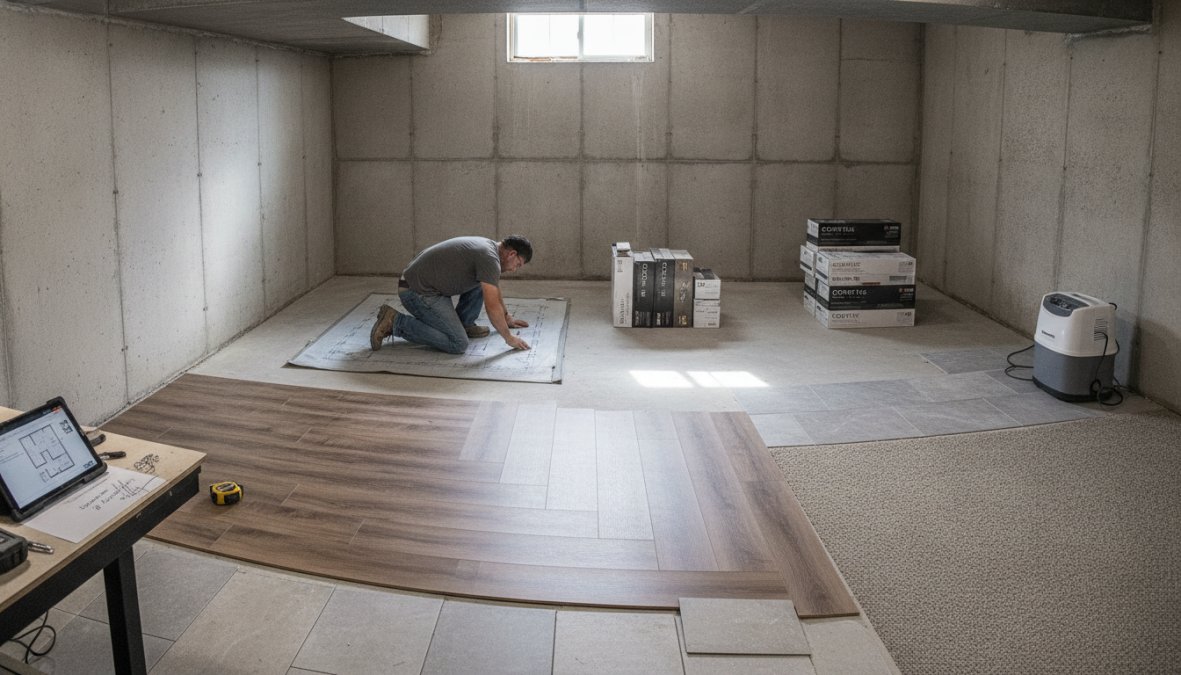
Moisture testing is non-negotiable before any basement flooring installation in Suffolk County. The standard method is a calcium chloride test, which measures moisture vapor emission rate (MVER) from the slab surface over 60 to 72 hours. A simpler field test involves taping a 2-foot square of plastic sheeting to the slab for 24 hours; condensation on the underside confirms active moisture migration.
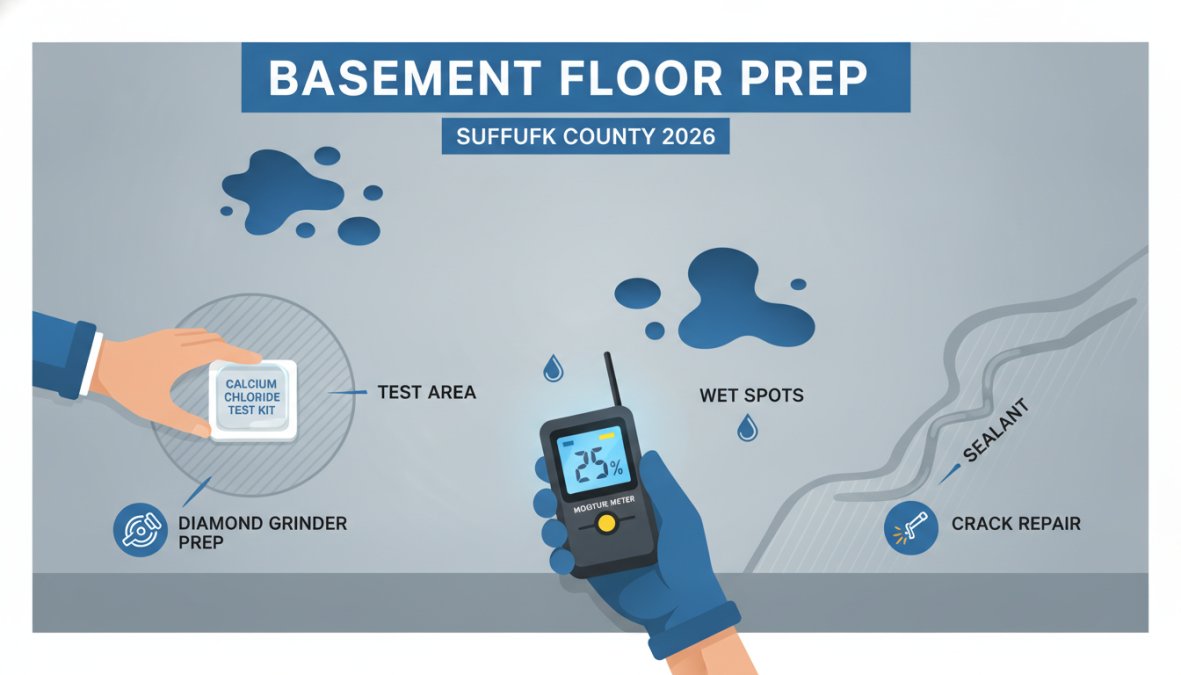
According to guidance from the Tile Council of North America, moisture vapor transmission through concrete is one of the leading causes of flooring failures in below-grade residential installations.
DRIcore Subfloor Panels offer a practical solution when moisture vapor is present but not severe. The patented air gap allows vapor to dissipate rather than accumulate, and the R-value of 1.4 meaningfully improves floor warmth on a cold concrete slab.
Floor Leveling and Repair Requirements
Most concrete slabs in Suffolk County homes are not perfectly flat. LVP and SPC require no more than 3/16 inch variation over a 10-foot span, while tile requires even tighter tolerances. Floor leveling compound addresses low spots; high spots require grinding. Both steps add labor time and cost but cannot be skipped.
Basement Moisture Control in Suffolk County: Climate Considerations
Long Island's position between the Atlantic Ocean and Long Island Sound creates humidity conditions more demanding than inland locations. Suffolk County basements face elevated moisture vapor pressure from May through September, and any flooring system that does not account for this will underperform.
Why Long Island Humidity Demands Moisture Barriers
Suffolk County's coastal climate means relative humidity regularly exceeds 70% during summer months. Concrete slabs transmit moisture vapor from the soil beneath them continuously. The rate increases during warm, humid weather when the vapor pressure differential between the soil and the basement interior is highest. This is why solid hardwood flooring is categorically inappropriate for Long Island basements regardless of how dry the space feels in winter.
A moisture barrier is a physical membrane, either a sheet product or liquid-applied coating, that reduces vapor transmission through the slab surface. It is distinct from a waterproofing system that manages bulk water intrusion.
Underlayment and Vapor Barrier Selection
The right underlayment choice depends on the flooring type being installed. For LVP and SPC with attached underlayment, no additional layer is typically needed. For engineered hardwood installed as a floating floor, a 6-mil polyethylene vapor barrier sheet installed directly over the concrete is standard practice. For tile over an uncoupling membrane, the membrane itself handles vapor management.
Cost of Basement Flooring Installation Long Island: Pricing Breakdown
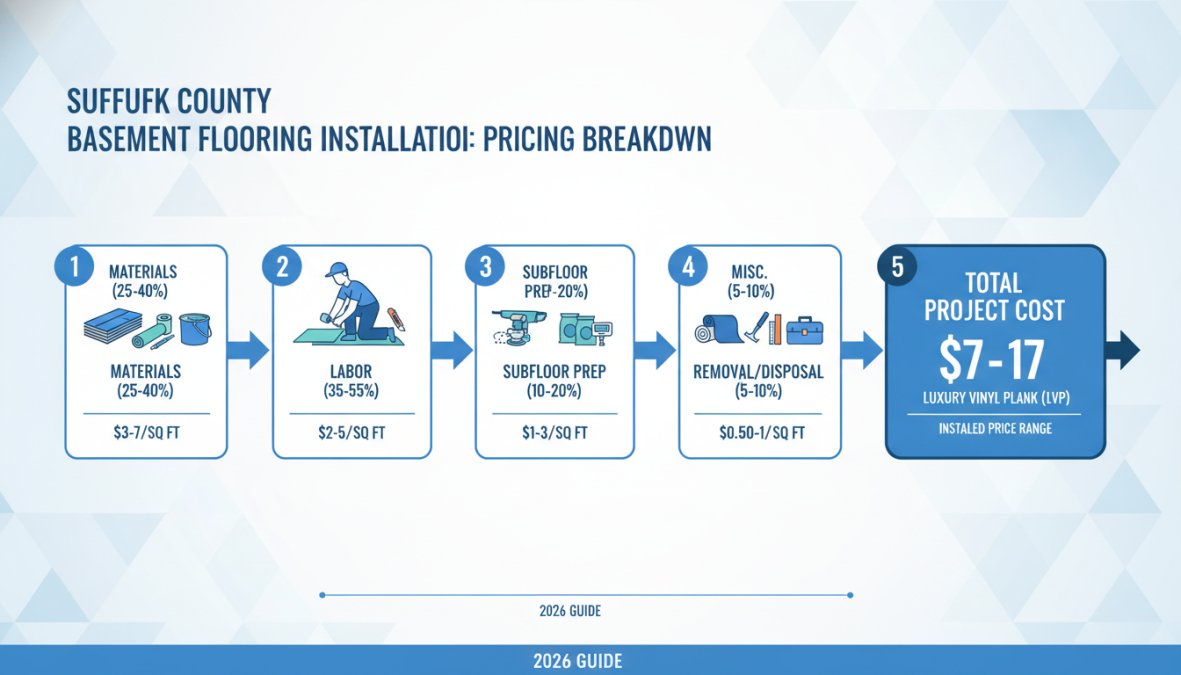
The cost of basement flooring installation on Long Island runs higher than national averages, reflecting both regional labor rates and the additional preparation steps that below-grade concrete typically requires.
Material Costs vs. Labor Costs
Material costs for the most common basement flooring options in Suffolk County:
- LVP / SPC: $4 to $9 per square foot for materials; $3 to $5 per square foot for labor, totaling $7 to $14 installed
- Porcelain tile: $3 to $12 per square foot for materials; $6 to $10 per square foot for labor, totaling $9 to $22 installed
- Engineered hardwood: $6 to $12 per square foot for materials; $4 to $6 per square foot for labor, totaling $10 to $18 installed
- Epoxy coating: $3 to $7 per square foot installed
Additional costs frequently underestimated:
- Moisture testing and remediation: $200 to $800
- Floor leveling compound: $1 to $2 per square foot
- DRIcore or similar subfloor panel system: $2 to $4 per square foot installed
- Transition strips and baseboards: $200 to $600
- Debris removal and disposal: $150 to $400
A 600-square-foot basement finished with SPC flooring, basic subfloor preparation, and new baseboards realistically costs $6,000 to $10,000 installed in Suffolk County in 2026.
DIY vs. Professional Installation
Floating LVP and SPC installations are accessible to experienced DIYers. Click-lock systems require basic tools, and installation timelines for a 400 to 600 square foot basement run two to three days. The labor savings of $3 to $5 per square foot are meaningful.
Tile and epoxy require professional installation. Tile installation over an uncoupling membrane requires consistent thin-set coverage and proper grout joint spacing. Epoxy requires surface grinding equipment that most homeowners do not own.
According to National Association of Home Builders guidance on basement finishing costs, subfloor preparation consistently accounts for a larger share of total project cost than homeowners anticipate.
Choosing the right basement flooring in Suffolk County requires understanding how the concrete slab introduces variables that don't exist elsewhere in the house. Hamptons Carpet One Floor and Home serves all of Suffolk County and carries the full range of products discussed in this guide, from SPC and engineered hardwood to tile and specialty subfloor systems. Visit the showroom or contact the team to get a product recommendation matched to your specific basement conditions, subfloor assessment, and installation timeline.
Frequently Asked Questions
Is luxury vinyl plank good for basements in Suffolk County?
Yes, luxury vinyl plank (LVP) and stone plastic composite (SPC) are excellent choices for Suffolk County basements. They're 100% waterproof, resist mold and mildew, and handle Long Island humidity well. Rigid core options like COREtec Plus and Shaw Floors Floorte Pro offer superior stability on concrete subfloors. Pricing ranges from $4-$9 per square foot for materials, making them cost-effective compared to engineered hardwood.
How do I prevent mold under basement flooring?
Prevent mold by addressing basement moisture control before installation. Use moisture barriers, underlayment with vapor protection, and ensure proper concrete preparation with moisture testing. DRIcore subfloor panels create an air gap that allows moisture to evaporate safely. Choose waterproof flooring materials like vinyl, tile, or epoxy. Maintain adequate ventilation and consider a dehumidifier in humid Suffolk County basements to keep moisture levels below 60%.
What's the average cost of basement flooring installation on Long Island?
Cost of basement flooring installation Long Island varies by material and labor. Luxury vinyl runs $4-$9 per square foot; porcelain tile $3-$12; engineered hardwood $6-$12. Labor typically adds $3-$8 per square foot. A 500 sq ft basement averages $2,000-$5,500 for materials plus installation. Subfloor preparation, moisture barriers, and disposal add $500-$1,500. Get quotes from local Suffolk County flooring contractors for accurate pricing on your specific project.
Does Suffolk County humidity affect basement flooring choices?
Absolutely. Suffolk County's coastal humidity and seasonal moisture fluctuations make waterproof, moisture-resistant flooring essential. Avoid solid hardwood and standard laminate. Instead, choose luxury vinyl, engineered hardwood with factory finishes, porcelain tile, or epoxy coatings. Proper basement moisture control, including vapor barriers and underlayment, is critical. Long Island's climate demands extra attention to subfloor preparation and acclimation before installation to prevent warping, buckling, and mold growth.
This article was written using GrandRanker