 Ultimate guide
Buy Carpet Tiles for Office: The Complete 2026 Guide
Table of Contents
- Why Buy Carpet Tiles for Office Spaces Over Other Flooring
- Best Carpet Tiles for High Traffic Office Areas
- Carpet Tiles vs. Broadloom for Offices: Which Should You Choose?
- How to Calculate Carpet Tile Quantity for Your Office
- Color, Pattern, and Installation Method Selection
- Carpet Tile Maintenance Tips to Protect Your Investment
- Wholesale Pricing, Discounts, and Where to Buy Carpet Tiles for Office Projects
- Conclusion
Last Updated: June 14, 2026
Office flooring decisions carry more long-term consequence than most managers realize. When you buy carpet tiles for office spaces, you're choosing a flooring system that affects acoustics, maintenance costs, indoor air quality, and how quickly you can replace worn sections without shutting down operations. At Hamptons carpet one floor and Home, we've helped Suffolk County businesses navigate these decisions for years.
Here's what most guides get wrong: they treat office carpet tiles as a commodity purchase. The difference between a commercial-grade modular carpet and a standard residential tile shows up within 18 months of heavy traffic. Below, we cover product selection, installation, maintenance, and wholesale pricing so you make a decision you won't regret in year two.
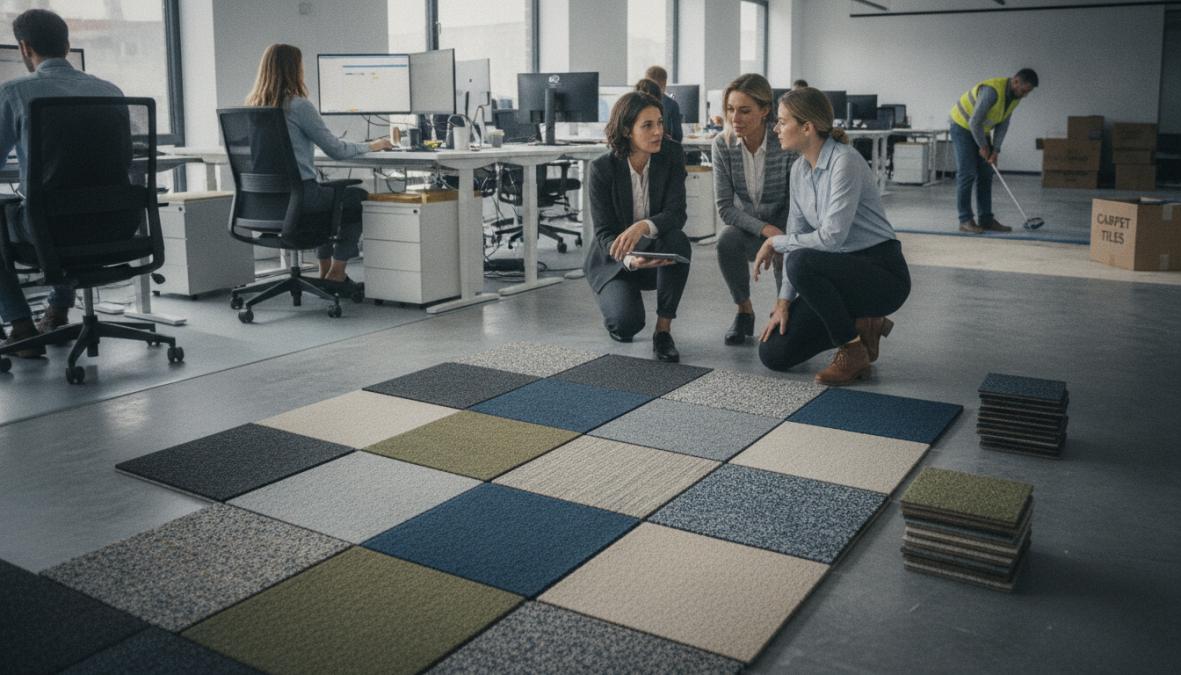
Commercial carpet tiles are a modular flooring solution consisting of individual square or plank-shaped sections, typically 18x18 or 24x24 inches, designed to be installed, replaced, and reconfigured independently.
Why Buy Carpet Tiles for Office Spaces Over Other Flooring
The strongest argument for carpet tiles over broadloom, LVT, or polished concrete isn't aesthetics, it's operational flexibility. A single damaged or stained tile can be pulled and replaced in minutes without disturbing surrounding flooring, a maintenance advantage that compounds over years.
Performance Benefits: Sound Absorption, Durability, and Indoor Air Quality
Office carpet tiles deliver measurable acoustic performance hard flooring cannot match. According to the Carpet and Rug Institute's technical guidance on acoustic performance, carpet can reduce impact noise transmission by up to 30 decibels compared to hard surfaces, critical in open-plan offices where keyboard clicks, footsteps, and conversation dominate.
Durability depends heavily on pile density and fiber type. Nylon-backed commercial carpet tiles consistently outperform polypropylene in wear testing; look for tiles rated for heavy traffic with sufficient pile density to prevent matting in corridors and reception areas.
Indoor air quality is often unfairly criticized. Modern commercial tiles from Shaw Contract and Interface use low-VOC adhesives and carry FloorScore certification. Properly installed modular carpet traps airborne particulates until vacuumed, reducing circulating dust.
Sustainability and Low Carbon Options from Leading Brands
The flooring industry has made genuine progress on sustainability. Interface offers tiles made with recycled fishing nets and ocean plastics, with verified carbon-neutral backing. Shaw Contract's EcoWorx backing is fully recyclable. Tarkett publishes Environmental Product Declarations (EPDs) for its commercial lines.
For Suffolk County businesses with green building goals, ask suppliers specifically for tiles with Cradle to Cradle certification or Red List-free material declarations.
Best Carpet Tiles for High Traffic Office Areas
The biggest mistake buyers make is applying residential durability standards to commercial environments. A tile that holds up in a home office will show matting and fiber crush within months in a busy corridor.
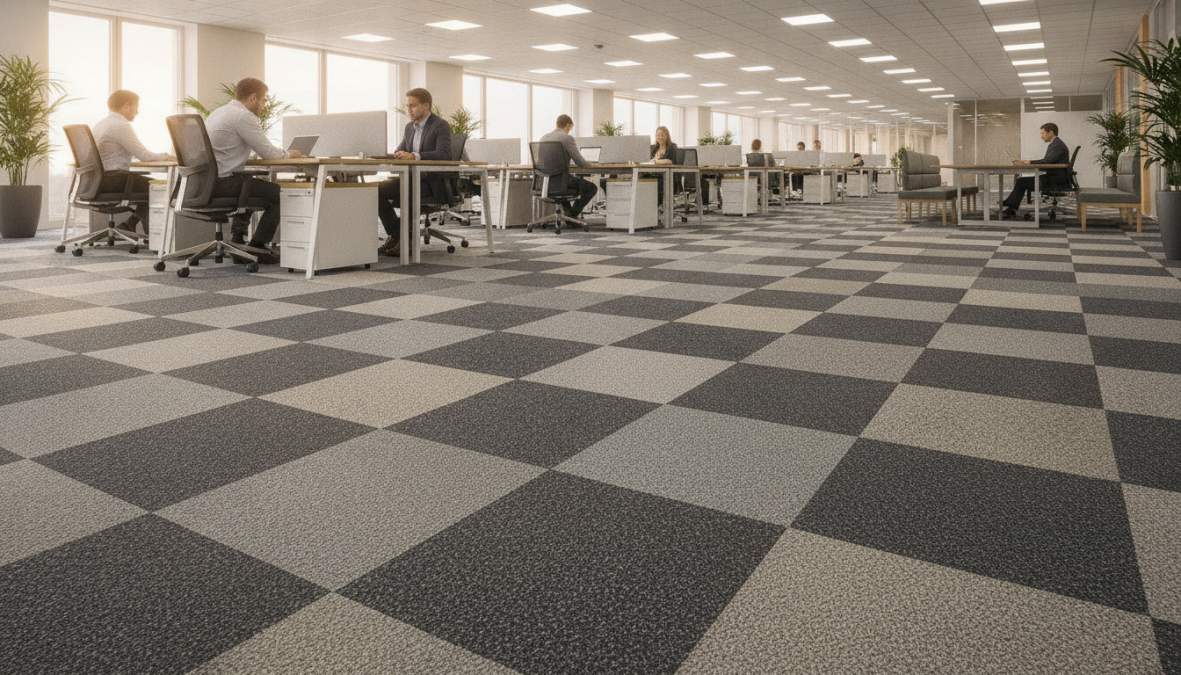
Commercial Grade vs. Standard Carpet Tiles: What to Look For
Commercial grade carpet tiles are defined by construction specifications, not price. Key metrics:
- Face weight: Minimum 20 oz. per square yard for heavy traffic; 28+ oz. for corridors and lobbies
- Pile density: Higher density resists crushing under chair casters
- Backing system: Cushion-backed tiles offer better acoustics; hard-backed tiles install flatter and replace more easily
- Fiber type: Solution-dyed nylon offers superior stain resistance and color retention over polypropylene
Standard residential tiles lack the backing stability and pile density for office use, they'll shift underfoot, show traffic patterns quickly, and fail under rolling chairs within a year.
Top Brands: Shaw Contract, Interface, Mohawk, and Tarkett
Shaw Contract produces some of the most specified commercial carpet tiles in North America. Their EcoWorx backing is fully recyclable and performs well in high-traffic environments across budget and premium lines.
Interface is the benchmark for sustainable commercial flooring. Tiles use recycled ocean plastics, and the company has published verified carbon footprint data since the 1990s. Interface is heavily specified in LEED-certified buildings.
Mohawk offers strong value with a broad catalog of non-directional patterns that simplify installation and reduce waste, with competitive lead times through distributors.
Tarkett brings European design sensibility and a strong emphasis on indoor air quality certification, making their tiles popular in healthcare and education environments.
| Brand | Best For | Backing Type | Sustainability Cert |
|---|---|---|---|
| Shaw Contract | High-traffic offices | EcoWorx (recyclable) | FloorScore, Cradle to Cradle |
| Interface | LEED projects | Carbon-neutral system | Carbon neutral, recycled content |
| Mohawk | Budget-conscious projects | Standard commercial | FloorScore |
| Tarkett | Healthcare, education | Cushion and hard back | EPD published, Red List-free |
Carpet Tiles vs. Broadloom for Offices: Which Should You Choose?
For most offices, carpet tiles win. Broadloom has one genuine advantage, a seamless appearance in large open areas. Everything else favors the modular format.
Cost-Benefit Analysis: Modular Carpet vs. Broadloom
Broadloom's upfront material cost is often lower per square foot. That's the number most buyers see first, and it misleads them.
Installation: Broadloom requires professional seaming, stretching, and tack strips. Carpet tiles install DIY with pressure-sensitive adhesive, cutting labor costs significantly.
Maintenance: A damaged broadloom section means patching or full replacement. A damaged carpet tile costs a few dollars and five minutes to swap.
Downtime: Broadloom replacement requires clearing the entire space. Carpet tile replacement is done section by section, often overnight.
Lifecycle: Worn tiles rotated from high-traffic to low-traffic zones periodically can extend the installation's life well beyond broadloom in the same environment.
Facilities managers who ran five-year total cost of ownership comparisons consistently found modular carpet came in lower than broadloom, even when initial material cost was higher.
How to Calculate Carpet Tile Quantity for Your Office
Calculating quantity is straightforward, but skipping the waste factor is a common and expensive mistake.
Step 1: Measure total square footage. Break irregular spaces into rectangles and sum them.
Step 2: Add 10% for waste in standard rooms; 15% for rooms with many angles or obstacles.
Step 3: Divide total square footage (including waste) by the area of one tile. A 24x24 inch tile covers 4 sq. ft.; an 18x18 inch tile covers 2.25 sq. ft.
Step 4: Round up to the nearest full case. Most commercial tiles ship in cases of 12-16 tiles.
Step 5: Order one additional case for future repairs. Dye lots change between production runs, and having matching tiles on hand is worth the small extra cost.
A practical example: a 1,200 sq. ft. open-plan office using 24x24 tiles needs 1,320 sq. ft. with 10% waste, equaling 330 tiles, 28 cases rounded up, plus one additional case for repairs.
Color, Pattern, and Installation Method Selection
Layout method affects waste generation, installation forgiveness, and how the space reads visually.
Monolithic, Quarter-Turned, and Non-Directional Layouts Explained
Monolithic layout runs all tiles in the same direction, creating a uniform appearance but showing seams and traffic patterns more readily. It demands the most installation precision.
Quarter-turned layout rotates each tile 90 degrees from its neighbor, creating a subtle checkered effect that disguises seams and wear patterns exceptionally well. It's the most practical choice for high-traffic offices.
Non-directional patterns have no discernible pile direction, allowing any orientation without visible seams, the fastest to install and most forgiving for less experienced installers.
For most offices, quarter-turned or non-directional patterns are the right call. Reserve monolithic layouts for formal reception areas or executive suites where the visual payoff justifies the extra care.
Step-by-Step DIY Installation Guide for Office Carpet Tiles
Total Time: 4-8 hours for a standard 1,000 sq. ft. office Difficulty: Intermediate
What You'll Need:
- Pressure-sensitive carpet tile adhesive
- Chalk line and tape measure
- Utility knife with fresh blades
- Notched trowel or roller
- Knee pads
Step 1: Prepare the subfloor. It must be clean, dry, and flat. Fill cracks with floor leveling compound and test for moisture before proceeding.
Step 2: Find the center of the room. Snap chalk lines from the midpoints of opposite walls to create a cross at the room's center.
Step 3: Dry-lay a test row. Lay tiles dry from center to each wall. Adjust your starting point if you'd end up with less than half a tile width at the perimeter, slivers look like mistakes.
Step 4: Apply adhesive. Use pressure-sensitive adhesive with a notched trowel, one quadrant at a time. Allow to tack up per manufacturer instructions (typically 20-30 minutes).
Step 5: Place tiles from center outward. Press firmly and slide slightly for full adhesive contact. For quarter-turned layouts, rotate each tile 90 degrees from its neighbor.
Step 6: Cut border tiles. Use a sharp utility knife and straight edge. Score and snap, or cut fully through for plank formats.
Step 7: Roll the installation. Use a 100-pound floor roller to ensure full adhesive contact across the entire installation.
Carpet Tile Maintenance Tips to Protect Your Investment
A well-maintained commercial carpet tile installation will outlast a neglected one by years. The modular format makes maintenance easier than any other flooring type, but only if you act on problems quickly.
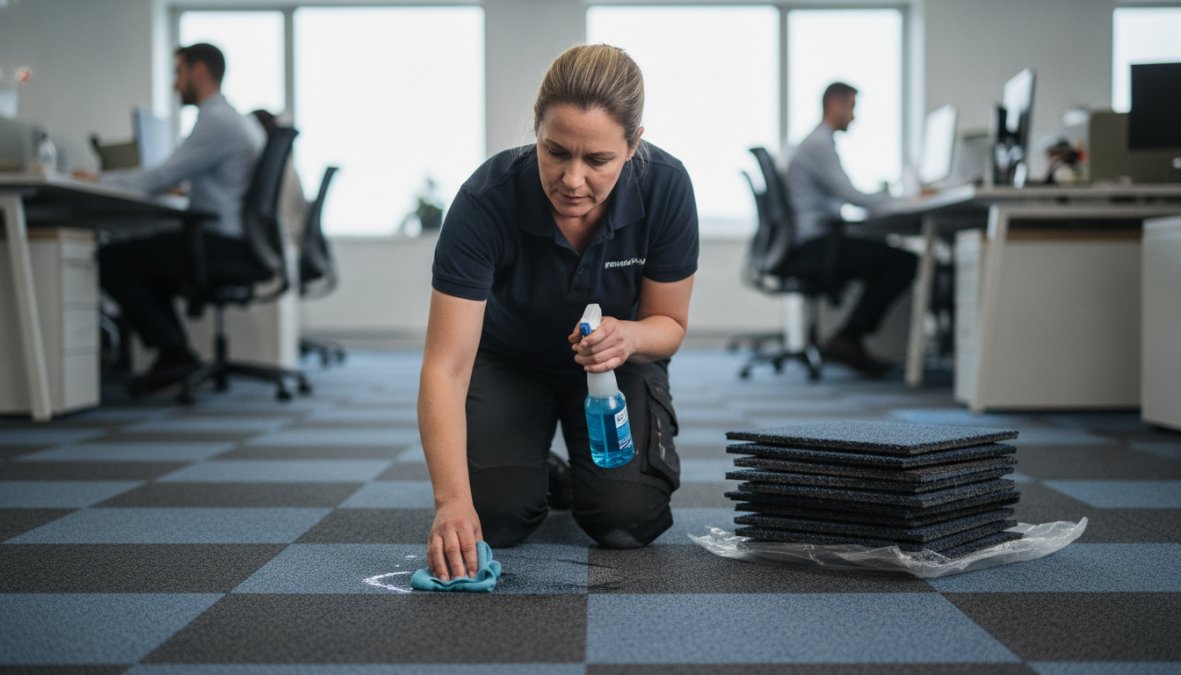
Stain Removal Protocols and Routine Cleaning Schedule
Routine cleaning schedule:
- Daily: Vacuum high-traffic areas with a commercial upright vacuum.
- Weekly: Vacuum all areas, including under desks and corners.
- Quarterly: Hot water extraction to remove embedded soil vacuuming misses.
- Annually: Inspect for wear and matting; rotate tiles from high-traffic to low-traffic zones to even out wear.
Stain removal protocols:
Act immediately, the longer a spill sits, the deeper it penetrates. Blot, never rub.
For water-based spills (coffee, soft drinks): blot excess, apply diluted neutral pH cleaner, blot again, rinse with cold water, blot dry.
For oil-based spills (grease, food): apply dry cleaning solvent or citrus-based spotter, work from the outside inward, blot repeatedly.
For stubborn stains: remove and replace the individual tile. According to the Carpet and Rug Institute's care and maintenance guidelines, prompt response within the first few minutes removes the majority of staining potential before it sets into the fiber. A stained carpet tile is a five-minute fix, not a repair project.
Wholesale Pricing, Discounts, and Where to Buy Carpet Tiles for Office Projects
Pricing varies widely based on fiber quality, backing system, brand, and order volume. Projects over 500 square feet typically qualify for contractor pricing; projects over 2,000 square feet often unlock additional volume discounts. Consolidating orders to a single SKU and quantity generates meaningful savings for multi-floor offices or facilities portfolios.
Quickship programs from Shaw Contract, Interface, and Mohawk maintain in-stock inventory on popular SKUs that ships within days rather than the 4-6 week lead time for custom orders, the practical choice when timelines are tight.
Closeout and discontinued SKUs offer genuine value when you can act quickly and buy the full quantity you'll ever need, since restocking is impossible once inventory clears.
As noted in the General Services Administration's guidance on commercial flooring procurement, bulk purchasing through established flooring retailers consistently yields lower per-unit costs than piecemeal ordering. For independent specification research, ASTM International's flooring standards documentation provides the technical benchmarks commercial carpet tiles are tested against.
For Suffolk County offices, Hamptons carpet one floor and Home sources commercial carpet tiles from leading manufacturers and can structure orders to qualify for wholesale pricing tiers. The real cost of cheap carpet tiles shows up at year three, tiles that mat, shift, or stain permanently force earlier replacement cycles that eliminate any upfront savings. Buying to specification matters more than buying to the lowest square-foot price.
Selecting the right office flooring compounds over years of daily use, and the wrong choice is expensive to undo. Hamptons carpet one floor and Home serves businesses across Suffolk County, NY, with access to commercial carpet tile lines from Shaw Contract, Interface, Mohawk, and Tarkett, along with the product knowledge to match your traffic levels, acoustic requirements, and budget to the right solution. Contact the team at Hamptons carpet one floor and Home to get a project quote and find out which products qualify for current wholesale pricing on your order volume.
Frequently Asked Questions
Are carpet tiles good for office spaces?
Yes. Commercial carpet tiles are one of the most practical flooring solutions for offices. They offer sound absorption that reduces ambient noise, are easy to replace individually when damaged or stained, and can be installed without professional help. Modular carpet also handles high-traffic zones well, especially when you choose commercial-grade options with a durable nylon backing. Brands like Shaw Contract, Interface, and Mohawk offer tiles specifically engineered for demanding office environments.
How much do office carpet tiles cost per square foot?
Office carpet tile pricing varies widely based on grade and brand. Standard modular carpet tiles typically range from around $1.50 to $4.00 per square foot, while commercial-grade or designer tiles from brands like Interface or Tarkett can run $4.00 to $8.00 or more per square foot. Wholesale pricing and closeout deals can significantly reduce costs. Always factor in adhesive, underlayment, and installation labor when calculating your total project budget.
What are the benefits of carpet tiles over broadloom carpet for offices?
Carpet tiles offer several advantages over broadloom for office use. Individual square or plank tiles can be replaced without pulling up an entire floor, which lowers long-term maintenance costs. They allow creative pattern layouts like monolithic or quarter-turned designs, and many options carry low-carbon or sustainable design certifications. Broadloom may cost less upfront on large open areas, but carpet tiles win on flexibility, repairability, and long-term value in most commercial settings.
Can you replace individual carpet tiles if they get stained or damaged?
Yes, this is one of the biggest practical advantages when you buy carpet tiles for office use. Because each tile is a self-contained modular unit, you can lift and swap a single damaged or heavily stained tile without disturbing the rest of the floor. It is a good idea to purchase 10-15% extra square footage when ordering so you have matching tiles on hand for future replacements. Keep spares stored flat in a climate-controlled area to prevent warping.
How do you install carpet tiles in an office yourself?
Start by finding the center of the room and snapping chalk lines to create quadrants. Dry-lay a test row to check alignment before applying adhesive or peel-and-stick backing. Work outward from the center, pressing each tile firmly into place. Use a utility knife and straight edge to cut border tiles. For high-traffic office areas, a pressure-sensitive adhesive is recommended over relying solely on self-adhesive backing. Allow adhesive to cure per manufacturer instructions before heavy use.
How do I calculate how many carpet tiles I need for my office?
Measure your room's length and width in feet and multiply to get total square footage. Add 10-15% for cuts, waste, and future replacements. Most commercial carpet tiles come in 24x24 inch or 18x18 inch squares, so divide your adjusted square footage by the tile size to get your tile count. For plank tiles, calculate by linear coverage. Always round up to the nearest full box. Our team at Hamptons Carpet One can help you calculate quantities and find quickship options for your project.
This article was written using GrandRanker