 blog
Buy Residential Carpet Online: A Complete 2026 Guide
Table of Contents
- Why Buy Residential Carpet Online Works for Coastal Homeowners
- Understanding Carpet Fiber Types and Durability Science
- Carpet Styles and Textures for Residential Spaces
- Stain-Resistant Technology: What the Claims Really Mean
- Carpet Padding and Underlayment: The Hidden Foundation
- How to Measure Your Space Accurately for Online Carpet Orders
- DIY vs. Professional Installation: True Cost Analysis
- Navigating Pricing, Samples, and Online Carpet Ordering
Last Updated: August 1, 2026
When it comes to home improvement decisions, buying residential carpet online has become a practical option for homeowners across the United States. At Hamptons carpet one floor and Home, we've helped countless coastal and suburban families navigate the complexity of selecting and purchasing flooring. This guide walks you through essential factors that determine whether online carpet purchases make sense for your home, how to evaluate quality before committing, and what to expect from delivery and installation.
The shift toward online carpet shopping reflects real changes in how homeowners approach flooring. What was once purely in-person, picking samples at a showroom and waiting weeks for installation, now includes digital ordering, curbside delivery, and professional installation coordination. This convenience comes with specific challenges: you can't feel texture through a screen, color representation on your monitor may not match your actual walls, and subfloor surprises can derail timelines and budgets.
Why Buy Residential Carpet Online Works for Coastal Homeowners
Online carpet purchasing makes particular sense if you live in a high-traffic environment, deal with salt air and sand intrusion, or have older homes with unique installation challenges. You can research fiber types, compare stain-resistant technologies, and review detailed product specifications from home, eliminating in-store sales pressure and giving you time for informed decisions.
Coastal properties face specific durability demands. Salt air accelerates wear on standard fibers, sand tracked indoors abrades carpet backing, and humidity promotes mold growth. When you buy residential carpet online, you can filter for products designed to handle these conditions: nylon and triexta fibers with antimicrobial treatments, high-density construction that resists matting, and moisture-resistant underlayment systems.
Understanding Carpet Fiber Types and Durability Science
The fiber you choose determines how your carpet performs under coastal conditions, heavy foot traffic, and your household's specific maintenance demands.
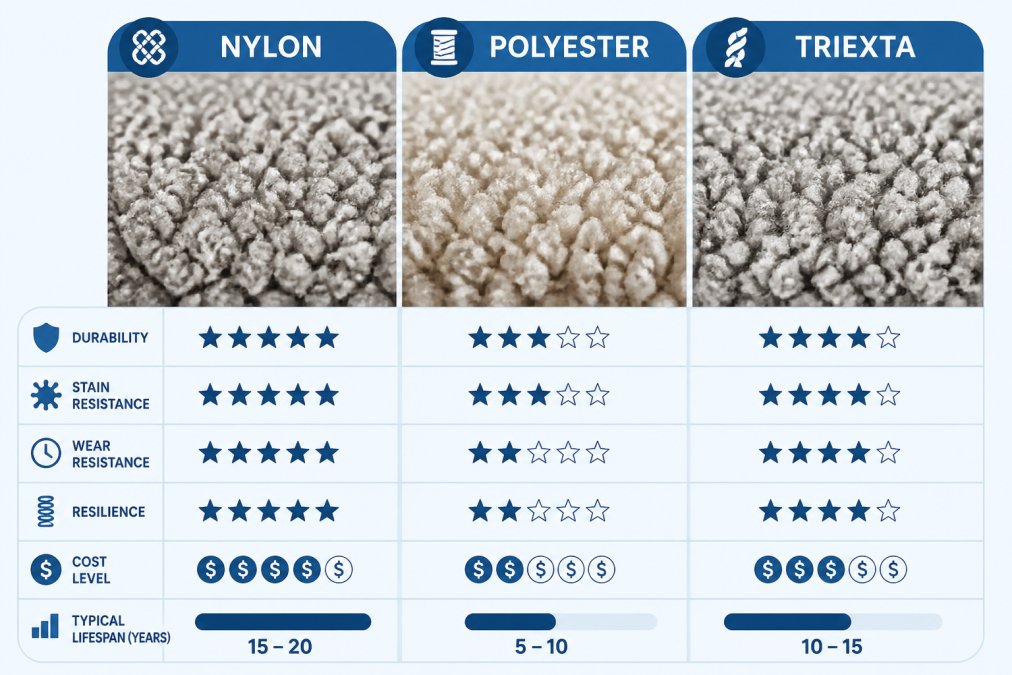
Nylon, Polyester, and Triexta: Which Resists Salt Air and Sand Best
Nylon remains the industry standard for high-traffic residential spaces because it resists abrasion and maintains appearance longer than competing fibers. Nylon's molecular structure allows it to recover from compression, so the pile bounces back after foot traffic. In well-maintained homes, nylon carpet can last 15+ years. For coastal properties, nylon's resistance to salt air degradation makes it the preferred choice among professional installers.
Polyester offers cost advantages and inherent stain resistance because the fiber itself is hydrophobic, liquids bead on the surface rather than absorbing into the fiber. However, polyester fibers compress more easily than nylon, showing footprints and furniture indentations more visibly over time. In sandy environments, polyester's lower density allows abrasive particles to work deeper into the pile, accelerating wear.
Triexta represents newer fiber technology engineered specifically for performance. It combines nylon-like durability with polyester-like stain resistance. The fiber resists moisture absorption, which matters in humid coastal climates where mold and mildew threaten standard carpet. Triexta's resilience exceeds both nylon and polyester, and the fiber naturally resists common household stains without requiring chemical treatments.
When you buy residential carpet online, triexta and nylon represent the best long-term values for coastal homes.
Pile Height, Density, and Twist: What Actually Matters for High-Traffic Areas
Pile height, the length of fiber strands measured from backing to tip, ranges from 1/8 inch (low loop) to 1 inch or more (plush). In high-traffic residential spaces, pile heights between 1/2 inch and 3/4 inch represent the practical sweet spot: soft enough for comfort, resilient enough to maintain appearance.
Density measures how tightly fibers are packed into the backing, typically expressed as ounces per square yard. Higher density directly correlates with durability and stain resistance. A carpet with 60 ounces per square yard will outperform a 40-ounce carpet of the same fiber type. Coastal homes with sand intrusion benefit significantly from density above 50 ounces per square yard.
Twist refers to how tightly fiber strands are twisted together. Higher twist counts (typically 4-6 turns per inch) create a tighter, more defined surface that resists unraveling and matting.
Carpet Styles and Textures for Residential Spaces
The visual texture of your carpet affects not only aesthetics but also how visible wear patterns become and how easily you can maintain the flooring.
Plush vs. Loop: Performance Trade-Offs in Wet Environments
Plush carpet features cut pile fibers that stand upright, creating a smooth, uniform surface that feels soft underfoot. Plush carpet shows footprints and furniture indentations visibly because the pile compresses under weight. In high-traffic coastal homes where sand accumulates, plush carpet requires more frequent vacuuming. Plush works well in formal living spaces, bedrooms, and low-to-moderate traffic areas.
Loop pile carpet features uncut fibers that form loops on the surface. Loop pile resists showing footprints because the loops maintain their shape even under compression. Texture loop (also called Berber) combines loops of different heights to create a patterned surface that masks dirt and wear patterns effectively. This makes loop pile the practical choice for entryways, hallways, and high-traffic residential spaces.
For coastal homes where sand and salt are constant concerns, loop or texture loop carpet outperforms plush in durability and maintenance.
Pet-Friendly and Hypoallergenic Options
Pet-friendly carpet incorporates stain-resistant treatments and uses fiber types that resist odor absorption and hide visible wear from claws and paws. Triexta and treated nylon both perform well for pet households. Darker colors and patterned textures also hide pet hair and dirt more effectively than light solids.
Hypoallergenic carpet reduces allergen accumulation through fiber selection and backing technology. Low-VOC (volatile organic compound) backing materials emit fewer chemical odors during and after installation. Some carpet lines include antimicrobial treatments that inhibit dust mite and mold growth, particularly valuable in humid coastal environments.
Stain-Resistant Technology: What the Claims Really Mean
Stain-resistant treatments applied to carpet fibers create a protective barrier that prevents liquids from absorbing into the fiber itself. The barrier gives you time to blot spills before they set permanently. However, stain-resistant treatments do not make carpet stain-proof, they simply delay stain penetration, so quick cleanup remains essential.
Common stain-resistant technologies include fluorocarbon treatments (the original Scotchgard formulation) and newer polymer-based systems. Fluorocarbon treatments are highly effective on oil-based and protein-based stains but require periodic reapplication. Polymer-based treatments tend to be more durable and don't require reapplication.
When you buy residential carpet online, note the distinction: some manufacturers include stain resistance as a permanent fiber characteristic (built into triexta and some nylon lines), while others apply stain-resistant treatments as a surface coating that diminishes over time. Permanent fiber treatments are worth the modest premium because you maintain stain resistance for the carpet's full lifespan.
Carpet Padding and Underlayment: The Hidden Foundation
Carpet padding, the layer between carpet and subfloor, determines comfort, longevity, and moisture management. Padding thickness ranges from 3/8 inch to 3/4 inch, with 1/2 inch representing the practical standard that balances comfort with durability.
Padding density matters as much as thickness. Denser padding resists compression and provides better support for the carpet pile above. For coastal homes, prioritize moisture-resistant formulations specifically designed to prevent mold and mildew growth in humid conditions. Rubber and synthetic polymer-based padding outperform natural fiber padding in moisture resistance.
Underlayment systems add an additional moisture barrier between padding and subfloor, essential in basements, kitchens, and bathrooms where moisture intrusion is a realistic concern. When you buy residential carpet online for a coastal home, specify moisture-resistant padding with an underlayment system in any room where water exposure is possible. This modest additional investment (typically $0.50-$1.50 per square foot) prevents catastrophic mold growth and extends carpet lifespan dramatically.
Historic homes and older construction often have subfloor challenges, uneven floors, moisture issues, or compromised structural integrity, that make padding selection critical. Professional installers assess subfloor conditions before recommending padding specifications.
How to Measure Your Space Accurately for Online Carpet Orders
Accurate measurements prevent costly mistakes: ordering too little carpet and facing shortages, or ordering too much and wasting money.
Room-by-Room Measurement Best Practices
Begin by sketching each room on graph paper, noting the shape, all wall lengths, and the location of fixed features like fireplaces and built-in shelving. Measure each wall length from corner to corner using a tape measure, recording measurements to the nearest inch. For L-shaped or irregularly shaped rooms, break the space into rectangles, measure each section separately, then calculate total square footage.
Measure at least twice. Measure along each wall, then measure diagonally across the room to verify that your wall measurements create a consistent rectangle. Discrepancies indicate measurement errors or room irregularity, common in older homes where walls have shifted over decades.
Account for closets separately. Measure closet dimensions and calculate whether closet carpet should be included in your order.
Accounting for Doorways, Closets, and Transition Strips
Doorways reduce the total carpet area you need because the doorway opening itself won't be carpeted. However, carpet extends into the doorway threshold, typically 6-12 inches. Measure from the far wall to the doorway threshold to capture this correctly.
Transition strips, the metal or vinyl moldings that connect carpet to adjacent flooring materials, require precise measurement at room boundaries. Measure the length of each wall where carpet meets tile, hardwood, or other flooring.
When you buy residential carpet online, provide detailed measurements to the retailer's design team. Most reputable online retailers offer free measurement verification to ensure your order quantity is correct. Hamptons carpet one floor and Home provides this service.
| Measurement Element | How to Measure | Common Mistakes |
|---|---|---|
| Main room square footage | Length × Width for each section | Forgetting L-shaped indentations or irregular walls |
| Closets | Measure separately; decide inclusion | Not accounting for closet depth correctly |
| Doorways | Measure from far wall to threshold | Subtracting full doorway width instead of opening only |
| Stairs | Linear feet of tread depth × number of stairs | Measuring stair width instead of depth |
| Transition strips | Linear feet at each room boundary | Not measuring all boundaries where carpet meets other flooring |
DIY vs. Professional Installation: True Cost Analysis
Installation costs typically range from $3-$12 per square foot depending on subfloor condition, room complexity, and geographic location. For a 300-square-foot room, total installation costs range from $900 to $3,600. Installation quality directly affects carpet longevity and appearance.
When Professional Installation Is Worth the Investment
Professional installers bring specialized equipment (power stretchers, seaming machines, tack strip installation tools) that homeowners cannot economically rent or purchase. Proper installation requires stretching carpet to precise tension, typically 1-2% of the carpet width, which prevents wrinkles, extends carpet lifespan, and maintains warranty coverage. Improperly installed carpet develops wrinkles within weeks, creating trip hazards and accelerating wear.
Professional installers also handle seaming, joining carpet pieces when a room is wider than standard carpet roll width (typically 12 feet). Visible seams indicate poor seaming technique; invisible seams indicate professional skill. For most residential spaces, professional installation is worth the cost because it protects your carpet investment. Budget $4-$8 per square foot for professional installation in standard residential rooms.
Historic Homes and Subfloor Challenges: Why Surprises Happen
Older homes frequently present subfloor challenges that increase installation complexity and cost. Original hardwood floors may be uneven, warped, or contain nails and debris that must be removed before carpet installation. Concrete subfloors in basements may have moisture issues, cracks, or uneven surfaces requiring leveling compounds. Homes built on piers or with crawl spaces may have subfloor movement that causes carpet to shift or wrinkle over time.
Professional installers assess subfloor condition during a pre-installation site visit and identify issues requiring remediation before carpet installation. Common remediation costs include subfloor leveling ($1-$3 per square foot), moisture barrier installation ($0.50-$1.50 per square foot), and mold remediation in crawl spaces ($500-$2,000+ depending on extent).
When you buy residential carpet online for an older home, budget for a professional pre-installation assessment ($150-$300 typically) to identify potential subfloor issues before your carpet arrives.
Navigating Pricing, Samples, and Online Carpet Ordering
Online carpet retailers offer transparent pricing, detailed product specifications, and convenient sample ordering.
Getting Accurate Samples Before You Commit
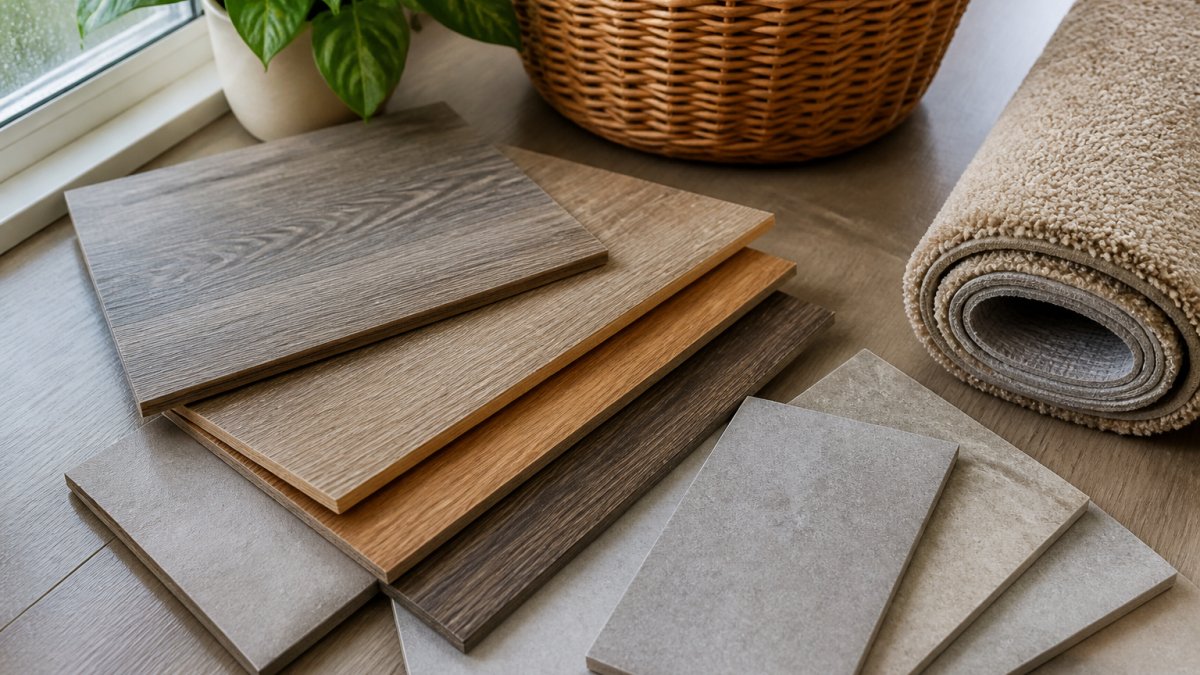
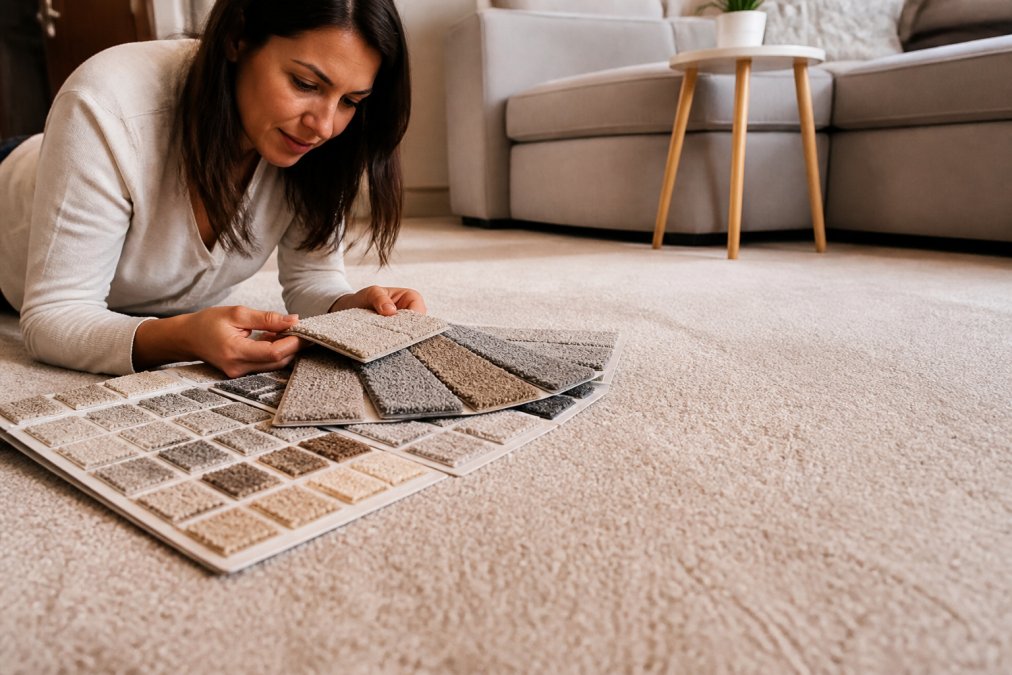
Request samples of your top three choices before committing to a full order. Reputable online retailers ship samples free or at minimal cost ($5-$15 per sample). Samples arrive within 3-5 business days and are typically 12 inches × 12 inches, large enough to assess color, texture, and pile height accurately.
Install samples in your actual rooms for at least 48 hours before ordering full quantities. Assess samples under your home's natural lighting at different times of day and in relation to your existing furnishings and wall colors. Pay attention to how the sample feels underfoot, how visible footprints become after walking on it, and how easily you can clean it.
Delivery Options: Curbside Pick-Up, Standard Delivery, and Timeline Expectations
Online carpet retailers typically offer multiple delivery options: standard delivery (carpet transported to your home and placed in the designated room), curbside delivery (carpet left at your curb), or customer pick-up at a local distribution center. Standard delivery costs $100-$300 depending on distance and order size. Curbside delivery costs less ($50-$150) but requires you to move carpet into your home and store it properly until installation.
Delivery timelines vary based on inventory availability and geographic location. In-stock carpet ships within 3-7 business days. Special orders or custom dyes may require 2-4 weeks. Carpet should be stored in a climate-controlled environment for at least 24 hours before installation to allow it to acclimate to your home's temperature and humidity.
According to the Carpet and Rug Institute's installation guidelines, proper acclimation and installation technique directly impact carpet warranty coverage. Installers who follow CRI standards typically provide stronger warranties and better long-term results.
Research from the Federal Trade Commission on online retail practices emphasizes that reputable online retailers provide clear return policies, transparent pricing, and honest product descriptions. Before ordering, verify the retailer's return window, restocking fees, and warranty coverage.
Choosing to buy residential carpet online puts control in your hands. You research fiber science, compare stain-resistant technologies, measure your space precisely, and select exactly what your home needs. The process requires more upfront effort than walking into a showroom and accepting recommendations, but the result is a flooring investment that performs well in your specific environment.
Hamptons carpet one floor and Home combines online convenience with professional guidance. Our team reviews your measurements, recommends fiber types matched to your coastal climate and traffic patterns, and coordinates professional installation with local specialists who understand historic home challenges and subfloor complexities. Get started with Hamptons carpet one floor and Home and receive a free pre-installation assessment that identifies potential subfloor issues before your carpet arrives.
Frequently Asked Questions
What should I look for when I buy residential carpet online to ensure it holds up in coastal environments?
Focus on stain-resistant technology, high density, and fiber types like nylon or triexta that resist moisture and salt air. Check the backing and padding quality, these affect durability in humid conditions. Request samples to see how colors appear in your actual lighting, and verify the warranty covers moisture-related issues. Ask about low-VOC options if air quality concerns you after installation.
How accurate are online carpet samples compared to what arrives after I buy residential carpet online?
Samples can look different under home lighting due to room color, natural light, and glare. Always request multiple samples and view them at different times of day. Lighting conditions in showrooms differ significantly from residential spaces. Professional retailers offer in-home consultations or extended sample periods so you can see colors in context before committing to a full purchase.
What hidden costs should I expect when I buy residential carpet online and schedule installation?
Beyond carpet and padding, budget for removal of old flooring, subfloor repair (common in older homes), transition strips, tack strips, and labor. Uneven floors, water damage, or original hardwood underneath can increase costs. Get a detailed written estimate that breaks down each line item. Professional installers should inspect your space before quoting to avoid surprise charges mid-project.
How do I know if I need professional installation or if DIY is realistic when I buy residential carpet online?
Professional installation is essential for seaming, stretching, and securing carpet properly, mistakes are costly and permanent. DIY works only for small carpet tiles or area rugs in simple layouts. If your floors are uneven, you have historic hardwood underneath, or the room has complex angles, professional installation prevents subfloor damage and ensures warranty coverage. Get quotes from multiple installers to compare value, not just price.
This article was written using GrandRanker