 Ultimate guide
Commercial Carpet Tile Installation Cost Breakdown 2026
Table of Contents
- Commercial Carpet Tile Installation Cost Breakdown: What to Expect
- Commercial Carpet Tile Installation Labor Cost Explained
- Carpet Tile Subfloor Preparation Cost and Moisture Remediation
- Key Factors Influencing Your Total Project Cost
- Carpet Tile vs. Broadloom Cost Comparison for Commercial Spaces
- Commercial Flooring Installation Timeline and Phased Project Costs
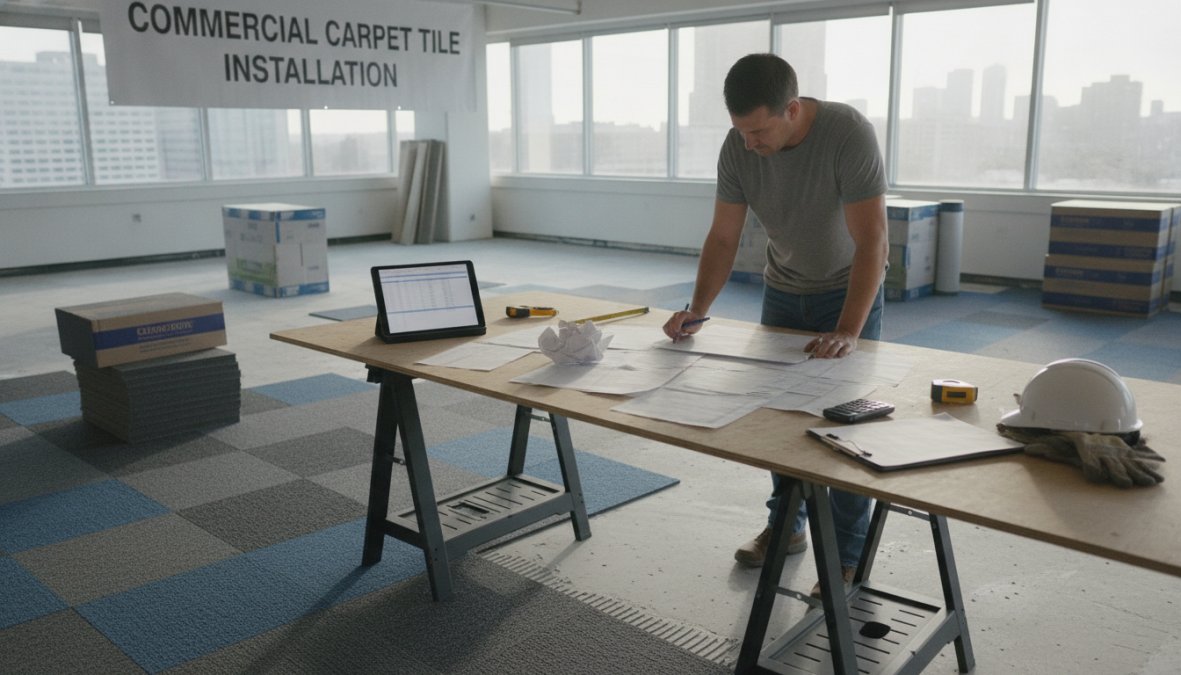
- Full Commercial Carpet Tile Installation Cost Breakdown by Project Size
- Conclusion
Last Updated: June 17, 2026
Commercial Carpet Tile Installation Cost Breakdown: What to Expect
Getting a clear commercial carpet tile installation cost breakdown before signing a contract is the single most important thing a facilities manager or business owner can do to avoid budget overruns. At Hamptons carpet one floor and Home, we work with commercial clients across Suffolk County, NY every week, and the number one source of project stress is a quote that didn't account for subfloor prep, adhesive type, or phased scheduling. This guide breaks down every line item so you know exactly what drives your total project cost before a single tile gets laid.
Commercial carpet tile installation is a modular flooring method where individual carpet squares, typically 18x18 or 24x24 inches, are installed over a prepared subfloor using adhesive or peel-and-stick backing. The modular format makes replacement and reconfiguration far easier than broadloom, which is why it dominates office, retail, and hospitality flooring specifications.
The core insight most cost guides miss: material and labor are rarely the biggest surprises. Subfloor remediation and waste overage are where budgets quietly collapse.
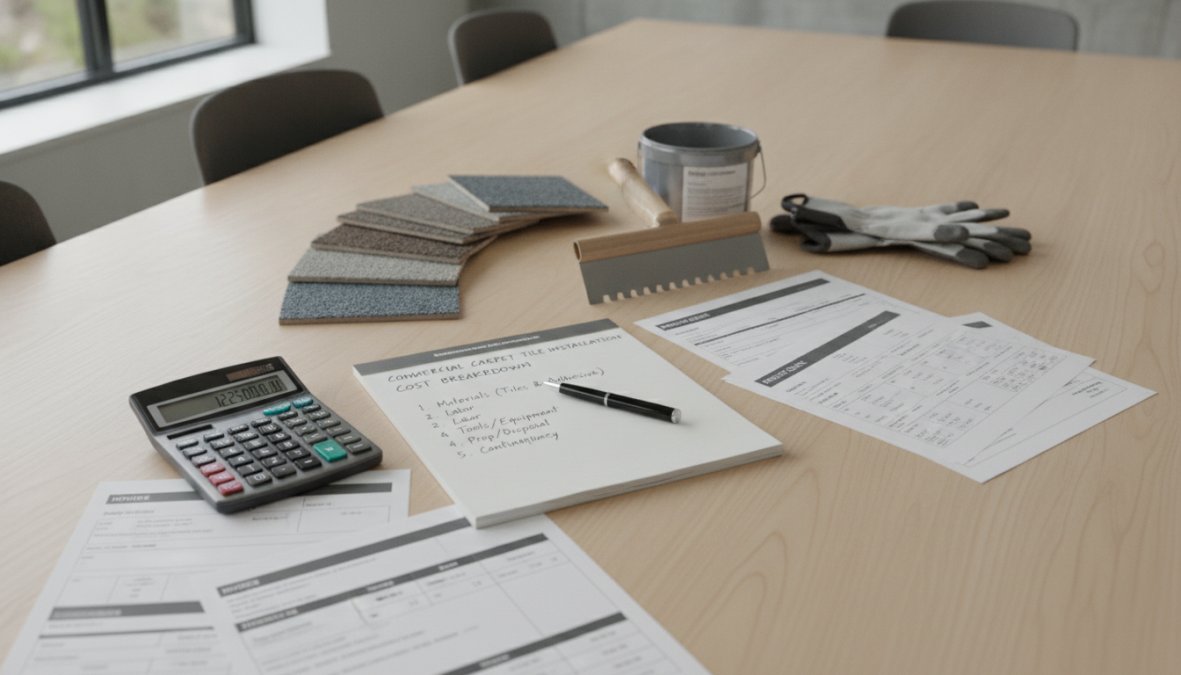
Average Cost Per Square Foot and Square Yard
Commercial carpet tile installation costs typically range from around four dollars per square foot for builder-grade material to over ten dollars per square foot for heavy-duty commercial-grade tiles once labor and prep are included. Expressed per square yard, that translates to roughly thirty-five to ninety dollars for a complete installed project.
| Cost Component | Low End | Mid Range | High End |
|---|---|---|---|
| Builder-grade tile (material) | Low | Moderate | N/A |
| Heavy-duty commercial tile (material) | N/A | Moderate | High |
| Standard labor rate | Low | Moderate | High |
| Subfloor prep (basic) | Low | Moderate | N/A |
| Subfloor remediation (moisture) | N/A | Moderate | High |
| Total installed (per sq ft estimate) | ~$4-5 | ~$6-8 | ~$10-14+ |
Your actual installation estimate will shift based on floor plan complexity, building access, and tile grade. A simple open-plan office prices very differently than a multi-suite medical facility with dozens of transitions.
Carpet Tile Grade Levels: Builder Grade to Heavy-Duty Commercial
Carpet tile grade is the most misunderstood variable in any commercial flooring installation estimate. There are three practical tiers:
Builder grade: Thin wear layer, typically used in light-traffic back offices or storage areas. Lower upfront cost, but degrades faster under heavy foot traffic.
Standard commercial grade: The most common specification for open-plan offices and conference rooms. Denser construction, better carpet backing, and a wear layer that handles moderate daily traffic without premature matting.
Heavy-duty commercial: Specified for corridors, retail floors, and hospitality spaces with continuous traffic. Heavier face weight, reinforced backing, and solution-dyed fiber that resists staining and fading. Higher price per square foot, but frequently lower total cost over a ten-year lifecycle.
Commercial Carpet Tile Installation Labor Cost Explained
Labor is typically the second-largest line item in a commercial flooring project. A standard labor rate covers layout, cutting, adhesive application, and seaming. What it often does not include: furniture moving, trash removal, and subfloor prep. Conflating these is how installation estimates go sideways.
According to the Flooring Contractors Association's commercial installation guidelines, labor complexity scales with floor plan geometry, the number of transitions to other flooring types, and site access constraints. For a straightforward open-plan office, labor is predictable. For a floor with multiple private offices, closets, and curved walls, expect the labor rate to increase as cutting waste and installation time both climb.
Adhesive vs. Peel-and-Stick: How Installation Method Affects Labor Rate
Adhesive installation uses a pressure-sensitive or full-spread adhesive applied before tiles are set. It requires more skill, more time, and proper ventilation, but bonds more reliably in high-traffic areas. Labor rates are higher because the process is less forgiving of errors.
Peel-and-stick installation uses factory-applied adhesive backing. It installs faster, lowering the labor rate per square foot. The trade-off is inconsistent performance on subfloors with minor imperfections or humidity variation. In a climate-controlled office with a clean, level concrete subfloor it works well; in a basement-level retail space with seasonal moisture fluctuation, it can fail prematurely.
The practical rule: specify adhesive installation for any commercial space with heavy traffic, moisture exposure, or a subfloor that isn't perfectly smooth and dry.
Carpet Tile Subfloor Preparation Cost and Moisture Remediation
Subfloor preparation is where the commercial carpet tile installation cost breakdown diverges most dramatically between a smooth project and a budget disaster. Every flooring contractor should include a subfloor assessment in their initial site visit. Basic prep covers grinding down high spots, filling low spots with leveling compound, and removing old adhesive residue. This is standard and should be expected in any quote.

Subfloor Moisture Testing and Remediation: The Hidden Line Item
Subfloor moisture testing is the line item most commercial flooring installation estimates omit entirely. Concrete subfloors, particularly at or below grade, emit moisture vapor that can destroy adhesive bonds and cause carpet tiles to buckle or delaminate within months. Moisture mitigation applies a vapor barrier or moisture-reducing primer before installation; cost varies based on moisture emission measured in pounds per 1,000 square feet per 24 hours. As documented in ASTM International's flooring moisture standards, most carpet tile adhesive manufacturers specify maximum emission levels, and exceeding them voids the warranty.
For commercial renovation projects in older Suffolk County buildings, moisture remediation can add a meaningful amount to total project cost. Skipping the test to save on pre-installation costs risks a failed installation, a warranty dispute, and a full reinstall at the building owner's expense.
Key Factors Influencing Your Total Project Cost
Several variables compound on each other in a commercial carpet tile project. Understanding them before you request an installation estimate gives you real negotiating leverage and prevents scope creep surprises.
Waste, Overage, and Complex Floor Plan Calculations
The standard overage recommendation is ten percent above measured square footage. For floor plans with multiple angles, alcoves, or geometric patterns, overage should be closer to fifteen percent. Waste comes from cut pieces at walls and transitions, and from directional pattern matching, tiles must be oriented consistently, so cut pieces from one row often can't be reused in the next.
The practical formula: measure net square footage, add ten to fifteen percent for waste, then add another five percent for future replacement stock. Keeping spare tiles from the original production run ensures color consistency if sections need replacing years later.
Additional Fees: Furniture Moving, Trash Removal, and Dump Charges
These three line items are almost always quoted separately and can add a meaningful percentage to the total project cost.
Furniture moving is charged per piece or per hour. For a fully furnished open-plan office, this is a significant labor addition. Some facilities managers coordinate furniture moving with their own staff to reduce this cost.
Trash removal covers disposal of old flooring, packaging, and adhesive containers. According to the EPA's construction and demolition debris management guidelines, proper disposal of commercial flooring materials is regulated and contractors must use licensed facilities. Verify that your installation estimate includes compliant disposal, not just "haul away."
Carpet Tile vs. Broadloom Cost Comparison for Commercial Spaces
The carpet tile vs. broadloom cost comparison is more nuanced than a simple price-per-square-foot figure suggests. Broadloom often has a lower material cost at installation; modular carpet tile typically costs more upfront. But lifecycle economics frequently reverse that conclusion.
| Factor | Carpet Tile | Broadloom |
|---|---|---|
| Material cost per sq ft | Moderate to high | Lower upfront |
| Installation labor | Moderate | Lower (open areas) |
| Subfloor prep required | Yes | Yes |
| Partial replacement | Easy (tile by tile) | Difficult (full sections) |
| Pattern matching waste | Moderate | Higher |
| Lifecycle cost (10 yr) | Lower | Higher |
| Suitability for phased install | Excellent | Poor |
| Access floor compatibility | Yes | No |
For raised access floors, modular carpet tile is the only practical option. For large open areas like hotel ballrooms, broadloom may be cost-competitive on initial installation. For virtually every office renovation, retail environment, or hospitality corridor, carpet tile wins on total project cost over time. The key difference is replaceability: a broadloom installation worn in one corridor requires replacing the entire section, while carpet tile lets you swap only the affected tiles.
Commercial Flooring Installation Timeline and Phased Project Costs
A standard commercial carpet tile installation for a mid-size office floor takes one to three days for installation, with subfloor prep potentially adding one to two days. Total project timeline from site assessment to final cleanup runs one to two weeks. That assumes the space is vacant, most commercial renovation projects don't have that luxury.
Phased Installation in Occupied Offices: What It Costs You
Phased installation completes a project in sections while the space remains in use. It's common in law firms, financial services offices, and medical practices where complete closure isn't feasible. It is also consistently the most expensive way to install commercial flooring.
The cost premium comes from several sources:
- Mobilization charges: Each phase requires the crew to return, set up, and break down.
- Furniture moving per phase: Workstations get moved, reinstalled, and moved again across multiple visits.
- Extended project management: More coordination, scheduling, and communication than a single-phase job.
- Adhesive compatibility: If phases are separated by weeks or months, adhesive from the first phase may need to be protected or retested before the adjacent phase begins.
Phased installation in an occupied office can add twenty-five to forty percent to the base installation cost compared to the same project completed in one unoccupied period. If phased installation is unavoidable, get it priced explicitly rather than assuming it's included in the standard labor rate.
Full Commercial Carpet Tile Installation Cost Breakdown by Project Size
A complete commercial carpet tile installation cost breakdown looks different at different scales. Here's how the cost layers stack across three common project sizes:
| Project Size | Approx. Sq Ft | Key Cost Drivers | Notes |
|---|---|---|---|
| Small office suite | 500-1,500 | Material grade, subfloor prep | Minimum charges may apply |
| Mid-size office floor | 2,000-5,000 | Labor efficiency, phasing, furniture | Best cost-per-sq-ft range |
| Large commercial space | 7,500+ | Adhesive type, moisture mitigation | Volume pricing on materials |
For small projects under 1,500 square feet, expect minimum project charges, mobilization, subfloor assessment, and setup time don't scale down proportionally, so the effective price per square foot is higher. Mid-size projects in the two thousand to five thousand square foot range typically represent the best per-square-foot value, with high labor efficiency and straightforward material ordering. Large commercial spaces benefit from volume pricing on materials, with complexity cost shifting to subfloor remediation, adhesive logistics, and project management.
For any commercial flooring project in Suffolk County, the most reliable way to validate your installation estimate is to request an itemized quote that separates material cost, labor rate, subfloor preparation, waste and overage, furniture moving, and dump charges as distinct line items. As noted in the Floor Covering Industry Foundation's commercial specification resources, transparent itemized pricing is the professional standard for commercial flooring projects.
Budgeting for a commercial flooring project without a clear line-item breakdown is how renovation costs spiral past approval thresholds. Hamptons carpet one floor and Home serves commercial clients throughout Suffolk County, NY, providing detailed installation estimates that separate material, labor, subfloor prep, and disposal costs so every stakeholder knows exactly what they're approving. Reach out to the Hamptons carpet one floor and Home team for a site assessment and itemized commercial carpet tile installation cost breakdown for your specific space.
Frequently Asked Questions
How much does commercial carpet tile installation cost per square foot?
The total commercial carpet tile installation cost typically ranges from around $3 to $10 or more per square foot, depending on material grade, labor rates in your region, and subfloor conditions. Builder-grade modular carpet tiles sit at the lower end, while heavy-duty commercial-grade tiles with a thicker wear layer push costs higher. Labor alone generally accounts for $1 to $3 per square foot of that total. Always request an itemized installation estimate from your flooring contractor to compare accurately.
What factors most influence the commercial carpet tile installation cost breakdown?
Several factors drive the final number in any commercial carpet tile installation cost breakdown: carpet tile grade and backing type, subfloor preparation requirements, adhesive versus peel-and-stick installation method, room complexity affecting overage calculations, and additional fees like furniture moving, trash removal, and dump charges. Moisture mitigation for concrete subfloors can also add a significant line item that many initial quotes omit. Getting a detailed scope of work upfront prevents budget surprises during your office renovation.
Does carpet tile subfloor preparation add significant cost to a commercial project?
Yes. Carpet tile subfloor preparation cost is one of the most commonly underestimated expenses in commercial flooring installation. Grinding high spots, patching cracks, applying self-leveling compound, and conducting subfloor moisture testing all add to the budget before a single tile is placed. Moisture remediation alone, if a concrete slab tests above acceptable vapor emission levels, can range from a minor topical sealer application to a full mitigation system, each carrying very different price tags.
Is carpet tile cheaper to install than broadloom carpet in a commercial space?
It depends on the project scope. Broadloom carpet often has a lower material cost per square foot, but carpet tiles can reduce waste on complex floor plans, lower long-term replacement costs since damaged tiles can be swapped individually, and simplify phased installation in occupied offices. When you factor in the full commercial flooring installation timeline, reduced downtime, and easier access to underfloor systems, carpet tiles frequently offer a better total cost of ownership for commercial spaces despite a higher upfront price per square foot.
How long does commercial carpet tile installation take, and does timing affect cost?
A standard commercial flooring installation timeline for carpet tiles runs roughly 1,000 to 2,000 square feet per day for an experienced crew, though subfloor preparation, adhesive cure times, and furniture moving can extend the schedule. Phased installation in occupied offices, where work happens in sections to avoid disrupting operations, typically increases labor cost by 15 to 30 percent due to repeated mobilization, careful site cleanup between phases, and tighter project management requirements. Planning the timeline carefully helps control total project cost.
What are the hidden costs in a commercial carpet tile installation project?
Beyond material and labor, hidden costs in commercial carpet tile installation commonly include subfloor moisture testing and remediation, disposal fees and dump charges for old flooring removal, furniture moving and reinstallation, overage material for complex layouts, and extended project management time for phased work in occupied spaces. Some flooring contractors also charge separately for site cleanup after installation. Requesting a fully itemized installation estimate, not just a per-square-foot price, is the best way to surface these costs before the project begins.
This article was written using GrandRanker