 How-to
Cost of Replacing Historic Home Flooring: 2026 Guide
Table of Contents
- What Drives the Cost of Replacing Historic Home Flooring
- Cost to Refinish Hardwood Floors vs. Full Replacement
- Historic Hardwood Floor Repair: When Saving Beats Swapping
- Flooring Options for Historic Homes That Hold Up
- Hardwood Flooring Installation Cost: What the Line Items Mean
- How to Find a Contractor Who Handles Old Houses
- Conclusion
- Frequently Asked Questions
Last Updated: October 17, 2026
What Drives the Cost of Replacing Historic Home Flooring
The cost of replacing historic home flooring in 2026 typically runs from $10 to $20 or more per square foot for hardwood replacement, while refinishing the original boards costs $4 to $10 per square foot, according to Hudson Hardwood's cost-benefit analysis for historic homes. That gap is the whole story in one line: you are often paying two to three times more to remove something that could be saved.
Hamptons carpet one floor and Home works on older properties across Suffolk County where the floors are never quite square and the subfloor is rarely what the last owner claimed. Here is what actually moves the number up or down.
Square Footage and Material Choice
Total square footage sets the base. A 400-square-foot room at $12 per square foot lands near $4,800 before anything unexpected appears.
Material choice swings the figure hard. Wide-plank oak costs more than narrow strip pine. Salvaged or reclaimed boards that match an original 1920s floor can push material costs well above standard stock.
Labor, Subfloor Conditions, and Preservation Rules
Labor is where old houses bite. Uneven joists, squeaks, and patched subfloor sections all add time.
Preservation rules matter too. If a property sits in a local historic district, exterior and structural work may require review before you touch anything. Check with your town's building department before ordering material, because approval delays cost money even when the boards are already paid for.
Cost to Refinish Hardwood Floors vs. Full Replacement
Refinishing is almost always the cheaper route. The same Hudson Hardwood comparison puts refinishing at $4 to $10 per square foot and replacement at $10 to $20 or more, with timelines of 3 to 7 days versus 1 to 2 weeks or longer.
That difference buys you more than money. Refinishing keeps the original wood, the original patina, and the original width of the boards, none of which a new floor can reproduce.
Here is the honest trade-off:
| Factor | Refinish | Full Replacement |
|---|---|---|
| Cost per sq ft | $4-$10 | $10-$20+ |
| Timeline | 3-7 days | 1-2 weeks+ |
| Keeps original wood | Yes | No |
| Fixes structural damage | No | Yes |
| Dust and disruption | Moderate | High |
Refinishing only works if the boards are thick enough to sand again. Floors that have been sanded three or four times may be too thin, and no amount of care changes that.
Historic Hardwood Floor Repair: When Saving Beats Swapping
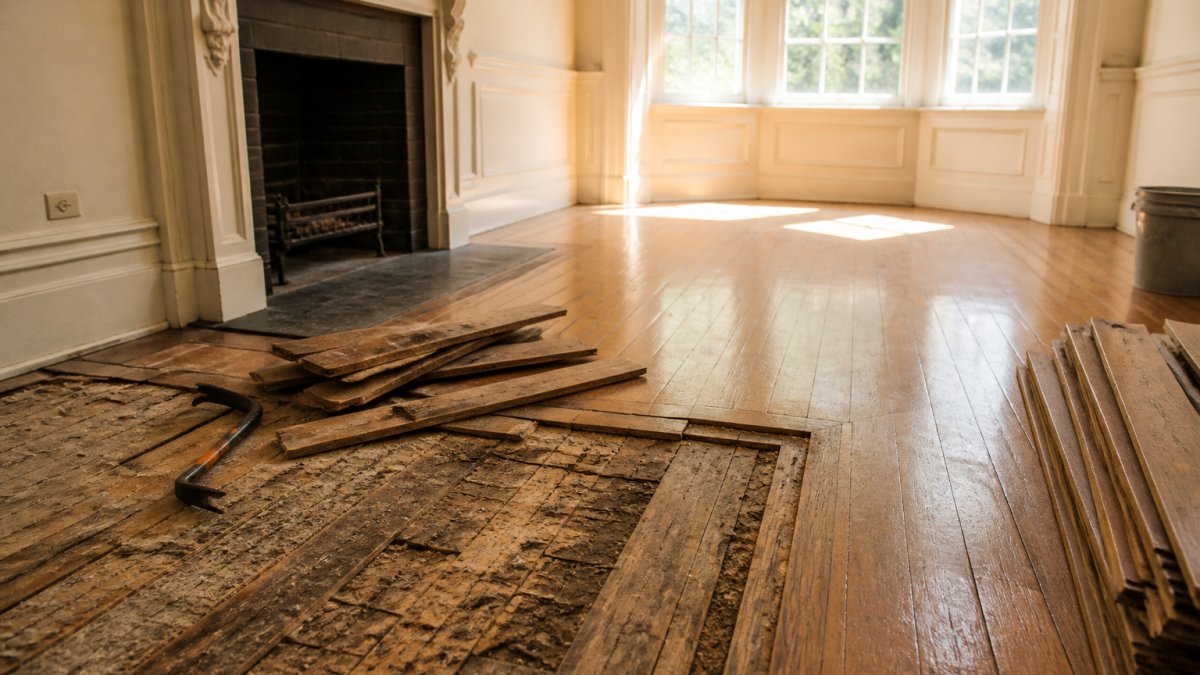
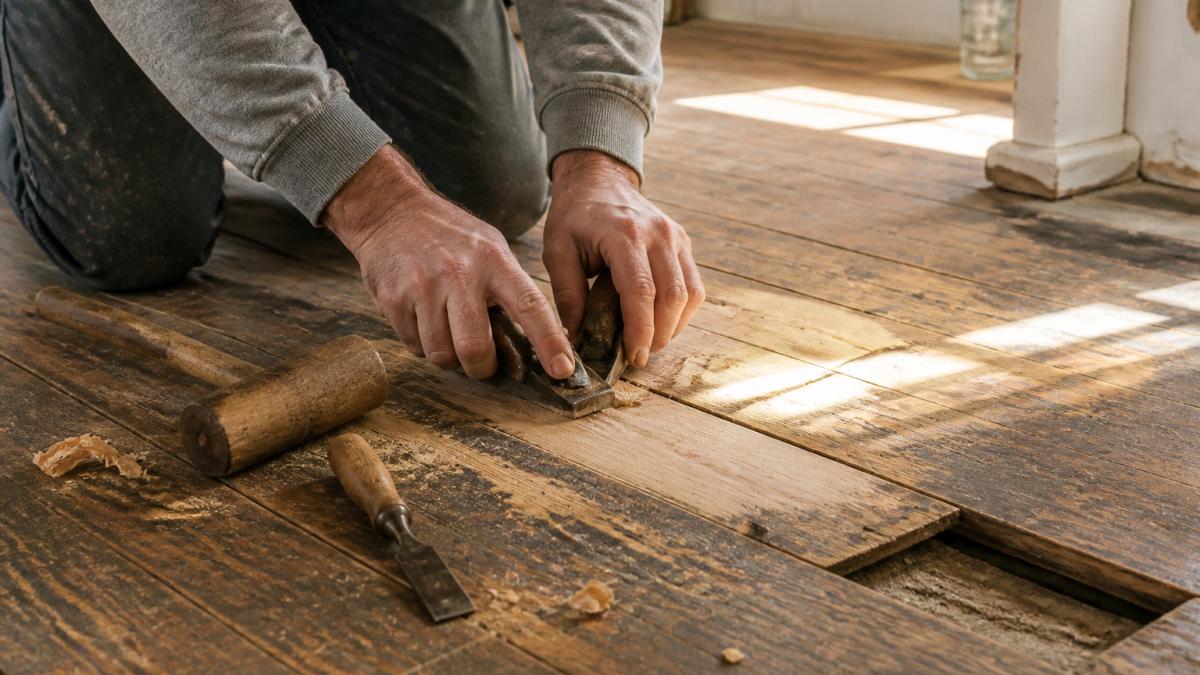
Historic hardwood floor repair wins whenever the boards are structurally sound. Repair means patching individual boards, filling gaps, and sanding back to a clean surface, and it preserves the character that makes an old house worth owning.
Replacement starts to make sense in a few specific cases:
- Water damage has rotted boards through their full thickness
- The floor has been sanded too many times to take another pass
- You want a historically correct finish that the current wood cannot deliver
That last point is real. A Houzz discussion on historic home flooring makes the case that replacing original hardwood is the right call when the goal is a genuinely correct historical finish, and that postponing is reasonable if the budget will not stretch.
Flooring Options for Historic Homes That Hold Up
Flooring options for historic homes come down to matching the era without sacrificing durability. The right pick depends on which rooms get the most traffic and how close to the coast you are.
- Refinished original hardwood: best for period accuracy and resale value
- New solid hardwood in a matching species: best when boards are beyond saving
- Engineered hardwood: better moisture tolerance, good for lower levels
- Luxury vinyl plank: practical for basements and utility spaces, though not period-correct
- Carpet or carpet tile: useful for bedrooms and stairs where sound matters
For coastal properties, moisture tolerance should outrank period purity. Salt air and tracked-in sand punish floors that were never meant for that environment.
Industry data backs up the caution. Floor Covering News reports that hardwood sales at the first point of distribution totaled $1.774 billion, down 3.8% from 2024, while the high-end segment held up best. Buyers are spending carefully and choosing quality over volume.
Hardwood Flooring Installation Cost: What the Line Items Mean
Hardwood flooring installation cost breaks into four parts, and knowing them keeps you from being surprised mid-project. Every quote should show each one separately.
- Material: the boards themselves, priced per square foot plus a waste allowance of roughly 5-10%
- Removal and disposal: tearing out the old floor and hauling it away
- Subfloor prep: leveling, patching, or replacing damaged sections
- Labor and finish: installation, sanding, staining, and sealing
Ask for a line-item quote, not a lump sum. A lump sum hides subfloor risk, and subfloor risk is where budgets break. A contractor who will not break out prep costs is a contractor who plans to bill you for them later.
One more number worth knowing: FCNews reports that residential replacement accounted for 69.4% of wood flooring sales in 2025, up from 66.4% the year before. Replacement is common, but common is not the same as necessary.
How to Find a Contractor Who Handles Old Houses
Finding the right contractor matters more than the material choice. Old houses reward experience and punish guesswork.
Use this checklist before you sign anything:
- Ask how many pre-1950 homes they have worked on in the last two years
- Request a written line-item quote with subfloor prep priced separately
- Confirm they will pull up a sample board before finalizing the scope
- Ask who handles dust containment and daily cleanup
- Get the payment schedule in writing, with a holdback until final walkthrough
- Verify insurance and ask for two references from older properties
- Confirm who files any required historic district paperwork
That last item trips people up. If your home sits in a review district, the paperwork is part of the job, and someone has to own it.
Conclusion
Replacing historic flooring is a real decision with real money behind it, and the gap between a $4 and a $20 square-foot outcome usually comes down to whether the original boards can be saved. Get one board pulled, get a line-item quote, and get the subfloor question answered before you commit.
That is where we come in. Hamptons carpet one floor and Home works with homeowners across Suffolk County on older and coastal properties, from refinishing original hardwood to selecting moisture-tolerant flooring options that hold up to salt air and sand. We quote subfloor conditions honestly and walk you through the trade-offs before any material is ordered.
Get started with Hamptons carpet one floor and Home and get a flooring plan built for the house you actually own.
Frequently Asked Questions
Is it cheaper to refinish or replace original hardwood floors?
Refinishing usually costs far less and can often be completed faster than a full replacement. The catch is board condition: if planks are cupped, rotted, or patched with mismatched wood, refinishing may not deliver a clean result, and partial historic hardwood floor repair plus refinishing can close the gap.
What factors affect the cost of historic home flooring replacement?
Four factors move the number most: square footage, material selection, labor complexity, and what sits under the old floor. Uneven joists, layered subfloor, and original trim that must be removed and reinstalled all add labor hours. Local preservation requirements can also limit which materials or fastening methods you can use on a contributing structure. Get a written scope that names subfloor repair as a line item, so surprises like the $5,000 quote that became $12,000 do not repeat.
Can original hardwood floors be repaired instead of replaced?
Often yes. Individual boards can be replaced, gaps filled, and squeaks fixed before a full sand and refinish. Refreshing historic floors is often a more cost-effective solution than installing new flooring, though some floors do reach a point where replacement makes more sense. A contractor should inspect for rot, insect damage, and how much wear layer remains above the tongue before recommending repair over replacement.
Does installing new flooring require removing the old floor?
Not always. Some installations can go over an existing hard surface if it is flat, sound, and securely fastened, but adding height can interfere with door clearance and original trim. In historic homes, removal is often the safer path because it exposes subfloor problems early and preserves the finished floor height your doorways were built around. Ask your installer to confirm the approach in writing before work starts, and expect the answer to affect both timeline and hardwood flooring installation cost.