 Ultimate guide
Durable Flooring for Pets: Best Options Compared (2026)
Table of Contents
- What Makes Flooring Truly Durable for Pets?
- Pet-Friendly Flooring Options: A Full Comparison
- Luxury Vinyl Plank vs Laminate for Pets: Which Wins?
- Scratch-Resistant Flooring for Dogs: What Actually Holds Up
- Traction, Acoustics, and Odor: The Overlooked Factors in Durable Flooring for Pets
- How to Clean Pet Accidents on Flooring Without Causing Damage
- Safety, Non-Toxic Materials, and What to Look for at Installation
- Which Pet-Friendly Flooring Is Right for Your Suffolk County Home?
Last Updated: June 4, 2026
Choosing the wrong floor before bringing home a dog or cat is one of the most expensive renovation mistakes homeowners make. Durable flooring for pets requires a completely different evaluation framework than standard flooring selection, and Hamptons carpet one floor and Home has helped hundreds of Suffolk County homeowners navigate exactly this decision. Below, we break down every major flooring type, compare them honestly across the factors that matter with animals in the house, and tell you which options hold up and which ones disappoint within the first year.
Most guides focus almost entirely on scratch resistance and ignore the three factors that cause the most long-term regret: traction for aging pets, acoustic performance, and odor retention after accidents. We cover all of it.
What Makes Flooring Truly Durable for Pets?
Durable flooring for pets resists physical damage from claws, repels moisture from accidents, maintains traction for animals at any life stage, and does not trap odors over time. Most flooring products excel at one or two of these criteria while quietly failing the others.
Moisture protection comes first. A floor that scratches but stays dry is far easier to manage than one that looks pristine until a single accident warps the planks permanently. Scratch resistance matters second. Traction and acoustics are third and fourth, and the criteria almost nobody evaluates at purchase.
Key Performance Factors: Scratch, Water, and Traction Resistance
Scratch resistance is measured by wear layer thickness for luxury vinyl plank or AC rating for laminate. A wear layer of 12 mil or above handles claw marks without exposing the core. AC4-rated laminate handles moderate pet traffic; AC5 handles heavy use.
Water resistance deserves precision. A waterproof core, like the rigid core in quality LVP, means moisture cannot penetrate to the subfloor even if a puddle sits for hours. Water-resistant laminate handles splashes but fails under standing liquid. Pet accidents are not splashes.
Traction is underrated. Smooth hard surfaces cause dogs to slide, stressing joints over time. Textured surface finishes and embossed LVP profiles provide significantly better grip than high-gloss alternatives.
The Hidden Concerns Most Guides Skip: Noise, Odor, and Repairability
Acoustic performance is the concern nobody mentions until they've installed a hard floor and discovered that a 60-pound dog running across LVP at 6 a.m. sounds like a construction site. Pre-attached underlayment with acoustic ratings reduces impact noise transmission and dampens the hollow "click" that floating floor installations produce.
Pet-specific odor retention is separate from cleaning ease. Porous materials, including some engineered hardwood and virtually all carpet, absorb urine at the subfloor level. Once odor penetrates the subfloor, surface cleaning accomplishes nothing. Non-porous surfaces like porcelain tile and waterproof-core LVP prevent this entirely.
Repairability is the third overlooked factor. Floating LVP allows individual plank replacement without refinishing the entire surface. Solid hardwood can be sanded and refinished multiple times. Laminate, once damaged, typically requires full section replacement because the locking system weakens around cuts.
Pet-Friendly Flooring Options: A Full Comparison
The best pet-friendly flooring for most households is luxury vinyl plank with a waterproof rigid core and a wear layer of 12 mil or higher. It combines moisture protection, scratch resistance, moderate traction, and easy cleaning in a single product. The right choice still depends on your specific animals, subfloor condition, and budget.
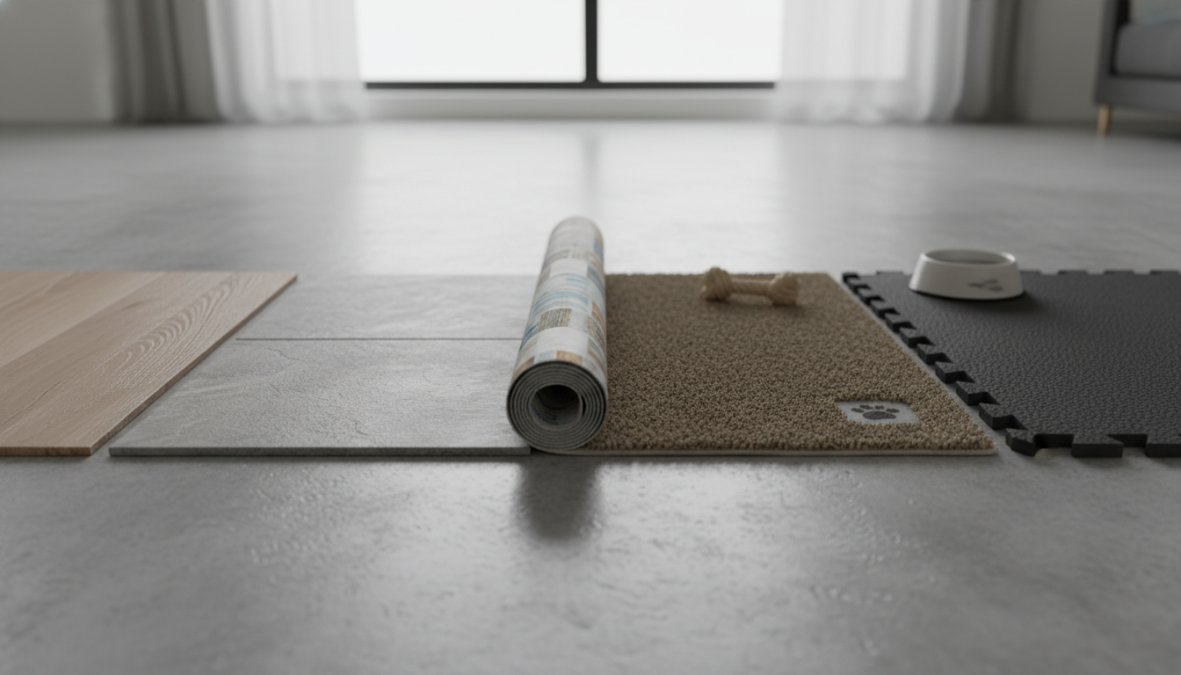
Comparison Table: Flooring Types at a Glance
| Flooring Type | Scratch Resistance | Waterproof | Traction | Odor Risk | Repairability | Relative Cost |
|---|---|---|---|---|---|---|
| Luxury Vinyl Plank (LVP) | High (12+ mil wear layer) | Yes (rigid core) | Moderate-High | Low | High (plank swap) | Moderate |
| Laminate (AC4/AC5) | Very High | No (water-resistant only) | Moderate | Moderate | Low | Low-Moderate |
| Porcelain Tile | Excellent | Yes | Low-Moderate | None | Low (grout cracks) | Moderate-High |
| Engineered Hardwood | Moderate | No | High | High | Moderate (refinish) | High |
| Solid Hardwood | Low-Moderate | No | High | Very High | High (refinish) | Very High |
| Carpet | Low | No | Excellent | Very High | Low | Low |
Carpet is the worst possible choice for pet households despite its traction advantages. Solid hardwood is a poor investment unless you commit to regular refinishing. LVP and porcelain tile lead the category for different reasons.
Luxury Vinyl Plank vs Laminate for Pets: Which Wins?
Luxury vinyl plank wins against laminate for pet households, and it's not particularly close. The waterproof core is the deciding factor. Laminate's Achilles heel has always been moisture, and pet accidents expose that weakness reliably.
LVP: Waterproof Core, Wear Layer, and Traction Advantages
LVP's rigid waterproof core, typically stone plastic composite (SPC) or wood plastic composite (WPC), means the plank cannot absorb liquid. The wear layer handles claw marks, textured finishes provide traction, and pre-attached underlayment options reduce acoustic impact. Target 12 mil minimum for residential pet applications. Products carrying FloorScore certification for indoor air quality confirm low-VOC emissions, which matters for animals that spend time on the floor.
Pros:
- Fully waterproof core prevents subfloor damage from accidents
- Scratch-resistant wear layer handles claw marks at 12 mil and above
- Individual planks can be replaced without full floor removal
- Available in textured finishes that improve traction
- Low-VOC options available with FloorScore certification
Cons:
- Lower-end products can feel hollow underfoot without quality underlayment
- High-gloss finishes show paw prints and scratches more visibly
- WPC core is softer and slightly less dent-resistant than SPC
Laminate: Scratch Resistance, Costs, and Moisture Limitations
Laminate offers one genuine advantage: surface scratch resistance. AC4 and AC5 ratings indicate the top layer withstands significant abrasion, often outperforming entry-level LVP on raw scratch tests. Cost-per-square-foot is also typically lower than comparable LVP.
The problem is the core. Laminate uses high-density fiberboard (HDF) that swells when it contacts moisture. A single cat accident sitting for more than a few minutes can cause permanent edge swelling that buckles and separates planks. Once that happens, the affected section requires full replacement.
Pros:
- Excellent surface scratch resistance at AC4/AC5 ratings
- Lower upfront cost than LVP in comparable quality tiers
- Realistic wood aesthetics at accessible price points
Cons:
- Not waterproof; HDF core swells with moisture exposure
- Damaged sections are difficult to replace without disrupting adjacent planks
- Hollow sound underfoot without premium underlayment
The verdict: laminate is acceptable for cat households with reliable litter box habits and no accident history. For dogs, the moisture risk makes it a poor long-term investment regardless of scratch resistance numbers.
Scratch-Resistant Flooring for Dogs: What Actually Holds Up
The most scratch-resistant flooring for dogs, ranked by practical performance: porcelain tile, followed by AC5 laminate, then SPC-core LVP. Engineered hardwood falls behind all three despite its premium positioning.
Porcelain Tile and Engineered Hardwood: Pros, Cons, and Pricing
Porcelain tile is genuinely impervious to claw damage. Its surface hardness exceeds what any dog nail can scratch under normal conditions, it's fully waterproof, completely non-porous, and holds zero odor from accidents. For large breeds with destructive scratching behavior, porcelain is the only floor that will look unchanged after five years.
The limitations are real. Grout lines collect dirt and require periodic sealing. The hardness that resists scratching also creates a slippery surface for dogs, older animals with joint issues can struggle significantly. Installation cost is higher than LVP or laminate, and tile is cold underfoot in winter. According to the Tile Council of North America's installation guidelines, proper subfloor preparation is critical for tile longevity in high-traffic homes.
Engineered hardwood sits in an awkward position for pet households. It offers wood aesthetics with better dimensional stability than solid hardwood, but scratch resistance is modest and moisture tolerance is limited. The veneer can be refinished, but only a limited number of times. Heavy scratchers will show wear within two to three years without protective coatings.
Traction, Acoustics, and Odor: The Overlooked Factors in Durable Flooring for Pets
Most flooring guides stop at scratch resistance and waterproofing. That's where the useful information actually begins for serious pet owners.
Slip Resistance and Aging Pets
Slip resistance is a welfare issue. Dogs that slip repeatedly on hard floors develop compensatory movement patterns that stress hips, knees, and spine, particularly pronounced in larger breeds and animals over seven years old. According to the American Kennel Club's guidance on canine joint health, hard slippery surfaces are a contributing factor in joint stress for aging dogs.
Surface finish determines traction more than material. High-gloss finishes create the most slipping risk; matte and hand-scraped textured finishes provide meaningfully better grip. Area rugs at feeding areas, sleeping spots, and high-traffic paths add traction without requiring full floor replacement.
Acoustic Performance and Pet-Specific Odor Retention
Acoustic performance comes down to underlayment. Pre-attached underlayment with IIC ratings above 50 significantly reduces impact noise transmission, worth the additional cost in multi-story homes. For single-story installations, it's a comfort upgrade rather than a necessity.
Pet-specific odor retention is the most underestimated long-term problem in flooring selection. Non-porous surfaces, porcelain tile and waterproof-core LVP, prevent urine from penetrating to the subfloor. Engineered hardwood allows moisture to wick through seams over time. Once urine reaches the subfloor, enzymatic surface cleaning accomplishes nothing.
How to Clean Pet Accidents on Flooring Without Causing Damage
Act within minutes, use the right cleaning solution for your floor type, and never use steam cleaners on floating floors. Delay is the primary cause of permanent damage, not the accident itself.
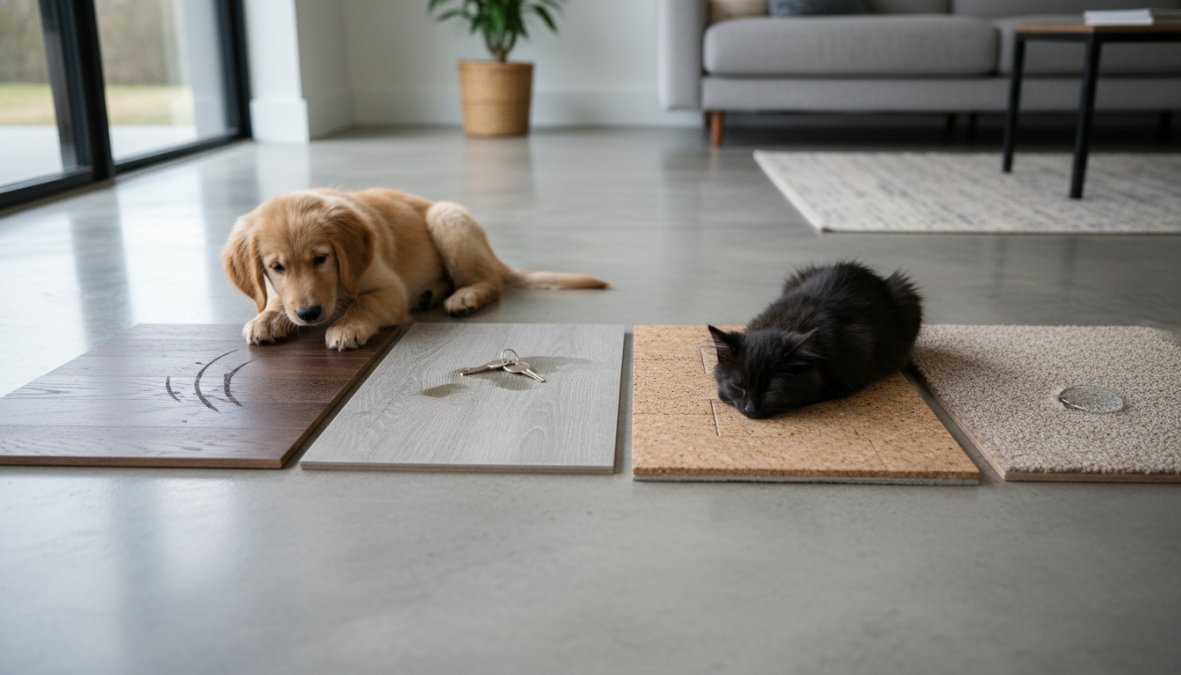
Cleaning Solutions by Flooring Type
Luxury Vinyl Plank: Blot immediately with an absorbent cloth, do not rub. Clean with a pH-neutral cleaner diluted in warm water; enzymatic cleaners formulated for pet accidents work well. Avoid bleach, ammonia, or abrasive particles. Never use steam mops, as repeated steam exposure can compromise locking joints.
Laminate: Speed is critical. Blot immediately and dry thoroughly with a damp (not wet) cloth and a laminate-specific cleaner. Avoid vinegar-based cleaners, which dull the surface finish over time.
Porcelain Tile: The most forgiving surface. Standard enzymatic pet cleaners work well. Pay attention to grout lines, re-seal annually in pet households.
Engineered Hardwood: Blot immediately and use a hardwood-specific cleaner with minimal moisture. If liquid has penetrated seams, affected boards may need replacement regardless of surface cleaning.
A useful reference for pet-safe product selection is the ASPCA's guide to pet-safe household products, which identifies ingredients in common cleaners that are toxic to dogs and cats. The most common mistake: vinegar is frequently recommended online as a natural cleaner, but on hardwood and laminate it damages the finish over repeated use. Match the cleaner to the floor, not just the stain.
Safety, Non-Toxic Materials, and What to Look for at Installation
Safety in flooring for pet households means physical safety (traction, edge profiles that don't catch paws) and chemical safety (VOC emissions from adhesives, finishes, and core materials). Animals spend more time on floors than humans do, making their exposure to off-gassing proportionally higher. FloorScore certification is the most reliable third-party indicator of low-VOC compliance for hard surface flooring; GREENGUARD Gold serves the same function for a broader range of products.
Floating floor installations with mechanical locking systems avoid adhesive entirely, the safest option for households where animals cannot be easily relocated during installation. Edge transitions deserve attention: sharp metal transition strips at doorways can catch dog nails, while T-molding transitions with rounded profiles are safer for animals moving quickly between rooms. A moisture barrier between the subfloor and new installation adds redundant protection regardless of the floor's own moisture resistance.
Which Pet-Friendly Flooring Is Right for Your Suffolk County Home?
The right choice depends on three variables: the size and behavior of your animals, your home's subfloor condition, and your tolerance for maintenance over time.
For most dog households, SPC-core LVP with a 12 mil or higher wear layer is the practical answer, it handles moisture, resists scratches, allows individual plank replacement, and comes in textured finishes that provide traction. For large, heavy breeds with serious scratching behavior, porcelain tile is the only surface that will remain visually unchanged over a decade. Laminate is acceptable only in cat households with no accident history. Engineered hardwood suits aesthetics-first buyers who accept the maintenance trade-offs and plan to refinish periodically.
One Suffolk County-specific variable: coastal humidity levels affect dimensional stability in wood-based products. Homes near the water should weight LVP and tile more heavily than engineered hardwood, which responds to humidity fluctuations more than either alternative.
Hamptons carpet one floor and Home serves all of Suffolk County and carries the full range of options discussed in this guide. The team can assess your specific subfloor conditions, measure your space, and recommend products that fit both your pets and your home's construction.
Selecting durable flooring for pets is a decision that affects daily life for years, and the wrong choice is expensive to fix. Hamptons carpet one floor and Home works with Suffolk County homeowners to match the right flooring to the specific demands of their household, including the size, breed, and behavior of their animals. Visit Hamptons carpet one floor and Home to discuss your project and get product recommendations backed by local expertise and hands-on experience with the full range of pet-friendly flooring options.
Frequently Asked Questions
What is the most durable flooring for dogs?
Luxury vinyl plank (LVP) is widely considered the most durable flooring for dogs because it combines a scratch-resistant wear layer, a waterproof core that handles pet accidents, and a slip-resistant texture. Porcelain tile is also extremely durable and water-resistant, though it can be harder on aging pets' joints. For most dog owners balancing durability, comfort, and budget, LVP is the top recommendation among pet-friendly flooring options.
Is luxury vinyl plank good for pets?
Yes, LVP is one of the best durable flooring choices for pets. Its waterproof core protects against pet accidents soaking through to the subfloor, and its wear layer resists claw marks better than laminate or engineered hardwood. Look for FloorScore certified, low-VOC products to ensure non-toxic materials. A thicker wear layer (12 mil or more) provides better long-term scratch resistance, especially for large or active dogs.
Is laminate flooring pet-friendly?
Laminate can be a pet-friendly option with some caveats. It offers good scratch resistance and a realistic wood look at a lower price point than LVP, but most laminate is not waterproof. Pet accidents left unattended can seep into seams, causing swelling and warping. Water-resistant laminate products exist but still fall short of LVP's waterproof core. For homes with puppies or incontinent pets, LVP is a safer long-term investment than standard laminate flooring.
What is the easiest flooring to clean with pets?
Porcelain tile and luxury vinyl plank are the easiest floors to clean after pet accidents. Both resist moisture and don't absorb odors the way carpet or wood can. For LVP and tile, blot accidents immediately, then clean with a pH-neutral cleaner, avoid ammonia-based solutions, which can attract pets back to the same spot. Engineered hardwood requires faster cleanup and gentler cleaning solutions to prevent moisture damage to the wear layer.
Does hardwood flooring hold up to pet claws?
Traditional solid hardwood struggles with pet claws, claw marks and dents are common, especially with large breeds. Engineered hardwood performs somewhat better due to its layered construction, but it still shows scratches over time. If you prefer a wood look, LVP with a thick wear layer mimics hardwood aesthetics while offering far better scratch and dent resistance. Hardwood can also retain pet odors in its grain, making long-term hygiene harder to maintain than with LVP or tile.
How do I choose pet-friendly flooring for an older or arthritic dog?
Traction is the most important factor for aging or arthritic pets. Smooth surfaces like polished tile or high-gloss LVP can be dangerously slippery. Choose matte-finish or textured LVP, or add area rugs with non-slip underlayment on tile floors. Softer surfaces like cork or carpet tiles can reduce joint stress but sacrifice durability. A mid-sheen LVP with a textured surface is often the best balance of traction, durability, and ease of maintenance for homes with senior dogs.
This article was written using GrandRanker