 Blog
Flooring Repair Services in Suffolk County: Complete Guide
Table of Contents
- Flooring Repair Services in Suffolk County: What You Need to Know
- Types of Flooring Repairs We Handle
- Common Suffolk County Flooring Issues and Solutions
- Professional Flooring Installation Services
- DIY vs. Professional Flooring Repair: Cost and Quality Analysis
- Sustainable and Eco-Friendly Refinishing Options
- Why Choose Licensed and Insured Flooring Contractors
- How to Get Your Free Estimate and Consultation
Last Updated: July 23, 2026
Flooring Repair Services in Suffolk County: What You Need to Know
Flooring damage in coastal properties accelerates faster than most homeowners expect. Salt air, moisture, temperature swings, and heavy foot traffic degrade hardwood, laminate, and tile at rates that would shock someone living inland. At Hamptons carpet one floor and Home, we've spent years helping Suffolk County residents navigate flooring repair services in suffolk county. The pattern is clear: homes that address damage early spend half as much as those who wait.
This guide covers everything you need to know about flooring repair services in suffolk county, from identifying common damage patterns specific to our coastal climate to understanding when professional repair beats replacement. We'll break down repair options available, explain the real difference between DIY attempts and professional work, and show you how to get an accurate estimate without surprise costs.
A floor that looks fine today can develop structural issues within months if moisture gets underneath. Conversely, many repairs that homeowners think require full replacement can be fixed for a fraction of that cost with the right approach.
Types of Flooring Repairs We Handle
Professional flooring repair services in suffolk county span several distinct categories, each requiring different expertise and equipment. Understanding which repair type your floor needs prevents overpaying for unnecessary work.
Hardwood Floor Refinishing and Restoration
Hardwood refinishing restores worn, scratched, or stained wood floors to like-new condition without replacing boards. The process involves sanding to bare wood, then applying new stain and polyurethane finish. This works when the wood structure remains sound but the surface finish has deteriorated.
Restoration addresses deeper issues: water stains penetrating the wood grain, bleaching from sun exposure, or discoloration from spills. Restoration sometimes requires chemical treatments or selective board replacement before refinishing begins.
Hardwood refinishing typically takes 3-7 days depending on room size and condition. The process is disruptive; dust spreads throughout your home despite containment efforts, and you'll need to stay out while finish cures.
Floor Sanding and Bleaching
Floor sanding removes the top layer of wood, eliminating surface scratches, minor stains, and worn finish. Dustless sanding technology captures 99% of dust during the process, reducing cleanup and air quality issues compared to traditional methods.
Bleaching addresses specific stain types that sanding alone won't remove. Bleach penetrates the wood grain to lighten dark stains caused by water, pet accidents, or oxidation. This technique works best on lighter wood species and doesn't work on pre-stained or pre-finished engineered wood.
The combination of sanding and bleaching creates a blank canvas for new stain and finish, costing less than full restoration when staining is your only goal.
Subfloor Repair and Water Damage Restoration
Subfloor damage represents the most serious flooring problem because it affects the structural foundation of your entire floor system. Water damage, termites, rot, or settling can compromise the subfloor, causing the finished floor above to become soft, bouncy, or prone to cupping.
Water damage restoration requires identifying the moisture source first. If you treat the symptom without fixing the cause, the problem returns within months. Professional assessment identifies whether the issue is a plumbing leak, foundation crack, or exterior drainage problem.
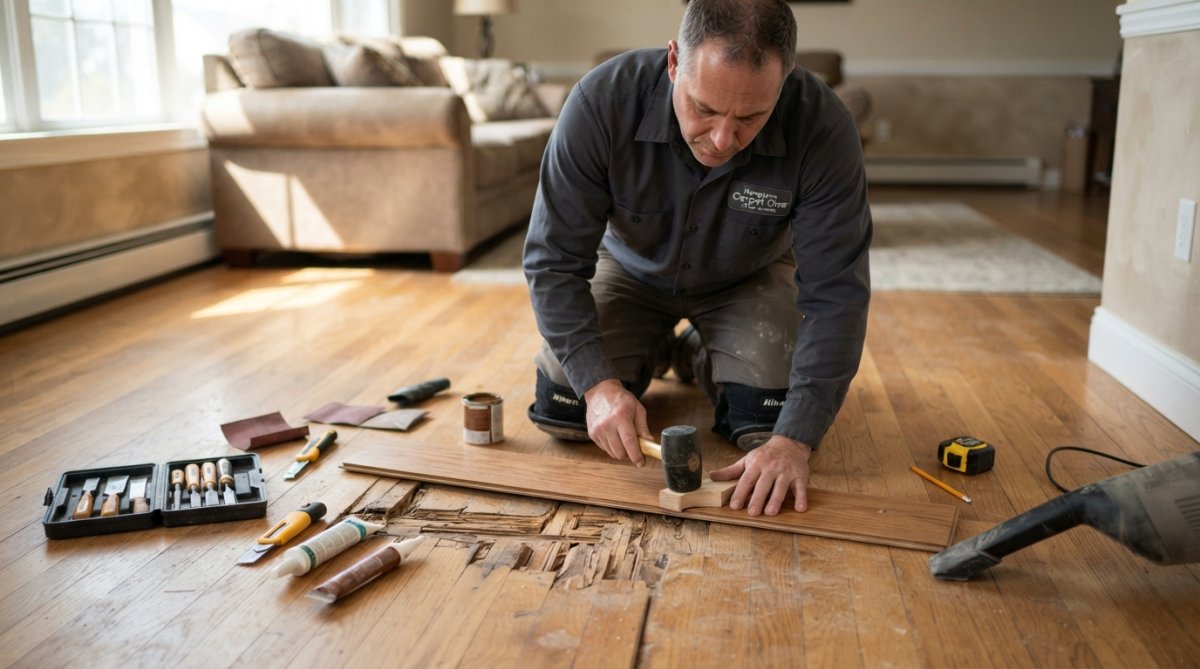
Subfloor replacement involves removing the damaged section, installing new plywood or OSB, and refinishing or replacing the finished floor above. Cost scales with damage extent, minor repairs might cost a few hundred dollars; extensive replacement can run into thousands.
Common Suffolk County Flooring Issues and Solutions
Coastal living creates specific flooring challenges that inland homeowners never face. Understanding these problems helps you spot damage early and take preventive action.
Salt Air and Moisture Damage
Salt air corrodes wood finishes and accelerates moisture infiltration in ways that standard humidity alone cannot. Salt particles deposit on windows, siding, and eventually work into your home through ventilation and air leaks. Once inside, salt residue attracts and holds moisture, creating an environment where wood swells and finishes fail prematurely.
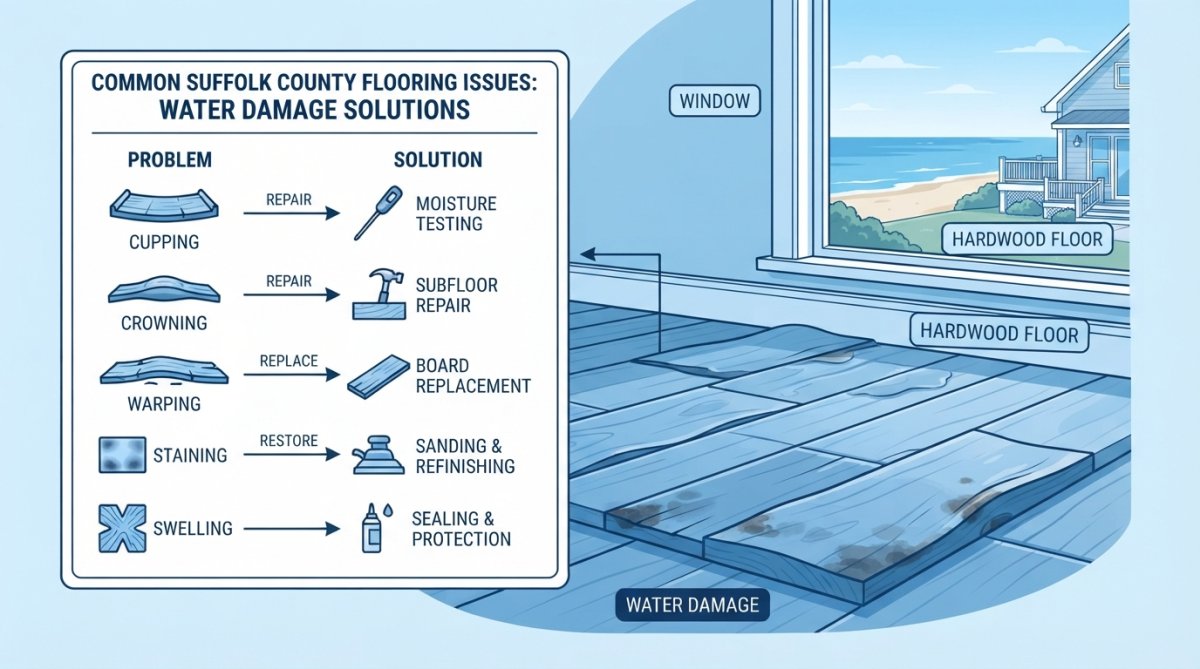
Moisture damage manifests as cupping (edges higher than center), crowning (center higher than edges), or warping (twisting). A floor near a window or door that sees salt spray may show damage while the same floor type in a back bedroom remains stable.
Prevention requires controlling interior humidity and sealing the finish properly. Dehumidifiers in summer months keep indoor humidity below 50%, dramatically slowing moisture absorption. High-quality polyurethane finishes provide better moisture barriers in coastal environments than water-based finishes.
Floor Cupping, Warping, and Gaps
Cupping occurs when the bottom of hardwood boards absorbs more moisture than the top surface, causing edges to rise. This typically happens in basements, kitchens, or bathrooms where moisture is consistently higher. Cupping is often reversible if caught early; drying out the space and refinishing restores the floor to flat.
Warping happens when moisture distribution becomes so uneven that the wood twists permanently. Warped boards rarely flatten again and usually require replacement.
Gaps between boards appear as wood dries out after installation or after humidity drops seasonally. Small gaps (under 1/8 inch) are normal and typically close when humidity rises again. Larger gaps may require board replacement if they don't close seasonally.
Professional Flooring Installation Services
New flooring installation requires precision that separates professional results from DIY disasters. Subfloor preparation, layout, and finishing details determine whether your floor lasts 10 years or 30.
New Hardwood Installation and Border Installation
Hardwood installation begins with subfloor preparation. The subfloor must be flat (within 3/16 inch variation over 10 feet), dry, and stable. Professional installers verify these conditions before starting; DIY installers often skip this step.
Solid hardwood requires acclimation, sitting in your home for 7-14 days before installation so the wood adjusts to local humidity. Engineered hardwood (plywood core with hardwood veneer) requires less acclimation but won't sand and refinish like solid hardwood.
Border installation adds visual interest by framing the room perimeter with contrasting wood or grain pattern. This detail work requires precise mitering and staining to match the field, increasing perceived quality and potential resale value.
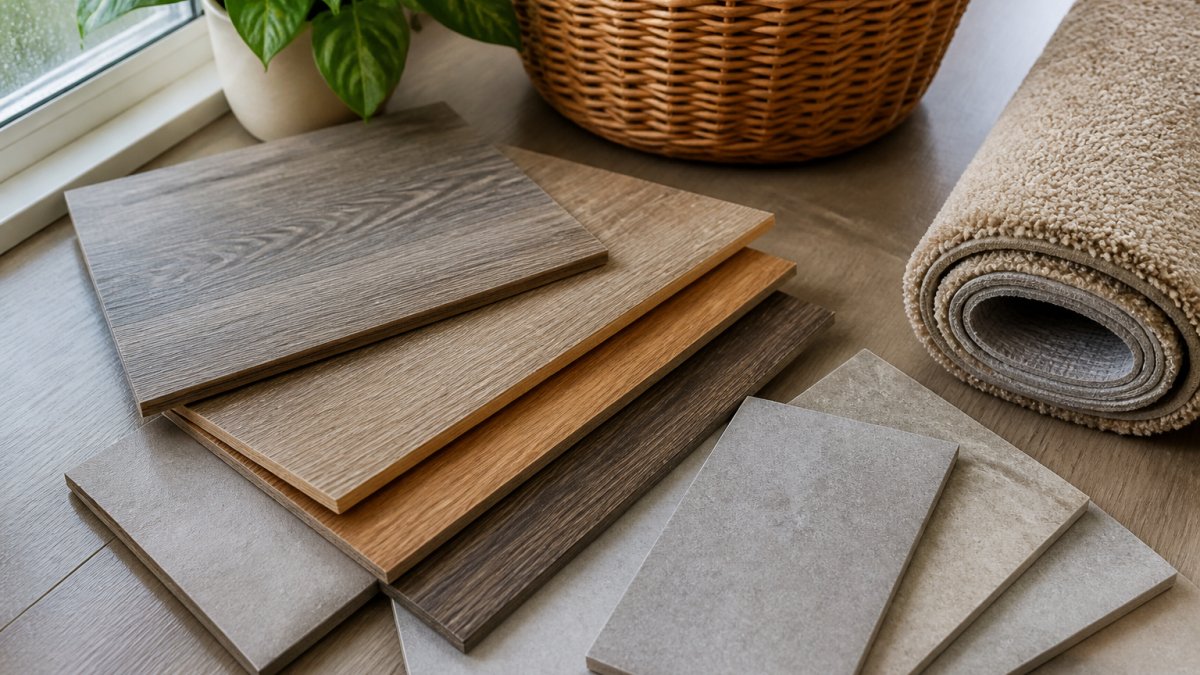
Laminate and Tile Flooring Options
Laminate flooring offers durability and water resistance at lower cost than hardwood. The core is high-density fiberboard with a photographic layer mimicking wood or stone. Laminate cannot be refinished; once the wear layer is gone, the floor must be replaced.
Luxury vinyl plank (LVP) has become the preferred alternative to laminate because it's more water-resistant, more comfortable underfoot, and offers better sound dampening. LVP mimics wood or stone appearance while providing waterproof protection.
Tile flooring in kitchens and bathrooms provides the most durable option but requires proper grout sealing and substrate preparation. Poor prep work leads to cracked grout, water damage, and mold.
| Flooring Type | Water Resistance | Refinishable | Cost Range | Best For |
|---|---|---|---|---|
| Solid Hardwood | Low | Yes | Higher | Living areas, bedrooms |
| Engineered Hardwood | Medium | Limited | Medium | Kitchens, basements |
| Laminate | Medium | No | Lower | Budget-conscious, moderate use |
| Luxury Vinyl Plank | High | No | Medium | Kitchens, bathrooms, pets |
| Tile | Very High | No | Medium-High | Bathrooms, entryways |
DIY vs. Professional Flooring Repair: Cost and Quality Analysis
The decision to repair your floor yourself versus hiring a professional hinges on three factors: actual cost difference, quality outcome, and your tolerance for disruption.
DIY refinishing appears cheaper because you only pay for materials and equipment rental. A typical DIY refinish for a 400-square-foot room costs less than professional refinishing, but hidden costs are substantial. Sanding equipment rental ($50-100 per day) adds up if you need multiple days to learn proper technique. Mistakes, uneven sanding, blotchy stain application, dust contamination, often require professional correction, which costs the same as doing it right the first time.
Quality differences become obvious within 6 months. Professional finishes remain clear and durable; DIY finishes often show lap marks, dust particles embedded in polyurethane, or uneven sheen.
Professional dustless sanding contains 99% of particles, while DIY dust infiltrates your HVAC system and persists for weeks. If you have respiratory issues, pets, or young children, professional work is necessary.
Sustainable and Eco-Friendly Refinishing Options
Environmentally conscious homeowners have more flooring options now than five years ago. Water-based polyurethane finishes, reclaimed wood, and low-VOC stains reduce environmental impact compared to traditional products.
Water-based polyurethane finishes emit fewer volatile organic compounds (VOCs) than oil-based polyurethane. They cure faster (24 hours vs. 3-7 days) and require less ventilation. The trade-off: water-based finishes are less durable in high-traffic areas and don't provide the amber warmth that oil-based finishes create on lighter woods.
Reclaimed hardwood flooring comes from salvaged barns, warehouses, or old buildings. These boards carry history and character that new wood cannot replicate. Reclaimed wood costs significantly more but appeals to homeowners seeking unique, sustainable materials. The environmental benefit is real, you're keeping wood out of landfills, but the cost premium means this option works best as an accent rather than full-floor installation.
FSC-certified hardwood comes from forests managed for sustainable harvesting. FSC certification verifies that forests are replenished at harvest rates, protecting ecosystem health. Most major hardwood suppliers now offer FSC options at modest price premiums.
Low-VOC stains and finishes reduce indoor air quality impacts during and after installation. They're particularly important for homes with children or respiratory sensitivities.
Why Choose Licensed and Insured Flooring Contractors
Licensed and insured contractors carry legal accountability that unlicensed workers do not. A license means the contractor has passed trade exams, maintains continuing education, and operates under state oversight. Insurance protects you if the contractor is injured on your property or causes damage.
Unlicensed contractors often undercut licensed competitors by 20-30% because they avoid licensing fees, insurance costs, and compliance overhead. That savings evaporates the moment something goes wrong. If an unlicensed contractor damages your subfloor and disappears, you have no recourse and no insurance claim to file.
Licensed contractors carry workers' compensation insurance, protecting you from liability if a worker is injured in your home. Without it, you could be held responsible for medical bills and lost wages.
How to Get Your Free Estimate and Consultation
The estimate process reveals how seriously a contractor takes your project. Professional contractors spend 30-60 minutes on-site, inspect the entire floor, document damage with photos, and provide written estimates with itemized costs.
On-Site Consultation Process
A proper consultation includes:
- Visual inspection of the entire floor, including areas under furniture where damage often concentrates
- Moisture testing with meters to identify hidden water damage
- Photo documentation of damage and reference materials for stain matching
- Discussion of options with pros and cons of each approach
- Written estimate with labor, materials, timeline, and warranty details
Red flags in the consultation process: contractors who rush through inspection in under 15 minutes, refuse to provide written estimates, pressure you to decide immediately, or won't explain why their price differs from competitors.
Stain Matching and Dustless Sanding Technology
Stain matching is critical when repairing part of an existing floor. Stain color changes with wood species, grain, age, and sunlight exposure. Professional contractors address this by bringing stain samples to your home, applying them to inconspicuous areas, and letting them dry fully before you decide.
Dustless sanding captures dust at the source using HEPA filtration. The equipment costs more and requires trained operators, but the air quality benefit is dramatic. Standard sanding creates visible dust clouds; dustless sanding keeps your home livable during refinishing.
Flooring damage in Suffolk County escalates quickly because of our coastal climate, but the right repair approach stops deterioration and restores your floor's value. Hamptons carpet one floor and Home serves all of Suffolk County with flooring repair services that address water damage, refinishing, installation, and restoration. Our team inspects your specific situation, explains your options honestly, and provides written estimates before any work begins. Get started with a free consultation and discover how professional flooring repair services in suffolk county can protect your home's foundation.
Frequently Asked Questions
What types of flooring repair services do you offer in Suffolk County?
We provide comprehensive flooring repair services including hardwood floor refinishing, floor sanding and bleaching, subfloor repair, water damage restoration, border and trim installation, and repairs for laminate and tile flooring. Each service is customized to address your specific flooring issues, whether you're dealing with salt air damage, moisture problems, or structural concerns common to Suffolk County homes.
How much does professional flooring repair cost compared to DIY repairs?
Professional flooring repair services provide superior durability and finish quality compared to DIY attempts. While DIY may seem cheaper upfront, professional work prevents costly mistakes like improper sanding, uneven stain application, or missed subfloor damage that can lead to expensive repairs later. Licensed contractors also carry insurance, protecting you from liability. For accurate pricing on your specific project, contact us for a free estimate tailored to your needs.
What should I expect during the on-site consultation and free estimate process?
During your on-site consultation, our flooring specialists will inspect your floors thoroughly, identify damage or wear, discuss your goals, and assess any underlying subfloor issues. We'll explain repair options, show you stain samples if refinishing is needed, and provide a detailed, transparent estimate with no hidden costs. This consultation helps us understand your home's unique conditions and recommend the best solution for your situation.
Why is professional dustless sanding better than traditional sanding methods?
Dustless sanding technology captures 99% of dust during the floor sanding process, minimizing disruption to your home and family. Traditional sanding creates weeks of dust cleanup and can affect air quality. Dustless sanding is faster, cleaner, and protects your furniture and belongings. It also allows us to work around your schedule with less inconvenience, making the refinishing process more pleasant and efficient for everyone in your home.
This article was written using GrandRanker