 Ultimate guide
Hardwood Floor Installation Cost: 2026 Pricing Guide
Table of Contents
- What Does Hardwood Floor Installation Cost on Average?
- Hardwood Flooring Labor Cost Per Square Foot by Region
- Key Factors That Affect Your Total Hardwood Floor Installation Cost
- Hidden Fees and Post-Installation Costs Most Homeowners Miss
- Cost to Install Hardwood Floors vs. Laminate: Honest Comparison
- How to Audit a Contractor Quote: Real-World Quote Analysis
- DIY Hardwood Floor Installation Cost: What You Actually Save
- How Long Does Hardwood Floor Installation Take?
Last Updated: June 9, 2026
Hardwood floor installation cost is one of the most searched flooring questions homeowners ask before starting a renovation, and for good reason: the price range is wide and the variables are many. At Hamptons carpet one floor and Home, we work with Suffolk County homeowners every week who come in with wildly different quotes for the same job. Below, we break down exactly what drives those differences, what to expect in 2026, and how to spot a quote that's missing something important.
Labor often equals or exceeds material cost, and most national averages are useless for Long Island homeowners. This guide covers a full cost breakdown by material and labor, a regional perspective on Suffolk County pricing, a real-world guide to auditing contractor quotes, and the hidden post-installation costs that catch people off guard.
What Does Hardwood Floor Installation Cost on Average?
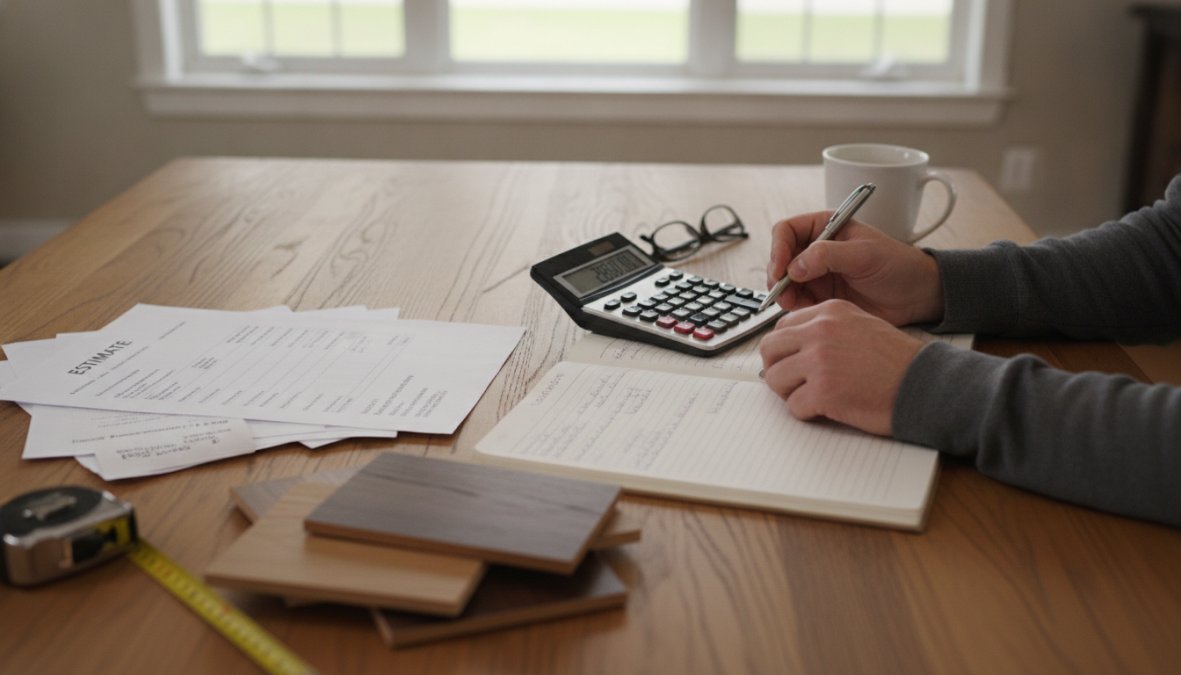
For most residential projects in the Northeast, budget material and labor as separate line items, contractors price them independently.
Average Cost Per Square Foot Breakdown
The key insight most homeowners miss: material and labor costs are roughly equal in many projects. Skimping on one rarely saves as much as expected, because the other half stays fixed.
| Cost Component | Lower Range | Mid Range | Higher Range |
|---|---|---|---|
| Materials (per sq ft) | Budget engineered | Mid-grade solid | Exotic/custom species |
| Labor (per sq ft) | Simple nail-down | Glue-down or floating | Custom patterns, stairs |
| Subfloor prep | Minor leveling | Moderate repairs | Full replacement |
| Trim and molding | Basic transitions | Standard baseboard | Custom millwork |
| Waste factor allowance | 7-10% | 10-12% | 12-15% |
According to National Wood Flooring Association installation guidelines, waste factor allowances should always be calculated before finalizing material orders, as cutting patterns and room geometry significantly affect actual consumption.
Engineered vs. Solid Hardwood Pricing Compared
Solid hardwood is a single piece of milled wood, typically three-quarters of an inch thick. Engineered hardwood uses a real wood veneer over a plywood or HDF core. The practical pricing difference comes down to material cost, installation flexibility, and refinishing potential. Solid wood can be sanded and refinished multiple times; engineered hardwood with a thick veneer can usually be refinished once or twice.
For Suffolk County homeowners dealing with humidity fluctuations common to Long Island's coastal climate, engineered hardwood often makes more practical sense below grade or over radiant heat systems, where solid wood's expansion and contraction creates real problems.
Hardwood Flooring Labor Cost Per Square Foot by Region
Labor is where national averages become genuinely misleading. Hardwood flooring labor cost per square foot in the New York metro area runs meaningfully higher than Midwest or Southern markets, reflecting higher contractor overhead, licensing requirements, and cost of living.
What Drives Labor Rate Differences Across Suffolk County and Long Island
Suffolk County competes with New York City pricing. Several region-specific factors push costs above national benchmarks:
- Union and licensing overhead: New York State contractor licensing requirements add compliance costs passed through to the homeowner.
- Fuel and travel time: Installers traveling from Nassau County or further west often build in travel costs for Hamptons or eastern Suffolk jobs.
- Seasonal demand: Spring and early summer renovation seasons create installer scarcity, pushing labor rates up.
- Project complexity: Older Hamptons-area homes frequently have irregular subfloors, plaster dust contamination, or radiant heating systems requiring additional prep time.
Get a minimum of three quotes from local contractors, not national aggregator referrals. The pricing spread between local Suffolk County installers and out-of-area contractors can be significant.
Key Factors That Affect Your Total Hardwood Floor Installation Cost
Most homeowners focus on wood species and ignore the variables that often have a bigger impact on the final bill.
Wood Species and Hardwood Grade
Red oak remains the most common choice for residential projects in the Northeast, balancing availability, hardness, and price. White oak has surged in popularity in modern and transitional styles, commanding a modest premium. Exotic species, Brazilian cherry, tigerwood, teak, sit at the upper end of material cost and are harder to nail through, slowing installation and increasing labor cost.
Hardwood grade also matters. Clear grade produces a uniform appearance at a higher price; common grades embrace natural variation and cost less. For large open-plan spaces, grade consistency is visually important. For smaller rooms with furniture coverage, lower grades are often indistinguishable in daily use.
Installation Method: Nail-Down, Glue-Down, or Floating Floor
Nail-down installation is the traditional method for solid hardwood over a wood subfloor, the most durable long-term connection, requiring plywood or OSB of adequate thickness.
Glue-down installation is required for concrete subfloors and common for engineered hardwood. It uses more adhesive, adds to supplies cost, and typically takes longer per square foot.
Floating floor installation means planks connect to each other without fastening to the subfloor. It's the fastest method and works well for engineered hardwood, but produces a slightly hollow sound underfoot and requires quality underlayment.
| Method | Best For | Relative Labor Cost | Subfloor Requirement |
|---|---|---|---|
| Nail-down | Solid hardwood, wood subfloor | Moderate | Plywood/OSB, min thickness |
| Glue-down | Engineered, concrete slab | Higher | Flat, clean concrete |
| Floating | Engineered, quick installs | Lower | Most subfloor types |
Subfloor Preparation, Moisture Barrier, and Site Conditions
Subfloor preparation is the single most common source of unexpected cost in flooring projects. A quote without a subfloor inspection line item may change dramatically once work begins. Preparation includes leveling, securing squeaky areas, repairing damaged sections, and sometimes full replacement. Moisture barrier installation is non-negotiable over concrete slabs and in below-grade applications.
Acclimation is another overlooked cost factor. Hardwood requires several days in the installation environment before it's laid, meaning the installer may need two visits, which some contractors bill separately.
Hidden Fees and Post-Installation Costs Most Homeowners Miss
The quoted hardwood floor installation cost is rarely the final number.
Trim, Molding, Transition Strips, and Waste Factor
Trim, molding, and transition strips are almost always quoted separately, and the cumulative cost across a multi-room project adds up fast. Transition strips are required wherever hardwood meets a different flooring material or changes elevation; quarter-round covers the expansion gap at every room's perimeter; stair nosing is a separate line item.
Waste factor is the percentage of material ordered above calculated square footage to account for cuts, defects, and pattern alignment. Standard waste is 7-10% for straight-lay patterns; diagonal or herringbone patterns require 12-15% or more. Contractors who quote based on exact room square footage without a waste factor are either planning to short-order material or expecting you to pay for a second delivery.
Long-Term Costs: Refinishing, Maintenance, and Indoor Air Quality
Solid hardwood can be refinished every 10-15 years, extending the floor's life significantly but adding periodic cost. Engineered hardwood with a thin veneer may only support one refinishing cycle. Maintenance costs include professional cleaning, occasional board replacement, and re-coating between full refinishing cycles. According to National Association of Realtors research on flooring and home value, hardwood floors consistently rank among the top features buyers prioritize in resale decisions.
Indoor air quality is a legitimate consideration. Prefinished hardwood off-gasses before reaching your home. Site-finished hardwood cures in your living space, low-VOC finishes are available and worth specifying if air quality is a concern.
Cost to Install Hardwood Floors vs. Laminate: Honest Comparison
Laminate's lower upfront cost is real. So is hardwood's longer lifespan and refinishability. Laminate cannot be refinished when scratched or worn, at end of life, it's replaced entirely. Hardwood can be sanded and refinished multiple times, effectively resetting its appearance.
For Suffolk County homeowners planning to stay long-term, the math often favors hardwood on a cost-per-year basis when you account for laminate's replacement cycle. For rental properties or shorter-term ownership, laminate's lower initial cost makes more sense. The honest limitation of hardwood: it's less tolerant of moisture and heavy pet traffic than quality laminate. A household with large dogs and young children may find laminate more practical regardless of budget.
How to Audit a Contractor Quote: Real-World Quote Analysis
Most homeowners accept or reject a quote based on the bottom line. That's the wrong approach. The structure of the quote tells you more than the total.
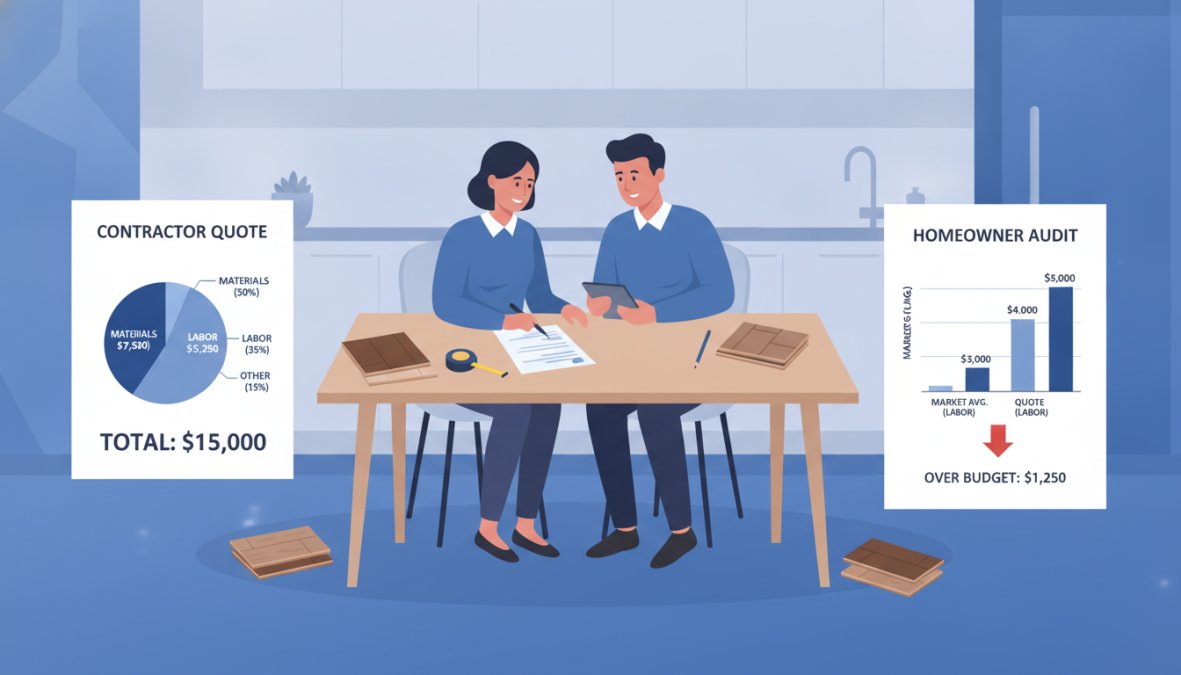
A complete hardwood floor installation quote should itemize every cost component separately. Here's what to check:
Quote Audit Checklist:
- Materials listed separately from labor, with species, grade, and plank width specified
- Square footage calculation shown, with waste factor percentage stated
- Subfloor preparation listed as a separate line item (even if quoted at zero, it should be acknowledged)
- Moisture testing or moisture barrier addressed explicitly
- Trim, molding, and transition strips itemized
- Equipment allowance or job supplies listed (adhesive, nails, underlayment)
- Acclimation time and any associated revisit fees addressed
- Furniture moving costs included or explicitly excluded
- Old flooring removal and disposal costs included or excluded
- Payment schedule specified (deposit, progress, final)
A quote missing four or more of these items is not a complete quote, it's an estimate that will expand. According to Federal Trade Commission guidance on home improvement contracts, homeowners should always request itemized written contracts before work begins.
The most common gap is subfloor preparation. Installers frequently quote assuming a perfect subfloor, then bill for prep as a change order once they've pulled up the existing floor. Asking "what happens if the subfloor needs work?" before signing tells you a lot about how a contractor operates.
DIY Hardwood Floor Installation Cost: What You Actually Save
DIY savings are real but often overstated. You eliminate the labor cost per square foot, a meaningful number for a Suffolk County project. You don't save on materials, underlayment, trim, adhesive, or subfloor prep requiring professional tools.
What you add: tool rental costs (flooring nailers, miter saws, moisture meters), the learning curve on the first few rows (which often means wasted material), and the risk of installation errors that affect long-term performance. Floating floor installation is the most DIY-accessible method. Nail-down requires a pneumatic flooring nailer and working knowledge of blind nailing technique.
The honest assessment: DIY makes sense for floating engineered hardwood in a single room with a clean subfloor. For whole-home solid hardwood installation, the skill requirement and equipment investment narrow the savings considerably. A common mistake is underestimating project time, which creates pressure to rush acclimation, and that's where moisture problems begin.
How Long Does Hardwood Floor Installation Take?
A single room of floating floor installation can be completed in a day by an experienced installer. A whole-home solid hardwood project with subfloor prep typically runs several days to a week.
The standard timeline breakdown:
- Acclimation period: 3-5 days minimum for solid hardwood, 24-48 hours for most engineered products. Non-negotiable, happens before installation begins.
- Subfloor preparation: Half a day to multiple days depending on condition.
- Installation: Roughly 300-500 square feet per day for an experienced crew using nail-down method. Glue-down runs slower.
- Trim and finishing: One additional day for baseboard reinstallation, transition strips, and final cleanup.
- Finish curing (site-finished floors): 24-72 hours before light foot traffic; up to a week before furniture replacement.
According to Wood Floor Business installation best practices, rushing any phase of acclimation or curing is the leading cause of post-installation performance complaints.
A typical 1,000 square foot project with standard nail-down installation and minor subfloor prep runs approximately 3-5 working days from start to final trim, not including the acclimation period.
Frequently Asked Questions
How much does it cost to install 1,000 square feet of hardwood flooring?
For a 1,000 square foot project, hardwood floor installation cost typically ranges from roughly $6,000 to $14,000 or more, depending on wood species, installation method, and local labor rates. Material costs and labor costs each make up a significant portion of that total. Subfloor preparation, underlayment, trim, and a standard waste factor overage of 10-15% will add to the base estimate. Always get at least three contractor quotes for a project this size.
What is the average labor cost per square foot for hardwood installation?
Hardwood flooring labor cost per square foot generally falls between $3 and $8 depending on your region, the installation method chosen, and site conditions. Nail-down installation on a standard subfloor tends to be at the lower end, while glue-down or floating floor methods on uneven or problematic subfloors can push labor costs higher. In high-cost markets like Suffolk County, NY, expect labor rates toward the upper range of national averages.
Is it cheaper to install hardwood or laminate flooring?
Laminate flooring is generally cheaper upfront, both in material costs and installation labor, compared to solid wood flooring or engineered hardwood. However, hardwood adds measurable property value, can be refinished multiple times, and typically lasts decades longer. When you factor in long-term maintenance and the cost to replace laminate sooner, the cost to install hardwood floors vs laminate often favors hardwood over a 20-plus year horizon.
Does hardwood floor installation cost include removing old carpet?
Not always. Many contractors price carpet removal and disposal as a separate line item. When reviewing contractor quotes, specifically ask whether old flooring removal, haul-away fees, and subfloor preparation are included. These are among the most common hidden fees homeowners encounter. Budget an additional $1-$2 per square foot for carpet removal and disposal if it is not bundled into the installation quote.
Are there hidden costs when installing hardwood floors?
Yes, several post-installation and site-related costs frequently catch homeowners off guard. These include subfloor leveling or repair, moisture barrier or underlayment materials, acclimation time delays, transition strips between rooms, trim and molding replacement, and the standard 10-15% waste factor added to material orders. For prefinished versus unfinished wood, finishing costs on-site can add significantly to the total hardwood floor installation cost if unfinished boards are chosen.
How does wood species affect hardwood floor installation cost?
Wood species is one of the biggest cost variables. Domestic species like red oak and white oak are typically the most affordable and widely available. Mid-range options include hickory and maple. Exotic wood species such as Brazilian cherry or teak can cost two to three times more per square foot in materials alone. Hardwood grade also matters, select grade boards with fewer knots cost more than lower grades. Species hardness can also affect labor costs if special tooling is needed.
Choosing the right hardwood flooring product and installer is genuinely complicated, and the cost variables are real. Hamptons carpet one floor and Home serves all of Suffolk County with flooring expertise specific to Long Island's climate, home styles, and contractor landscape. Visit our showroom to see material samples, get a project estimate, and work with a team that understands the real costs involved in getting this right.
This article was written using GrandRanker