 blog
Herringbone vs Chevron for Small Rooms: 2026 Guide
Table of Contents
- Herringbone vs Chevron Flooring: What Actually Sets Them Apart
- Herringbone Flooring in Small Rooms: Where It Works
- Chevron Flooring in Small Rooms: Where It Works
- Herringbone Flooring Cost and What Drives It Up
- Matching the Pattern to Your Room: A Decision Framework
- Furniture, Thresholds, and Transitions in Tight Spaces
- Frequently Asked Questions
Last Updated: October 13, 2026
Herringbone vs Chevron Flooring: What Actually Sets Them Apart
Choosing between herringbone and chevron for small rooms comes down to one distinction: herringbone planks meet at 90-degree angles to form a broken zigzag, while chevron planks are cut at angled ends so they join point-to-point into a continuous V shape. This guide from Hamptons carpet one floor and Home breaks down how each layout behaves in compact rooms, what drives cost up, and how to match the pattern to your actual floor plan.
Here's the part most guides skip: the two patterns are often treated as interchangeable, and they are not. Herringbone vs chevron flooring differs in geometry, installation method, and how much visual movement the floor creates. In a powder room or narrow hallway, those differences decide whether the floor opens the room up or closes it in.
How the Planks Are Shaped and Joined
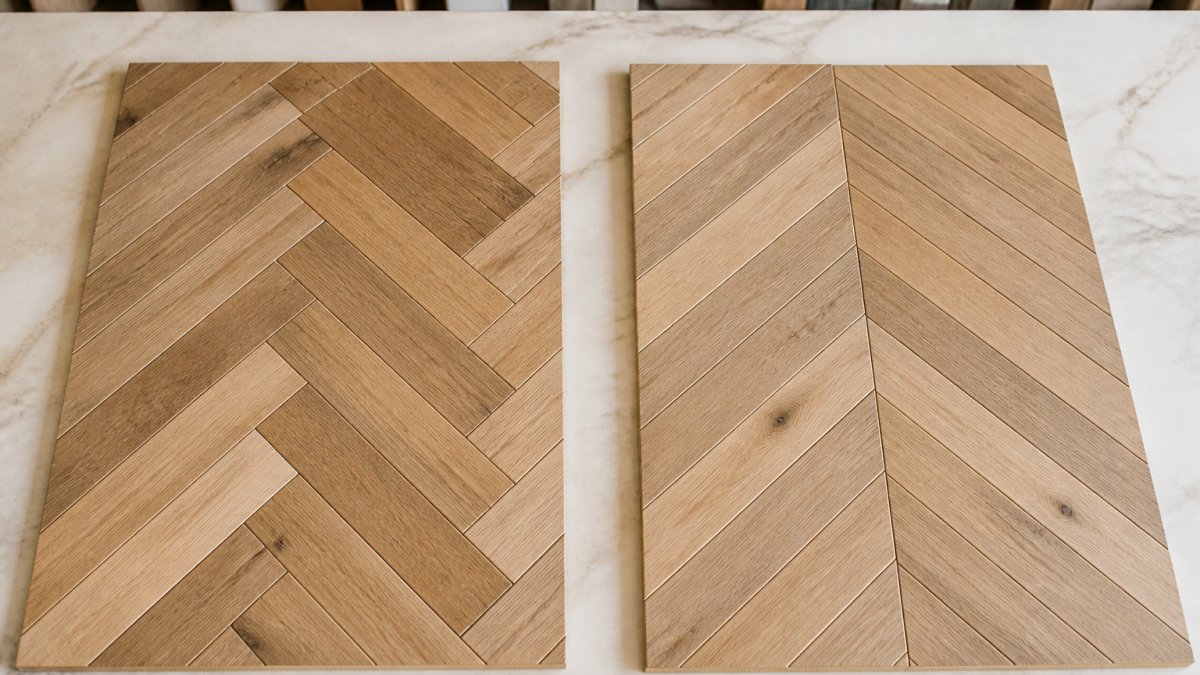
Herringbone uses rectangular planks with square-cut ends. Each plank is set at a 90-degree angle to its neighbor, producing a staggered layout that looks like a broken zigzag. Chevron uses planks cut at angled ends so adjacent boards meet in a clean point-to-point line, forming an unbroken V.
That geometry drives the installation work. Herringbone can be laid with standard planks and more offcuts, while chevron needs precision cutting on both ends of every board. The National Wood Flooring Association's installation guidance notes that pattern work demands tighter tolerances than a straight lay.
The Visual Difference: Zigzag vs Continuous V
A herringbone floor reads as texture. The staggered joints break up the surface, which softens the pattern and adds depth without a hard directional pull. A chevron floor reads as a single, continuous arrow. The uninterrupted V creates strong visual movement that points the eye down the length of the room.
For small rooms, that is the whole ballgame. One pattern spreads the eye around; the other sends it in a straight line.
| Feature | Herringbone | Chevron |
|---|---|---|
| Plank ends | Square-cut | Angled-cut |
| Joint style | 90-degree, staggered | Point-to-point, continuous V |
| Visual effect | Textured, broken zigzag | Strong directional V |
| Cutting complexity | Moderate | High |
| Best small-room use | Irregular or square layouts | Long, narrow layouts |
Herringbone Flooring in Small Rooms: Where It Works
Herringbone flooring in small rooms works best when the room has an awkward or squarish footprint. Because the pattern is staggered rather than perfectly aligned, it disguises odd angles and uneven wall lines.
Here is the mechanism behind that forgiveness. In a herringbone layout, no single joint line runs the full length of the room. The 90-degree turns break every sightline into short segments, so the eye never gets a continuous reference line to compare against the wall.
Room Shape, Light, and Installation Direction
Run herringbone parallel to the longest wall in a rectangular room and it can make the space feel wider. Run it at a 45-degree angle and it adds energy, though it also increases waste and cutting time. In a dim room, the broken joints catch light unevenly, which adds depth but can look busy if the plank width is too narrow.
Three practical direction rules for compact rooms:
- Aim the pattern toward the primary light source. In a small bedroom with one window, running the zigzag toward the window lets the light rake across the joints and add depth. Running it perpendicular to the window flattens the pattern.
- Aim the pattern toward the doorway you enter from. In a powder room or foyer, the first sightline should travel with the pattern, not across it. This makes a 5-by-6-foot powder room feel deeper than its dimensions suggest.
- Avoid the 45-degree lay in rooms under about 60 square feet. The angled lay adds roughly 10 to 15 percent more cutting waste than a parallel lay and requires more layout time, which is hard to justify when the room is small enough that the angle reads as noise rather than energy.
Dimension-Based Examples
- Powder room, 5 by 6 feet: herringbone, parallel to the longer wall, moderate plank width. The staggered joints hide the fact that the room is barely wider than a door swing.
- Boxy foyer, 6 by 8 feet: herringbone, parallel to the entry wall. The pattern reads as texture underfoot rather than a directional statement, which keeps the space from feeling like a corridor.
- Irregular bonus room with angled walls: herringbone, laid parallel to the longest uninterrupted wall. The staggered joints pull attention away from the angles.
- Narrow hallway, 3 by 12 feet: herringbone is the weaker choice here. The room is too long and too narrow for the zigzag to do its forgiving work, and the eye reads the pattern as busy rather than expansive.
Chevron Flooring in Small Rooms: Where It Works
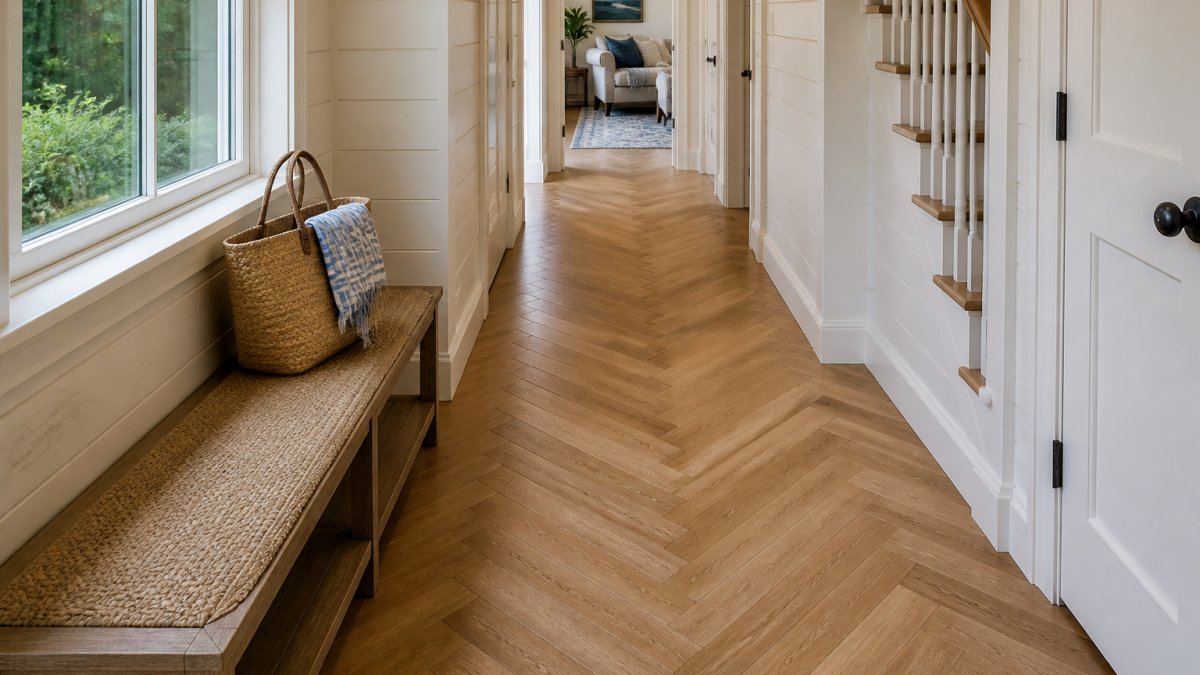
Chevron flooring in small rooms is the stronger choice for long, narrow spaces such as hallways and galley kitchens. The continuous V pulls the eye lengthwise, which stretches a corridor visually. In a square room, that same directional pull can fight the proportions instead of helping them.
Pattern Scale and Visual Density
Pattern scale decides how busy a floor feels. A wide plank with a large V reads calmer and suits a small room that already has patterned wallpaper or busy cabinetry. A narrow plank with a tight V adds detail but raises visual density, which can overwhelm a compact space.
- Wide planks, large V: calmer, better for busy rooms
- Narrow planks, tight V: more detail, better for plain rooms
- Matching scale to room size: larger patterns suit smaller rooms better than most people expect
That last point runs against common advice. Many guides push narrow planks for small rooms, but in practice a moderate-to-wide plank often keeps a tight space from feeling frantic.
Herringbone Flooring Cost and What Drives It Up
Herringbone flooring cost runs higher than a straight lay for three reasons: more material waste from angled cuts, more labor hours, and more precision required at every joint. Chevron typically costs more again, because both ends of every plank are cut to an angle.
Waste is the hidden line item. Pattern floors generate more offcuts than straight installation, and in a small room those offcuts are a larger share of the total material. Ask for a waste allowance in writing before you commit.
Why Small Rooms Do Not Get Cheaper Per Square Foot
Most homeowners assume a small room means a small bill. Pattern flooring breaks that assumption in three ways:
- Fixed setup costs do not shrink with the room. Layout, snapping reference lines, and pattern alignment take roughly the same number of hours in a 60-square-foot powder room as in a 200-square-foot bedroom. Spread across fewer square feet, that fixed time raises the per-square-foot labor rate.
- Cutting waste is proportionally higher. A straight lay in a rectangular room typically runs about 5 to 10 percent waste. A herringbone lay commonly runs 10 to 15 percent, and a 45-degree herringbone lay can push toward 15 to 20 percent. In a small room with many doorways, closets, or angled walls, the higher end of those ranges is more likely.
- Precision cuts multiply. Every plank in a chevron layout has two angled ends. Every plank in a herringbone layout has square ends but must be cut to length at the pattern boundary. In a small room, the pattern boundary is a larger share of the total plank count, so the cutting labor per square foot goes up, not down.
What to Ask For in a Quote
A complete pattern-flooring quote should separate these line items so you can compare bids fairly:
- Material quantity, including the stated waste allowance
- Subfloor preparation (leveling, patching, or underlayment)
- Layout and reference-line setup
- Cutting and installation labor
- Transition strips and thresholds
- Removal and disposal of existing flooring, if applicable
Material Choice Changes the Math More Than Pattern Does
Pattern choice affects labor and waste. Material choice affects the base price far more. Engineered hardwood, solid hardwood, luxury vinyl plank, and laminate all come in herringbone and chevron formats, and the spread between the least and most expensive option is wider than the spread between herringbone and chevron labor.
Pricing depends on the material, room dimensions, and subfloor condition, so we quote each project individually. Contact Hamptons carpet one floor and Home for current pricing on your space.
Matching the Pattern to Your Room: A Decision Framework
Use the room's proportions to pick the pattern, not the other way around. This framework covers most small-room cases:
- Long and narrow (hallway, galley kitchen): chevron, run lengthwise
- Square or boxy (powder room, small foyer): herringbone, run parallel to the longest wall
- Irregular or angled walls: herringbone, for its forgiving staggered joints
- Dim lighting: moderate plank width, either pattern
- Busy cabinetry or wallpaper: wider planks, larger pattern scale
If two rooms connect, keep one pattern throughout. Switching patterns at a threshold in a small home makes each room feel smaller, not larger.
Furniture, Thresholds, and Transitions in Tight Spaces
Pattern direction should follow the furniture layout, not just the walls. In a small living room, run the pattern toward the main seating area so the floor pulls the eye into the room rather than across it.
Transitions matter more in small homes than large ones. A clean threshold strip between two flooring types keeps the eye moving. A bulky transition strip chops the space in two.
If you are weighing this against other options, our team can walk you through how each pattern performs on your specific subfloor. The U.S. Environmental Protection Agency's indoor air quality guidance is also worth reviewing if you are choosing materials for a home with sensitivity concerns.
Frequently Asked Questions
Which pattern makes a small room look bigger, herringbone or chevron?
There is no consistent consensus on this. Some flooring sources say herringbone adds visual interest without overwhelming small spaces, while others say it can make a compact room feel smaller. Chevron's continuous V shape creates strong directional lines that can draw the eye lengthwise in a narrow room. The deciding factors are usually plank width, pattern scale, and how the floor is oriented relative to the room's longest wall.
Do herringbone and chevron flooring require different installation methods?
Yes. Herringbone planks are rectangular with square-cut ends that meet at 90-degree angles, so the pattern interlocks point-to-point. Chevron planks have angled ends cut to a specific degree so pairs meet in a continuous V. Chevron requires more precision cutting because every plank end must align cleanly with its neighbor. Herringbone is more forgiving of minor variation, which can mean less labor time on a small job.
Does herringbone flooring cost more than chevron in a small room?
Pricing depends on the material you choose, plank width, and the complexity of the layout, so exact figures vary by project. Chevron generally involves more precision cutting because of the angled ends, which can increase labor. Herringbone uses standard rectangular planks with square ends, which can reduce cutting time. In small rooms, waste from offcuts matters more per square foot, so ask for a waste allowance in your quote. Contact Hamptons Carpet One Floor and Home for current pricing.
Is herringbone or chevron better for a narrow room like a hallway or powder room?
For a narrow hallway, running either pattern lengthwise emphasizes the room's longest dimension and makes the space feel less compressed. Chevron's continuous V creates a stronger directional pull, which suits long, narrow spaces. Herringbone's staggered zigzag can add texture without as much directional emphasis. In a powder room, a smaller pattern scale with narrower planks usually works better than a large-scale pattern that gets cut off by fixtures.