 How-to
How to Avoid Surprise Flooring Installation Costs
Table of Contents
- Why Flooring Costs Spiral: The Real Numbers
- Understanding the Subfloor Condition and Its Impact
- Factors Affecting Flooring Installation Price
- Getting a Detailed Written Estimate and Flooring Installation Contract Checklist
- How to Prepare for Professional Flooring Installation
- Hidden Costs to Budget For: Removal, Disposal, and Contingency
- DIY vs. Professional Installation: The True Cost Comparison
- Protecting Yourself: Insurance, References, and Warranty Coverage
- Frequently Asked Questions
Last Updated: August 31, 2026
According to Angi's State of Home Spending Pulse Report, 43% of homeowners who recently hired someone for a home improvement project had the cost exceed the original quoted estimate. Of those who went over budget, more than one-third spent at least 30% more than expected. For flooring installation specifically, these overruns often stem from hidden costs that homeowners don't anticipate during the planning phase. At Hamptons Carpet One Floor and Home, we've helped countless customers navigate the complexities of flooring projects by teaching them what to watch for before signing a contract. This guide breaks down how to avoid surprise flooring installation costs and protect your budget from the start.
Why Flooring Costs Spiral: The Real Numbers
Flooring installation costs typically range from $4 to $15 per square foot total on average, with labor alone running $2 to $8 per square foot (HomeGuide, 2026) (homeguide.com). Most homeowners receive quotes that don't account for the full scope of work their specific space requires.
According to Clever Real Estate's Home Renovation Report, 70% of homeowners went over budget on their latest renovation project, with 39% exceeding their renovation budget specifically due to unexpected costs (Clever Offers, 2026; RubyHome, 2025). This pattern repeats because most homeowners don't understand what actually drives flooring installation pricing.
Understanding the Subfloor Condition and Its Impact
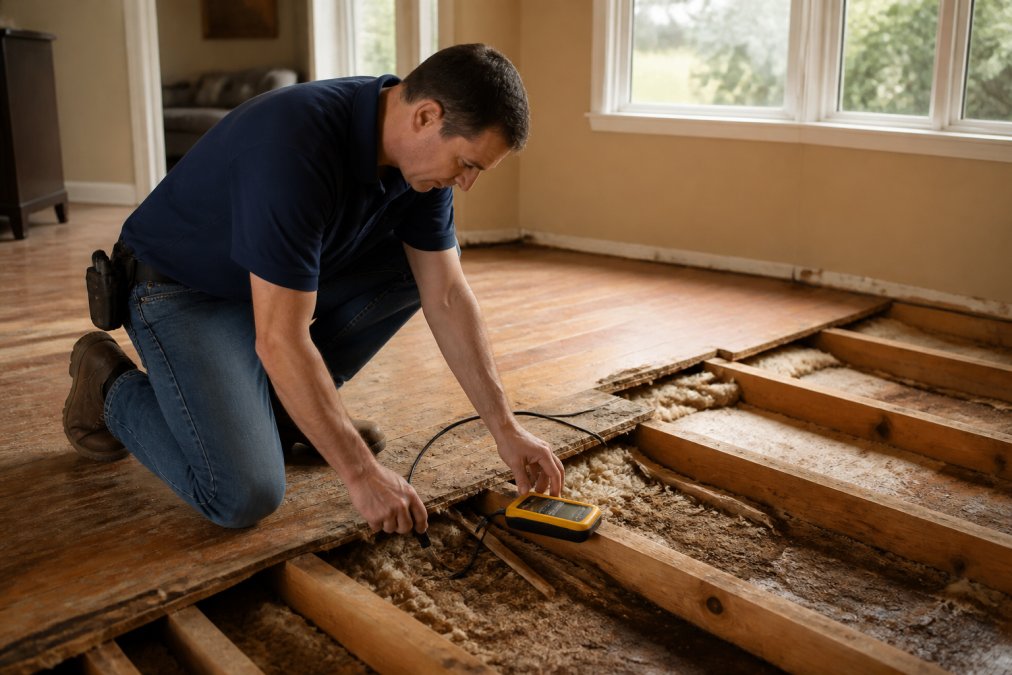
Your subfloor is the foundation everything else rests on, and its condition can make or break your project budget. Many homeowners have no idea what condition their subfloor is in until a contractor starts pulling up the old flooring.
A damaged or uneven subfloor requires remediation before new flooring can be installed properly. Subfloor leveling alone can cost $3 to $10 per square foot (SnapScope AI, 2025). If the subfloor has moisture damage, mold, or structural issues, costs escalate dramatically. Replacing a compromised subfloor runs $1,500 to $5,000 for a 500-square-foot space.
Before any work begins, a qualified installer should inspect the existing floor, measure moisture levels, check for levelness, and identify any structural concerns. Moisture testing is particularly critical in coastal or humid environments. A major retail chain with 1,200 stores contacted the International Flooring Technology Institute (IFTI) to perform concrete floor moisture testing as part of their remodel program after discovering that improper moisture testing was leading to excessive moisture throughout the slab (IFTI, 2026).
Factors Affecting Flooring Installation Price
Material Type and Installation Complexity
Not all flooring materials cost the same to install. Labor typically accounts for 40% to 60% of your total flooring project cost (Modernize, 2026).
Basic installations like laminate, carpet, or click-lock luxury vinyl plank (LVP) range from $1.50 to $3.50 per square foot in labor. Standard installations like engineered hardwood or standard tile run $3 to $6 per square foot. Complex installations, solid hardwood with nail-down methods, custom tile patterns, or glue-down applications, cost $5 to $10 per square foot.
Choosing installer-friendly materials like luxury vinyl plank or laminate with click-lock systems can reduce labor time significantly compared to traditional nail-down hardwood (TaskRabbit, 2026). This is a direct strategy for controlling your total project expense.
Labor Costs and Project Timeline
Labor costs vary by region, installer experience, and project complexity. The quoted labor rate often doesn't include additional work like subfloor replacement, old flooring removal, or furniture moving (Angi, 2026).
Ask your contractor specifically what labor includes and what it doesn't. Is removal of the old flooring included in the quoted rate, or is that a separate line item? What about hauling away debris, moving furniture, or reinstalling baseboards? Each task carries its own cost, and omitting them from your initial quote creates the gap between expected and actual costs.
Project timeline also affects labor costs. A rushed installation might require overtime, increasing your per-square-foot labor charge. Discuss timeline expectations upfront and understand how delays or accelerated schedules impact pricing.
Getting a Detailed Written Estimate and Flooring Installation Contract Checklist
What Must Be Included in Your Estimate
A proper flooring installation estimate should be detailed enough that you understand exactly what you're paying for. Your estimate must include:
- Total square footage being installed
- Material type, grade, and brand
- Per-square-foot material cost and total material cost
- Per-square-foot labor cost and total labor cost
- Removal and disposal of existing flooring
- Subfloor preparation, leveling, or repairs (if needed)
- Underlayment or moisture barrier installation
- Baseboard removal and reinstallation
- Furniture moving and protection
- Transition molding or thresholds
- Any site-specific challenges and associated costs
- Timeline for completion
- Warranty coverage (material and labor)
- Payment terms and schedule
A detailed estimate prevents misunderstandings and gives you a document to reference if the contractor tries to add charges mid-project.
Change Order Clauses and Contractual Protection
Your contract must include language about change orders. A change order is a formal, written request to modify the original scope of work. Without clear change order language, a contractor can claim they discovered unexpected conditions and simply add thousands to your bill without your formal approval.
Your contract should state: "Any work beyond the scope outlined in this estimate requires a written change order signed by both parties before work begins. Verbal authorizations will not be honored."
How to Prepare for Professional Flooring Installation
Site Inspection and Scope of Work Documentation
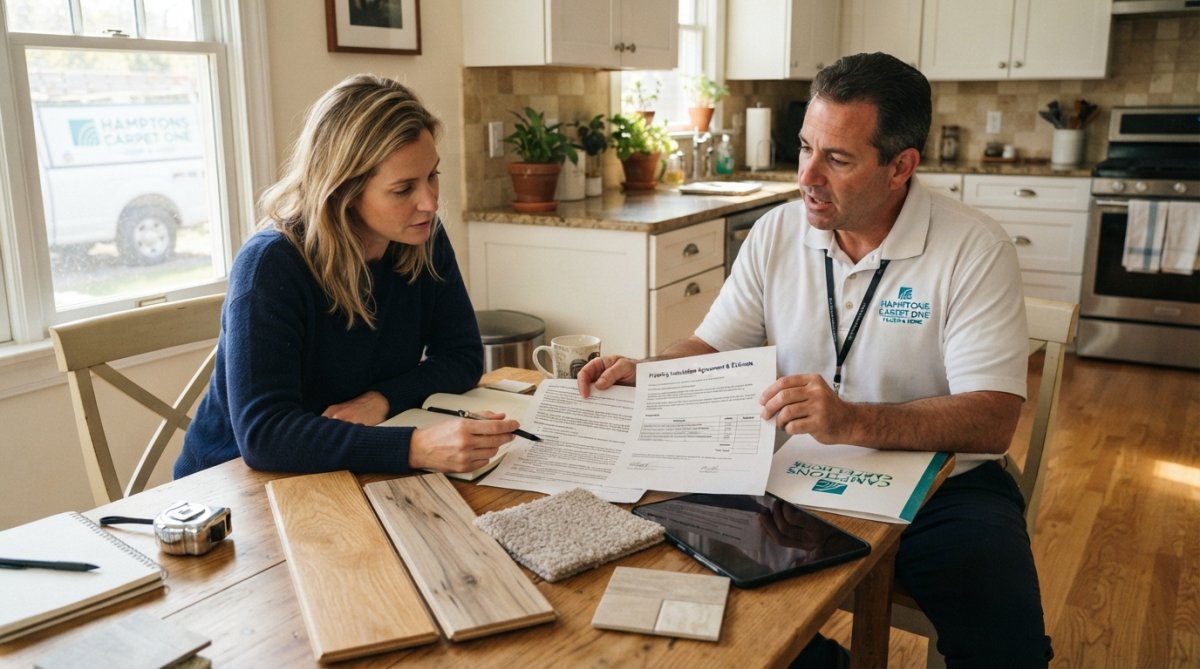
Before you sign anything, insist on a detailed site inspection. A professional installer will measure the room, check for moisture, assess the subfloor condition, identify obstacles, and note special considerations.
During the inspection, take photos and notes. Ask the contractor to explain what they see and what it means for your project. The scope of work document should list everything the contractor will do, in order, with enough specificity that a different contractor could understand exactly what was completed and what remains.
Furniture Removal and Floor Preparation Steps
Clear communication about furniture removal prevents delays and extra charges. Determine in advance: Will the contractor move furniture, or will you? If they move it, where will it go?
Removing old flooring yourself can save up to $3.50 per square foot, but only if you can do it without damaging the subfloors and if hazardous materials like mold or asbestos aren't present (Angi, 2026). If you're unsure about asbestos or other hazards, hire a professional.
| Preparation Task | Responsibility | Timeline |
|---|---|---|
| Remove furniture | Homeowner or contractor (specify in estimate) | Before installation day |
| Clear debris from old flooring | Contractor | Day of installation |
| Vacuum and clean subfloor | Contractor | Day of installation |
| Remove baseboards | Contractor (unless noted) | Before installation |
| Protect walls and adjacent rooms | Contractor | Day of installation |
| Protect HVAC vents and fixtures | Homeowner (usually) | Before installation |
Hidden Costs to Budget For: Removal, Disposal, and Contingency
Haul-Away Fees and Debris Disposal
Old flooring has to go somewhere. Haul-away and debris disposal typically cost $1 to $3 per square foot (SnapScope AI, 2025). For a 500-square-foot room, that's $500 to $1,500 just for disposal. Ask your contractor directly: "Is haul-away included in your quote, or is that a separate charge?" Get the answer in writing.
Moisture Testing and Concrete Grinding
If you have a concrete subfloor, moisture testing is non-negotiable, especially in humid climates or basements. Moisture testing typically costs $100 to $300 for a standard residential space.
Concrete grinding, smoothing out high spots or uneven concrete, costs $3 to $10 per square foot depending on severity. This work isn't always apparent until the old flooring is removed, which is why contingency planning matters.
Material Waste Factor and Overage Calculations
Flooring materials aren't installed with zero waste. Installers account for cuts, pattern matching, and mistakes. The waste factor typically ranges from 10% to 15% of the total material needed. Your estimate should specify the waste factor.
DIY vs. Professional Installation: The True Cost Comparison
The temptation to install flooring yourself or hire an unlicensed handyman is strong when you see professional quotes. But this calculation often backfires.
Professional installers bring expertise, tools, and insurance. They know how to handle subfloor issues, manage moisture, ensure proper transitions, and install flooring to manufacturer specifications. If something goes wrong, their insurance covers it. If you do it yourself and something fails, you're out of pocket for repairs.
Consider the real costs of DIY or amateur installation: renting specialized tools ($50-$300), time investment (often 2-5 days for a 500-square-foot room), mistakes requiring rework ($2,000-$5,000 or more), voided manufacturer warranty, and potential damage to surrounding areas.
One homeowner compared quotes from multiple flooring retailers and found one estimate "chocked full of hidden fees." By asking detailed questions and getting a comprehensive written estimate, they saved over $5,000 on hardwood flooring installation, paying around $6,900 compared to an estimate over $12,000 (Club Thrifty, 2026). Professional installation protects your investment and ensures the warranty is valid.
Protecting Yourself: Insurance, References, and Warranty Coverage
Before hiring any flooring contractor, verify three things: insurance, references, and warranty.
Insurance: Ask for proof of liability insurance and workers' compensation insurance. Call the insurance company to verify the policy is active. If a worker gets injured on your property and the contractor isn't insured, you could be liable.
References: Ask for at least three recent references from similar projects. Call them and ask: Did the project stay on budget? Was work completed on time? Were there any issues after installation? How did the contractor handle problems?
Warranty: Understand what's covered and for how long. Most manufacturers warrant flooring material for 10-25 years. The contractor should warrant their labor for 1-5 years. Get warranty terms in writing. The 2026 State of the Retail Flooring Industry Report highlights that installer certification is increasingly important for reducing claims and improving customer satisfaction (Floorzap, 2026).
Budget surprises on flooring projects are preventable. The key is asking detailed questions, getting everything in writing, and understanding exactly what you're paying for before work begins. Request a comprehensive site inspection, demand a detailed written estimate that includes all potential costs, and insist on clear change order language in your contract.
When you're ready to move forward, Hamptons Carpet One Floor and Home can guide you through the entire process. We provide detailed site inspections, transparent written estimates that account for your specific space and conditions, and professional installation with comprehensive warranty coverage. Get started with a consultation and see how we can help you avoid the hidden costs that derail so many flooring projects.
Frequently Asked Questions
Q: What are the most common hidden costs in flooring installation?
A: Hidden costs often include subfloor damage repair ($1,500-$5,000), moisture testing and treatment, haul-away fees ($1-$3 per square foot), baseboard removal and reinstallation ($1-$4 per linear foot), concrete grinding or leveling ($3-$10 per square foot), and furniture moving ($50-$150 per room). Labor costs typically range from $0.60-$4 per square foot but often don't cover these additional services. Always ask your installer what's included in the quoted labor rate to identify gaps.
Q: How do I ensure my flooring quote includes subfloor repairs?
A: Request a site inspection before any quote is provided. Ask the contractor to document the subfloor condition in writing, including photos of any damage, moisture issues, or uneven areas. Your written estimate should explicitly list subfloor work as a separate line item with a fixed price or a clear range with a change order process. Include language that any subfloor repairs discovered during installation require written approval before work proceeds, protecting you from surprise bills.
Q: What questions should I ask a flooring contractor before signing a contract?
A: Ask about the scope of work (what's included and excluded), timeline and project phases, warranty coverage on labor and materials, how change orders are handled and priced, whether they carry liability insurance, references from recent jobs, and contingency plans if hidden damage is found. Request a detailed written estimate that breaks down material, labor, and additional services separately. Clarify furniture removal responsibility, and how disruptions to your family schedule will be managed.
Q: What is a fair price to install flooring, and how can I avoid overpaying?
A: Flooring installation typically costs $4-$15 per square foot total, with labor ranging $2-$8 per square foot depending on material type and complexity. Basic installations (laminate, click-lock LVP) cost $1.50-$3.50/sq ft in labor, while complex jobs (solid hardwood, custom tile) run $5-$10/sq ft. Get at least three written estimates and compare line-by-line details, not just final totals. Avoid the cheapest bid, which often signals skipped prep work or low-quality materials. Choose certified installers and verify references to protect against costly mistakes that require remediation.
This article was written using GrandRanker