 blog
Is Engineered Hardwood Durable Enough for Beach Homes?
Table of Contents
- Is Engineered Hardwood Durable Enough for Beach Homes?
- Best Flooring for Beach Houses: How the Main Options Compare
- Engineered Hardwood vs. Solid Hardwood in Coastal Conditions
- Engineered Hardwood vs. Luxury Vinyl Plank for Beach Homes
- Engineered Hardwood Wear Layer Thickness and Refinishing Limits
- Sand, Grit, Dents, and High-Traffic Wear
- Installation, Acclimation, and Sand-Control Maintenance
- Frequently Asked Questions
Last Updated: October 15, 2026
Is Engineered Hardwood Durable Enough for Beach Homes?
Sand, salt air, and swinging humidity make coastal floors a hard test, but engineered hardwood can hold up in a beach home when you choose the right wear layer, core, and finish, then maintain it with a sand-control routine.
Below, we compare engineered hardwood to solid wood and luxury vinyl plank, where it fails, and how to spec it for a beach house.
Best Flooring for Beach Houses: How the Main Options Compare
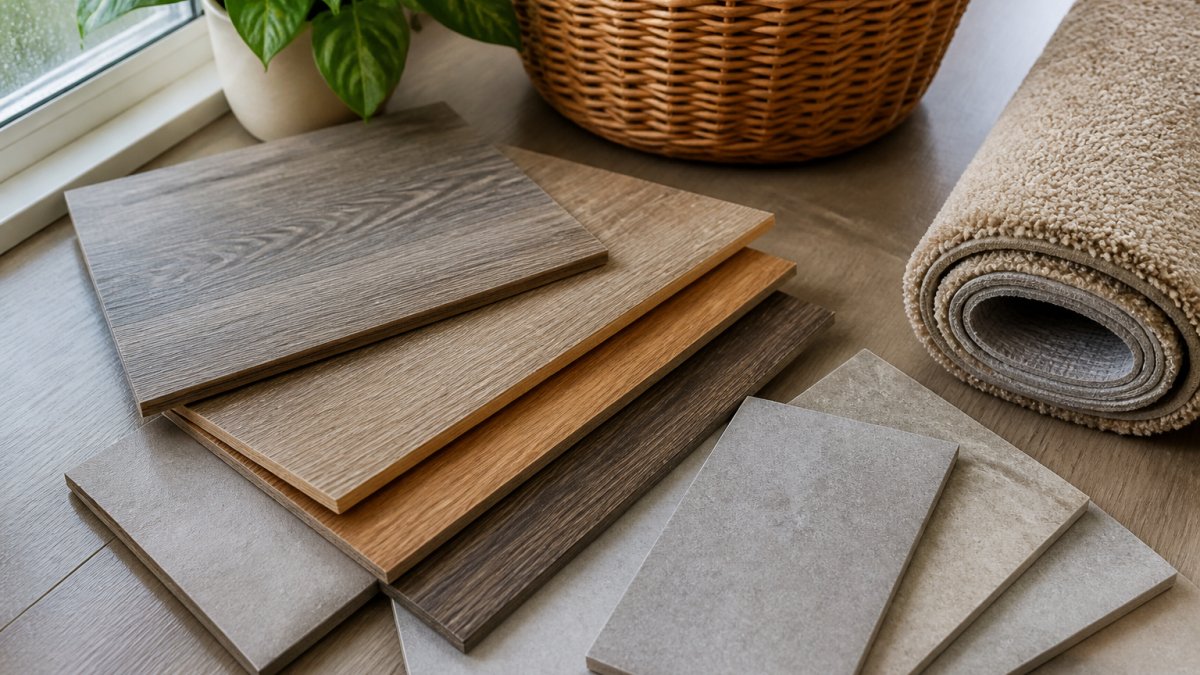
The best flooring for beach houses balances moisture resistance, scratch resistance, and how much natural wood look you want. Engineered hardwood gives you real wood with better dimensional stability than solid. Luxury vinyl plank gives you the most water resistance and the lowest maintenance.
Here's how the three stack up:
| Feature | Engineered Hardwood | Solid Hardwood | Luxury Vinyl Plank |
|---|---|---|---|
| Moisture tolerance | Moderate to good | Low | High |
| Dimensional stability | High | Low | High |
| Refinishing life | Limited by wear layer | Multiple times | Not refinishable |
| Best rooms | Living, bedrooms, dining | Dry, climate-controlled rooms | Kitchens, baths, mudrooms |
| Sand and grit | Scratches possible | Scratches possible | Scratches possible |
For a whole-house coastal renovation, many homeowners mix options: engineered hardwood in the main living spaces and luxury vinyl plank in wet, high-traffic zones.
Engineered Hardwood vs. Solid Hardwood in Coastal Conditions
Engineered hardwood outperforms solid hardwood in coastal conditions because its cross-ply core resists the seasonal movement that makes solid wood cup, gap, and warp.
The U.S. Department of Agriculture's Wood Handbook explains how wood absorbs and releases moisture with changes in relative humidity, which drives that swelling and shrinking.
That said, engineered hardwood is not fully beach-proof. Salt air, wet feet, and standing water are the real threats, not humidity alone.
Engineered Hardwood vs. Luxury Vinyl Plank for Beach Homes
Luxury vinyl plank beats engineered hardwood on pure water resistance, but engineered hardwood wins on look, feel, and resale appeal. LVP is fully water-resistant, easy to clean, and forgiving of sand and wet feet, which is why it dominates mudrooms, bathrooms, and rentals.
If your priority is the lowest-maintenance floor that shrugs off water, choose LVP. If you want genuine wood underfoot and are willing to maintain it, engineered hardwood delivers a better result.
Engineered Hardwood Wear Layer Thickness and Refinishing Limits
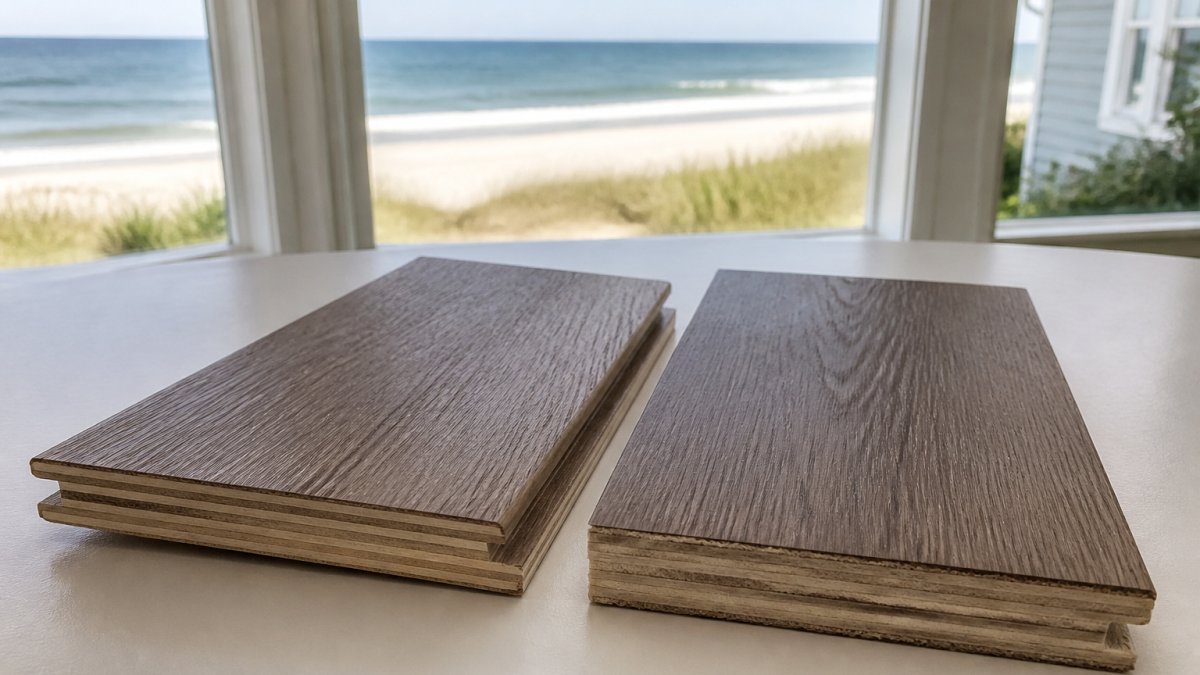
Engineered hardwood wear layer thickness is the single most important spec for durability, because it sets how many times the floor can be sanded and refinished. The wear layer is the top slice of real wood above the core: thicker means more refinishing life and better wear resistance, thinner means only a light screen-and-recoat, or none at all.
Most guides treat all engineered hardwood as equally durable. It isn't. The wear layer is where products diverge, and it's the number to compare first.
How to read the wear layer spec
Wear layers are listed in millimeters, and the market range is wide. A practical way to sort products:
- Thin decorative layers (roughly 0.6 mm and under): Often called "engineered veneer" or "engineered click." These typically cannot be sanded and refinished. Some can take a light screen-and-recoat, but even that depends on the manufacturer. Treat these as a one-life floor.
- Mid-range layers (roughly 1 to 2 mm): The common range for mid-priced engineered planks. These usually support one or two light sandings or screen-and-recoats, but not aggressive resurfacing. Refinishing potential depends heavily on the core and the finish system.
- Thick wear layers (roughly 3 mm and up): These behave more like solid wood on the surface. They generally support multiple sandings and refinishing cycles, which is what makes them the better long-term choice for a home you plan to keep.
These are general bands, not hard rules. The manufacturer's refinishing guidance is the authority, and it should be in writing before you buy.
Why the same product line can ship with different wear layers
The trap: a single product line often ships in multiple grades at different price points, and the showroom sample may not be the grade you're buying. A 2 mm and a 4 mm version of the same "collection" can look identical in a photo. The wear layer is where the cost difference lives.
What wear layer doesn't tell you
Wear layer thickness is necessary but not sufficient. Two other specs matter just as much:
- Core construction. Plywood cores generally handle moisture swings better than high-density fiberboard (HDF) cores, because the cross-ply layers resist swelling in different directions. HDF cores are denser and often more dent-resistant, but they're less forgiving if water reaches the core.
- Finish system. A factory-applied aluminum oxide or UV-cured urethane finish is harder and more scratch-resistant than an oil or wax finish. The trade-off is that oil and wax finishes are easier to spot-repair without sanding the whole floor.
A thick wear layer over a weak core still fails. A strong core under a paper-thin veneer still can't be refinished. Read all three specs together.
Refinishing limits in practice
Refinishing removes a thin layer of surface to expose fresh wood, then applies a new finish.
In a beach home, sand abrasion dulls the finish faster than normal foot traffic. With a thin wear layer, you may reach the point where the finish is worn but the floor can't be sanded again, replacement, not refinishing. That's the scenario a thicker wear layer buys you out of.
A simple buying checklist
Before committing to engineered hardwood for a coastal home, confirm:
- Wear layer thickness in millimeters, in writing, for the exact SKU.
- Core material (plywood vs. HDF) and how it's rated for moisture.
- Finish type and whether the manufacturer allows screen-and-recoat or full sanding.
- The manufacturer's stated refinishing guidance and any warranty conditions tied to it.
- Whether the product is rated for the installation method you plan to use (glue-down, floating, or staple-down).
With those five answers, you can compare products on durability instead of marketing language.
Sand, Grit, Dents, and High-Traffic Wear
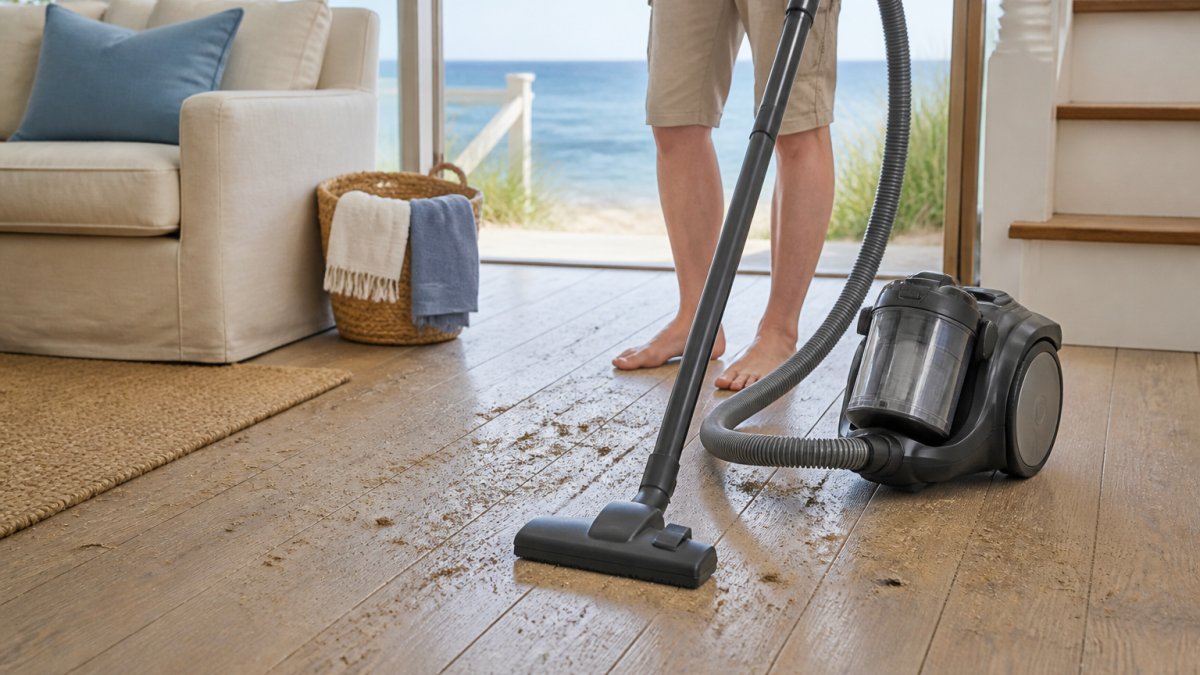
Sand and grit are the number one enemy of any wood floor in a beach home, because tracked-in grains act like sandpaper under every footstep.
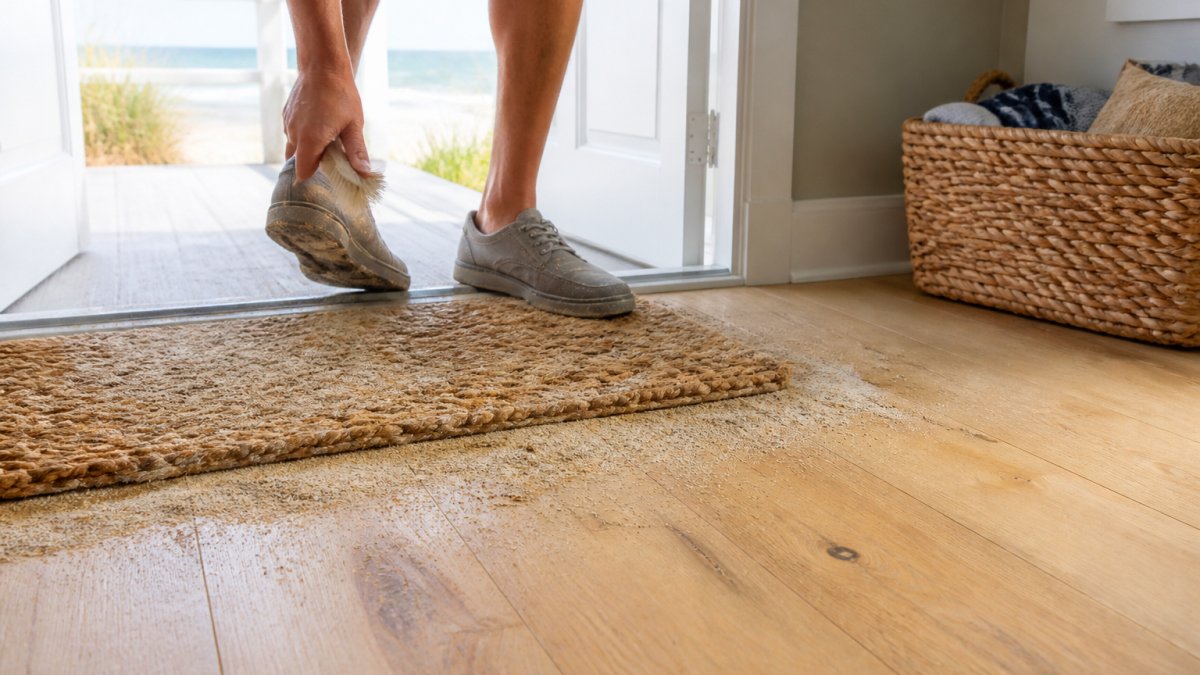
Matte finishes hide scratches and sand scuffs better than high-gloss, which is why they suit coastal homes. Harder wood species resist dents more than softer ones.
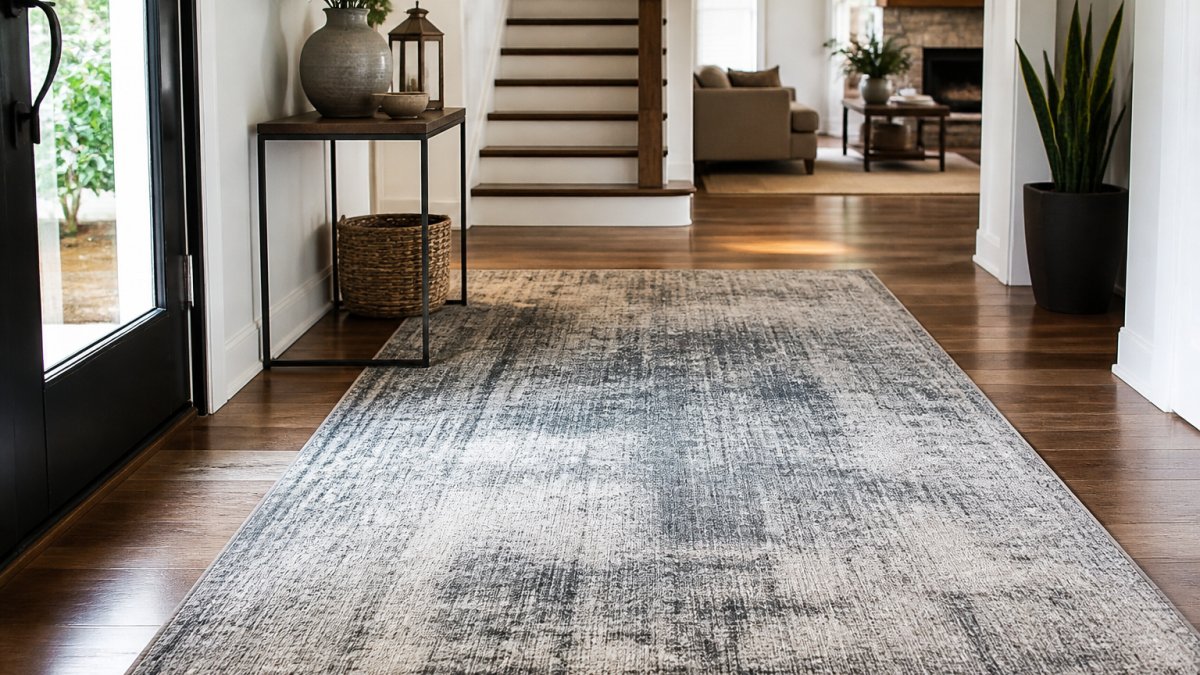
- Place coarse mats outside and soft mats inside every exterior door
- Sweep or vacuum grit daily during beach season
- Use felt pads under all furniture legs
Installation, Acclimation, and Sand-Control Maintenance
Proper acclimation and installation decide whether engineered hardwood performs or fails in a coastal home. Acclimation means letting planks sit in the room where they'll be installed so they adjust to local humidity; skip it and the floor can gap or cup.
Most coastal flooring failures aren't the floor's fault. They're installation and maintenance failures that show up months later, after the warranty window has narrowed.
Acclimation: what it actually involves
Acclimation is not just "let the boxes sit in the garage for a day." Planks need to reach equilibrium with the room's temperature and humidity, which takes longer in a humid coastal climate.
- Bring the flooring into the room where it will be installed, in the boxes, at least several days before installation. Many manufacturers specify a minimum acclimation period; follow theirs.
- Condition the space first. HVAC should be running and the home should be at normal living temperature and humidity before the flooring arrives. Acclimating in an unconditioned house doesn't work.
- Don't stack boxes tight against exterior walls or on a bare slab. Air needs to move around them.
If your installer wants to skip acclimation to save a day, that's a red flag. The floor may look fine at install and cup or gap the following season.
Subfloor moisture testing and prep
Concrete slabs and crawlspace subfloors wick moisture, and coastal homes carry a higher moisture load. Before installation:
- Test the subfloor for moisture. Installers use a calcium chloride test or an in-situ relative humidity probe for concrete, and a moisture meter for wood subfloors. Ask what test they used and what the reading was.
- Check for flatness. Most manufacturers specify a flatness tolerance (often expressed as a deviation over a set distance). Uneven subfloors cause hollow spots, squeaks, and premature wear at the high points.
- Address any prior water damage or active leaks before the floor goes down. Installing over a damp subfloor traps the problem under the new floor.
Expansion gaps and installation method
Wood moves, even engineered wood. Every installation needs a perimeter gap under the baseboard or covered by trim so the floor can expand without buckling. Pin the floor tight to the walls and it has nowhere to go when humidity rises.
- Glue-down is common in coastal homes because it limits movement and feels solid underfoot. It also handles minor subfloor irregularities better than floating.
- Floating is faster and easier to replace in sections, but it needs a proper expansion gap and a vapor barrier, and it can feel hollow.
- Staple-down or nail-down is typically for plywood subfloors and behaves more like solid wood installation.
Ask your installer which method they're using and why, the right answer depends on your subfloor, your floor's rating, and expected movement.
Sand-control maintenance routine
The fix for sand and grit is mostly prevention, and it's a routine, not a one-time purchase.
- Two-stage entry mats. A coarse, abrasive mat outside every exterior door to knock off sand, and a soft, absorbent mat inside to catch what's left. Shake them out weekly during beach season.
- Sweep or vacuum high-traffic zones daily during beach season. A soft-bristle broom or a vacuum with the beater bar off is safest for the finish.
- Damp-mop, don't soak. Use a manufacturer-approved cleaner and a mop that's damp, not dripping. Standing water is the enemy.
Seasonal rhythm for a coastal home
A practical seasonal pattern for coastal homeowners:
- Spring: Inspect entry mats, replace worn ones, check furniture pads, and schedule any recoat before the busy season.
- Summer: Daily grit removal, weekly mat cleaning, and watch for any sign of moisture at doors and sliders.
- Fall: Deep clean, check for scratches and dull spots, and decide whether a recoat is needed before winter.
If you're weighing options, our team can walk you through engineered hardwood, solid, and luxury vinyl plank side by side.
Frequently Asked Questions
Is engineered hardwood durable enough for a beach home?
Yes, for most rooms. Engineered hardwood's layered construction handles humidity swings better than solid hardwood because the core layers resist seasonal movement. It still needs precautions: keep indoor humidity steady, use mats at entries, and clean sand off quickly. Avoid it in full bathrooms and laundry rooms where standing water is routine. For open living areas, bedrooms, and hallways in a coastal home, it holds up well when installed and maintained correctly.
Is engineered hardwood better than solid hardwood in humid coastal conditions?
In coastal humidity, engineered hardwood is generally the safer choice. Its plywood core adds dimensional stability, so it expands and contracts less than a solid plank when moisture levels change. Solid hardwood is one piece of wood throughout, so it moves more with seasonal humidity and can cup or gap. That said, engineered hardwood is not beach-proof. It still needs acclimation before installation and a stable indoor humidity range to perform well.
Can sand scratch engineered hardwood floors?
Yes. Sand and grit are abrasive, and tracked-in sand acts like sandpaper on any floor finish over time. Matte and textured finishes hide scratches better than high-gloss, and a thicker wear layer gives you more surface to work with before refinishing is needed. The practical fix is prevention: place mats at every entry, ask guests to remove shoes, and vacuum or sweep often. A weekly damp mop lifts fine grit that sweeping misses.
Is luxury vinyl plank more durable than engineered hardwood for a beach house?
For pure water resistance, luxury vinyl plank wins. It is fully waterproof, so wet feet, splashes, and minor leaks are far less of a threat. Engineered hardwood offers real wood warmth and can be refinished, which LVP cannot. Some coastal homeowners choose LVP for mudrooms, kitchens, and basements, and engineered hardwood for living rooms and bedrooms. Matching the material to the room's moisture exposure is the most reliable approach.
A beach house floor takes more abuse than almost any other floor you'll own, and choosing wrong means living with the consequences for years. Hamptons carpet one floor and Home helps coastal homeowners get it right the first time with wear-layer guidance, moisture-aware product selection, and careful installation built for sandy, humid conditions. Get started with Hamptons carpet one floor and Home and choose a floor that holds up season after season.