 How-to
Is Waterproof Laminate Flooring Safe for Pets?
Table of Contents
- Is Waterproof Laminate Flooring Safe for Pets?
- Understanding Waterproof vs. Water-Resistant Laminate
- Best Laminate Flooring for Dogs: Scratch and Stain Resistance
- The Real Problem: Waterproof Laminate Flooring and Pet Urine
- Laminate vs. Vinyl Flooring for Pets: Which Handles Accidents Better
- How to Clean Pet Accidents from Laminate Flooring
- Slip Resistance, Safety, and Long-Term Durability for Pet Homes
- Conclusion: Is Waterproof Laminate Right for Your Pet?
- Frequently Asked Questions
Last Updated: October 6, 2026
Is Waterproof Laminate Flooring Safe for Pets?
Whether is waterproof laminate flooring safe for pets depends on your specific situation: your pet's habits, the room's moisture exposure, and how quickly you can respond to accidents. The answer depends on your specific situation: your pet's habits, the room's moisture exposure, and how quickly you can respond to accidents.
At Hamptons carpet one floor and Home, we help homeowners in Suffolk County choose flooring that actually holds up to real pet life. Before you commit to this flooring type, you need to understand what "waterproof" really means and where laminate actually falls short for pets.
The truth is that waterproof laminate can handle spills and muddy paws better than traditional laminate. But standing urine and prolonged moisture exposure remain serious concerns. This guide walks you through the real performance of waterproof laminate with pets, shows you how it compares to vinyl, and explains what you need to know before installation.
Understanding Waterproof vs. Water-Resistant Laminate
The terms "waterproof" and "water-resistant" get used interchangeably, but they mean different things for laminate flooring. Understanding the distinction matters because it changes how the product performs in your home.
Water-resistant laminate has a protective surface layer that repels water temporarily. Spills sit on top rather than soaking in immediately. You have time to wipe them up before moisture penetrates the core. This is what most laminate offers.
Waterproof laminate uses specialized construction with sealed edges and a moisture barrier underneath. Water still won't soak through instantly, but the product is engineered to resist moisture better over time. Some waterproof laminate can handle brief water exposure without swelling.
The key word is "brief." Even waterproof laminate isn't truly impervious to water. Leave a water bowl next to the dish and refill it daily without wiping spills, and you'll eventually see swelling at the edges. The wear layer protects the surface, but moisture can still travel along seams and through the core if given enough time and exposure.
For pet homes, this distinction matters most when accidents happen. A spill you catch in five minutes is different from urine that sits for hours. Waterproof laminate gives you more margin for error, but it's not a free pass to ignore wet spots.
Best Laminate Flooring for Dogs: Scratch and Stain Resistance
Dogs bring two main challenges to laminate flooring: scratches from claws and stains from accidents and muddy paws. Waterproof laminate can handle both better than standard options, but not perfectly.
Scratch resistance comes from the wear layer, the hard protective coating on top. Thicker wear layers resist claw marks better. When evaluating laminate for dogs, look for a wear layer rated for high traffic and heavy use. Laminate labeled for commercial or high-traffic residential use typically performs better than budget options.
Muddy paws and tracked-in sand are actually easier to manage than scratches. Wipe them up quickly and the floor stays clean. The real problem is that sand acts like an abrasive. Walk on sandy laminate repeatedly and you'll see the wear layer dull and scratch over time. In coastal homes where sand gets tracked in constantly, this becomes a real issue.
Stain resistance depends on how quickly you clean. Laminate doesn't absorb stains the way carpet does, which is an advantage. But pet accidents that sit for hours can discolor the surface. Waterproof laminate holds up better here because moisture doesn't penetrate as fast, giving you more time to clean before permanent damage sets in.
The honest take: laminate can work for dogs if you're willing to clean quickly and your dog is fully trained. Puppies and dogs prone to accidents will test the limits of any laminate, waterproof or not.
The Real Problem: Waterproof Laminate Flooring and Pet Urine
This is where the conversation gets real. Waterproof laminate flooring and pet urine don't mix as well as marketing suggests. Urine is acidic and contains compounds that damage laminate over time, and waterproof construction doesn't fully solve this problem.
When urine sits on laminate, even waterproof laminate, it can seep into seams and underneath the planks. The longer it sits, the more damage occurs. Within hours, urine can cause discoloration and odor that becomes permanent. Within days, moisture can cause swelling and warping, especially along the edges where planks meet.
Waterproof laminate delays this damage compared to standard laminate. The sealed edges and moisture barrier buy you time. But that time is measured in hours, not days. If you don't catch an accident within a few hours and clean thoroughly, expect lasting damage.
The seams are the weak point. Even waterproof laminate has seams between planks. Urine can work its way into these gaps, especially if the floor wasn't installed with proper spacing or if the subfloor moved slightly. Once moisture gets underneath, the core swells and the floor becomes permanently damaged.
Waterproof laminate is best suited to small, fully trained adult pets in dry rooms. It's not recommended for puppies, senior dogs prone to accidents, or pets with incontinence. If your pet has any history of indoor accidents, laminate, even waterproof laminate, carries real risk.
Laminate vs. Vinyl Flooring for Pets: Which Handles Accidents Better
Vinyl flooring, especially luxury vinyl plank (LVP), outperforms laminate for pet homes. The difference comes down to construction and how each material handles moisture.
Vinyl is inherently waterproof. Water doesn't penetrate vinyl at all because the material itself is non-porous. Spills and accidents don't cause swelling or permanent damage the way they do with laminate. You can leave a water bowl on vinyl indefinitely without worry.
Vinyl also handles urine better. While urine can still stain vinyl if left long enough, it doesn't cause structural damage. The floor won't swell or warp. You clean it up and move on. With laminate, even waterproof laminate, urine exposure carries the risk of permanent swelling and odor that seals into the core.
Vinyl comes in two main types: sheet vinyl and luxury vinyl plank. Sheet vinyl is a single piece with no seams in the middle of the room, which eliminates the seam problem entirely. Luxury vinyl plank looks more like real wood and is easier to install, but it has seams where water can potentially get through.
The trade-off is that vinyl doesn't feel quite like real wood or laminate. Some people find it softer underfoot and less authentic-looking. But for pet homes, especially homes with dogs prone to accidents, vinyl typically makes more sense than waterproof laminate.
| Flooring Type | Water Damage Risk | Urine Damage Risk | Scratch Resistance | Best For |
|---|---|---|---|---|
| Standard Laminate | High | High | Moderate | Dry rooms, trained pets |
| Waterproof Laminate | Moderate | Moderate to High | Moderate | Trained dogs, quick cleanup |
| Vinyl Plank | Low | Low | Good | Active pets, accident-prone homes |
| Sheet Vinyl | Very Low | Very Low | Good | Homes with frequent spills |
How to Clean Pet Accidents from Laminate Flooring
If you choose waterproof laminate despite the risks, knowing how to clean accidents properly is essential. Speed and technique matter.
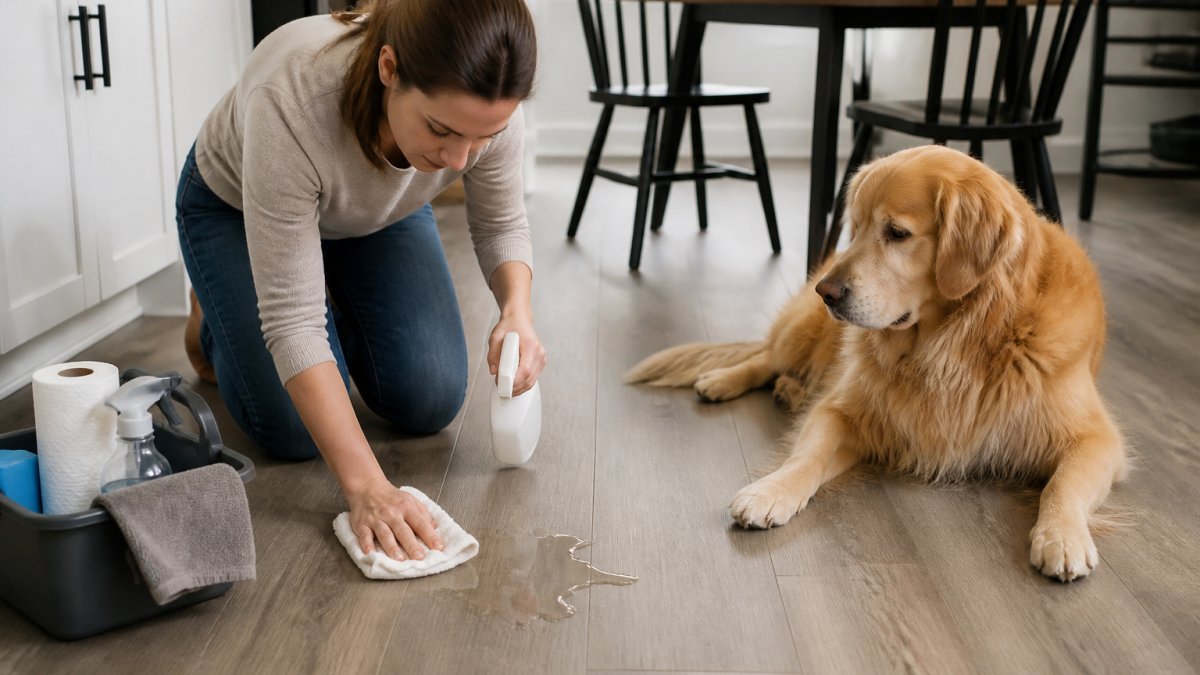
Act within the first hour. The longer urine sits, the more damage occurs. Check for accidents multiple times daily if you have a pet prone to accidents.
Blot, don't rub. Use a cloth or paper towels to blot up the urine. Rubbing spreads the liquid and pushes it deeper into seams. Press down firmly to absorb as much as possible.
Use enzymatic cleaner. Regular cleaners don't break down urine compounds. Enzymatic cleaners contain bacteria that digest urine, eliminating both stains and odor.
Dry thoroughly. After cleaning, use dry cloths to remove all remaining moisture. Open windows to increase air circulation. Use a fan if needed. Any moisture left behind can seep into seams and cause swelling.
Don't use excessive water. Avoid wet mopping over accident areas. The extra water increases the risk of moisture penetrating seams and the core. Stick to damp cloths, not soaking wet ones.
Reseal seams if needed. If an accident happened near a seam, consider applying a waterproof sealant to that area after cleaning. This adds an extra barrier against future moisture penetration.
Even with perfect cleanup, repeated accidents in the same spot will eventually cause damage. Waterproof laminate can't withstand constant urine exposure.
Slip Resistance, Safety, and Long-Term Durability for Pet Homes
Waterproof laminate often has a smooth, glossy finish that looks great but creates a hazard for pets. Dogs and cats can slip on smooth laminate, especially when running or turning quickly.
Slip resistance matters for pet safety. A slippery floor increases the risk of joint injuries and makes pets hesitant to move freely. Senior pets are especially vulnerable. Laminate with a textured or matte finish offers better traction than high-gloss options.
When choosing waterproof laminate, ask about the finish. Textured surfaces grip better than smooth ones. Some laminate products are designed specifically for homes with pets and include anti-slip treatments.
Long-term durability in pet homes depends on maintenance. With active pets, expect the lifespan to be shorter. Repeated scratches, stains, and moisture exposure wear down the protective layers faster.
Sand tracked in from outdoors is a silent killer for laminate durability. In coastal areas where sand is constant, laminate shows wear more quickly. Regular sweeping and vacuuming reduce this damage, but you can't eliminate it entirely.
Waterproof laminate is more durable than standard laminate in pet homes, but it's not as durable as vinyl or hardwood. If you're planning to stay in your home for 10+ years with active pets, consider whether laminate is worth the long-term cost of repairs and replacement.
Conclusion: Is Waterproof Laminate Right for Your Pet?
Waterproof laminate flooring can work for pets, but only in specific situations. It's best suited to homes with small, fully trained adult dogs in rooms where accidents are rare.
The key limitations are clear: urine damage, moisture sensitivity at seams, and slip hazards. Waterproof laminate delays these problems compared to standard laminate, but it doesn't eliminate them.
For most pet homes, vinyl flooring is a better choice. It's truly waterproof, handles urine without permanent damage, and requires less fuss. If you prefer the look and feel of laminate, be realistic about the trade-offs and commit to fast cleanup protocols.
At Hamptons carpet one floor and Home, we help homeowners in Suffolk County choose flooring that matches their actual pet situation, not an idealized version.
Before choosing waterproof laminate, consider these questions: Does your pet have a history of accidents? How quickly can you respond to spills? Are you comfortable with potential repairs? Can you commit to regular maintenance?
If you answer "no" to any of these, vinyl is likely the safer investment. If you have a fully trained adult pet and understand the limitations, waterproof laminate can deliver good performance at a reasonable cost.
Choosing pet-friendly flooring is one of the biggest decisions you'll make for your home. At Hamptons carpet one floor and Home, we guide homeowners through this choice with honest advice about what actually works.
Frequently Asked Questions
Can dog urine damage waterproof laminate flooring?
Yes. While waterproof laminate resists surface moisture, urine that sits for hours or days can seep into seams and joints, causing swelling, warping, and permanent damage beneath the wear layer. Immediate cleanup is essential. If urine sits overnight or longer, the subfloor may absorb moisture before you notice, leading to structural failure that replacement cannot fix.
Is waterproof laminate flooring slippery for dogs?
Many laminate floors have a smooth, hard surface that can be slippery for dogs, especially on high-gloss finishes. This creates hazardous conditions for pets with arthritis or mobility issues and increases their risk of injury. Textured or matte laminate surfaces offer better traction, but you should verify the finish before purchase and consider area rugs in high-traffic pet zones.
Which is better for pets, vinyl or laminate flooring?
Luxury vinyl plank (LVP) is generally more pet-friendly than laminate. LVP is fully waterproof, not just water-resistant, and handles standing water and urine exposure far better. Laminate's main advantage is cost and appearance, but it requires faster cleanup and is riskier for pets prone to accidents. For households with puppies, senior pets, or frequent spills, vinyl is the safer choice.
What should I look for in the best laminate flooring for dogs?
Prioritize a wear layer at least 12 mils thick for scratch resistance, a matte or textured finish for slip resistance, and genuine waterproof construction (not just water-resistant). Verify that seams are sealed during installation. Budget for quick cleanup supplies and ask about repair costs, since scratches and stains may require full-plank replacement rather than spot repair.