 Ultimate guide
Low Maintenance Flooring for Busy Families: 2026 Guide
Table of Contents
- What Makes Flooring Truly Low Maintenance for Busy Families
- Durable Flooring Materials for High Traffic Areas
- Luxury Vinyl Plank vs Laminate for Families: Which Wins?
- Best Flooring for Kids and Pets: Scratch-Resistant Options Ranked
- How to Clean Low Maintenance Floors the Right Way
- Installation Difficulty, Repairability, and Long-Term Value
- Flooring Budget Guide: Cost-Effective Choices for Every Home
- Choosing the Right Low Maintenance Flooring for Your Family
Last Updated: May 31, 2026
Choosing low maintenance flooring for busy families is one of the most practical decisions you can make before a home renovation, and Hamptons Carpet One Floor and Home has helped hundreds of Suffolk County homeowners get it right. The wrong floor will show every scratch, trap allergens, and require constant upkeep. The right one handles spills, pets, and heavy foot traffic without demanding much in return. Below, we'll show you exactly how to match your family's specific needs to the flooring material that will hold up best, and we'll call out the angles most guides skip entirely.
Here's what most guides get wrong: they rank flooring by aesthetics first and durability second. For families with kids and pets, that priority order is backwards. A floor that looks stunning on day one but shows wear within a year is not a low-maintenance floor. It's a high-regret purchase.
What Makes Flooring Truly Low Maintenance for Busy Families
Low maintenance flooring for busy families is flooring that resists daily damage, cleans quickly without special products, and does not require periodic refinishing or professional treatment to stay presentable. Three core properties determine whether a floor qualifies: the wear layer thickness, water resistance rating, and stain resistance.
Key Factors: Wear Layer, Water Resistance, and Stain Resistance
The wear layer is the transparent protective coating on top of a floor's surface. For luxury vinyl plank, a wear layer of 12 mil or thicker is the baseline for family use. Anything below 8 mil will show scratches within months in high-traffic areas like hallways and playrooms.
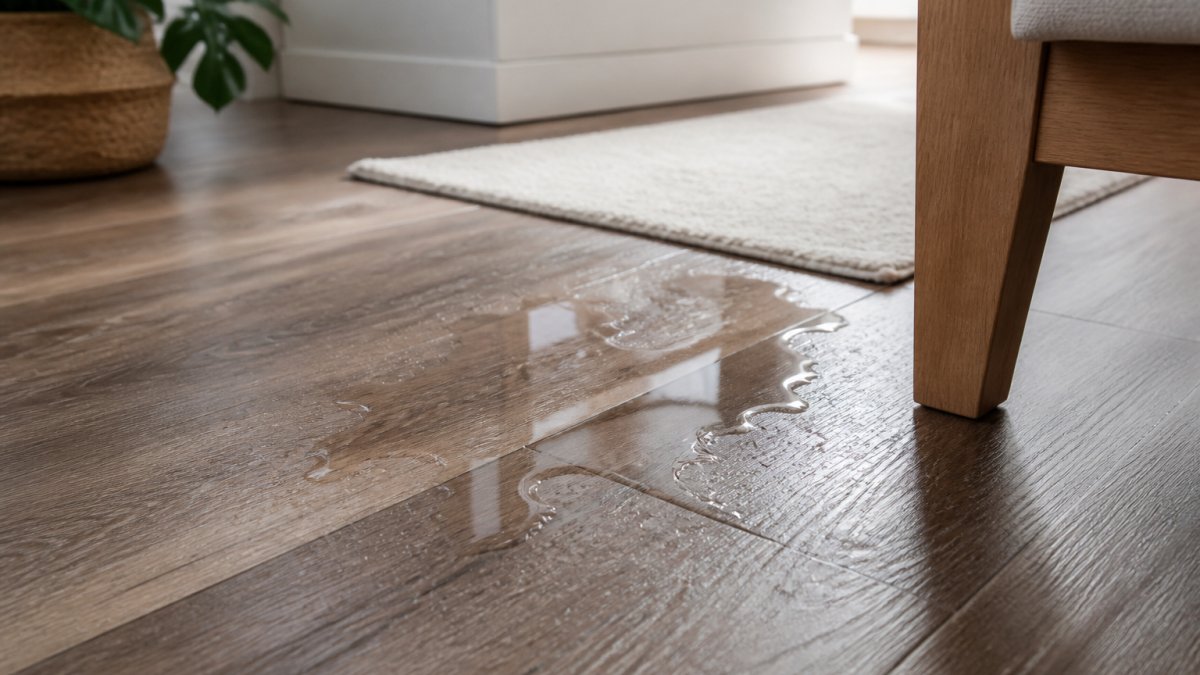
Water resistance matters more than most buyers realize. There is a meaningful difference between water-resistant and waterproof. Water-resistant floors can handle spills if wiped up promptly. Waterproof floors, including most luxury vinyl plank and porcelain tile, tolerate standing water without warping the subfloor or the surface. For households with young children or pets, waterproof is worth the premium.
Stain resistance is largely determined by the surface finish and material density. Glazed porcelain tile and vinyl surfaces resist most household stains. Unfinished wood and low-density laminate absorb liquids quickly, making stain removal a real challenge.
Flooring Types at a Glance: Quick Comparison Table
| Flooring Type | Water Resistance | Scratch Resistance | Maintenance Level | Avg. Durability |
|---|---|---|---|---|
| Luxury Vinyl Plank (LVP) | Waterproof | High (12+ mil wear layer) | Very Low | 15-25 years |
| Porcelain Tile | Waterproof | Very High | Low | 30+ years |
| Engineered Hardwood | Water-Resistant | Moderate | Moderate | 20-30 years |
| Laminate | Water-Resistant | Moderate | Low-Moderate | 10-20 years |
| Solid Hardwood | Low | Low-Moderate | High | 30+ years (with refinishing) |
| Carpet | Low | N/A | High | 5-15 years |
Durable Flooring Materials for High Traffic Areas
The biggest mistake families make is selecting flooring based on showroom samples rather than real-world performance data. A floor that looks identical to two others on display may behave completely differently under daily punishment. Durable flooring materials for high-traffic areas share one trait: they are engineered specifically to handle volume.
Luxury Vinyl Plank: The Family-Friendly Front-Runner
Luxury vinyl plank is the most practical choice for durable flooring in high-traffic areas, and it has earned that position on performance, not marketing. LVP consists of multiple layers: a rigid core (often stone-plastic composite or wood-plastic composite), a printed design layer, and a wear layer on top. The rigid core resists denting and dimensional changes caused by temperature fluctuation, which makes LVP stable in spaces like sunrooms and basements where solid hardwood would buckle.
The wear layer is what separates entry-level LVP from family-grade product. For homes with pets, look for a minimum 20 mil wear layer. For households with kids only, 12-15 mil is generally sufficient. The higher the mil rating, the longer the floor resists scratching from furniture legs, pet claws, and dropped objects.
LVP is also genuinely spill-proof at the surface and, with a waterproof core, will not swell if water reaches the subfloor through seams. That said, standing water left for extended periods can still cause issues with the adhesive or the subfloor beneath, so prompt cleanup remains good practice.
According to the National Wood Flooring Association's flooring guidance, proper installation over a flat, clean subfloor is one of the most important factors in long-term floor performance, regardless of material type.
Porcelain Tile: Unmatched Durability in High-Moisture Areas
Porcelain tile is the correct answer for high-moisture areas. Full stop. Bathrooms, laundry rooms, mudrooms, and kitchens with heavy cooking activity all benefit from porcelain's near-impervious surface. Porcelain is denser than ceramic tile, absorbs virtually no moisture, and resists both scratches and staining at a level no other flooring type can match.
The practical limitation is comfort underfoot and installation complexity. Porcelain is hard and cold, which makes it less appealing in living rooms and bedrooms. Radiant heating beneath tile solves the temperature problem but adds installation cost. Grout lines also require periodic sealing to prevent staining, which is the one maintenance task tile owners cannot skip.
For families considering tile in playrooms, the hardness factor deserves honest attention. Falls on tile hurt more than falls on vinyl or carpet. In spaces where young children spend significant floor time, this is worth weighing against the durability advantage.
Engineered Hardwood: Beauty With More Resilience
Engineered hardwood occupies the middle ground between solid hardwood and LVP. It consists of a real hardwood veneer bonded to multiple layers of plywood or HDF core, which gives it more dimensional stability than solid wood. It can handle moderate moisture exposure that would cause solid hardwood to warp, making it viable in kitchens and finished basements.
The honest limitation: engineered hardwood can be refinished fewer times than solid hardwood, and it cannot be refinished at all if the veneer is thinner than 2mm. Scratch resistance depends heavily on the species and finish. Harder species like hickory and white oak outperform softer ones like pine. For families with large dogs, engineered hardwood requires protective pads under furniture and regular dry mopping to stay presentable.
Luxury Vinyl Plank vs Laminate for Families: Which Wins?
Luxury vinyl plank vs laminate for families comes down to more than one decisive difference. Water resistance is the headline, but installation complexity, repairability after damage, and long-term cost of ownership separate these two materials in ways most guides never explain.
The Water Resistance Gap Is Real, But It Is Not the Whole Story
Laminate flooring is made primarily from high-density fiberboard (HDF), a wood-fiber composite that swells when moisture penetrates the core. LVP uses a stone-plastic composite (SPC) or wood-plastic composite (WPC) core that does not absorb water. That difference matters in practice: a single overlooked spill near a laminate seam, a knocked-over cup, a pet's water bowl, condensation from a refrigerator, can cause irreversible swelling that lifts the surrounding planks. LVP handles the same scenario without consequence.
But water is not the only variable. Here is what the comparison actually looks like across the factors families care about most:
| Feature | LVP | Laminate |
|---|---|---|
| Waterproof core | Yes (SPC/WPC) | No (HDF swells) |
| Scratch resistance | High (wear layer rated in mil) | High (rated by AC class) |
| DIY installation difficulty | Low, click-lock, forgiving subfloor tolerance | Low, click-lock, but moisture barriers are mandatory |
| Repairability | Easy, individual plank swap in floating install | Moderate, plank swap possible, but water damage spreads beyond the visible plank |
| Comfort underfoot | Moderate, WPC cores add cushion | Moderate, thicker underlayment improves feel |
| Realistic lifespan | 15-25 years in family use | 10-20 years in dry conditions; shorter near moisture |
| Best rooms | Whole home, including kitchens and bathrooms | Bedrooms, formal dining rooms, dry living areas |
Scratch Resistance: Wear Layer Mil vs AC Rating
LVP scratch resistance is measured in mil (thousandths of an inch) of wear layer thickness. Laminate scratch resistance is measured by the AC (Abrasion Class) rating system, which runs from AC1 (light residential) to AC5 (heavy commercial).
For family use, the practical equivalents are:
- LVP 12 mil ≈ AC3 laminate, adequate for households with kids and light pet activity
- LVP 20 mil ≈ AC4 laminate, appropriate for large dogs and high-traffic hallways
- LVP 28+ mil, commercial-grade; no laminate equivalent exists at this level
At equivalent scratch-resistance ratings, quality laminate often costs less per square foot than LVP. That price gap is real and worth acknowledging. The trade-off is that laminate's scratch resistance becomes irrelevant the moment moisture reaches the core.
Installation: Where the Two Materials Actually Differ
Both LVP and laminate use click-lock floating installation systems that are accessible to a moderately skilled DIYer. The process is similar enough that a homeowner comfortable installing one can install the other. The meaningful installation differences are:
Moisture barrier requirements: Laminate almost always requires a separate underlayment with a vapor barrier, particularly over concrete subfloors. Many LVP products have underlayment pre-attached and do not require an additional moisture barrier. Skipping the vapor barrier under laminate over a concrete slab is one of the most common causes of premature laminate failure in basements and ground-floor rooms.
Subfloor flatness tolerance: Both materials require a flat subfloor, but SPC-core LVP is more rigid and bridges minor subfloor imperfections better than laminate. The standard tolerance for both is 3/16 inch over a 10-foot span, but thicker SPC cores (6mm and above) are more forgiving in practice.
Acclimation time: Laminate typically requires 48-72 hours of acclimation in the installation space before installation. Many SPC LVP products require little or no acclimation because the rigid core does not expand and contract with humidity changes the way wood-fiber products do. In a busy household where you need to move furniture back quickly, that difference matters.
Repairability After Damage: The Scenario Competitors Skip
Imagine a scenario that happens in most family homes within the first three years: a single plank is gouged by a moved appliance, or a section near the dishwasher shows moisture damage. Here is what repair actually looks like for each material:
LVP (floating installation): Remove the baseboard trim on the nearest wall. Disassemble the click-lock planks from the wall edge to the damaged plank. Swap the damaged plank. Reassemble. Total time for an experienced DIYer: 1-3 hours. The critical requirement is having matching material from the original installation run, color lots change between production batches, so always store 5-10% overage.
Laminate (floating installation): The same disassembly process applies, and individual plank replacement is technically possible. The complication is that moisture damage in laminate rarely stays contained to one plank. The swelling that makes a plank visible has usually already affected the adjacent planks and the underlayment beneath. What looks like a one-plank repair often becomes a section repair once the floor is opened. Keeping overage material is equally important, and color-matching older laminate is often harder because laminate product lines turn over faster than LVP lines.
The Verdict for Busy Families
LVP wins for most family applications, not because laminate is a bad product, but because family homes do not reliably stay dry. The moisture risk is not hypothetical; it is a statistical certainty over a 10-to-15-year floor lifespan with children and pets in the home.
Laminate is a legitimate choice in genuinely dry rooms, bedrooms, formal dining rooms, home offices, where the budget is tight and spill risk is low. In those specific contexts, AC4-rated laminate with a quality attached underlayment performs comparably to mid-range LVP at a lower upfront cost.
The hybrid approach many experienced installers recommend: LVP in kitchens, hallways, bathrooms, mudrooms, and living rooms; laminate in bedrooms and low-traffic dry areas. This approach captures laminate's cost advantage where moisture risk is minimal while protecting the rooms where damage is most likely.
Best Flooring for Kids and Pets: Scratch-Resistant Options Ranked
Scratch-resistant flooring for kids and pets requires a wear layer or surface hardness that exceeds the force of pet claws and dropped toys. Here are the top options ranked by real-world performance.
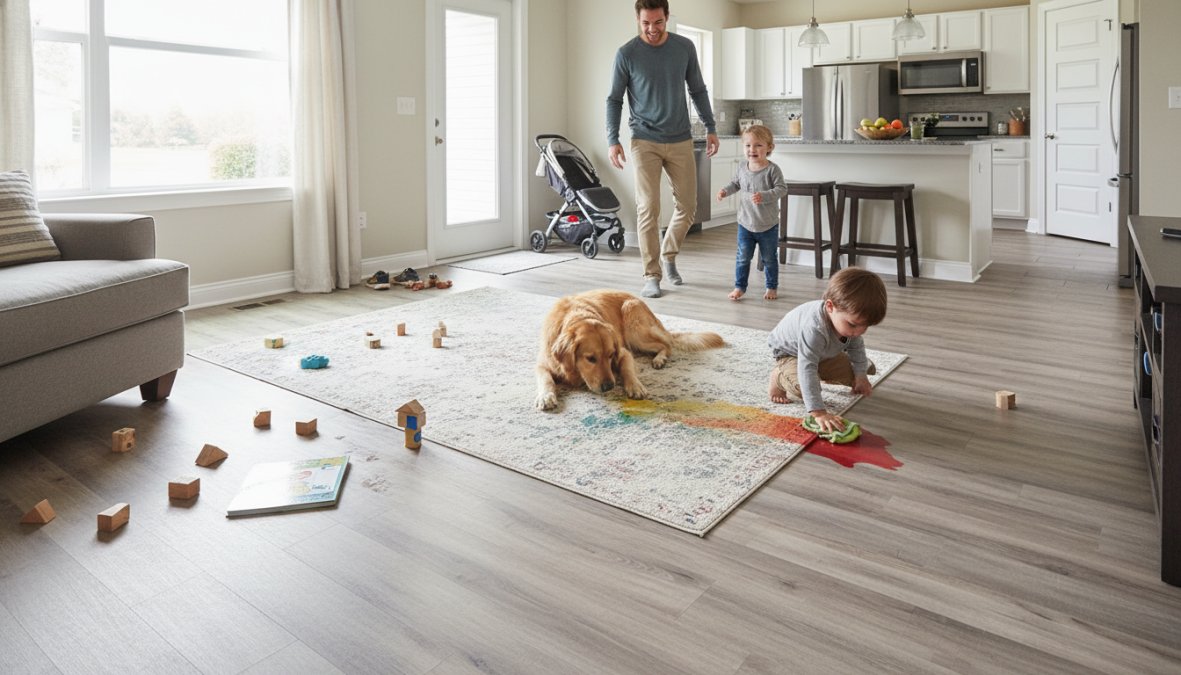
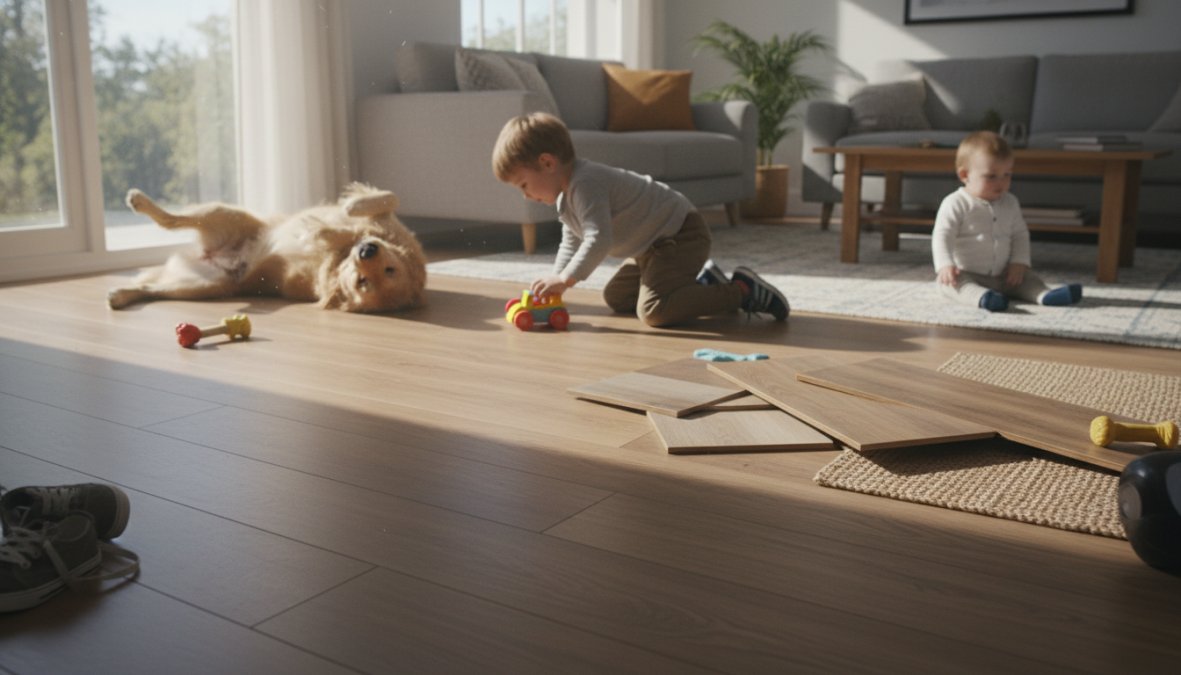
A young child and a dog playing on the floor will test any surface within weeks. The flooring that survives that test reliably is the floor worth buying.
- Porcelain tile - Hardest surface available. Pet claws cannot scratch glazed porcelain. Cold underfoot.
- LVP with 20+ mil wear layer - Best overall for families. Handles pet claws, spills, and toy impacts.
- LVP with 12-15 mil wear layer - Good for households with kids only or smaller pets.
- Engineered hardwood (hard species) - Acceptable with protective measures. Requires more maintenance.
- Laminate (AC4 rating or above) - Viable in dry rooms with moderate pet activity.
- Solid hardwood - Beautiful but high-maintenance. Shows scratches from pets quickly.
Allergy-Friendly and Non-Toxic Flooring Considerations
This is the angle most flooring guides skip entirely, and it matters more than many families realize. Hard-surface flooring is inherently more allergy-friendly than carpet because it does not trap dust mites, pet dander, or pollen. Regular vacuuming and dry mopping removes allergens from hard floors completely, while carpet retains them even after cleaning.
The non-toxic question is more nuanced. Some flooring products contain volatile organic compounds (VOCs) from adhesives, backing materials, or surface finishes. According to the Environmental Protection Agency's indoor air quality guidance, VOC emissions from flooring materials can contribute to poor indoor air quality, particularly in newly installed spaces.
To minimize VOC exposure:
- Look for flooring certified to GREENGUARD Gold standards
- Choose products with low-VOC or water-based adhesives
- Ventilate rooms thoroughly after installation for at least 72 hours
- Consider click-lock installation systems that require no adhesive
LVP and engineered hardwood from reputable manufacturers increasingly carry GREENGUARD or FloorScore certifications, which are independently verified. Ask specifically for certification documentation, not just a manufacturer's claim.
How to Clean Low Maintenance Floors the Right Way
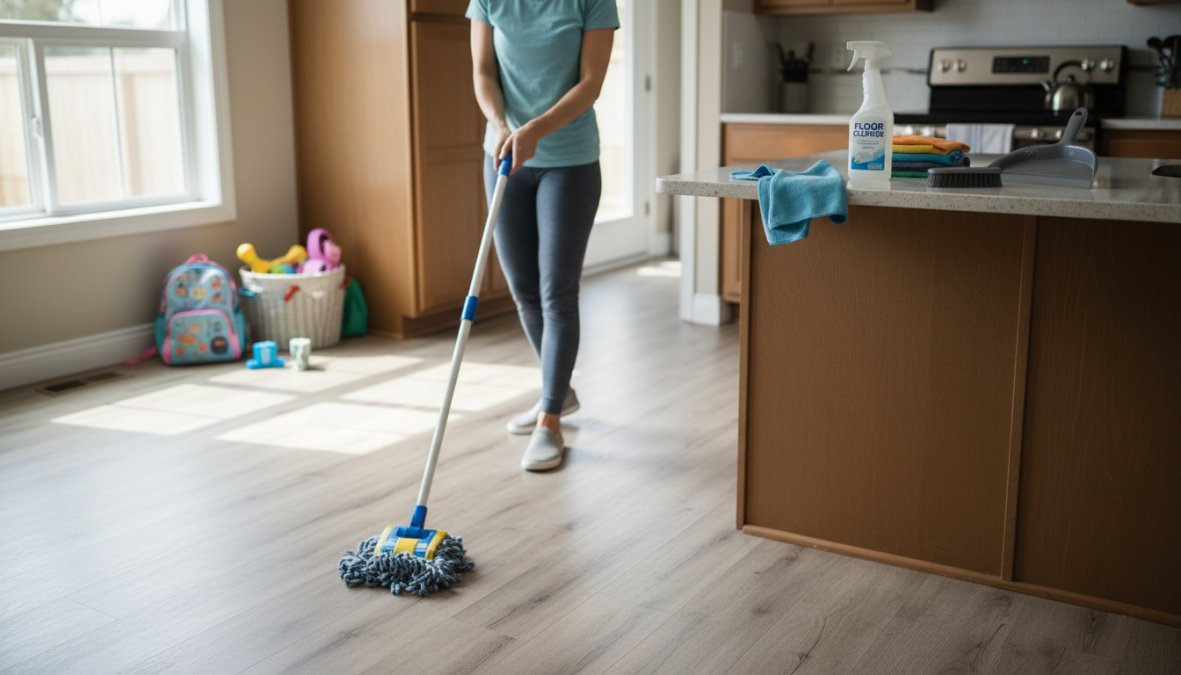
Cleaning low-maintenance floors correctly is simpler than most people expect, but the wrong method can degrade the surface faster than daily foot traffic. The core principle: less is more. Harsh chemicals, steam mops, and excessive water are the enemies of most flooring finishes.
Daily and Weekly Cleaning Routines by Floor Type
Luxury Vinyl Plank:
- Daily: dry mop or vacuum with a soft brush attachment to remove grit (grit causes micro-scratches over time)
- Weekly: damp mop with a pH-neutral cleaner diluted in water
- Never: steam mop, abrasive scrubbers, wax-based cleaners, or oil soaps
Porcelain Tile:
- Daily: sweep or vacuum
- Weekly: damp mop with a mild detergent; clean grout lines with a stiff brush monthly
- Annually: reseal grout lines to prevent staining
Engineered Hardwood:
- Daily: dry mop or vacuum (avoid beater bar attachments)
- Weekly: lightly damp mop with a hardwood-specific cleaner
- Never: wet mop, steam, or vinegar-based solutions (vinegar strips the finish)
Laminate:
- Daily: dry mop or vacuum
- Weekly: damp mop, wringing the mop almost completely dry
- Never: standing water near seams, steam, or wax
Installation Difficulty, Repairability, and Long-Term Value
Most flooring guides focus entirely on the purchase decision and ignore what happens three years later when a plank gets damaged or a tile cracks. That is a significant blind spot for families, because damage is not a question of if but when.
DIY vs Professional Installation: What Families Should Know
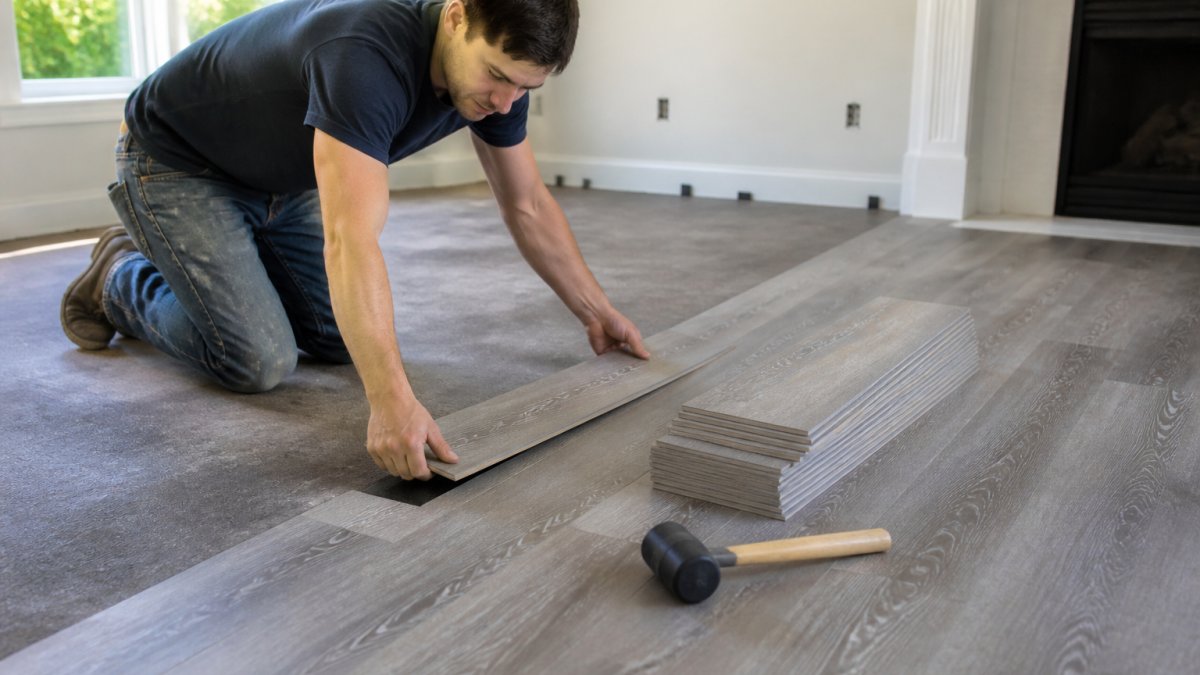
Click-lock LVP and laminate are the most DIY-accessible flooring types. The floating installation method requires no adhesive and no special tools beyond a tapping block and pull bar. A moderately skilled homeowner can install 200-300 square feet per day. The subfloor must be flat to within 3/16 inch over a 10-foot span; failing to check this is the most common DIY installation mistake and causes clicking, gapping, and premature wear.
Porcelain tile requires more skill. Proper tile installation involves subfloor preparation, mortar bed application, tile layout planning, and grout work. Errors in any of these steps cause cracked tiles, uneven surfaces, or grout failure. For most families, professional tile installation is worth the cost.
Engineered hardwood can be installed as a floating floor or glued/nailed down. Glue-down and nail-down installations are more stable but require professional tools and experience. According to the World Floor Covering Association's installation standards, improper subfloor moisture testing before hardwood installation is the leading cause of premature floor failure.
Which Floors Are Easiest to Repair After Damage
Repairability is one of the most underrated factors in flooring selection. Here is the honest ranking:
- LVP - Individual planks can be removed and replaced in a floating installation without disturbing the surrounding floor. Keep 5-10% extra material from the original installation.
- Porcelain tile - Individual tiles can be replaced if you have matching material. Grout color matching is the main challenge.
- Engineered hardwood - Floating installations allow plank replacement. Glued-down installations require professional repair.
- Laminate - Floating installation allows plank replacement, but water-damaged laminate often swells beyond the affected plank.
- Solid hardwood - Individual boards can be replaced, but color and finish matching requires professional refinishing.
Flooring Budget Guide: Cost-Effective Choices for Every Home
Budget-friendly flooring does not mean cheap flooring. It means selecting the most cost-effective material for each specific room based on traffic, moisture exposure, installation method, and how long you intend to stay in the home. The families who overspend on flooring almost always make the same mistake: they apply one quality level and one price tier to every room, regardless of how differently those rooms are actually used.
Material Cost Ranges: What to Expect Per Square Foot
Prices vary by region, supplier, and product tier, but the following ranges reflect typical retail pricing for materials only in the current market. Installation costs are separate and addressed below.
| Flooring Type | Entry-Level (materials only) | Mid-Range | Premium |
|---|---|---|---|
| LVP (6-8 mil wear layer) | Lower end of vinyl range | , | , |
| LVP (12-15 mil wear layer) | , | Mid vinyl range | , |
| LVP (20+ mil wear layer) | , | , | Upper vinyl range |
| Laminate (AC3) | Lower end of laminate range | , | , |
| Laminate (AC4-AC5) | , | Mid laminate range | , |
| Engineered Hardwood | , | Mid-to-upper range | Premium range |
| Porcelain Tile | Lower end of tile range | Mid tile range | Upper tile range |
| Solid Hardwood | , | Mid hardwood range | Premium hardwood range |
Note: Prices shift with supply chain conditions, regional labor markets, and product availability. Always get current quotes from local suppliers before budgeting a project. The ranges above are relative guides, not fixed figures.
The pattern worth noting: entry-level LVP and entry-level laminate occupy similar price territory for materials. The cost gap between them is smaller than most buyers expect. The larger cost variable is almost always installation, not materials.
DIY vs Professional Installation: The Cost Gap Competitors Ignore
This is the factor most flooring guides skip entirely, and it is often the largest single variable in total project cost. Material cost is only part of the equation. Installation method, DIY floating, professional floating, glue-down, or mortar-set, can change the total cost of a flooring project significantly.
Click-lock LVP and laminate are the most DIY-accessible flooring types. A moderately skilled homeowner with basic tools (tapping block, pull bar, miter saw or circular saw, and a tape measure) can install a floating floor. The subfloor preparation is the step most DIYers underestimate: the floor must be flat to within 3/16 inch over a 10-foot span, clean, and dry. Self-leveling compound to correct a wavy subfloor adds material cost but is within DIY capability. Skipping this step causes clicking joints, gapping, and premature wear, and voids most manufacturer warranties.
Porcelain tile is the flooring type where professional installation most consistently pays for itself. Proper tile work involves subfloor deflection assessment (tile cracks when the subfloor flexes), mortar bed mixing and application, tile layout planning to avoid narrow cuts at visible edges, and grout work. Errors in any of these steps result in cracked tiles, lippage (uneven tile edges), or grout failure within a few years. For most families, the professional installation cost for tile is not optional, it is the cost of getting a 30-year floor instead of a 5-year floor.
Engineered hardwood sits in the middle. Floating engineered hardwood installation is DIY-accessible and follows similar principles to LVP. Glue-down and nail-down installations require professional tools (flooring nailer, moisture meter, adhesive spreader) and experience with moisture testing. According to the World Floor Covering Association's installation standards, improper subfloor moisture testing before hardwood installation is the leading cause of premature floor failure, a mistake that is far more common in DIY installations than professional ones.
The practical framework for installation decisions:
- DIY-appropriate: Click-lock LVP, click-lock laminate, floating engineered hardwood
- DIY-possible with research: Glue-down LVP, basic ceramic tile in small areas
- Professional recommended: Porcelain tile, nail-down or glue-down engineered hardwood, solid hardwood
- Professional required for warranty: Most glue-down applications; any installation over radiant heat
Total Cost of Ownership: The Calculation That Changes the Decision
Upfront material cost is the least useful number for evaluating flooring value. Total cost of ownership, materials plus installation plus maintenance plus replacement timeline, often reverses the apparent value ranking.
Consider a practical comparison for a 200-square-foot kitchen:
Scenario A: Entry-level laminate, DIY installation Lower upfront cost for materials and near-zero installation labor if DIY. Realistic lifespan in a kitchen with a family: 8-12 years before moisture damage or surface wear requires replacement. Replacement cost is the full project cost again, plus the disruption of moving appliances and furniture.
Scenario B: Mid-range LVP (15 mil), DIY installation Moderately higher material cost, similar DIY installation labor. Realistic lifespan in the same kitchen: 15-20 years. Individual damaged planks are replaceable without full floor replacement. Over a 20-year horizon, the LVP scenario typically costs less in total even though it costs more upfront.
Scenario C: Porcelain tile, professional installation Highest upfront cost combining materials and professional labor. Realistic lifespan: 30-plus years with grout resealing every few years. Over a 30-year horizon, porcelain tile in a kitchen or bathroom is often the lowest total cost option despite the highest initial investment.
As noted by Consumer Reports' flooring buying guide, total cost of ownership, including installation, maintenance, and replacement timeline, often shifts the value comparison significantly away from the lowest-priced option.
Room-by-Room Budget Allocation Strategy
The most cost-effective approach for a whole-home flooring project is not uniform quality throughout. It is tiered investment based on room function:
Invest more (high-traffic, high-moisture rooms):
- Kitchen: LVP 15-20 mil or porcelain tile with professional installation
- Mudroom/entry: Porcelain tile, the ROI on durability here is the highest in the home
- Main bathroom: Porcelain tile
- Main living area and hallways: LVP 15 mil minimum
Spend less (low-traffic, low-moisture rooms):
- Bedrooms: Entry-level LVP or AC3-AC4 laminate
- Guest rooms: Entry-level LVP or laminate
- Home office: Laminate or entry-level LVP
Playrooms, a special case: Playrooms justify mid-range LVP (20 mil) for scratch and spill resistance, but the comfort-underfoot argument for carpet in playrooms is legitimate. If carpet is chosen for a playroom, select a low-pile, stain-treated option and treat it as a 7-10 year replacement rather than a long-term investment.
One Budget Mistake That Costs More Than the Floor Itself
The single most expensive flooring mistake families make is not buying the wrong material, it is buying the right material and installing it over an unprepared subfloor. Moisture in a concrete subfloor, an uneven wood subfloor, or an existing adhesive residue layer will cause premature failure in any flooring type. Subfloor preparation adds cost and time to a project, but it is the investment that determines whether a 20-year floor actually lasts 20 years. Before finalizing any flooring budget, include a line item for subfloor assessment and correction. If you are hiring a professional installer, ask specifically what subfloor preparation is included in the quote and what conditions would trigger additional charges.
Choosing the Right Low Maintenance Flooring for Your Family
The right low maintenance flooring for busy families is not a single product. It is a room-by-room decision based on moisture exposure, foot traffic, pet activity, and budget. The framework is straightforward:
- High moisture + high traffic (kitchen, mudroom, bathroom): LVP with 15+ mil wear layer or porcelain tile
- High traffic, low moisture (living room, hallway): LVP 12-15 mil or engineered hardwood (hard species)
- Low traffic, low moisture (bedrooms, guest rooms): Laminate or entry-level LVP
- Playrooms: LVP with 20 mil wear layer for maximum scratch and spill resistance
Before finalizing any purchase, verify that in-stock inventory matches your square footage needs including a 10% overage for cuts and future repairs. Ordering from multiple production runs can result in color variation that is visible after installation.
The families who are happiest with their flooring five years after installation are the ones who prioritized durability and repairability over aesthetics alone. A floor that still looks good after three years of kids and pets is a floor that earned its price.
Frequently Asked Questions
What is the easiest flooring to keep clean with kids and pets?
Luxury vinyl plank is widely considered the easiest low maintenance flooring for busy families with kids and pets. Its spill-proof surface, scratch-resistant wear layer, and easy-to-clean texture mean most messes wipe up with a damp mop or dry cloth. Porcelain tile is another strong option for high-moisture areas like kitchens and bathrooms. Both resist stains, odors, and heavy foot traffic better than carpet or solid hardwood.
Is luxury vinyl plank good for busy families?
Yes, luxury vinyl plank is one of the most family-friendly flooring options available. It offers water resistance, a durable wear layer that handles scratches from pets and toys, and a comfortable feel underfoot. It works well in playrooms, kitchens, hallways, and other high traffic areas. LVP is also cost-effective compared to hardwood or tile and is available in a wide range of styles that complement most home aesthetics.
Is hardwood flooring a bad idea for families with children?
Solid hardwood isn't ideal for every family situation, it can scratch, dent, and warp when exposed to moisture or heavy use. However, it can be refinished multiple times, which gives it strong long-term value. Engineered hardwood offers a middle ground: it has a real wood surface layer but a more stable subfloor construction that handles humidity better. For busy households, pairing hardwood with area rugs in high-traffic zones can extend its lifespan significantly.
How do I choose flooring that is both durable and low maintenance?
Start by evaluating your household's specific pain points: pet claws, spills, allergies, or heavy foot traffic. Prioritize a thick wear layer for scratch resistance, water resistance or a moisture barrier for spill-prone rooms, and stain resistance for playrooms and dining areas. Compare installation costs and repairability before committing. Luxury vinyl plank and porcelain tile consistently score highest across these criteria, making them top picks for durable, low maintenance flooring in busy homes.
What is the most cost-effective low maintenance flooring for families?
Laminate flooring and luxury vinyl plank are the most budget-friendly low maintenance options for families. Laminate typically costs less upfront and mimics the look of hardwood well, though it is less water-resistant than LVP. Luxury vinyl plank costs slightly more but offers better moisture protection, making it a stronger long-term value for busy households. Both are available as in-stock inventory at most flooring retailers, which can reduce lead times and overall home renovation costs.
Which flooring is safest and most allergy-friendly for children?
Hard surface floors like luxury vinyl plank, porcelain tile, and engineered hardwood are the most allergy-friendly choices because they don't trap dust, pet dander, or allergens the way carpet does. When selecting LVP or laminate, look for products with low VOC (volatile organic compound) emissions and certifications like FloorScore or GREENGUARD to ensure non-toxic indoor air quality. Regular vacuuming and dry mopping keep allergen levels low on all hard surface floors.
Selecting the right flooring across multiple rooms is genuinely complex, and getting it wrong is an expensive mistake. Hamptons Carpet One Floor and Home serves all of Suffolk County, NY, with a full selection of LVP, engineered hardwood, porcelain tile, and laminate options to fit every room and budget. Visit us to see in-stock inventory in person, get professional guidance on subfloor requirements, and find the durable, family-friendly flooring your home needs.
This article was written using GrandRanker