 Blog
Luxury Vinyl vs Hardwood Cost: Complete 2026 Guide
Table of Contents
- Luxury Vinyl vs Hardwood Cost: Material & Installation Breakdown
- Installation Methods & Complexity: DIY vs Professional Flooring Installation Cost
- Durability, Lifespan & Maintenance Differences
- Cost to Refinish Hardwood Floors vs LVP Limitations
- Hardwood Flooring Resale Value Impact
- LVP vs Engineered Hardwood Cost: Total Cost of Ownership Over 10-20 Years
- Health, VOC Emissions & Indoor Air Quality Considerations
- Aesthetics, Comfort & Underfoot Feel
Luxury Vinyl vs Hardwood Cost: Complete 2026 Guide
Last Updated: July 26, 2026
When comparing flooring options for your home, the decision between luxury vinyl vs hardwood cost often comes down to more than just the price tag at checkout. At Hamptons carpet one floor and Home, we've helped hundreds of homeowners in Suffolk County navigate this choice, and what we've learned is that the true cost extends far beyond material expenses. Installation complexity, long-term durability, maintenance demands, and resale value impact all factor into whether luxury vinyl plank (LVP) or hardwood makes financial sense for your specific situation. This guide breaks down every cost component so you can make an informed decision based on your budget, lifestyle, and long-term plans for your home.
Luxury Vinyl vs Hardwood Cost: Material & Installation Breakdown
Luxury vinyl plank typically ranges from $2.00 to $3.98 per square foot for materials, while hardwood spans from $4.00 per square foot for solid options to $7.00-$19.00 per square foot for premium engineered products like Mirage.
Professional installation for LVP typically costs $3.00-$8.00 per square foot; hardwood installation generally runs $8.00-$15.00 per square foot due to more precise fitting and finishing requirements. Regional labor costs significantly impact total expense. Installing flooring in Suffolk County runs 20-40% higher than less densely populated areas. Get estimates from at least three local contractors before committing.
Installation Methods & Complexity: DIY vs Professional Flooring Installation Cost
Click-Lock vs Glue-Down vs Nail-Down Installation
Click-lock installation is the most DIY-friendly approach for both LVP and engineered hardwood. Planks interlock without adhesive, allowing homeowners with basic carpentry skills to install flooring themselves and save $3,000-$8,000 in labor costs. However, success depends entirely on subfloor preparation; even minor imperfections cause planks to separate or squeak.
Glue-down installation bonds planks directly to the subfloor using adhesive and works for both LVP and engineered hardwood, but demands precision. Mistakes become permanent and expensive to fix. Most homeowners hire professionals, typically costing $4.00-$10.00 per square foot.
Nail-down installation applies exclusively to solid hardwood. Contractors use pneumatic nail guns to secure planks to wooden subfloors, then sand and finish the entire floor. This labor-intensive process requires professional expertise and accounts for much of hardwood's higher installation cost ($8.00-$15.00 per square foot).
Regional Labor Cost Variance & Hidden Subfloor Preparation Costs
Suffolk County's proximity to New York City means labor rates run 30-50% higher than upstate or neighboring states. Subfloor preparation costs represent the hidden expense most homeowners overlook. Concrete subfloors need moisture testing and moisture barriers ($1.00-$3.00 per square foot). Uneven subfloors may need self-leveling compound ($2.00-$5.00 per square foot). Rotted wood subfloors require section replacement, potentially adding thousands to your project cost.
Request that contractors provide a detailed subfloor inspection and written estimate before committing. This protects you from mid-project cost surprises.
Durability, Lifespan & Maintenance Differences
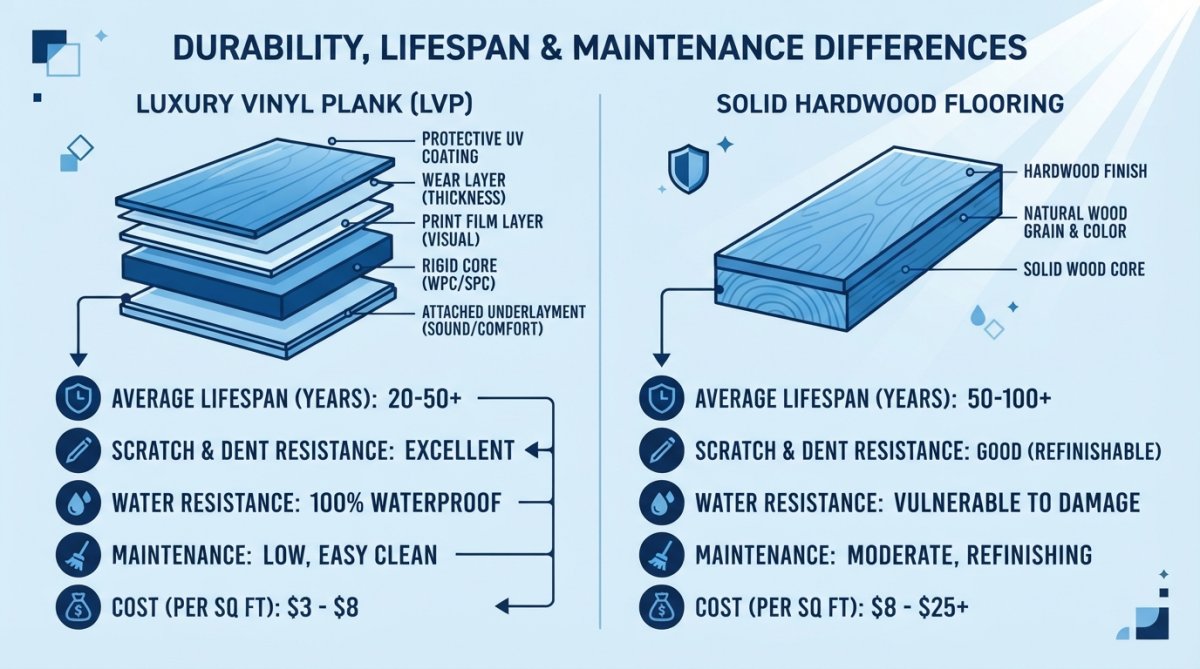
The longevity of your flooring choice directly impacts the cost-per-year you'll pay. A more expensive option lasting 30 years costs less annually than a cheaper option needing replacement in 10 years.
Wear Layer Thickness & Scratch Resistance
Luxury vinyl plank durability depends on wear layer thickness. Lifeproof products feature 22 MIL wear layers; Home Decorators Collection typically offers 20 MIL. Higher MIL ratings resist scratches, dents, and UV fading better than thinner layers.
Solid hardwood offers no wear layer in the traditional sense; the entire plank is wood, meaning minor scratches can be sanded out during refinishing. However, hardwood is more susceptible to scratching and denting than LVP. Families with pets or children often find LVP's scratch resistance more practical.
Engineered hardwood sits between these options, providing authentic wood aesthetics with better durability than solid hardwood but less refinishing capability.
Water Resistance & Moisture Performance
Luxury vinyl is 100% waterproof; spills, pet accidents, and moisture never damage LVP. COREtec's rigid core construction and integrated underlayment add dimensional stability while maintaining complete waterproof protection.
Solid hardwood is vulnerable to moisture. Humidity fluctuations cause wood to expand and contract, creating gaps between planks or cupping. Water damage can permanently warp hardwood beyond repair. Many homeowners cannot install solid hardwood in bathrooms, kitchens, or basements without accepting significant risk.
Engineered hardwood tolerates moisture better than solid hardwood due to its cross-grain plywood core, but it still isn't waterproof. If your home has high humidity, moisture-prone areas, or pets that occasionally have accidents, LVP's waterproof nature saves thousands in potential water damage repairs.
Cleaning & Long-Term Maintenance Requirements
Luxury vinyl requires minimal maintenance; regular sweeping and occasional damp mopping with vinyl-specific cleaners keep it looking new. The protective wear layer resists staining and doesn't need special treatments or refinishing.
Hardwood demands more attention. Solid hardwood should be swept regularly and mopped sparingly with hardwood-specific products. Spills must be cleaned immediately to prevent staining. Over time, the finish wears, requiring refinishing to restore appearance and protection.
Cost to Refinish Hardwood Floors vs LVP Limitations
Refinishing Options for Solid & Engineered Hardwood
Solid hardwood can be refinished 5-10 times over its lifetime, depending on plank thickness. A typical refinishing project costs $3.00-$8.00 per square foot, or $3,000-$8,000 for 1,000 square feet. This extends hardwood's life indefinitely; a solid hardwood floor can last 50+ years with periodic refinishing.
Engineered hardwood refinishing depends on veneer thickness. Anderson Tuftex's products can be refinished 1-2 times, while Mirage's ultra-thick wear layer allows 3-5 refinishing cycles. If you plan to stay in your home 20+ years and maintain hardwood through refinishing, the long-term cost-per-year becomes competitive with LVP despite higher initial expense.
Why Luxury Vinyl Cannot Be Refinished
Luxury vinyl's manufacturing process creates a permanent finish that cannot be sanded, stained, or refinished. Once the wear layer wears through or the surface becomes damaged, the entire floor must be replaced. This represents LVP's primary long-term cost disadvantage.
However, LVP's durability means many homeowners never reach this point. A 20-25 year lifespan for quality LVP means many homeowners replace it before significant wear occurs, often due to style preferences rather than failure.
Hardwood Flooring Resale Value Impact
Return on Investment for Hardwood Installations
Hardwood flooring is considered a premium feature that appeals to buyers and justifies higher asking prices. A 1,000 square foot hardwood installation costing $12,000-$18,000 in materials and labor might contribute $8,000-$15,000 in perceived value during a home sale, depending on local market conditions. This doesn't represent a full return on investment, but hardwood generally performs better in resale value than other flooring options.
How Luxury Vinyl Affects Home Value
Luxury vinyl's impact on resale value is significantly lower. While quality LVP is durable and attractive, many buyers still perceive it as a budget option compared to hardwood. A 1,000 square foot LVP installation costing $5,000-$10,000 typically adds $2,000-$5,000 in perceived value during resale.
If you plan to sell within 5-10 years and expect buyers to value hardwood's prestige, hardwood's resale advantage may justify its higher initial cost. If you plan to stay long-term or if your local market doesn't heavily reward hardwood, LVP's lower cost and durability make more financial sense.
| Flooring Type | Initial Cost (1,000 sq ft) | Estimated Resale Value Lift | Cost Per Year (20 years) |
|---|---|---|---|
| Solid Hardwood | $12,000-$18,000 | $8,000-$15,000 | $600-$900 |
| Engineered Hardwood | $8,000-$12,000 | $6,000-$10,000 | $400-$600 |
| Luxury Vinyl Plank | $5,000-$10,000 | $2,000-$5,000 | $250-$500 |
LVP vs Engineered Hardwood Cost: Total Cost of Ownership Over 10-20 Years
The true comparison in luxury vinyl vs hardwood cost emerges when you calculate total cost of ownership across decades, not just the initial purchase.
Year-by-Year Expense Projection
A solid hardwood floor installed for $15,000 requires minimal maintenance for the first 10 years (sweeping, mopping, occasional repairs: ~$200-$300/year). At year 15-20, refinishing costs $5,000-$8,000. Over 20 years, total cost reaches $18,000-$21,000.
Luxury vinyl installed for $7,500 requires basic maintenance ($100-$150/year). At year 15-20, wear may necessitate replacement ($7,500-$10,000), bringing 20-year total cost to $10,000-$13,500.
Engineered hardwood installed for $10,000 falls between these scenarios. Over 20 years, total cost reaches $13,000-$16,000.
When Hardwood Becomes the Better Long-Term Investment
Hardwood's advantage emerges when you stay in your home 25+ years and plan to refinish, or when you sell and capture resale value lift. For homeowners planning 30+ year occupancy and willing to maintain hardwood through refinishing, hardwood's per-year cost eventually becomes competitive or superior to LVP replacement cycles.
Health, VOC Emissions & Indoor Air Quality Considerations
Volatile organic compound (VOC) emissions from flooring materials affect indoor air quality, particularly in homes with children, elderly residents, or those with respiratory sensitivity.
Luxury vinyl plank products vary in VOC emissions. Armstrong Flooring's luxury vinyl tile features low VOC emissions and Urethane Plus coating. Budget LVP options may off-gas more noticeably during and immediately after installation.
Solid hardwood typically has minimal VOC emissions from the wood itself, though site-applied finishes can off-gas significantly. Pre-finished hardwood off-gases less than site-finished options because the finish cures at the factory.
Engineered hardwood's VOC profile depends on adhesives used in the plywood core and the factory finish applied. Quality products like Anderson Tuftex and Mirage use low-VOC adhesives and finishes. If VOC emissions concern you, request documentation of VOC ratings and look for products certified by FloorScore or GreenGuard.
Aesthetics, Comfort & Underfoot Feel
Visual Appeal & Design Flexibility
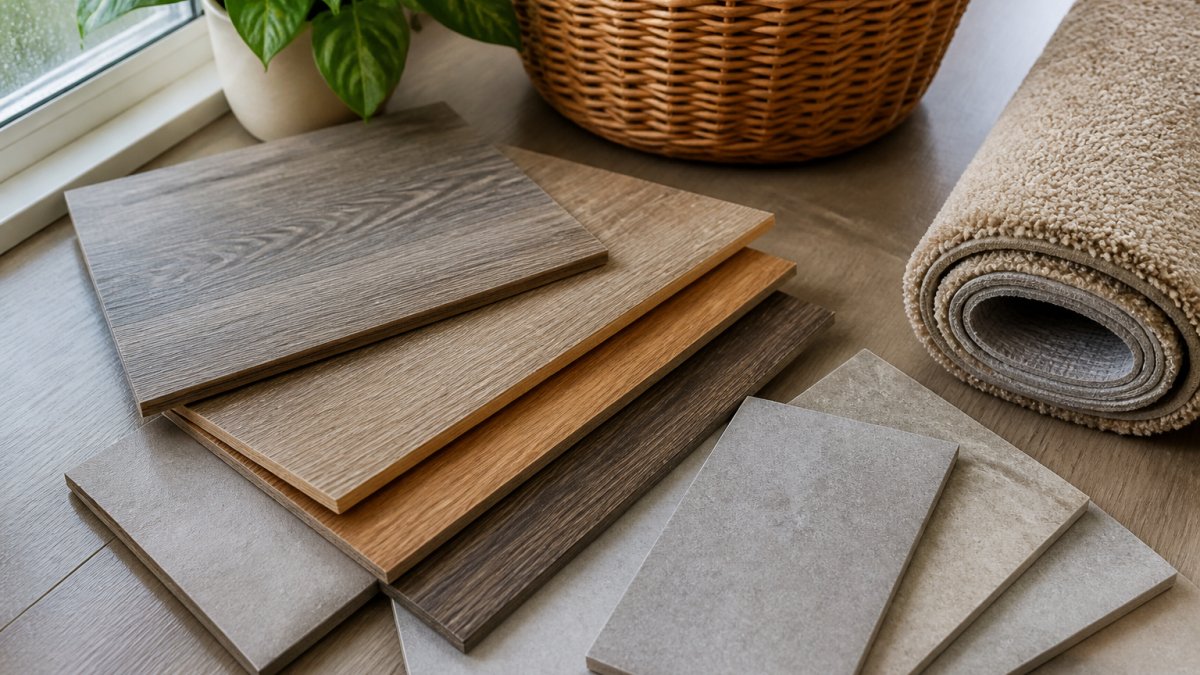
Hardwood offers authentic wood grain, color variation, and warmth that many homeowners find irreplaceable. Luxury vinyl's photographic technology now produces remarkably realistic wood and stone looks. However, close inspection reveals the manufactured nature, which some homeowners find acceptable and others find disappointing.
LVP offers greater design flexibility; you can find wood looks, stone looks, and hybrid designs that hardwood cannot replicate.
Comfort Underfoot & Sound Performance
Hardwood floors are harder underfoot and transmit sound readily, making footsteps and dropped objects audible. Luxury vinyl, particularly products with integrated underlayment like COREtec, feels softer and warmer underfoot. The integrated cork or foam layer absorbs sound, creating a quieter, more comfortable walking experience. For families with young children or elderly residents, LVP's comfort advantage is significant.
The decision between luxury vinyl vs hardwood cost ultimately depends on your specific situation: timeline in the home, moisture concerns, budget constraints, and personal preferences for aesthetics and comfort. Hardwood rewards long-term commitment and delivers resale value; luxury vinyl provides durability, waterproof protection, and lower initial expense.
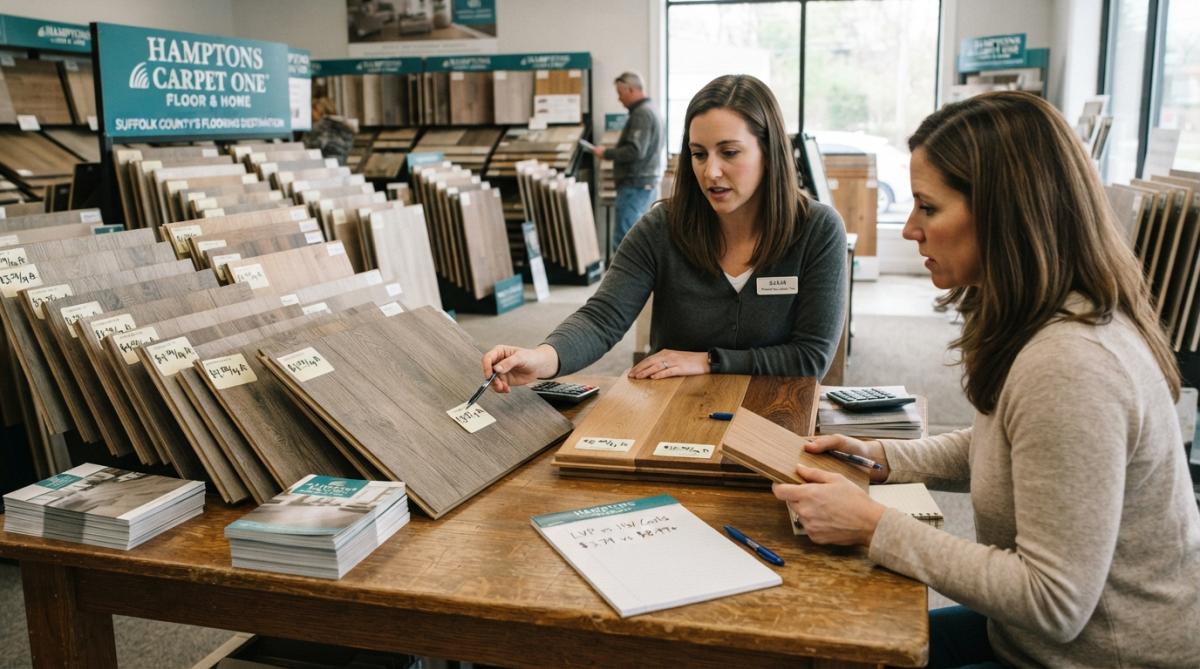
At Hamptons carpet one floor and Home, we help homeowners in Suffolk County evaluate both options with honest assessment of total cost of ownership, installation complexity, and long-term maintenance. We carry quality options across both categories and can walk you through detailed cost projections specific to your home's conditions and your timeline. Schedule a consultation to discuss which option makes financial and practical sense for your situation; the difference between the right choice and the wrong one often amounts to thousands of dollars over the life of your floor.
Frequently Asked Questions
What's the real difference between luxury vinyl and hardwood when it comes to total cost of ownership?
Luxury vinyl has lower upfront material and installation costs, making it budget-friendly initially. However, hardwood's ability to be refinished multiple times and its strong resale value impact can make it a better long-term investment over 10-20 years. The true cost depends on your timeline, how long you plan to stay in your home, and maintenance discipline. Hardwood typically adds 5-10% to home resale value, while luxury vinyl may not significantly impact value. Factor in refinishing costs for hardwood versus replacement costs for LVP when calculating total ownership expense.
How much does regional labor cost variance affect DIY vs professional flooring installation cost?
Installation labor costs vary significantly by region. Suffolk County, NY and surrounding Northeast markets typically have higher labor rates than Midwest or Southern regions, sometimes 30-50% more. Professional installation for hardwood in high-cost areas can add $8-15+ per square foot, while luxury vinyl with click-lock systems may run $3-8 per square foot. DIY is possible for luxury vinyl with click-lock installation but risky for hardwood. Subfloor preparation, often the hidden cost, can add $1-3 per square foot if repairs are needed. Always get a detailed quote that breaks down material, labor, and subfloor prep separately.
Can luxury vinyl be refinished like hardwood, and does this affect the cost comparison?
No, luxury vinyl cannot be refinished. Once the wear layer is damaged, the entire floor must be replaced. Hardwood, especially engineered hardwood with thick veneer, can be sanded and refinished 1-5 times depending on construction, extending its life 30-50+ years. This is a major cost advantage for hardwood. Refinishing costs $1-4 per square foot, which is significantly cheaper than replacing luxury vinyl. Over a 20-year period, the ability to refinish hardwood can save thousands in replacement costs and is a key reason hardwood typically delivers better return on investment for long-term homeowners.
What hidden costs should I expect when comparing luxury vinyl vs hardwood cost for my home?
The biggest hidden cost is subfloor preparation. If your existing subfloor is uneven, water-damaged, or requires leveling, expect $1-3+ per square foot in repairs before installation begins. This can turn a $5,000 project into $12,000+ quickly. Other hidden costs include underlayment (especially for hardwood), removal of old flooring, and potential mold remediation in older homes or coastal properties like those in Suffolk County. Luxury vinyl is more forgiving with subfloor issues due to its rigid core, but hardwood requires a stable, dry foundation. Always request a pre-installation inspection and a detailed estimate that itemizes subfloor work separately.
This article was written using GrandRanker