 Comparison
Luxury Vinyl vs Tile for Retail Spaces: 2026 Guide
Table of Contents
- Luxury Vinyl vs Tile for Retail Spaces: A Side-by-Side Comparison
- Best Flooring for High Traffic Retail: Durability, Wear Layer, and Slip Resistance
- LVT vs Ceramic Tile Cost: Lifecycle Value and Flooring Procurement
- Retail Flooring Installation Time: Floating Floor vs Glue-Down Methods
- Luxury Vinyl Tile Maintenance for Stores: Grout Lines vs Seamless Surfaces
- Acoustics, Thermal Comfort, and the Hidden Operational Costs of Luxury Vinyl vs Tile for Retail
- Aesthetics, Design Flexibility, and Suitability by Commercial Sector
- Pros and Cons: Luxury Vinyl and Tile for Retail Spaces
Last Updated: June 15, 2026
Choosing the right floor for a retail environment is one of the most consequential decisions a store owner or facilities manager will make. The debate over luxury vinyl vs tile for retail spaces touches installation timelines, long-term maintenance costs, employee health, and the acoustic environment your customers experience every day. At Hamptons carpet one floor and Home, we've guided Suffolk County retailers through this exact decision for years, and the answer is rarely as simple as "tile is tougher."
Here's what most guides get wrong: they evaluate these two materials as if they're competing on equal terms across all retail contexts. LVT wins decisively in some scenarios. Porcelain tile wins in others. The goal is knowing which scenario you're in.
Luxury Vinyl vs Tile for Retail Spaces: A Side-by-Side Comparison
Luxury vinyl tile (LVT) is a multi-layer resilient flooring product that replicates the look of stone or wood using a photographic layer protected by a clear wear layer, while porcelain and ceramic tile are kiln-fired clay products prized for their hardness and longevity. Both are commercially viable, but they perform differently under the operational demands of retail.
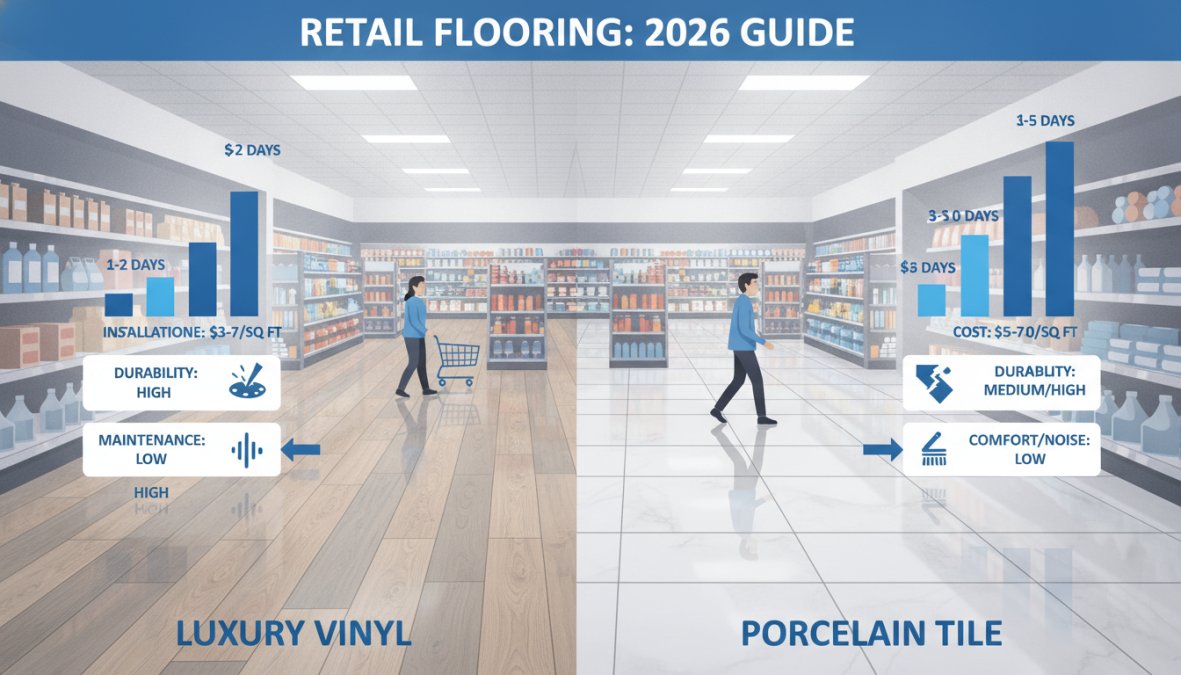
The table below captures the core trade-offs at a glance.
| Factor | Luxury Vinyl Tile (LVT) | Porcelain / Ceramic Tile |
|---|---|---|
| Wear layer | Up to 30 mil (commercial grade) | N/A - surface hardness rated by PEI group |
| Slip resistance | Textured surface; R-value varies by product | Dependent on finish; unglazed options rated higher |
| Installation time | Faster; floating or glue-down | Slower; mortar bed, cure time required |
| Grout lines | None (seamless surface) | Present; require ongoing maintenance |
| Acoustic performance | Softer underfoot; absorbs impact noise | Hard surface; amplifies foot traffic noise |
| Repairability | Individual planks replaceable | Individual tiles replaceable if rectified |
| Subfloor prep | Moderate | High; level tolerance is strict |
| Thermal comfort | Warmer underfoot | Cold and hard underfoot |
| Moisture sensitivity | 100% waterproof (most commercial LVT) | Impervious tile; grout can absorb moisture |
| Lifecycle cost | Lower total cost of ownership in many retail settings | Higher upfront and maintenance costs |
This comparison reflects general commercial-grade products. Specific performance depends on the product specification you select.
Best Flooring for High Traffic Retail: Durability, Wear Layer, and Slip Resistance
The biggest mistake retailers make is buying residential-grade flooring for commercial applications. A product that performs beautifully in a home sees thousands of times more foot traffic in a store, and the difference shows up fast.
Wear Layer Thickness and Commercial-Grade Performance
Wear layer thickness is the single most important specification when evaluating LVT for high-traffic retail, it's the transparent protective coating above the design layer that determines how long the floor resists scratching, scuffing, and surface degradation.
Residential LVT typically carries a 6-12 mil wear layer. For genuine high-traffic retail, a 28-30 mil wear layer is the appropriate specification. Karndean Designflooring's commercial LVT line offers wear layers up to 30 mil, engineered for environments where dropped merchandise, cleaning chemicals, and continuous foot traffic are daily realities. Porcelain tile addresses durability through the PEI group rating system; PEI Group IV and V products handle heavy commercial traffic, but grout lines remain a maintenance liability regardless of tile rating.
Slip Resistance and Safety Standards in Retail Environments
Slip resistance is non-negotiable in retail. According to the National Floor Safety Institute's commercial flooring guidelines, slip-and-fall incidents are among the leading causes of injury in retail environments, making coefficient of friction (COF) ratings a critical procurement specification.
Commercial-grade LVT meets or exceeds the 0.42 COF threshold recommended for walkway surfaces. Porcelain tile performance varies significantly by finish: polished tiles can be dangerously slippery when wet, while unglazed or textured porcelain performs considerably better. LVT's textured surface delivers more consistent slip resistance across wet and dry conditions, making it the safer default for general retail floor areas. Reserve polished tile for lower-traffic display zones where moisture exposure is minimal.
LVT vs Ceramic Tile Cost: Lifecycle Value and Flooring Procurement
Upfront material cost is where tile often appears to win. That impression rarely survives a full lifecycle cost analysis.
True commercial flooring cost includes material procurement, installation labor, subfloor preparation, ongoing maintenance, and eventual replacement. Tile installation requires a mortar bed, precise leveling, grouting, and cure time, translating to longer store closure and higher labor costs. LVT, particularly floating floor systems, installs faster over existing subfloors, reducing both labor cost and downtime. According to the Resilient Floor Covering Institute's commercial flooring guidance, LVT's subfloor tolerance requirements are also generally less stringent than large-format tile, which demands near-perfect flatness to prevent lippage and cracking. Maintenance cost widens the gap further: LVT's grout-free surface requires straightforward cleaning protocols, while tile's grout lines accumulate dirt and staining that require periodic deep cleaning, regrouting, and sealing.
Repairability: Replacing Individual Tiles vs. Seamless LVT Sections
Both LVT and tile allow individual unit replacement, but the practical experience differs. Replacing a cracked porcelain tile requires matching the original batch (which may be discontinued), removing the tile without disturbing adjacent units, re-mortaring, re-grouting, and waiting for cure. LVT plank replacement is faster: floating floor systems allow individual planks to be swapped without adhesive, and the process rarely causes collateral damage to adjacent units. Keeping a small quantity of matching LVT in storage is standard best practice, and for a retailer planning a 10-year floor life, this repairability advantage meaningfully reduces the risk of a single damage event forcing a costly partial or full floor replacement.
Retail Flooring Installation Time: Floating Floor vs Glue-Down Methods
Installation method directly affects how long your store is out of commission.
LVT offers two primary commercial formats. Glue-down LVT bonds directly to the prepared subfloor and is preferred for high-traffic retail where dimensional stability under rolling loads matters. Floating floor LVT uses a click-lock mechanism, requires no adhesive, installs faster, and can often be used the same day. Ecotile's interlocking PVC tile system installs without adhesives over existing subfloors and can be removed and reinstalled, practical for leased spaces or pop-up concepts where permanent modification isn't permitted. Porcelain tile has no equivalent to a floating installation; every application requires mortar, grout, and 24-72 hours of cure time before foot traffic. For a retailer fitting out a new space or renovating mid-season, this timeline difference is operationally significant.
Luxury Vinyl Tile Maintenance for Stores: Grout Lines vs Seamless Surfaces
Grout maintenance is the hidden cost that tips the lifecycle calculation firmly toward LVT in most retail settings.
Tile's grout lines are porous. In a retail environment, they collect debris, cleaning solution residue, spilled beverages, and bacteria, and standard mopping pushes dirt in rather than removing it. Maintaining hygienic grout requires periodic machine scrubbing, chemical treatment, and eventual regrouting. For food and beverage retailers or any store with health code considerations, this is not optional.
LVT's seamless, non-porous surface eliminates this problem. For retailers evaluating luxury vinyl tile maintenance for stores, the practical protocol is:
- Daily: dry dust mop to remove grit (the primary cause of wear layer abrasion)
- Weekly: damp mop with manufacturer-approved pH-neutral cleaner
- Periodically: inspect wear layer in highest-traffic zones; spot-replace damaged planks as needed
- Annually: assess whether a commercial floor finish application is appropriate for the specific product
According to ASTM International's commercial resilient flooring standards, following the manufacturer's maintenance protocol is essential to preserving both the warranty and wear layer performance over the floor's intended service life.
Acoustics, Thermal Comfort, and the Hidden Operational Costs of Luxury Vinyl vs Tile for Retail
This is where the operational cost difference between LVT and tile becomes most tangible, and where most procurement guides fall short.
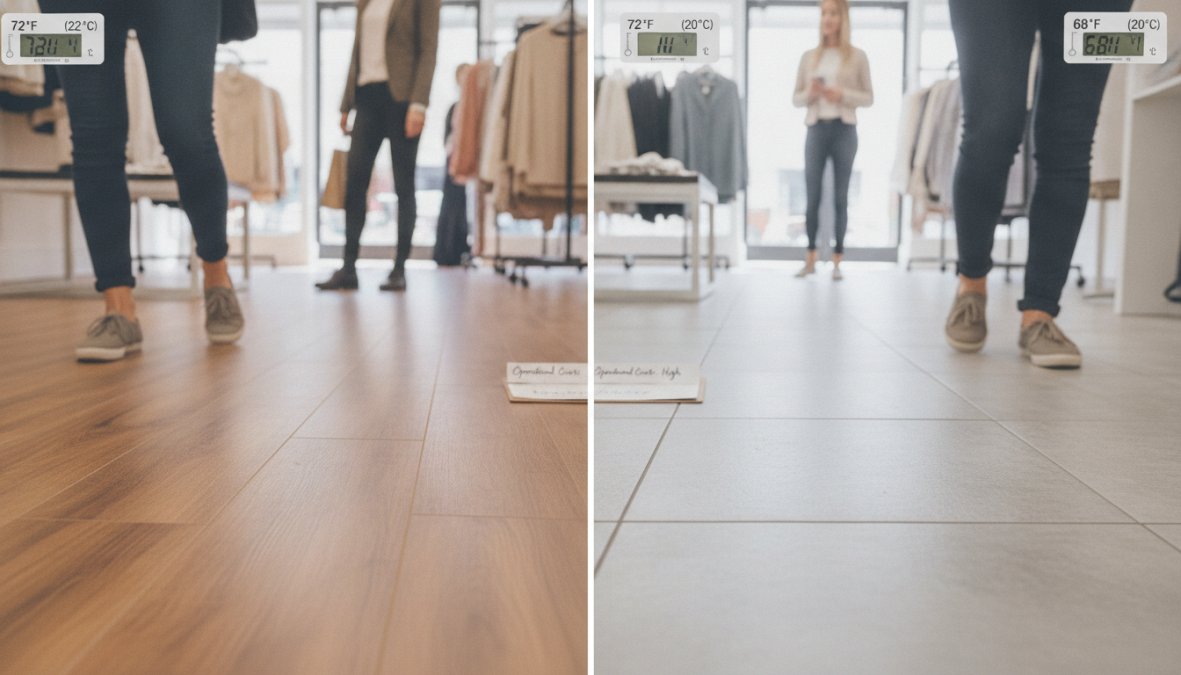
Acoustic Performance and Its Impact on the Retail Customer Experience
Hard tile surfaces reflect sound. Foot traffic, cart wheels, dropped merchandise, and ambient conversation all amplify into the store's acoustic environment. Research from the Acoustical Society of America's guidelines on commercial interior acoustics identifies hard floor surfaces as a primary contributor to elevated noise levels in commercial interiors, correlating with reduced dwell time and customer discomfort.
LVT absorbs impact noise. Products with acoustic backing, like Karndean's commercial range, reduce impact sound transmission compared to tile, relevant both for the store itself and for tenants below in multi-story retail. Quieter stores feel less chaotic, encourage longer browsing, and reduce staff fatigue from sustained noise exposure.
Thermal Comfort and Employee Fatigue: Why Underfoot Feel Matters
Tile is cold and hard. Any employee who has worked an eight-hour shift on porcelain knows this without needing a study to confirm it. LVT's layered construction provides measurable thermal insulation and slight underfoot give, reducing impact stress on feet, knees, and lower backs during long standing periods. Staff turnover, sick days, and productivity losses from physical fatigue don't appear in a flooring specification sheet, but they absolutely appear in a P&L.
Aesthetics, Design Flexibility, and Suitability by Commercial Sector
A retailer who specifies large-format polished porcelain for a flagship store can achieve a stunning visual effect at opening, and then spend the next five years managing grout discoloration, slip incidents near the entrance, and noise complaints from staff. The aesthetic decision wasn't wrong; the operational consequences just weren't fully considered.
LVT's design library has expanded dramatically. Products like Karndean's commercial range replicate wood grain, stone, and concrete with high fidelity, and Interface's commercial LVT integrates seamlessly with carpet tile systems, enabling retailers to zone spaces without transition strips. Large-format porcelain retains a genuine advantage where the visual weight of real stone or a seamless slab finish is architecturally required, as in luxury retail or high-end hospitality.
Retail, Hospitality, and Healthcare: Which Flooring Fits Each Setting
General retail and fashion: LVT is the stronger operational choice. Design flexibility, acoustic performance, thermal comfort, and lower maintenance overhead align well with a busy retail floor.
Supermarkets and food retail: Porcelain tile's impervious surface and chemical resistance make it competitive in areas with frequent wet cleaning and heavy cart traffic, but grout line hygiene requires rigorous maintenance protocols.
Hospitality: Both materials are used in combination. LVT performs well in guest corridors; tile dominates wet areas. Interface's modular LVT suits hospitality environments needing flexible zoning.
Healthcare: LVT's non-porous, seamless surface is a natural fit for pharmacy retail floors and clinic reception areas where hygiene standards align with clinical settings.
Pros and Cons: Luxury Vinyl and Tile for Retail Spaces
A direct summary for procurement decision-makers comparing luxury vinyl vs tile for retail spaces.
Luxury Vinyl Tile (LVT) - Pros:
- Seamless, non-porous surface eliminates grout maintenance
- Acoustic backing options reduce impact noise in retail environments
- Warmer and more resilient underfoot, reducing staff fatigue
- Faster installation with floating floor options; less store downtime
- Lower lifecycle cost in most retail settings
- Highly realistic design options across wood, stone, and concrete aesthetics
- Individual planks replaceable without skilled tile work
Luxury Vinyl Tile (LVT) - Cons:
- Wear layer can be damaged by sharp point loads (stiletto heels, heavy dragged equipment)
- Requires professional subfloor preparation for optimal longevity
- Not appropriate for outdoor or exposed exterior applications
- Some products have higher VOC concerns; specify low-VOC commercial grades
Porcelain / Ceramic Tile - Pros:
- Exceptional hardness and resistance to heavy impact
- Impervious tile surface is highly hygienic and chemical-resistant
- Long service life when properly installed and maintained
- Large-format slab options deliver premium aesthetic for flagship retail
- PEI Group V rating handles the most demanding commercial foot traffic
Porcelain / Ceramic Tile - Cons:
- Grout lines require ongoing cleaning, sealing, and eventual regrouting
- Cold and hard underfoot; contributes to staff fatigue on long shifts
- Amplifies foot traffic and ambient noise in retail environments
- Longer installation timeline with mandatory cure period
- Higher subfloor preparation requirements; strict flatness tolerance
- Polished finishes carry slip risk in wet conditions
The verdict for most retail operators: LVT delivers a better balance of performance, operational efficiency, and total cost of ownership. Tile earns its place in specific high-moisture, heavy-impact, or premium-aesthetic applications where its unique properties justify the additional maintenance commitment.
Selecting between luxury vinyl and tile for a retail space involves trade-offs that extend well beyond material cost, and getting the specification wrong creates operational problems that compound over years. Hamptons carpet one floor and Home works with Suffolk County retailers to evaluate flooring options against real operational requirements, including foot traffic volumes, staff comfort, maintenance protocols, and design objectives. Contact the Hamptons carpet one floor and Home team to discuss your retail flooring project and get a specification that performs as well in year five as it does on opening day.
Frequently Asked Questions
Is luxury vinyl tile good for commercial retail space?
Yes, luxury vinyl tile is well-suited for commercial retail spaces. Commercial-grade LVT with a wear layer of 20 mil or higher offers strong scratch resistance, stain resistance, and impact resistance under heavy foot traffic. Its non-porous surface is easy to clean, and its seamless installation eliminates grout lines that can trap dirt. Products like Karndean commercial LVT are specifically engineered for high-traffic retail environments, making LVT a practical and cost-effective resilient flooring choice.
Is tile or vinyl cheaper for retail flooring when you factor in lifecycle cost?
When comparing LVT vs ceramic tile cost over the full lifecycle, luxury vinyl is often more cost-effective. While porcelain tile may have a similar or lower upfront material cost, tile installation requires more subfloor preparation, longer installation time, and ongoing grout maintenance. LVT typically installs faster, reducing store downtime, and its seamless surface lowers long-term cleaning labor costs. For most retail flooring procurement decisions, LVT delivers stronger lifecycle value than traditional ceramic or porcelain tile.
Does luxury vinyl scratch easily in high-traffic retail areas?
Commercial-grade luxury vinyl with a thick mil wear layer, typically 20 to 30 mil, is designed to resist scratching in high-traffic environments. Standard residential LVT can show wear faster, so specifying commercial-grade products is essential for retail flooring. Porcelain tile is harder and more scratch-resistant at the surface level, but LVT's resilience and ability to replace individual damaged planks or tiles makes it a practical long-term option for busy retail stores.
How long does luxury vinyl flooring last in a retail store?
With proper maintenance, commercial-grade LVT can last 15 to 25 years in a retail environment, depending on foot traffic volume and wear layer thickness. A 20 to 30 mil wear layer is recommended for high-traffic retail use. Following a consistent luxury vinyl tile maintenance protocol, including regular sweeping, damp mopping, and avoiding harsh chemical cleaners, significantly extends the floor's lifespan and preserves its appearance in demanding retail settings.
What is the most durable flooring for retail stores?
Porcelain tile with a PEI Group IV or V rating offers the highest surface hardness and is extremely durable for heavy commercial foot traffic. However, commercial-grade LVT is a strong competitor because it combines durability with impact resistance, acoustic performance, and underfoot comfort. For most retail applications, commercial LVT with a thick wear layer provides an excellent balance of durability, design flexibility, and lower maintenance demands than traditional tile flooring.
This article was written using GrandRanker