 Comparison
Tile vs Vinyl in Beach Houses: Cost Comparison
Last Updated: October 22, 2026
Quick Summary
Installed vinyl flooring runs $5 to $12 per square foot, while installed porcelain tile runs $12 to $30 or more, so vinyl costs less upfront in any beach house flooring comparison. Tile wins on lifespan and water resistance, while vinyl wins on repair cost and disruption, so which is cheaper over time depends on how long you keep the floor and whether both bids include the same subfloor prep.
- Luxury vinyl plank generally falls between $3 and $12 per square foot installed, the budget-friendly option for most projects.
- Tile needs a rigid, flat subfloor, so its prep scope is usually larger than vinyl's and often includes an uncoupling membrane.
- Tile maintenance centers on grout, since sand ground into grout lines shortens the interval between sealings.
- A damaged vinyl plank can often be swapped without touching the rest of the floor, especially in a floating installation.
- Compare bids using the same room, prep scope, and material grade, and ask for prep as a separate line item.
Table of Contents
- Tile vs Vinyl in Beach Houses: The Cost Comparison at a Glance
- Tile Installation Cost per Square Foot in Coastal Homes
- Luxury Vinyl Plank Installation Cost per Square Foot
- Subfloor Preparation Cost for Flooring in Older Beach Houses
- The Best Flooring for Beach Houses: Moisture, Salt, Sand, and Humidity
- Total Cost of Ownership and Repairability Over Time
- How to Get an Apples-to-Apples Estimate for Your Beach House
- Conclusion
- Frequently Asked Questions
Tile vs Vinyl in Beach Houses: The Cost Comparison at a Glance
Installed vinyl flooring runs $5 to $12 per square foot, while installed porcelain tile runs $12 to $30 or more, according to Portofino Flooring's vinyl vs. tile cost guide. That gap is the headline in any beach house flooring cost comparison of tile vs vinyl, and it is also where most estimates stop being useful.
Installed Cost Ranges Side by Side
The table below shows what published sources report for installed costs. Treat these as national reference ranges, not quotes for your house.
| Flooring Type | Installed Cost per Sq Ft | Source |
|---|---|---|
| Vinyl (sheet or plank) | $5 - $12 | Portofino Flooring, 2026 |
| Porcelain tile | $12 - $30+ | Portofino Flooring, 2026 |
| Luxury vinyl plank (LVP) | $3 - $12 | ASP Super Home, 2026 |
| Tile (broader range) | $12 - $50 | ASP Super Home, 2026 |
What the Numbers Do and Don't Tell You
Those ranges are wide because they bundle different products and labor markets. A $3-per-square-foot LVP and a $12-per-square-foot LVP are not the same product, and neither is a ceramic tile at the low end versus a large-format porcelain at the top. The numbers tell you the direction of the gap: vinyl costs less upfront, consistently.
Tile Installation Cost per Square Foot in Coastal Homes
Tile installation cost per square foot in a coastal home typically lands between $12 and $30 or more installed, driven by tile type, subfloor condition, and the labor required to cut and set it.
Material and Labor Breakdown for Porcelain and Ceramic
Porcelain tile costs more per square foot than basic ceramic because it is denser and more moisture-resistant, which is exactly why it is often preferred in beach houses. Published comparisons put installed tile as high as $50 per square foot in some cases (ASP Super Home's LVP vs. tile comparison), and that upper end usually reflects difficult installs, not expensive tile.
Luxury Vinyl Plank Installation Cost per Square Foot
Luxury vinyl plank installation cost per square foot generally falls between $3 and $12 installed, making it the budget-friendly option in most beach-house projects. The lower end reflects floating installation over a sound subfloor; the upper end reflects glue-down installs, thicker wear layers, and rooms that need prep work first.
Where Vinyl Saves Money and Where It Doesn't
Vinyl saves on material and labor time, since floating plank goes down fast. Where vinyl stops saving money is in the details most guides skip: sand is abrasive and a cheap wear layer scratches, moisture trapped under a plank floor in a house that sits empty for weeks can cause peeling at the seams, and an uneven subfloor will telegraph every dip.
Subfloor Preparation Cost for Flooring in Older Beach Houses
Subfloor preparation is the line item that most often turns a tidy per-square-foot comparison into a real budget, and in older coastal homes it is the most likely to be underestimated. Tile needs a rigid, flat, stable surface or the tile and grout will crack. Vinyl needs a clean, dry, level surface or it will telegraph every dip and lift at the seams.
What Drives Prep Cost in a Coastal Home
Prep cost is driven by four variables: the condition of the existing subfloor, the moisture profile of the house, the flatness tolerance required by the chosen material, and whether the old flooring must be removed and disposed of. Older beach houses often have a plywood subfloor that has been patched repeatedly, deflects between joists, and smells musty. In those homes, prep can include:
- Demolition and disposal of the existing floor covering, including tack strip, adhesive, and underlayment. In older homes, adhesive removal can be slow and may require encapsulation.
- Subfloor repair or replacement where plywood is soft, delaminated, or water-stained. Sections near sliding doors and exterior walls are the usual suspects.
- Deflection correction by adding blocking or a second layer of plywood so the floor meets the tile industry's flatness standard, typically 1/8 inch in 10 feet for tile and 3/16 inch in 10 feet for most vinyl plank.
How Prep Scope Differs for Tile and Vinyl
Tile is less forgiving of subfloor movement than vinyl, so its prep scope is usually larger.
The practical result is that a tile bid and a vinyl bid for the same room may include very different prep scopes. A vinyl bid that assumes a floating floor over the existing subfloor may look cheaper until the installer finds rot or deflection.
What Prep Typically Adds to the Budget
Prep is priced by scope, not by square foot alone. A straightforward prep over a sound subfloor might add a modest amount per square foot for cleaning, priming, and minor leveling; a full prep with demolition, subfloor repair, leveling, and a membrane can add substantially more, and in the worst cases approach or exceed the material cost.
The Best Flooring for Beach Houses: Moisture, Salt, Sand, and Humidity
The best flooring for beach houses balances water resistance, abrasion resistance, and repairability, and both tile and vinyl can qualify at the right grade.
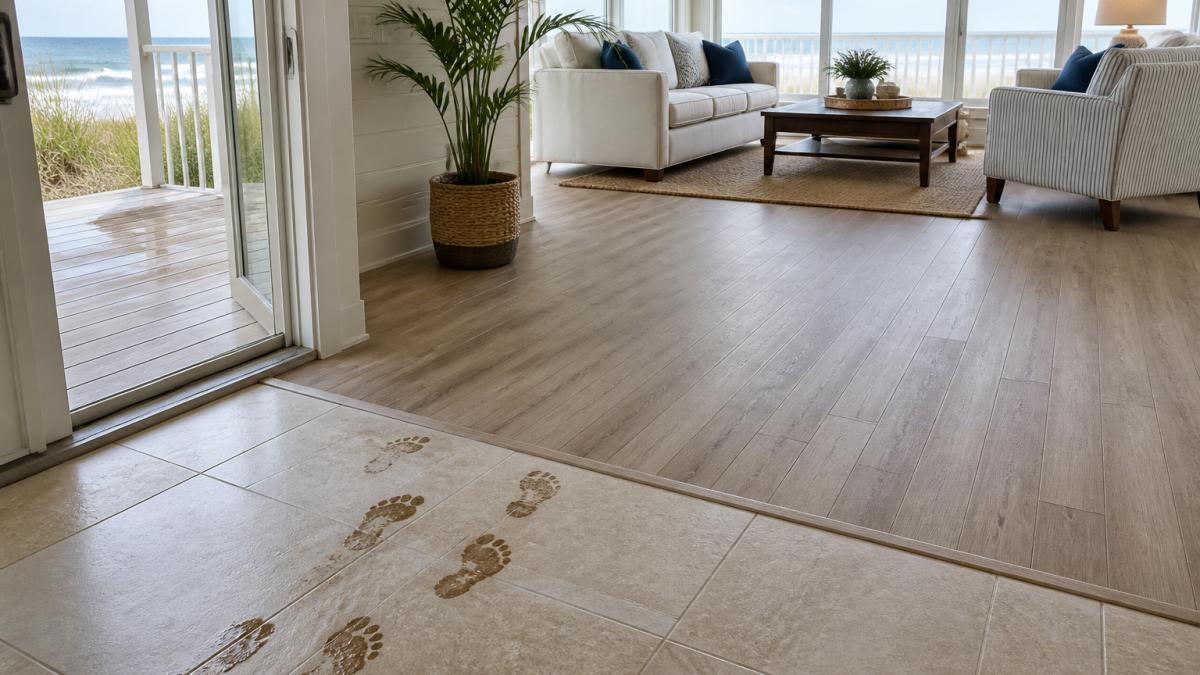
Tile wins on water: porcelain is essentially waterproof, handles humidity without swelling, and shrugs off salt air. Its weakness is sand, since grit ground into grout lines dulls the finish and stains the grout.
Failure Risks That Change the Math
Each failure risk carries a cost. Tile cracks when the subfloor flexes, and grout stains and needs sealing in sandy environments. Vinyl peels at seams, cups at edges, and fades under intense UV. Replacing cracked tile is slow and expensive; replacing a scratched vinyl plank or small section is fast and cheap.
Total Cost of Ownership and Repairability Over Time
Total cost of ownership is where a beach house flooring decision diverges most from a mainland one, because coastal conditions accelerate the wear and failure modes that drive maintenance and replacement spending. Published comparisons note that tile lasts longer and can boost resale value, while vinyl costs less and feels warmer (America's Floor Source's tile vs. luxury vinyl comparison).
A Defined Horizon Makes the Comparison Honest
Pick a horizon before you compare. Ten years is a useful planning window for a beach house because it spans multiple rental seasons, several humidity cycles, and at least one major storm season. Over that window, the cost categories are purchase and installation, routine maintenance, repair of localized damage, and replacement of the floor or a section of it.
Maintenance Costs by Material in a Coastal Home
Tile maintenance in a beach house centers on grout. Sand gets ground into grout lines, dulling the finish and staining the grout, and in a sandy house the interval between sealings is shorter.
Vinyl maintenance centers on cleaning and protecting the wear layer. Quality LVP with a thick wear layer resists sand abrasion better than a builder-grade plank.
Repair Costs and Disruption
Repairability is where vinyl quietly wins on cost and disruption. A damaged plank in a high-traffic hallway can often be swapped without touching the rest of the floor, especially in a floating installation.
Tile repair is slower and more expensive. A cracked tile means removing it, cleaning out the old adhesive, and setting a replacement, and matching dye lots and grout color across an aged floor is difficult.
A Transparent Sample Budget for the Same Room
To make the comparison apples-to-apples, use the same room, the same prep scope, and the same material grade for both options. The sample below is a planning framework, not a quote, and the dollar figures are placeholders you should replace with local bids.
| Cost Category | Vinyl Plank (LVP) | Porcelain Tile |
|---|---|---|
| Material | $____ per sq ft | $____ per sq ft |
| Labor | $____ per sq ft | $____ per sq ft |
| Demolition and disposal | $____ | $____ |
| Subfloor prep and leveling | $____ | $____ |
| Underlayment or membrane | $____ | $____ |
| Trim, transitions, and thresholds | $____ | $____ |
| Waste factor (typically 5-10% for vinyl, 10-15% for tile) | $____ | $____ |
| Installed total | $____ | $____ |
| Maintenance over 10 years (sealing, cleaning) | $____ | $____ |
| Localized repair allowance over 10 years | $____ | $____ |
| 10-year total cost of ownership | $____ | $____ |
The point of the table is not the numbers you fill in but the categories you compare.
Which Material Wins on Total Cost of Ownership
The answer depends on how long you keep the floor and how hard the house gets used. If you rent seasonally and expect wear, vinyl's lower upfront cost and localized repairability tend to win over ten years, provided the plank is quality and the subfloor is prepped correctly. If you are flooring a forever home, tile's durability and water resistance earn their premium, and grout maintenance becomes a manageable recurring cost rather than a replacement risk.
How to Get an Apples-to-Apples Estimate for Your Beach House
An apples-to-apples estimate compares the same square footage, prep scope, and material grade across both options. Most quotes fail that test because one bid includes prep and the other doesn't, or one prices a builder-grade plank against a premium porcelain. Use this checklist when you collect bids:
- Measure the actual square footage of each room, including closets and transitions
- Confirm whether subfloor prep, leveling, and underlayment are included
- Specify the exact product line and wear layer for vinyl, or the tile type and size for tile
Bring that checklist to any quote, including ours. A fair bid will survive the questions. A bid that falls apart under them was never apples to apples.
Conclusion
Comparing tile and vinyl in a beach house comes down to more than the per-square-foot number, because coastal conditions punish shortcuts a dry inland house would never reveal. If you want a quote that accounts for subfloor prep, moisture, sand, and repair costs instead of hiding them, Hamptons carpet one floor and Home can help.
Frequently Asked Questions
Is tiling cheaper than luxury vinyl plank for a beach house?
No, tile is almost always the higher-cost option upfront. Portofino Flooring lists installed vinyl at $5 to $12 per square foot and installed porcelain tile at $12 to $30 or more per square foot. A contractor comparison from ASP Super Home shows LVP at $3 to $12 and tile at $12 to $50 installed. For a beach house, the gap widens because tile often needs more subfloor prep to handle moisture and deflection.
How much does it cost to install 1,500 square feet of luxury vinyl plank?
Using published installed ranges of $5 to $12 per square foot, 1,500 square feet of vinyl plank runs roughly $7,500 to $18,000 in materials and labor. A contractor comparison citing $3 to $12 per square foot puts the low end near $4,500. Your actual beach house quote depends on subfloor condition, room layout, and whether old flooring must be removed first.
Which flooring handles sand and wet feet better: tile or vinyl?
Both handle water well when installed correctly, but they fail differently. Tile is waterproof at the surface and resists sand abrasion, though grout lines trap grit and need regular cleaning. Luxury vinyl plank is also water-resistant, but beach houses with humidity swings and direct sun can cause plank edges to lift or peel over time. In coastal homes, the installation method and subfloor moisture control matter more than the surface material.
What extra installation costs should beach-house owners budget for?
Coastal homes often add subfloor preparation for moisture or unevenness, underlayment or vapor barriers, adhesive versus floating installation differences, and removal of old flooring. Seasonal access and elevated structures can also slow the crew. Ask for a line-item quote that separates material, labor, subfloor prep, and disposal so you can compare bids fairly and avoid surprise charges midway through the project.