 Ultimate guide
Moisture Resistant Flooring for Suffolk County: Complete Guide
Table of Contents
- Why Moisture Resistant Flooring Matters in Suffolk County
- Best Flooring for Basements Long Island: Waterproof Options
- Luxury Vinyl Plank vs Laminate for Humidity: Which Wins?
- Moisture Barrier for Concrete Floors: Installation Essentials
- Waterproof Flooring Installation: Glue-Down vs. Floating
- Durability, Scratch Resistance, and Long-Term Performance
- Maintenance and Cleaning Tips for Moisture-Resistant Floors
- Eco-Friendly and Low-VOC Waterproof Flooring Options
Last Updated: June 19, 2026
Suffolk County homeowners face a flooring challenge most guides ignore: coastal humidity, freeze-thaw cycles, and basement moisture that make standard flooring fail faster here than almost anywhere else in New York. Choosing moisture resistant flooring for Suffolk County is a structural decision affecting floor longevity and maintenance costs. At Hamptons Carpet One Floor and Home, we work with homeowners weekly who replaced flooring prematurely due to wrong product selection. Below, we'll show you which materials hold up, how installation affects moisture performance, and what competitors rarely discuss: subfloor prep and Long Island's specific climate variables.
Why Moisture Resistant Flooring Matters in Suffolk County
Suffolk County sits at the intersection of two moisture problems: ambient humidity from Long Island Sound and the Atlantic coast, plus freeze-thaw cycles affecting concrete subfloors from November through March.
Long Island's Climate and Humidity Challenges
Long Island's coastal position keeps relative humidity elevated year-round, particularly in spring and fall. Standard laminate flooring, which uses a wood-fiber core, absorbs this moisture and expands, causing edge swelling, joint separation, and buckling that maintenance cannot reverse.
Moisture resistant flooring must address both liquid water intrusion and vapor transmission. Liquid intrusion comes from spills and flooding. Vapor transmission is slower and harder to detect, but it's why floors in Suffolk County homes fail even when never directly wet.
Seasonal Moisture Fluctuations and Basement Risk
Basements in Suffolk County are particularly vulnerable. Concrete slabs absorb ground moisture year-round, intensifying in spring when snowmelt raises the water table. According to the American Society of Home Inspectors' guidance on basement moisture, most homes with basements experience some moisture intrusion over time.
Any flooring installed directly over a concrete slab in a Suffolk County basement needs either a built-in moisture barrier or a product with a rigid waterproof core. Floating installations with an underlayment vapor barrier are the minimum standard.
Best Flooring for Basements Long Island: Waterproof Options
The best flooring for basements on Long Island is 100% waterproof luxury vinyl plank (LVP) with a rigid core, installed over a properly prepared concrete subfloor with a vapor barrier. No other product category combines waterproof performance, durability, and installation flexibility as effectively for below-grade applications.
Why Basements Need Specialized Flooring
Basements present conditions standard flooring cannot handle. Concrete subfloors emit moisture vapor even when appearing dry. Temperature differentials cause condensation. Absence of natural airflow means any moisture that enters stays there.
The best basement flooring shares three characteristics: a non-porous wear surface, a waterproof core that won't swell when exposed to moisture, and compatibility with below-grade installation. Standard hardwood fails all three. Carpet fails the first two. Traditional laminate fails the first.
Top Basement Flooring Solutions
| Flooring Type | Waterproof Core | Below-Grade Suitable | Moisture Barrier Needed | Typical Durability |
|---|---|---|---|---|
| Rigid Core LVP | Yes | Yes | Recommended | 20-25 years |
| WPC Vinyl | Yes | Yes | Recommended | 15-20 years |
| Standard Laminate | No | No | N/A | Fails with moisture |
| Engineered Hardwood | Partial | Limited | Yes | Variable |
| Ceramic Tile | Yes | Yes | Yes | 25+ years |
Rigid core LVP is the top choice for most basement applications. WPC (wood plastic composite) vinyl offers a softer underfoot feel. Ceramic tile performs well but adds installation complexity.
Luxury Vinyl Plank vs Laminate for Humidity: Which Wins?
Luxury vinyl plank wins decisively over laminate for humidity-prone environments. LVP uses a 100% plastic core that doesn't absorb water, while laminate uses high-density fiberboard (HDF) that swells when exposed to moisture. In Suffolk County's climate, this difference is not theoretical.
LVP Advantages in Humid Environments
The wear layer on luxury vinyl plank is clear, hard plastic that repels surface moisture completely. The rigid core doesn't expand or contract with humidity changes the way wood-fiber products do. This dimensional stability is critical for floating floors, where planks must move as a unit without joint separation.
LVP tolerates temperature fluctuations better than laminate. In unheated rooms, laminate can contract enough to create visible gaps at seams. For any Suffolk County room that sees moisture, including kitchens, bathrooms, laundry rooms, mudrooms, and basements, LVP is the appropriate product.
Why Laminate Falls Short in Suffolk County
Laminate has improved significantly, and some products carry water-resistant ratings. The distinction that matters: water-resistant means the surface resists brief liquid exposure. Waterproof means the core itself won't absorb moisture. Most laminate is the former, not the latter.
The HDF core acts like a sponge when water reaches it through seams or edges. Once swollen, planks don't return to original dimensions. In a coastal environment with constant humidity cycles, even water-resistant laminate faces ongoing stress that shortens its lifespan considerably.
Moisture Barrier for Concrete Floors: Installation Essentials
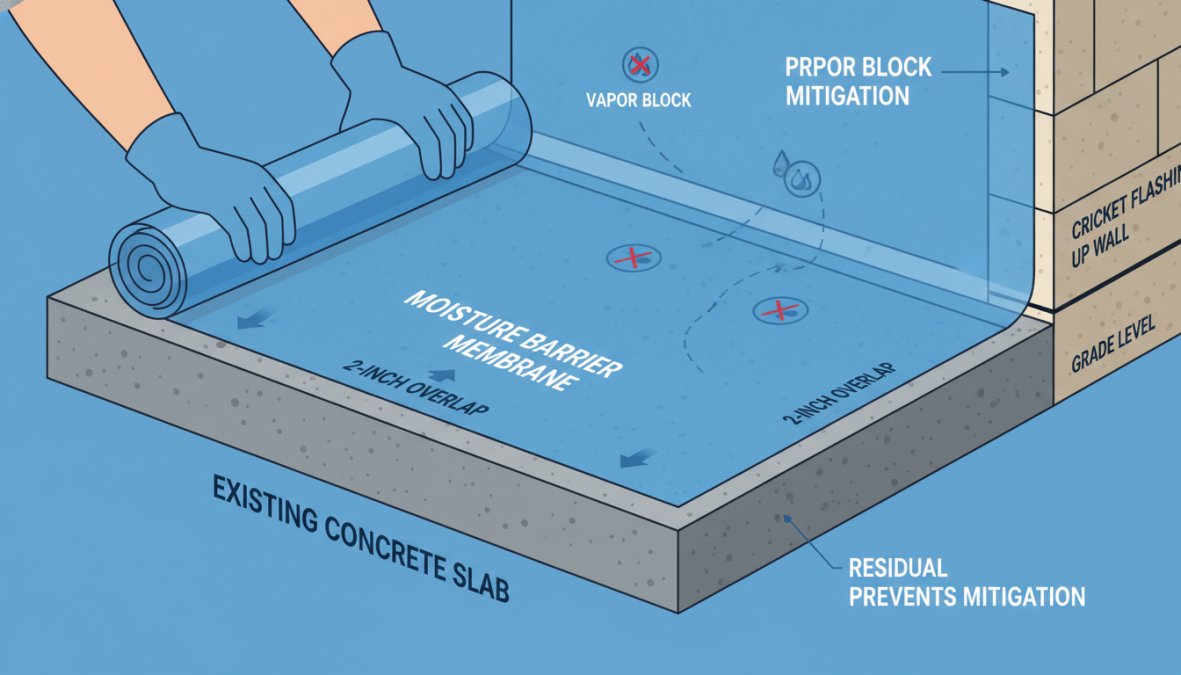
A moisture barrier for concrete floors is a vapor-impermeable membrane installed between the concrete subfloor and flooring material to block moisture vapor transmission. Installing one correctly is the most important step in any Suffolk County basement or ground-level flooring project.
Assessing Your Subfloor Before Installation
Before selecting a moisture barrier, test the concrete slab for moisture emission. The plastic sheet test is basic: tape a 24-inch square of plastic sheeting to the slab, seal all edges, and leave it 72 hours. Condensation on the underside indicates active moisture emission.
For precise measurement, a calcium chloride test or relative humidity probe test provides quantifiable data. According to the Floor Covering Installation Board's standards for moisture testing, specific moisture emission thresholds determine which installation methods and adhesives are appropriate.
Any slab with visible cracks, efflorescence (white mineral deposits), or flooding history needs remediation before flooring installation.
Vapor Barrier Types and Application Methods
Three main vapor barrier types are used in residential flooring installations:
- Polyethylene sheet film (6-mil minimum): Rolled out over the slab, overlapped at seams by at least 8 inches, and taped with moisture-resistant tape.
- Combination underlayment with integrated vapor barrier: Many LVP underlayment products include a built-in vapor barrier layer, simplifying installation.
- Epoxy moisture mitigation coating: Applied directly to the concrete surface for high moisture emission rates.
The right choice depends on your slab's moisture emission rate and the flooring manufacturer's requirements. Skipping this step voids most LVP warranties for below-grade installations.
Waterproof Flooring Installation: Glue-Down vs. Floating
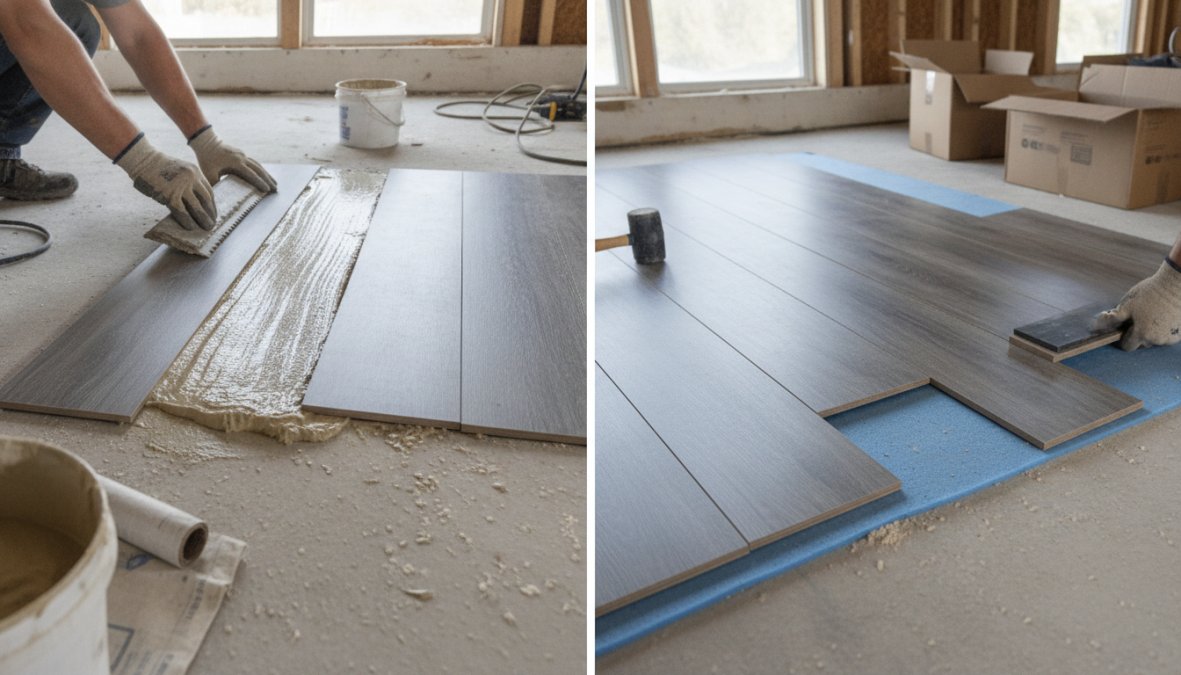
Waterproof flooring installation in Suffolk County comes down to two primary methods: floating and glue-down. Each has specific advantages depending on subfloor condition, room use, and tolerance for future replacement.
Floating Floor Advantages for Moisture Control
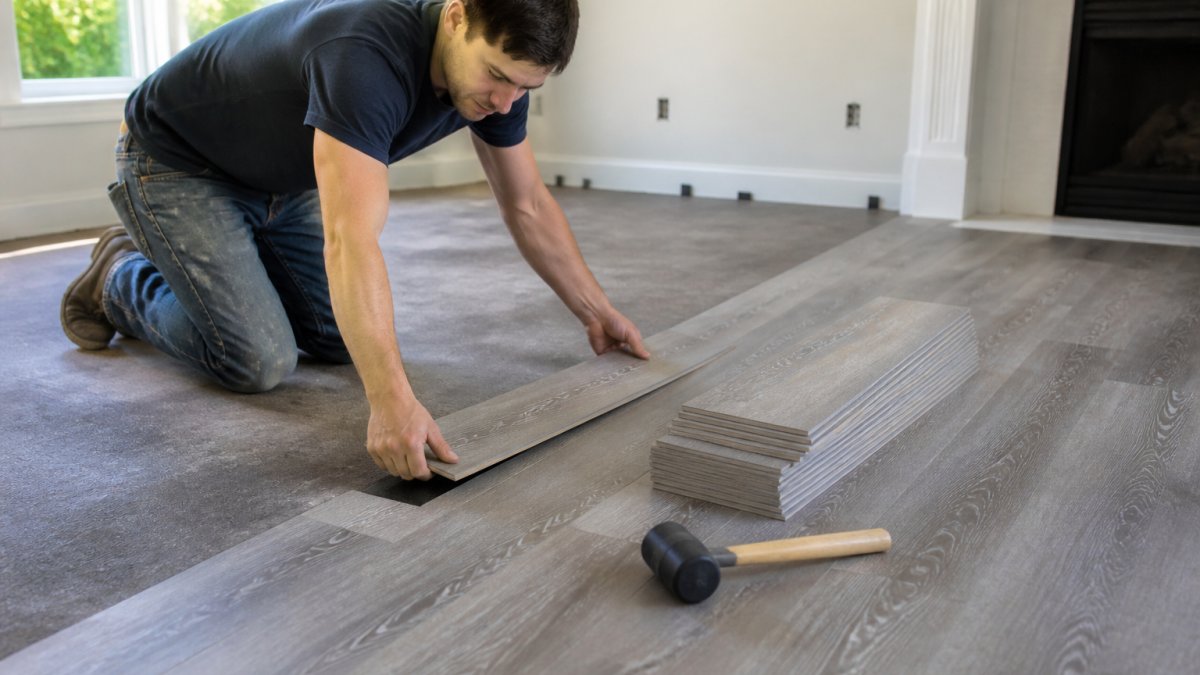
A floating floor means planks interlock but aren't adhered to the subfloor. The entire assembly moves as a unit. For moisture management, this is significant: if moisture reaches the floor assembly, planks can be removed, dried, and reinstalled without the damage that occurs when adhesive-bonded planks delaminate.
Floating installations accommodate minor subfloor imperfections better than glue-down. They're faster to install and easier to replace section by section if damage occurs. For most residential LVP installations in Suffolk County, a floating floor with appropriate vapor barrier underlayment is recommended.
Glue-Down Installation for Maximum Stability
Glue-down installation bonds each plank directly to the subfloor using pressure-sensitive adhesive. This eliminates hollow sound and is preferred for large open areas where a floating floor might develop movement over time.
For Suffolk County applications, glue-down requires a moisture-tolerant adhesive rated for the slab's moisture emission level. Using standard adhesive on a high-moisture slab causes delamination within months. The subfloor must also be flat to within 3/16 inch over a 10-foot span.
Durability, Scratch Resistance, and Long-Term Performance
Durability in moisture resistant flooring for Suffolk County is about how the floor holds up under daily use, furniture movement, and pet traffic over a 15-25 year lifespan.
Wear Layer Thickness and Protection Standards
The wear layer is the clear protective coating on LVP's surface. It determines scratch resistance, stain resistance, and how long the floor maintains its appearance. Wear layer thickness is measured in mils (thousandths of an inch):
- 6-8 mil: Entry-level residential for low-traffic bedrooms.
- 12 mil: Standard residential for living rooms, dining rooms, and kitchens.
- 20 mil: Heavy residential for high-traffic areas, households with pets, or frequent foot traffic.
- 28+ mil: Commercial grade, rarely necessary for residential applications.
For most Suffolk County homeowners, a 20-mil wear layer is the practical recommendation. The cost difference over 12-mil is modest relative to extended lifespan in high-traffic areas.
Stain Resistance and High-Traffic Area Solutions
The urethane finish applied over the wear layer determines stain resistance. Higher-quality products use aluminum oxide-reinforced finishes that resist both staining and surface abrasion. For kitchen and bathroom flooring, this matters more than wear layer thickness alone.
According to the Resilient Floor Covering Institute's product performance standards, LVP products meeting commercial-grade specifications provide the highest resistance to both abrasion and chemical staining, making them appropriate for residential high-traffic areas.
Maintenance and Cleaning Tips for Moisture-Resistant Floors
Moisture resistant flooring for Suffolk County requires less maintenance than hardwood or tile, but the wrong cleaning approach can degrade the finish prematurely.
Daily Care and Preventative Practices
The most effective maintenance is the simplest: keep grit off the floor. Sand, dirt, and fine particles act as abrasives under foot traffic and degrade the wear layer faster than any other factor. Entrance mats at exterior doors and regular dry sweeping or vacuuming (without a beater bar) address this effectively.
Felt pads under furniture legs prevent scratching when furniture is moved. For kitchen and bathroom flooring, a no-shoes policy dramatically extends the floor's appearance over time.
Addressing Spills and Water Damage Quickly
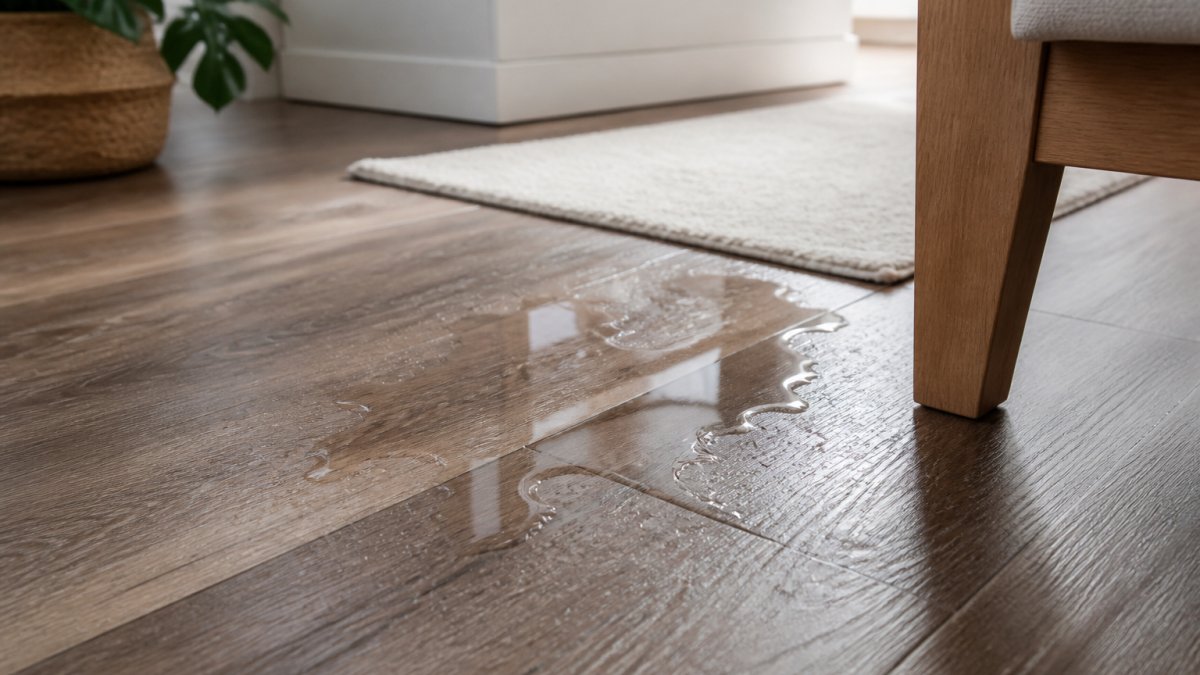
The waterproof core of LVP means standing water on the surface won't damage the plank itself. The risk is water reaching the subfloor through seams or edges. Wipe spills promptly, particularly near baseboards and transitions where water can migrate beneath the floor.
For cleaning, use a pH-neutral cleaner designed for luxury vinyl. Avoid steam mops, which can force moisture into seams. A damp mop with the appropriate cleaner is all most LVP floors need weekly.
Eco-Friendly and Low-VOC Waterproof Flooring Options
The conventional assumption is that waterproof flooring means synthetic materials and high chemical off-gassing. The reality in 2026 is more nuanced.
What to Look For in Low-VOC Flooring
VOC (volatile organic compound) emissions are the chemical off-gassing from adhesives, finishes, and core materials. Elevated VOC levels affect indoor air quality, which matters particularly in Suffolk County homes sealed tightly during winter.
The key certification to look for is GREENGUARD Gold, which tests products for VOC emissions under real-world indoor environment conditions. FloorScore certification is another recognized standard for resilient flooring. Products carrying either certification meet strict indoor air quality standards appropriate for residential use.
For glue-down installations, look for low-VOC or zero-VOC adhesive formulations. The adhesive is often the largest source of off-gassing and is frequently overlooked when homeowners focus only on the flooring product itself.
Some manufacturers now offer LVP products with recycled content in the core layer, reducing environmental footprint without compromising waterproof performance. According to EPA guidance on indoor air quality and flooring materials, proper ventilation during and after installation significantly reduces occupant exposure to installation-related VOC emissions.
The good news: the best-performing waterproof LVP products and the lowest-VOC options increasingly overlap. Premium manufacturers recognize that indoor air quality certification is a selling point, so products with the thickest wear layers and most durable cores often carry the best environmental certifications as well.
Choosing the right moisture resistant flooring for Suffolk County involves more variables than most guides acknowledge: coastal humidity, below-grade moisture vapor, seasonal freeze-thaw cycles, and the specific demands of kitchens, bathrooms, and basements. Hamptons Carpet One Floor and Home serves all of Suffolk County with flooring expertise tailored to Long Island's specific conditions. Visit our showroom to see the full range of waterproof LVP, moisture-resistant options, and talk through subfloor preparation with our team before your next installation project.
Frequently Asked Questions
What is the best flooring for high humidity areas in Suffolk County?
Luxury vinyl plank (LVP) and rigid core vinyl are the top choices for Suffolk County's humid climate. These waterproof flooring options resist moisture absorption better than laminate or traditional hardwood. LVP features a wear layer that provides stain resistance and durability, making it ideal for basements, kitchens, and bathrooms. Rigid core options offer enhanced stability and moisture resistance, especially when installed with a proper moisture barrier for concrete floors.
Do I need a moisture barrier for concrete floors in Suffolk County?
Yes, a moisture barrier is essential for concrete subfloors in Suffolk County, especially in basements where groundwater seepage is common. A vapor barrier prevents moisture from rising through the concrete and damaging your waterproof flooring from underneath. Test your concrete's moisture level before installation. If moisture readings exceed acceptable levels, install a quality moisture barrier as part of your subfloor preparation. This protects your investment and extends flooring lifespan significantly.
Is luxury vinyl plank better than laminate for humidity?
Yes, luxury vinyl plank (LVP) is significantly better than laminate for humid environments. LVP is fully waterproof and resists moisture absorption, while laminate swells and warps when exposed to humidity. Laminate's core material breaks down in damp conditions, making it unsuitable for basements or high-moisture areas. For Suffolk County homes, LVP offers superior water resistance, easier maintenance, and longer durability in moisture-prone spaces like bathrooms and kitchens.
How do I prevent moisture damage to my flooring in Suffolk County?
Prevent moisture damage by choosing waterproof flooring options like LVP, installing a proper moisture barrier for concrete floors, and maintaining good ventilation. Control indoor humidity with dehumidifiers, especially in basements. Clean up spills immediately and use mats in high-moisture areas. Ensure gutters and downspouts direct water away from your home's foundation. During humid seasons, monitor moisture levels and use air conditioning to regulate humidity. These practices combined with quality moisture-resistant flooring protect your investment long-term.
This article was written using GrandRanker