 Ultimate guide
Professional Flooring Installation for Commercial Properties
Table of Contents
- Why Professional Flooring Installation for Commercial Properties Is a Business Decision
- Best Commercial Flooring Materials for High-Traffic Environments
- Industries Served: Matching Flooring Solutions to Your Commercial Space
- Commercial Flooring Installation Cost: Cost-Benefit Analysis by Material
- Understanding the Commercial Flooring Installation Timeline
- The Professional Flooring Installation Process for Commercial Properties
- Hiring Commercial Flooring Contractors: What to Look For
- Preventative Maintenance Programs That Extend Flooring Lifespan
Last Updated: June 16, 2026
Flooring is one of the highest-impact decisions a commercial property owner makes, and one of the most commonly underestimated. Professional flooring installation for commercial properties affects safety compliance, operational continuity, maintenance costs, and long-term durability. At Hamptons carpet one floor and Home, we have guided commercial clients across Suffolk County, NY through this process, and the same costly mistakes appear repeatedly. Below, we break down what separates a successful commercial flooring project from one that creates problems within the first year.
The real challenge is execution. The best material installed incorrectly on an unprepared subfloor will fail prematurely. This guide covers material selection, the installation process, cost-benefit analysis, sustainability factors, and phased strategies that keep your business running during renovation.
Why Professional Flooring Installation for Commercial Properties Is a Business Decision
Commercial flooring installation is a capital investment decision, not a maintenance decision. The choice you make today determines your cleaning costs, liability exposure, ADA compliance status, and replacement timeline for the next decade.
Commercial spaces face fundamentally different stress loads than residential ones. Material grade, installation technique, and subfloor preparation must all meet commercial-grade standards. The business case for professional installation comes down to three factors: safety standards compliance, flooring lifespan, and operational disruption. An improperly installed floor creates slip hazards, voids manufacturer warranties, and often requires full replacement within three to five years rather than the ten to fifteen years a professionally installed floor delivers.
According to the U.S. Access Board guidelines on ADA compliance for commercial flooring, floor surfaces in commercial spaces must meet specific requirements for slip resistance and changes in level. Non-compliance creates real liability exposure when an employee or customer is injured.
Best Commercial Flooring Materials for High-Traffic Environments
Choosing the right material starts with an honest assessment of your space. Commercial flooring solutions that perform well share three characteristics: durability for the specific traffic load, compliance with applicable safety standards, and cost-effective maintainability over their lifespan.
Luxury Vinyl Tile (LVT): Durable, Moisture-Resistant, and Cost-Effective
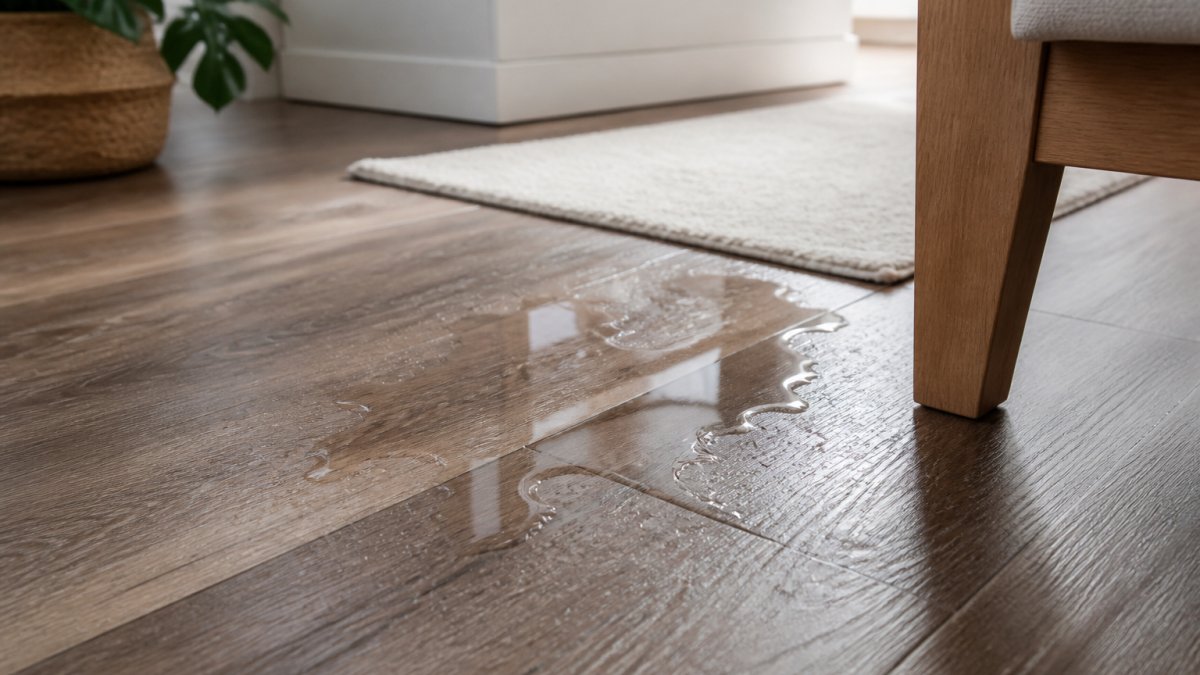
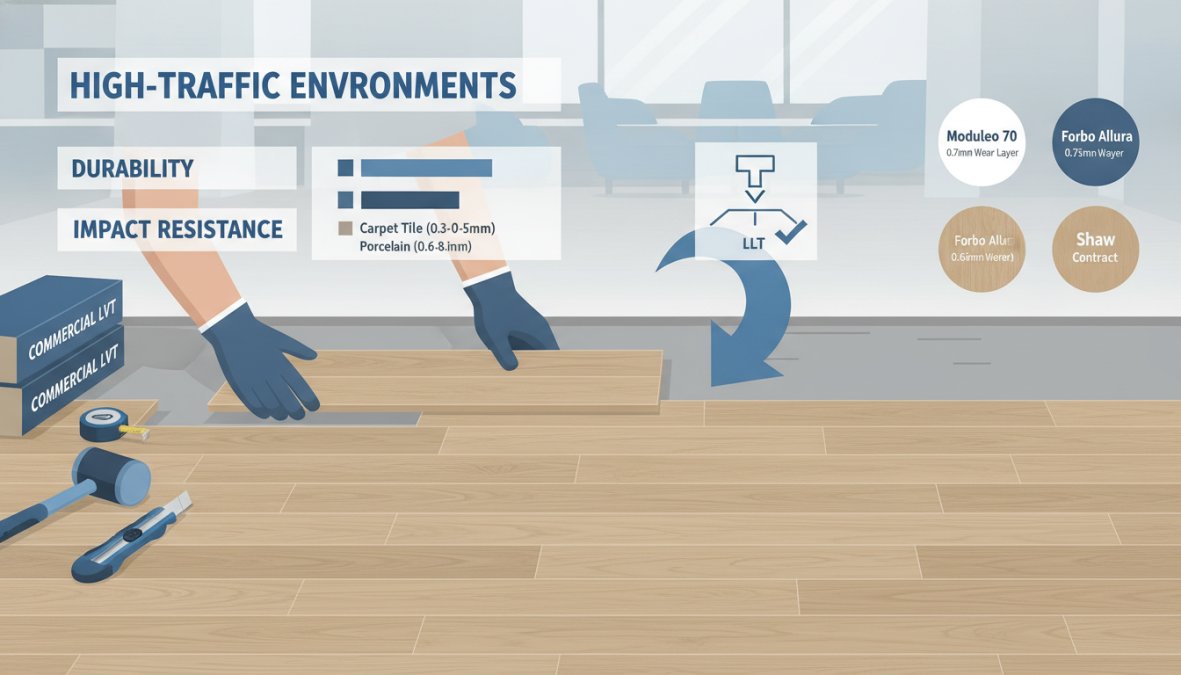
Luxury vinyl tile (LVT) is the most versatile commercial flooring material for most property types. Its multi-layer construction, rigid core, photographic design layer, and protective wear layer, resists moisture, heavy foot traffic, and surface scratching. Commercial-grade LVT carries a wear layer of 20 mil or higher, appropriate for retail floors, office corridors, and hospitality spaces. Moisture resistance makes it suitable for kitchens, restrooms, and any space with water exposure, while faster installation reduces labor costs and operational downtime.
| Material | Best Use | Moisture Resistance | Typical Lifespan | Maintenance Level |
|---|---|---|---|---|
| Luxury Vinyl Tile (LVT) | Retail, office, hospitality | High | 15-25 years | Low |
| Commercial Carpet | Office, conference rooms | Low | 8-12 years | Medium |
| Polished Concrete | Warehouse, industrial | High | 20+ years | Low |
| Rubber Flooring | Healthcare, gyms | High | 10-20 years | Low |
| Ceramic/Porcelain Tile | Healthcare, food service | High | 20+ years | Medium |
Commercial Carpet: Acoustic Features and Comfort for Office Environments
Commercial carpet remains the preferred flooring solution for office environments because of acoustic performance. Hard surface floors reflect sound; carpet absorbs it, measurably reducing noise transmission between workstations and conference areas, making it effective in call centers, law offices, and multi-tenant buildings. Its honest limitation is moisture resistance: carpet is not appropriate for food service, healthcare treatment areas, or any space with regular water exposure. Regular extraction cleaning and prompt stain treatment are essential to preserving appearance and extending lifespan.
Healthcare and Industrial Warehouse Flooring: Slip Resistance and Safety Standards
Healthcare and industrial warehouse flooring share one non-negotiable requirement: slip resistance. Healthcare flooring must resist chemical cleaning agents, support heavy rolling equipment, and maintain a coefficient of friction that satisfies safety standards. Rubber flooring and sheet vinyl are the most common solutions, both offer high slip resistance, seamless installation options that prevent bacterial growth, and resistance to disinfectants. Industrial warehouse flooring faces different demands: heavy equipment loads, forklift traffic, and chemical exposure. Polished concrete with a penetrating sealer or epoxy coatings are the standard solutions.
According to OSHA standards for walking and working surfaces, commercial and industrial floors must be maintained in a clean, dry condition and free of slip, trip, and fall hazards.
Industries Served: Matching Flooring Solutions to Your Commercial Space
The right flooring solution depends entirely on industry context. A floor that performs perfectly in a corporate office will fail within months in a restaurant kitchen.
- Retail: LVT and polished concrete handle high traffic and clean quickly between business hours.
- Healthcare: Sheet vinyl, rubber, and commercial tile meet infection control, slip resistance, and chemical resistance requirements.
- Hospitality: Carpet tiles in guest corridors, LVT in lobbies, and ceramic tile in food service areas is a common approach.
- Education: Commercial carpet in classrooms, LVT in hallways, and rubber flooring in gymnasiums is a well-established combination.
- Industrial and Warehouse: Epoxy coatings and polished concrete address load-bearing capacity, chemical resistance, and safety markings.
- Corporate Office: Commercial carpet and LVT are both viable depending on specific areas within the space.
Early consultation with flooring contractors who understand the performance requirements of each space type prevents material failures and compliance issues after installation is complete.
Commercial Flooring Installation Cost: Cost-Benefit Analysis by Material
Most property owners focus on material cost per square foot. The smarter analysis includes installation cost, expected lifespan, annual maintenance cost, and replacement cost. The real cost of commercial flooring is calculated over the full lifecycle:
Flooring Cost-Benefit Framework:
- Calculate material cost per square foot (commercial grade only)
- Add installation cost per square foot (including subfloor preparation)
- Estimate annual maintenance cost (cleaning products, labor, periodic refinishing)
- Divide total 10-year cost by square footage for a true cost-per-year comparison
- Factor in operational disruption cost if replacement is required before year 10
LVT and polished concrete typically deliver the lowest 10-year total cost for high-traffic areas, while commercial carpet delivers the lowest total cost for low-traffic office environments where acoustic performance justifies the higher maintenance investment.
Sustainability, LEED Certification, and Regulatory Compliance Considerations
Sustainability is no longer a secondary consideration. According to U.S. Green Building Council LEED certification requirements, flooring materials contribute to multiple LEED credit categories, including indoor environmental quality, materials and resources, and low-emitting materials. Specifying products with low VOC emissions, recycled content, or regional sourcing can contribute meaningfully to a project's LEED point total.
From a regulatory compliance standpoint, commercial flooring must meet ADA requirements for surface texture and transition heights, fire rating requirements specific to the building type, and slip resistance standards for the intended use.
Understanding the Commercial Flooring Installation Timeline
The actual timeline depends on four variables: total square footage, material type, subfloor condition, and whether the space can be vacated during installation. A straightforward LVT installation in a 5,000 square foot office with a prepared subfloor might be completed in three to five days; a complex healthcare facility with multiple material types and phased access restrictions could require several weeks.
What most project timelines miss is the acclimation period. Many commercial flooring materials require 24 to 72 hours of acclimation in the installation environment before work begins. Skipping this step causes dimensional changes that result in gaps, buckling, or adhesive failure.
Phased Installation Strategies to Minimize Operational Disruption
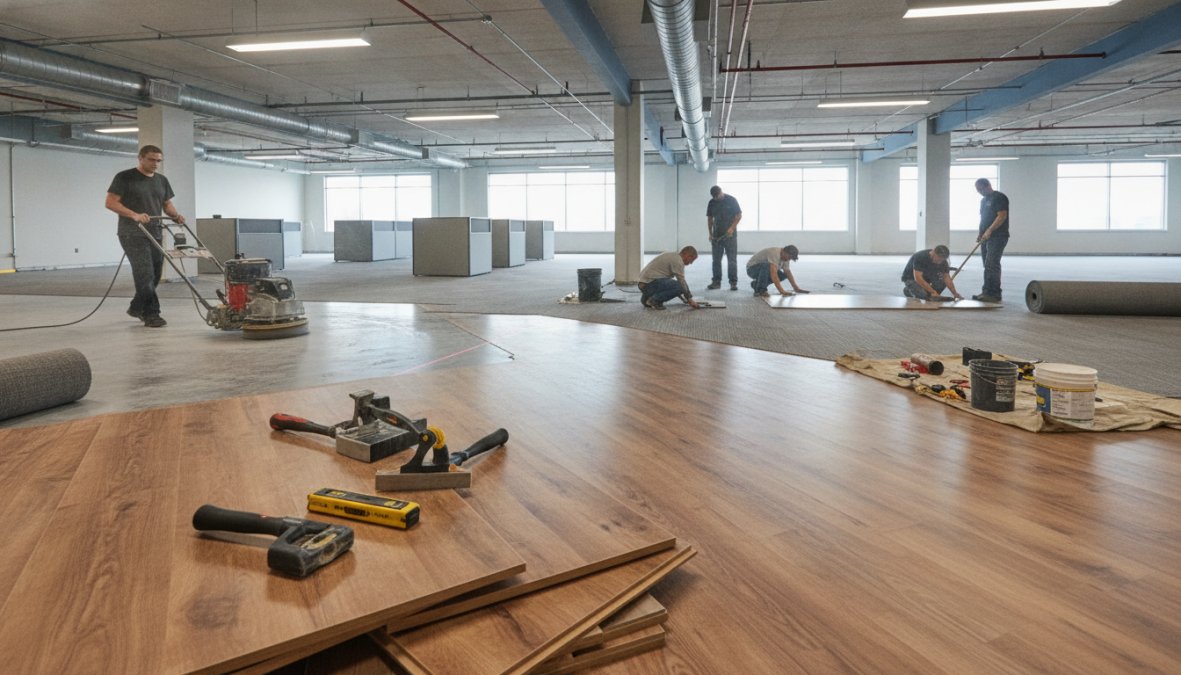
Phased installation divides the total installation area into zones, completing one at a time while the rest of the space remains operational. A well-executed phased installation plan includes:
- Zone mapping that sequences installation to minimize traffic disruption
- Clear communication of access restrictions and timelines to all building occupants
- Dust and debris containment barriers between active and inactive zones
- Scheduling of high-disruption work (grinding, adhesive application) during off-hours
- A defined completion date for each zone with built-in buffer time
The tradeoff is a longer total project duration, a five-day vacated job can take two to three weeks when phased around active operations. The operational cost savings from staying open typically justify this extended timeline.
The Professional Flooring Installation Process for Commercial Properties
Professional flooring installation follows a structured process that, when executed correctly, produces a floor that meets its rated lifespan. Shortcuts at any stage compromise the final result.
Step 1: On-Site Consultation and Site Evaluation
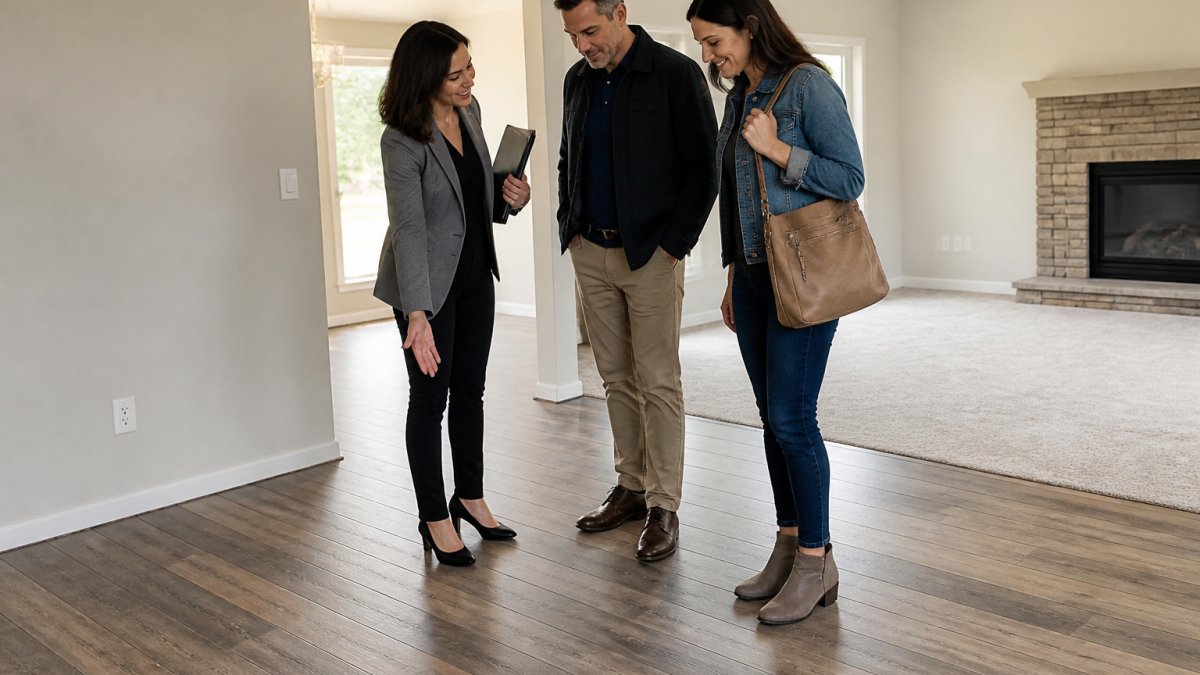
Every commercial flooring project begins with an on-site consultation and thorough site evaluation. Experienced flooring contractors assess subfloor condition, measure moisture levels, identify existing damage or contamination, and confirm that proposed materials are appropriate for the environment. Moisture testing is critical: excess moisture in a concrete subfloor causes adhesive failure and mold growth beneath the finished floor, and identifying it at this stage allows for mitigation before installation begins.
Step 2: Subfloor Preparation and Material Selection
Subfloor preparation is the most labor-intensive and most important phase. A subfloor that is not flat, clean, and structurally sound will cause problems regardless of material quality. Preparation typically includes grinding high spots, filling low spots with self-leveling compound, removing existing adhesive residue, and applying moisture barriers where required. Material selection is finalized at this stage, confirming that specified products are available, meet lead times, and are appropriate for confirmed subfloor conditions.
Step 3: Installation, Floor Finish, and Final Inspection
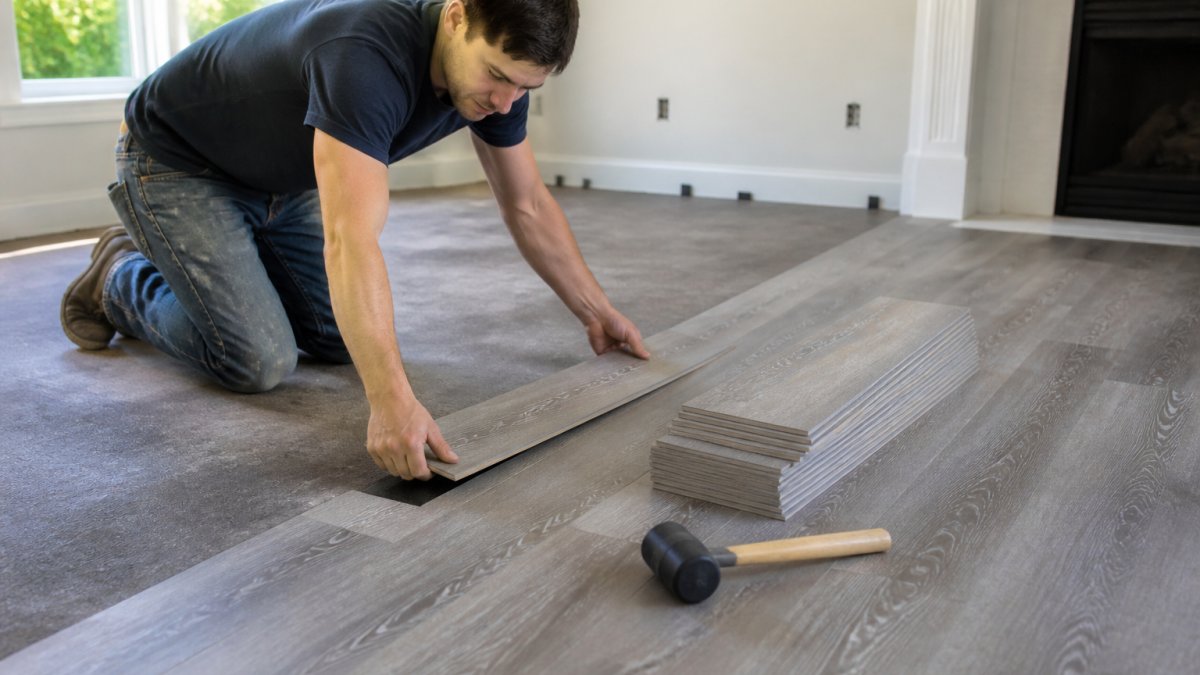
Installation technique varies by material. LVT may be glued down, floated, or installed with a click-lock system; commercial carpet is typically stretched and tacked or glued. All installations should include proper transition strips at doorways and material changes. Floor finish application follows for materials that require it, polished concrete and some vinyl products receive a topcoat sealer that enhances appearance and extends wear resistance. Final inspection confirms that all seams are tight, transitions are secure, and the finished floor meets specification.
Hiring Commercial Flooring Contractors: What to Look For
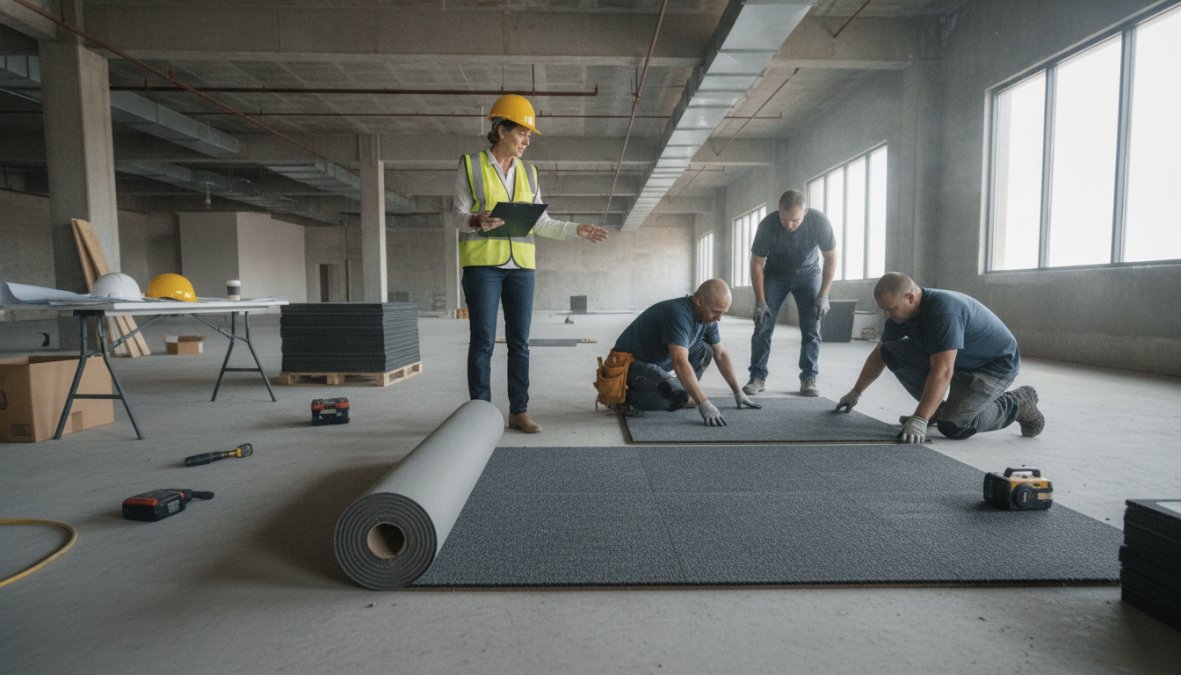
The quality of your installation depends almost entirely on the contractor you hire. A qualified commercial flooring contractor should demonstrate specific experience with your building type, provide references from comparable projects, carry appropriate licensing and insurance, and offer a written warranty on both materials and labor. Beyond installation skill, project management capability matters, a contractor poor at scheduling and communication will create operational disruptions that cost more than the savings from a lower bid.
Key criteria for evaluating commercial flooring contractors:
- Documented experience with commercial-grade installations (not primarily residential)
- Manufacturer certification for the specific products being installed
- Written scope of work that includes subfloor preparation in detail
- Clear communication on phased installation scheduling if applicable
- Proof of liability insurance and workers' compensation coverage
- References from projects of similar scale and complexity
Preventative Maintenance Programs That Extend Flooring Lifespan
A properly installed commercial floor that receives no structured maintenance will underperform its rated lifespan. LVT requires regular dry mopping to remove abrasive grit, periodic damp mopping with a pH-neutral cleaner, and avoidance of wax-based products. Commercial carpet requires scheduled vacuuming, periodic hot-water extraction cleaning, and prompt spot treatment. Polished concrete requires periodic resealing and dry dust mopping.
According to Floor Covering Industry Foundation guidance on commercial floor care, the majority of premature commercial floor failures are attributable to inadequate maintenance rather than material defects or installation errors. Establishing a written maintenance schedule and training cleaning staff on correct procedures is as important as the installation itself.
A well-structured preventative maintenance program includes:
- Daily: Dry mopping or vacuuming to remove abrasive particles
- Weekly: Damp mopping or spot cleaning with approved products
- Monthly: Inspection of transitions, seams, and high-wear zones
- Annually: Professional deep cleaning and wear layer assessment
- As needed: Touch-up sealing or finish reapplication for hard surface floors
Once the wear layer is compromised, the underlying material degrades rapidly and replacement becomes unavoidable. Preventative maintenance exists to prevent that outcome.
Commercial flooring projects fail most often not because of bad materials, but because of poor planning, inadequate subfloor preparation, and the absence of a maintenance program after installation. Hamptons carpet one floor and Home serves commercial clients throughout Suffolk County, NY, providing material selection guidance, professional installation coordination, and ongoing maintenance support for commercial floor covering projects of all scales. Contact Hamptons carpet one floor and Home to schedule an on-site consultation and get a detailed assessment of your commercial space.
Frequently Asked Questions
What is the most durable flooring for commercial use?
Luxury vinyl tile (LVT) and commercial-grade carpet tile are among the most durable options for high-traffic areas. LVT is moisture-resistant, easy to maintain, and handles heavy foot traffic well, making it popular across retail, healthcare, and office settings. Polished concrete and rubber flooring are also strong choices for industrial warehouse flooring where slip resistance and wear resistance are top priorities. The best option depends on your industry, traffic volume, and subfloor conditions.
How long does commercial flooring installation take?
The commercial flooring installation timeline varies based on the size of the space, material selected, and subfloor preparation required. A small office might take two to four days, while a large retail or healthcare facility could take one to three weeks. Phased installation strategies can spread the work across sections of the building, allowing operations to continue with minimal disruption. Always factor in drying or curing time for adhesives and floor finishes when planning your project schedule.
How much does professional commercial flooring installation cost?
Commercial flooring installation cost depends on material choice, square footage, subfloor condition, and labor rates in your area. LVT and commercial carpet tend to be more cost-effective upfront, while hardwood or polished concrete may have higher installation costs but longer flooring lifespans. A thorough cost-benefit analysis should include maintenance expenses, replacement frequency, and potential downtime costs. Requesting an on-site consultation is the most reliable way to get an accurate estimate for your specific commercial property.
What should I look for when hiring commercial flooring contractors?
When hiring commercial flooring contractors, prioritize experience with commercial-grade projects, not just residential work. Look for contractors who offer on-site consultation, understand ADA compliance and safety standards, and have a clear project management process. Ask for references from similar commercial renovation projects, verify licensing and insurance, and confirm they can accommodate phased installation if your business needs to stay operational. Contractors familiar with architects and designers can also help streamline material selection and approval processes.
How do you prepare a commercial space for new flooring installation?
Professional flooring installation for commercial properties begins with a thorough site evaluation and subfloor preparation. This includes inspecting the existing subfloor for moisture, levelness, and structural integrity. Furniture, equipment, and existing flooring materials must be removed, and any subfloor damage repaired before installation begins. Proper preparation is critical, skipping this step leads to premature wear and tear, adhesion failures, and voided warranties. A qualified commercial flooring contractor will assess all of these factors before recommending installation techniques.
This article was written using GrandRanker