 How-to
5 Underlayment Types That Stop Laminate Noise
Last Updated: October 24, 2026
Quick Summary
Underlayment for laminate reduces noise by absorbing impact energy between the planks and subfloor. Choose based on your subfloor type and moisture environment, with felt and rubber offering better sound reduction than foam, while concrete subfloors require thicker underlayment with built-in moisture barriers.
- Impact noise from footsteps is the primary problem underlayment solves for laminate flooring.
- Felt and rubber underlayments perform better on concrete than foam due to higher density.
- Proper installation with sealed seams can improve acoustic performance by 20-30% compared to poor installation.
- Underlayment with integrated moisture barriers is essential for coastal properties and moisture-prone areas.
- Thicker underlayment generally performs better, with 3/8-inch or more recommended for concrete subfloors.
Table of Contents
- Why Laminate Flooring Makes Noise When Walking
- Impact Noise vs. Airborne Noise: What's the Difference
- How Underlayment Reduces Sound and Impact Noise
- Understanding Laminate Underlayment Sound Ratings: IIC and STC
- Best Underlayment Materials for Laminate Flooring
- Underlayment for Laminate Over Concrete Subfloors
- Moisture Barriers and Vapor Protection in Underlayment
- Installation Steps That Affect Sound Performance
- Frequently Asked Questions
Why Laminate Flooring Makes Noise When Walking
Laminate flooring is popular because it's affordable and durable. But it has a weakness: sound. When you walk across laminate, the planks flex slightly against the subfloor beneath them. That movement creates noise, hollow footsteps, creaks, and echoes that travel through your home.
The problem gets worse on hard surfaces like concrete. Without proper support underneath, laminate planks have more room to move. Each step sends vibrations downward instead of absorbing them. This is why beach houses and coastal properties often struggle with noise complaints from laminate, the combination of moisture, sand, and foot traffic amplifies the problem.
The solution is underlayment. Think of it as a shock absorber between your laminate and the subfloor. A quality underlayment for laminate reduces sound transmission, dampens impact noise, and protects your floor from moisture. But not all underlayment performs the same way.
Understanding your options, and what the acoustic ratings actually mean, is the first step to stopping laminate noise.
Impact Noise vs. Airborne Noise: What's the Difference
These two types of noise require different solutions, and mixing them up leads to poor choices.
Impact noise is what you hear when something strikes a surface. Footsteps on laminate, dropped objects, chairs scraping across the floor, these create impact noise. It travels downward through the floor structure and into the room below.
Airborne noise travels through the air. It's the sound of voices, music, or machinery. Airborne noise bounces around rooms and passes through gaps in the floor system. Underlayment helps with airborne noise too, but less directly.
For laminate flooring, impact noise is the bigger problem. Most homeowners complain about footsteps, not about sound traveling up from downstairs. This distinction matters when you're comparing underlayment options.
When you're shopping for underlayment for laminate, focus first on impact noise performance. That's where you'll notice the most improvement in your daily life.
How Underlayment Reduces Sound and Impact Noise
Underlayment works through density and compression. When you step on laminate, the plank tries to move downward. A soft, compressible underlayment absorbs that movement instead of letting it transfer to the subfloor. The material compresses under your weight, then springs back when you lift your foot.
Thicker underlayment generally performs better than thin underlayment, but only up to a point. A 3/8-inch layer performs better than 1/8-inch, but the improvement levels off beyond a certain thickness.
Density matters more than thickness alone. A dense material compresses less but transmits fewer vibrations. A softer material compresses more but absorbs more energy. The best underlayment for laminate finds the middle ground: enough density to keep the floor stable underfoot, enough cushioning to absorb impact.
Installation quality directly affects performance. Gaps between underlayment seams, wrinkles, or improper sealing reduce acoustic performance. Sound finds the path of least resistance. If your underlayment isn't installed smoothly and sealed properly, noise escapes through those gaps.
This is where professional installation makes a real difference.
Understanding Laminate Underlayment Sound Ratings: IIC and STC
When you're comparing underlayment products, you'll see acoustic ratings labeled IIC and STC. These numbers matter, but they're not absolute performance guarantees.
IIC stands for Impact Insulation Class. It measures how well a material reduces impact noise, footsteps, dropped objects, chair movement. Higher IIC numbers mean better impact noise reduction.
STC stands for Sound Transmission Class. It measures airborne noise reduction, voices, music, machinery. Like IIC, higher numbers mean better performance. An STC 65 product is better at blocking airborne sound than an STC 55 product.
Here's the key insight: these ratings are approximate. The same underlayment product may perform differently on a concrete subfloor versus a wood subfloor. Installation method, existing floor condition, and even room acoustics affect the real-world results.
Don't treat these numbers as absolute. Instead, use them to compare products side by side. If you're choosing between two underlayments, pick the one with the higher IIC rating for impact noise reduction.
Best Underlayment Materials for Laminate Flooring
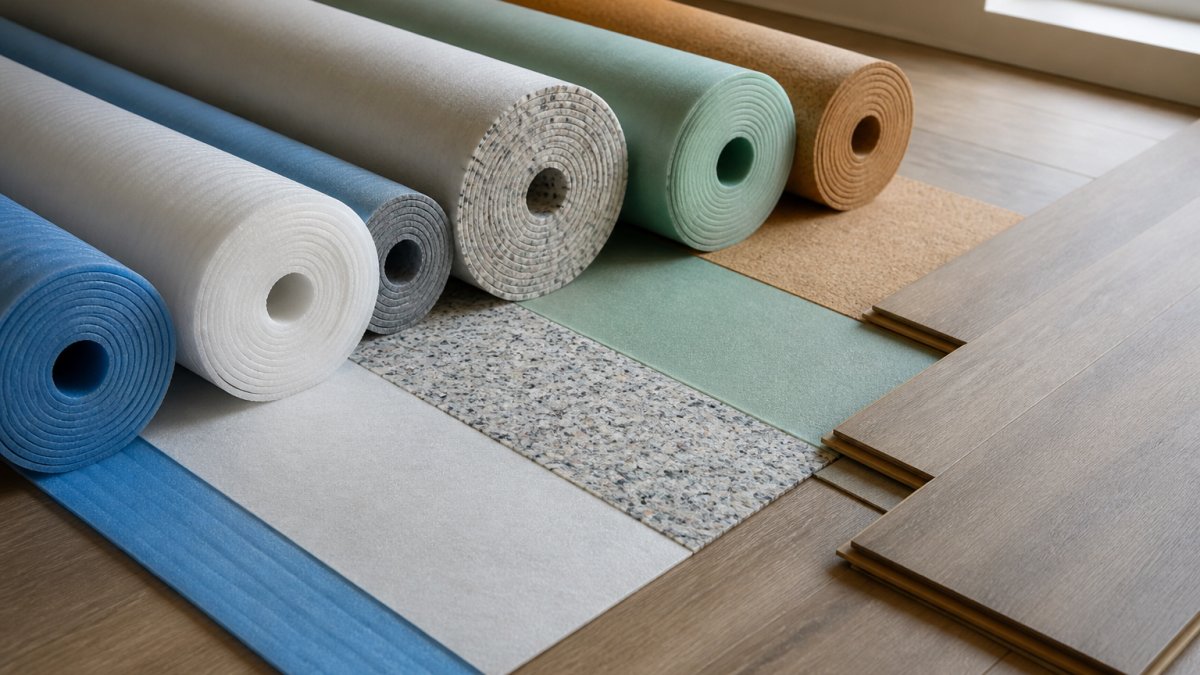
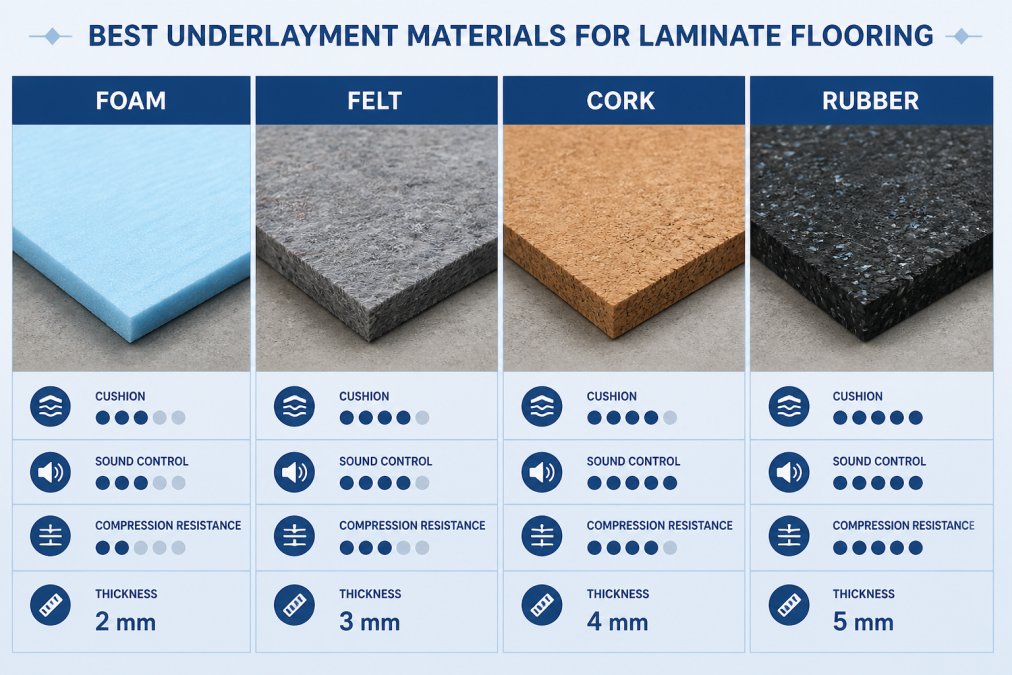
Different materials offer different acoustic performance, moisture protection, and durability. Your choice depends on your subfloor type, budget, and noise reduction goals.
| Material | Best For | Key Advantage | Key Limitation |
|---|---|---|---|
| Foam | Budget-conscious projects | Lightweight, affordable | Lower density, less impact absorption |
| Felt | Balanced performance | Denser than foam, good sound reduction | Heavier, more expensive than foam |
| Cork | Premium acoustic performance | Natural density, excellent sound reduction | Higher cost, moisture sensitivity |
| Rubber | High-traffic areas | Durability, strong acoustic performance | Most expensive option |
Foam Underlayment
Foam is the most common and affordable option. It's lightweight, easy to install, and performs adequately for most residential projects. Foam comes in various densities, higher density foam performs better acoustically than low-density foam.
The downside is that foam is softer than other materials. It compresses more under foot traffic, which means it may need replacement sooner in high-traffic areas. Foam also absorbs moisture more readily than cork or rubber, making it less ideal for coastal properties or basements prone to dampness.
Best for: Budget-conscious homeowners, dry climates, low-traffic areas. Skip if: You need maximum durability or live in a moisture-prone environment.
Felt Underlayment
Felt is denser than foam, which means better impact noise reduction and longer lifespan. Felt underlayment resists compression better than foam, so it maintains its acoustic properties longer under heavy foot traffic.
Felt performs well in most residential settings. It's thicker than foam (often 3/8-inch or more), which adds to its acoustic performance. The trade-off is cost, felt underlayment typically costs more than foam.
Best for: Homeowners prioritizing sound reduction and durability, residential installations. Skip if: Budget is your primary concern or you're working with a very tight subfloor height.
Cork Underlayment
Cork is a natural material with excellent acoustic properties. It's naturally dense and resilient, meaning it resists compression and maintains performance over time. Cork also has natural moisture resistance compared to foam, though it's not waterproof.
The downside is cost. Cork underlayment is the most expensive option for most installations. It also requires careful handling during installation, cork can crack or crumble if mishandled. For coastal properties, cork offers a good balance of acoustic performance and moisture tolerance, but it's not the best choice if your subfloor is actively wet.
Best for: Premium installations, homeowners prioritizing natural materials, moderate moisture environments. Skip if: Budget is tight or your subfloor has active water issues.
Rubber Underlayment
Rubber is the most durable underlayment material. It resists compression, moisture, and degradation better than any other option. Rubber underlayment maintains its acoustic properties even after years of heavy foot traffic. It's ideal for commercial spaces, high-traffic residential areas, and environments where durability matters most.
The trade-off is cost and installation. Rubber underlayment is expensive and heavier than other options, making installation more labor-intensive. Rubber also has a distinct smell when new, which fades over time but can be noticeable during installation.
Best for: High-traffic commercial spaces, coastal properties, long-term durability. Skip if: Budget is limited or you prefer lighter materials.
Underlayment for Laminate Over Concrete Subfloors
Concrete presents unique challenges for laminate flooring. Concrete wicks moisture from the ground, and it's a hard, rigid surface that transmits impact noise directly upward. Underlayment for laminate over concrete must do two jobs: reduce sound and prevent moisture damage.
Choose an underlayment with a built-in moisture barrier. Many products marketed for concrete subfloors include a vapor barrier layer. This barrier sits between the concrete and the foam, felt, or cork layer above it.
Thickness matters more with concrete than with wood subfloors. Concrete doesn't flex or absorb any impact energy, it's completely rigid.
Felt and rubber underlayments perform better on concrete than foam. Their higher density absorbs more of the impact energy before it reaches the hard concrete surface.
Installation is critical on concrete. Ensure the concrete is clean and dry before laying underlayment. Any debris or moisture trapped under the underlayment will compromise both acoustic performance and moisture protection.
Moisture Barriers and Vapor Protection in Underlayment
Coastal properties and moisture-prone areas require underlayment with vapor protection built in.
Without a vapor barrier, moisture from concrete or damp soil rises through the floor system. This moisture can warp laminate planks, cause mold growth, and create a musty smell.
Look for underlayment products that specify a moisture barrier rating. Some products have a 100% vapor barrier, others have partial barriers. For coastal properties or basements, a complete barrier is worth the extra cost.
The barrier should extend slightly up the walls and be sealed at seams. This creates a complete moisture-blocking layer under your entire floor. Gaps in the barrier create pathways for moisture to reach your laminate.
Underlayment with integrated moisture barriers is thicker and heavier than standard underlayment. Installation takes longer because seams must be taped and sealed. But the protection is essential in high-moisture environments.
Installation Steps That Affect Sound Performance
How you install underlayment directly impacts how well it reduces noise.
Start with a clean, dry subfloor. Sweep away all dust, debris, and sand.
Roll out underlayment in the same direction as your laminate planks will run.
Tape all seams with the appropriate tape (usually aluminum foil tape or specialty underlayment tape).
Press the underlayment flat against the subfloor as you work. Wrinkles and air pockets reduce acoustic performance.
Cut underlayment carefully around obstacles like doorways and vents. Seal these cuts with tape to maintain the acoustic barrier.
Let the underlayment acclimate to room temperature and humidity before laying laminate.
Finally, don't walk on the underlayment more than necessary before laying laminate.
Choosing the right underlayment for laminate is about matching the material to your specific situation. Coastal properties need moisture protection and durability.
The best underlayment for laminate flooring soundproofing depends on your subfloor type, moisture environment, and noise reduction goals.
Frequently Asked Questions
What's the difference between impact noise and airborne noise in laminate flooring?
Impact noise is the sound of footsteps, dropped objects, or furniture movement traveling through the floor structure. Airborne noise is sound that travels through the air, like voices or music. Underlayment for laminate primarily reduces impact noise by absorbing vibrations from footsteps before they travel through the subfloor. Airborne noise requires different solutions, such as acoustic panels or insulation between walls. Understanding this distinction helps you choose the right underlayment for your specific noise problem.
What do IIC and STC sound ratings mean for laminate underlayment?
IIC (Impact Insulation Class) measures how well underlayment reduces impact noise like footsteps; higher numbers indicate better sound reduction. STC (Sound Transmission Class) measures resistance to airborne noise. For laminate flooring, IIC is the more relevant rating because laminate noise problems are typically impact-related. Actual performance depends on your specific floor assembly and subfloor type. Always check the product specifications and ask your installer how ratings translate to your installation conditions.
Can I use underlayment for laminate over concrete?
Yes, but concrete requires special attention to moisture. Concrete subfloors can wick moisture upward, which damages laminate from below. When installing underlayment for laminate over concrete, choose a product with a built-in vapor barrier or pair your underlayment with a separate moisture barrier. Felt and rubber underlayments often provide better moisture protection than foam alone. A moisture barrier prevents water from the concrete from reaching the laminate planks, which is critical for floor longevity in basements or ground-level installations.
Why does my laminate flooring make noise when I walk on it?
Laminate makes noise when walking because the planks are hard and rigid; they transmit vibrations from footsteps directly into the subfloor and the room below. Without underlayment, every step creates impact noise. Laminate also moves slightly under foot pressure, and gaps between planks amplify sound. Proper underlayment absorbs these vibrations and cushions the planks, reducing both the noise you hear and the sound transmission to rooms below. Density and thickness of the underlayment matter: denser materials like felt and rubber absorb more sound than thin foam.