 Comparison
Waterproof Luxury Vinyl Plank vs Laminate: 2026 Guide
Table of Contents
- Waterproof Luxury Vinyl Plank vs Laminate: Head-to-Head Comparison Table
- Core Material Composition: What Each Floor Is Actually Made Of
- Appearance, Texture, and Hardwood Realism
- Durability, Scratch Resistance, and Wear Layer Performance
- Luxury Vinyl Plank vs Laminate Cost: What You'll Actually Pay
- Best Waterproof Flooring for Basements and Moisture-Prone Rooms
- VOC Emissions, Indoor Air Quality, and Repairability
- How to Clean Luxury Vinyl Plank and Waterproof Laminate
- Which Waterproof Flooring Is Right for You? A Decision Framework
- Conclusion
Last Updated: May 26, 2026
Choosing the wrong flooring for a moisture-prone room is an expensive mistake, and the debate over waterproof luxury vinyl plank vs laminate is one of the most consequential decisions homeowners face in 2026. At Hamptons carpet one floor and Home, we work with Suffolk County homeowners every day who arrive convinced one option is clearly superior, only to discover the real answer depends on factors most comparison guides never address. Below, we cover everything from core material construction and acoustic performance to VOC emissions and subfloor prep, so you can make a confident, informed decision before spending a dollar.
Here's what most guides get wrong: they treat "waterproof laminate" as though it's equivalent to LVP in moisture resistance. It isn't, and that distinction matters enormously for basements, bathrooms, and kitchens.
Waterproof Luxury Vinyl Plank vs Laminate: Head-to-Head Comparison Table
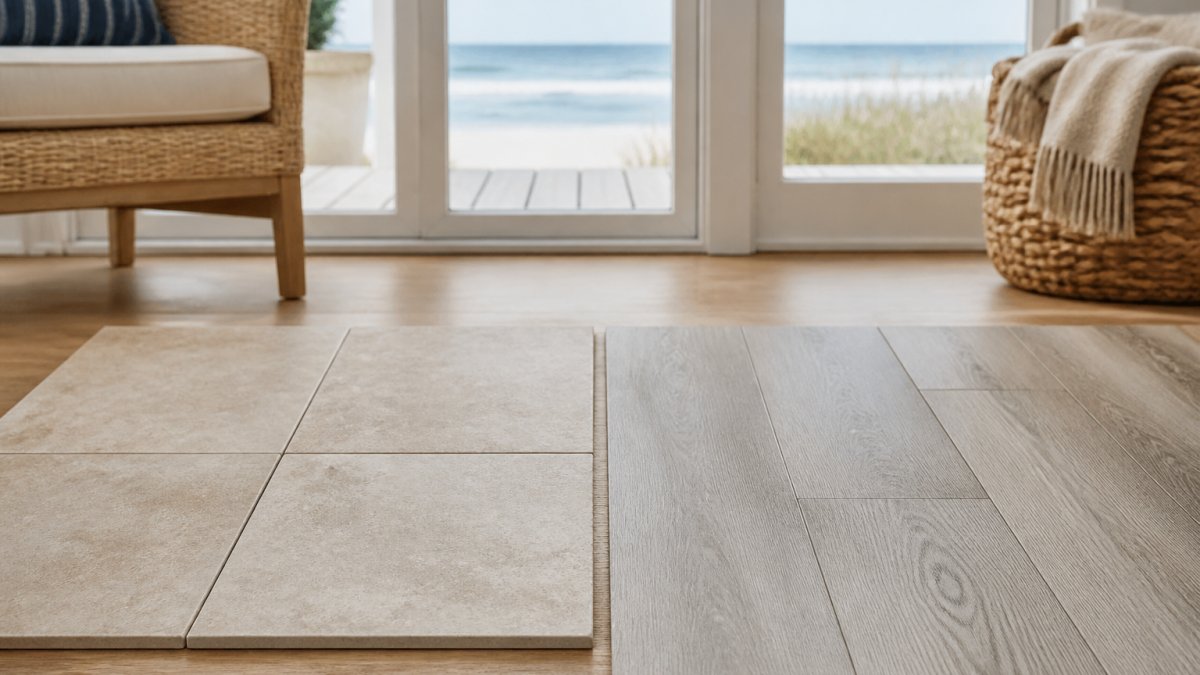
The fastest way to understand waterproof luxury vinyl plank vs laminate is side by side. The table below captures the key differentiators across the criteria that actually matter for a purchase decision.
| Feature | Luxury Vinyl Plank (LVP) | Waterproof Laminate |
|---|---|---|
| Core Material | SPC or WPC (synthetic) | HDF with hydroseal coating |
| True Waterproof | Yes, 100% | Surface-resistant, not fully waterproof |
| Water Damage Risk | None if installed correctly | Core can swell if seams are breached |
| Wear Layer | 6 mil - 20 mil+ | AC3 - AC5 aluminum oxide |
| Scratch Resistance | Moderate to high | Very high (AC4/AC5) |
| Hardwood Realism | Good to excellent | Excellent (GenuEdge, deep embossing) |
| Underfoot Feel | Softer (WPC), firmer (SPC) | Harder, more hollow sound |
| Installation | Click-lock, floating floor | Click-lock, floating floor |
| Subfloor Tolerance | High (SPC handles minor imperfections) | Requires very flat subfloor |
| Price Range | Starting ~$2.50/sq. ft. | Starting ~$2.00/sq. ft. |
| Best For | Basements, baths, kitchens | Living rooms, bedrooms, light moisture |
| Pet-Friendly | Yes | Yes (with hydroseal warranty) |
This table reflects product data from brands like COREtec Plus, Shaw Floorté Pro, Mohawk RevWood Plus, and Pergo TimberCraft +WetProtect. The pricing and features cited come directly from those manufacturers.
Core Material Composition: What Each Floor Is Actually Made Of
The real difference between LVP and waterproof laminate isn't marketing language. It's chemistry.
LVP: SPC and WPC Rigid Core Construction
Luxury Vinyl Plank is built entirely from synthetic materials. The two dominant core constructions are SPC (Stone Plastic Composite) and WPC (Wood Plastic Composite). SPC cores combine limestone powder and PVC into an extremely dense, dimensionally stable plank. WPC cores add a foamed polymer layer, which creates a slightly softer, warmer feel underfoot. Both constructions are inherently waterproof throughout the entire plank thickness, not just at the surface.
COREtec Plus, for example, uses a WPC rigid core with an attached cork underlayment, which contributes to its sound-dampening qualities. Shaw Floorté Pro uses SPC rigid core construction, prioritizing dent resistance and stability in high-traffic areas. The wear layer on top, typically ranging from 6 mil for entry-level products to 20 mil or more for commercial-grade options, is what protects against daily abrasion and scratches.
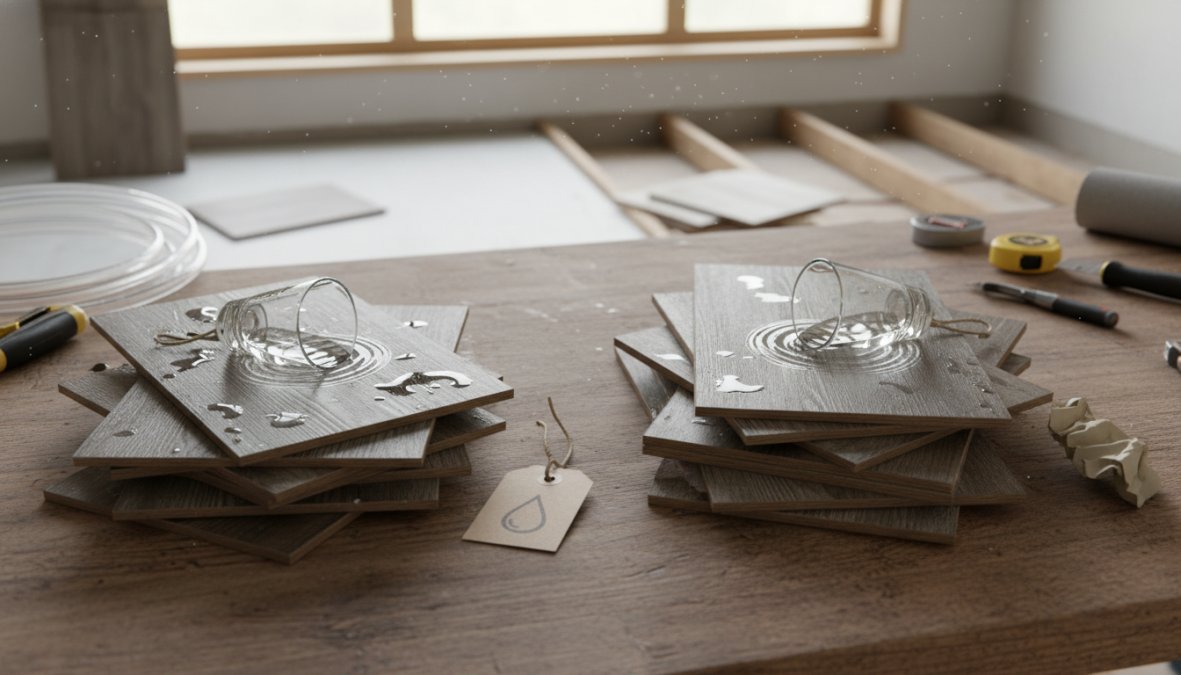
Because the entire plank is synthetic, water simply cannot penetrate the core. Dimensional stability is excellent: LVP won't swell, buckle, or warp when exposed to moisture.
Waterproof Laminate: HDF Core With Hydroseal Technology
Waterproof laminate is a fundamentally different product. The core is HDF (High-Density Fiberboard), which is a wood-based material. Left unprotected, HDF absorbs moisture and swells. What makes "waterproof laminate" different from standard laminate is hydroseal technology applied to the edges and surface, plus tightly engineered click-lock seams that prevent water from reaching the core.
Mohawk RevWood Plus uses a Uniclic locking system specifically designed to trap spills on the surface. Pergo TimberCraft +WetProtect provides a lifetime waterproof warranty covering both the surface and the subfloor beneath, which is a meaningful commitment. The critical caveat: these warranties apply to surface spills that are cleaned up in a reasonable timeframe. Sustained flooding or standing water that finds its way through seams over time can still compromise an HDF core.
The honest takeaway: waterproof laminate is moisture-resistant, not unconditionally waterproof. The distinction matters in rooms where water exposure is frequent or severe.
Appearance, Texture, and Hardwood Realism
Many buyers assume laminate automatically looks more realistic than LVP. That assumption is increasingly outdated.
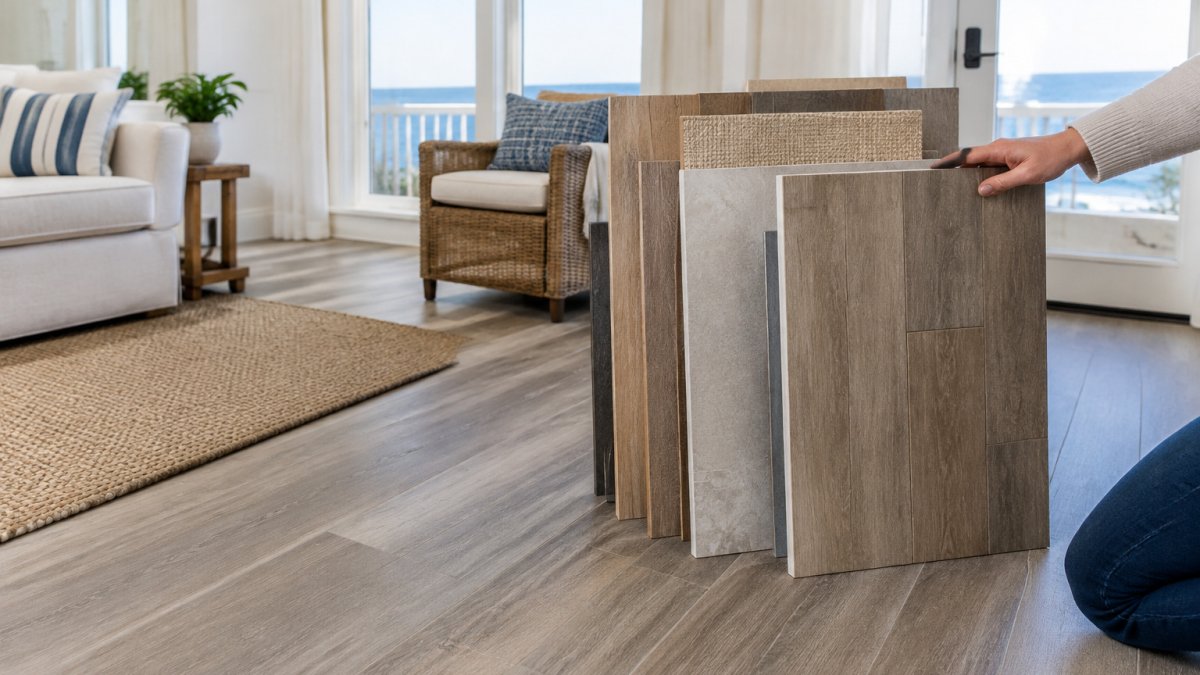
Modern LVP uses high-resolution photographic print layers combined with embossing techniques that create genuine texture variation across the plank surface. Shaw Floorté Pro offers many wood and stone visuals with realistic surface texture. COREtec Plus planks feature hand-scraped and wire-brushed finishes that replicate the tactile quality of real hardwood.
Waterproof laminate still holds an edge in one specific area: edge detail. Mohawk RevWood Plus uses GenuEdge technology, which wraps the surface design over the plank edge, eliminating the flat, uniform edge that can make laminate look artificial in close inspection. Pergo TimberCraft +WetProtect uses deep embossing in register with the printed grain pattern, so the texture aligns with the visual grain rather than running counter to it.
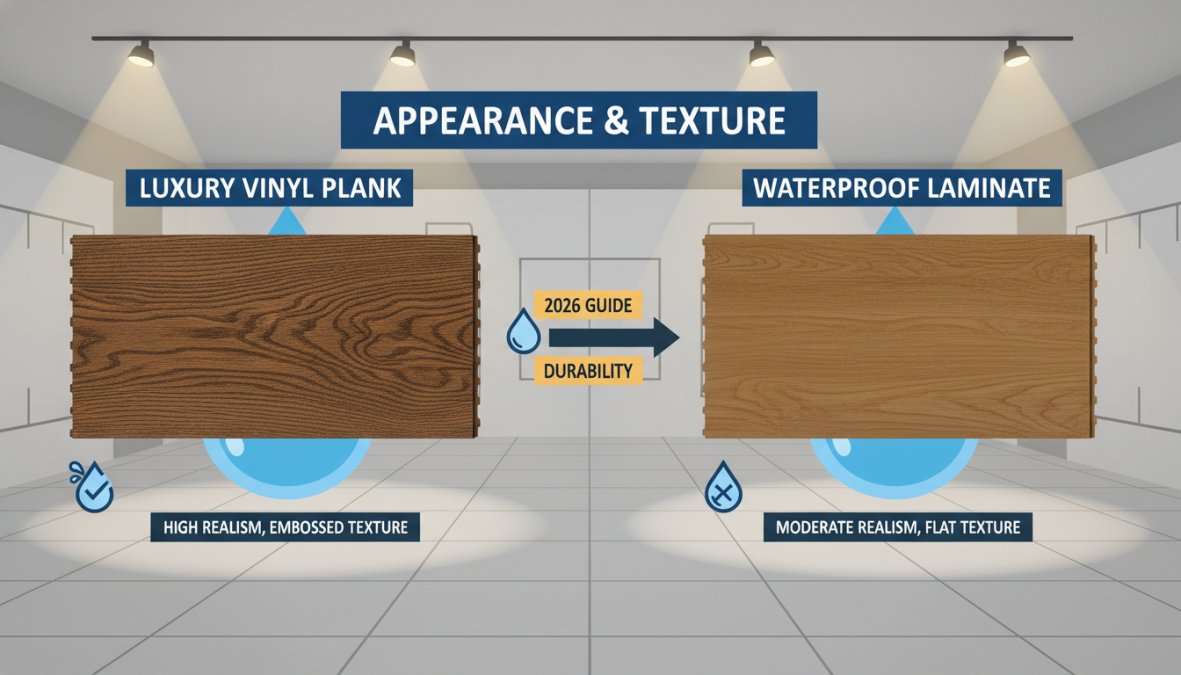
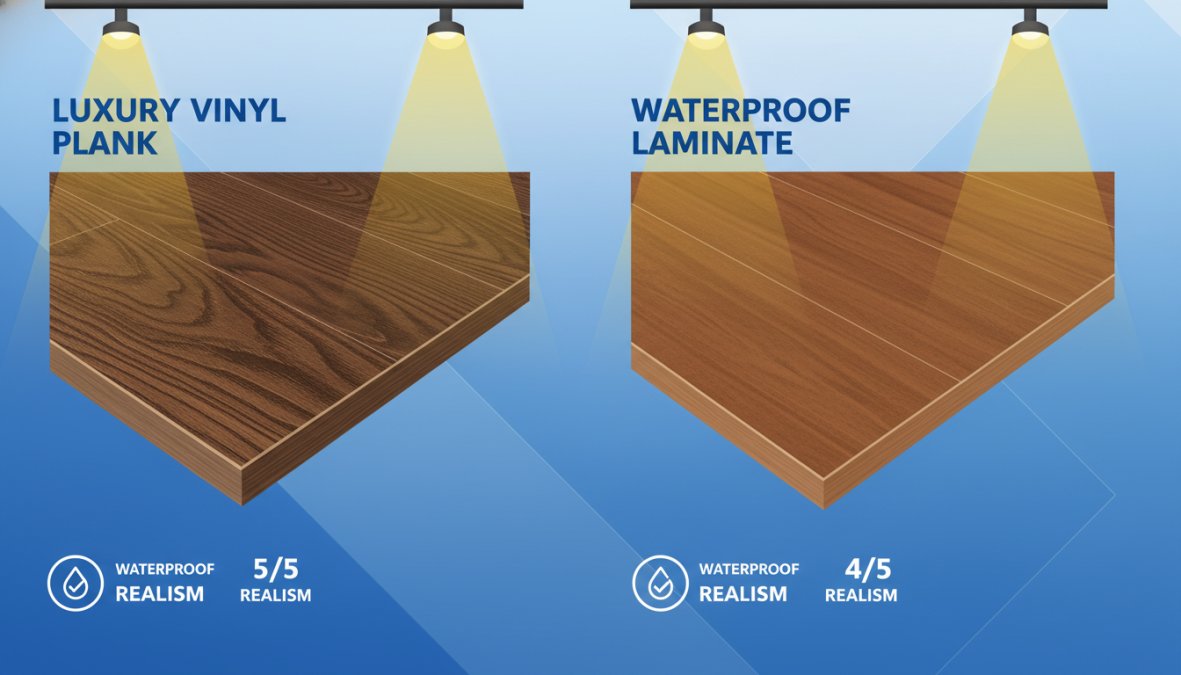
The practical difference for most homeowners: in a well-lit living room, a quality waterproof laminate like Pergo TimberCraft may look marginally more convincing than mid-range LVP. But premium LVP products close that gap significantly. At the price points where these products compete, hardwood realism is no longer a decisive advantage for laminate.
Durability, Scratch Resistance, and Wear Layer Performance
Scratch resistance is the category where waterproof laminate genuinely outperforms most LVP.
Laminate's wear layer is aluminum oxide-infused, rated on the AC (Abrasion Criteria) scale. Pergo TimberCraft +WetProtect carries an AC4 rating, suitable for heavy residential traffic. Mohawk RevWood Plus offers exceptional scratch and dent resistance that exceeds what most vinyl wear layers can match at comparable price points.
LVP wear layer performance is measured in mil thickness rather than AC ratings. A 12 mil wear layer handles normal residential use well. A 20 mil wear layer, common in commercial-grade SPC products like Shaw Floorté Pro, competes directly with AC4 laminate for scratch resistance. The trade-off: thicker LVP wear layers typically cost more per square foot.
Pet-Friendly and High Foot Traffic Considerations
Both product categories market themselves as pet-friendly, but the performance profiles differ. Mohawk RevWood Plus carries an "All Pet" warranty that covers all pets and all accidents, which is a meaningful differentiator for households with multiple animals. The aluminum oxide surface resists claw marks better than standard LVP wear layers.
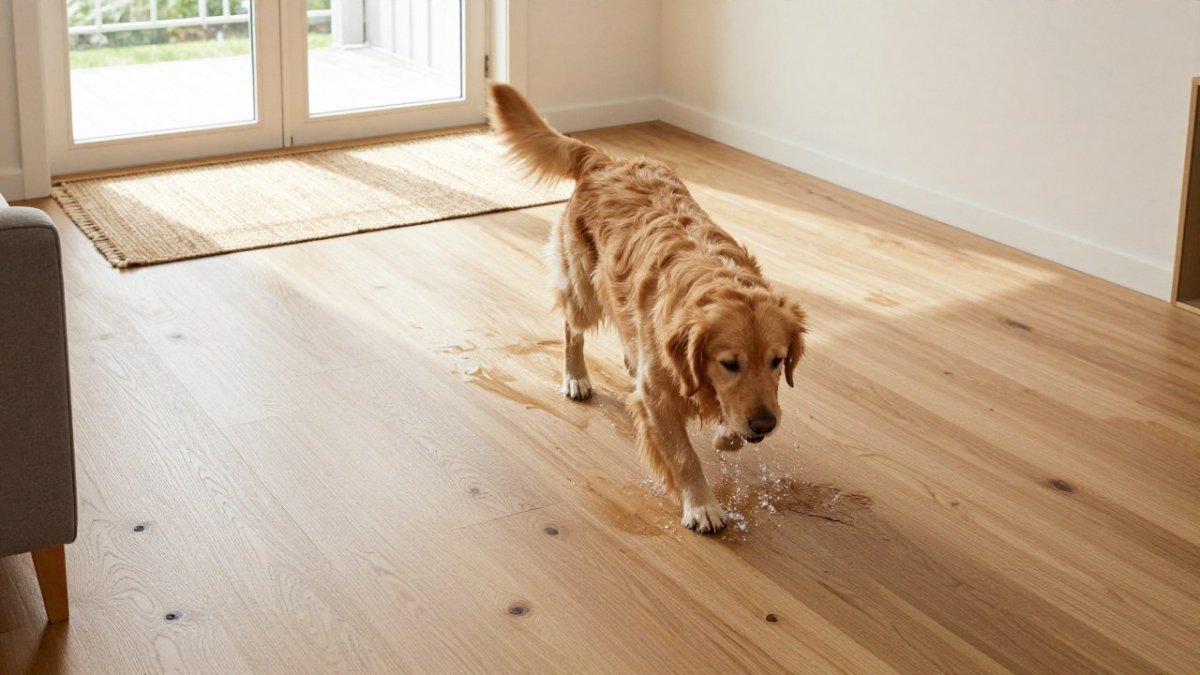
LVP's advantage for pet owners is different: true waterproofing. A dog or cat that has an accident on LVP creates no long-term damage risk to the floor, even if the mess sits for hours. On waterproof laminate, the same accident needs to be cleaned promptly to prevent seam infiltration. For high foot traffic, SPC-core LVP like Shaw Floorté Pro handles denting from furniture legs and heavy use better than WPC-core options, thanks to its denser construction.
According to the Resilient Floor Covering Institute's installation and product guidelines, wear layer thickness is the single most important factor in LVP longevity for residential applications.
Luxury Vinyl Plank vs Laminate Cost: What You'll Actually Pay
Material price per square foot is the number most guides lead with, and it's also the least useful number for budgeting a real project. Total installed cost, materials, underlayment, subfloor preparation, labor, and waste factor, routinely runs 40-70% higher than the material price alone. Here's how to build an honest budget for both product types.
Material Cost: What the Ranges Actually Mean
Both product categories span a wide price range, and the overlap is significant at mid-tier price points.
| Product | Material Cost (per sq. ft.) | Tier |
|---|---|---|
| Entry-level waterproof laminate | ~$1.50-$2.50 | Budget |
| Pergo TimberCraft +WetProtect | ~$2.00-$4.99 | Mid to premium |
| Mohawk RevWood Plus | ~$3.00-$6.00 | Mid to premium |
| Entry-level LVP (6 mil wear layer) | ~$1.50-$2.50 | Budget |
| COREtec Plus (WPC) | ~$3.50-$5.50 | Mid to premium |
| Shaw Floorté Pro (SPC) | ~$2.50-$6.50 | Mid to premium |
The honest observation: at the $3.00-$5.00 per square foot range where most homeowners shop, material cost is not a meaningful differentiator between the two product types. The decision should be driven by application requirements, not a $0.50/sq. ft. material difference.
Budget-tier products in both categories, those below $2.00/sq. ft., carry real trade-offs: thinner wear layers (6 mil or less on LVP, AC1-AC2 on laminate), thinner core construction that telegraphs subfloor imperfections, and less realistic surface embossing. For a rental property or a short-term renovation, budget-tier products are defensible. For a primary residence, the mid-tier products represent meaningfully better long-term value.
Underlayment: Attached vs. Separate
Underlayment adds $0.25-$0.75 per square foot to material cost when purchased separately. Many mid-range and premium products in both categories include attached underlayment, which eliminates this line item.
- COREtec Plus: Includes attached cork underlayment. No separate underlayment purchase required on most subfloor types.
- Shaw Floorté Pro: Most collections include attached underlayment; verify by SKU.
- Pergo TimberCraft +WetProtect: Includes attached foam underlayment on most collections.
- Mohawk RevWood Plus: Attached underlayment included on most collections.
If your chosen product does not include attached underlayment, budget for a 2mm-3mm foam or cork underlayment. Do not double-layer underlayment (attached plus separate), this creates excessive flex in the floor assembly, stresses the locking joints, and voids most manufacturer warranties.
Subfloor Preparation: The Hidden Cost Variable
This is where project budgets most commonly go wrong, and it affects laminate installations more severely than LVP.
Waterproof laminate requires a subfloor that is flat to within 3/16 inch over a 10-foot span. Many premium laminate products specify even tighter tolerances. SPC-core LVP is more tolerant, most manufacturers allow up to 3/16 inch variation over 10 feet, and the rigid core bridges minor dips and humps more effectively than laminate's stiffer HDF construction.
Subfloor prep cost scenarios:
- Minor leveling (isolated high spots, small cracks): Self-leveling compound, applied by a DIYer, costs roughly $30-$60 per 50 lb. bag. A 50 lb. bag covers approximately 40-50 square feet at 1/4 inch depth. This is a manageable DIY task.
- Moderate leveling (multiple low spots, uneven concrete slab): A flooring installer may charge $1.00-$2.00 per square foot for professional leveling on a concrete subfloor. On a 500 sq. ft. basement, that's $500-$1,000 in prep cost before a single plank is installed.
- Significant subfloor remediation (OSB or plywood with deflection, squeaks, or damaged areas): Structural repairs to a wood subfloor can run $2.00-$5.00 per square foot depending on the extent of damage and local labor rates.
For laminate installations specifically, skipping or underinvesting in subfloor prep is the single most common cause of post-installation failures: squeaking, gapping at end joints, and cracked locking profiles. These failures are not covered under product warranties because they result from improper installation conditions, not product defects.
Labor Cost: Floating Floor Installation
Both LVP and waterproof laminate use click-lock floating floor systems, so labor rates are comparable between the two product types. Professional installation for floating floor systems typically runs $1.50-$3.00 per square foot for labor alone in most U.S. markets, with regional variation. Complex room layouts with multiple angles, transitions, or stair nosing work add to this figure.
DIY installation is genuinely feasible for both products in straightforward rectangular rooms. The tools required, a miter saw or circular saw, a tapping block, a pull bar, and a rubber mallet, are available at any home improvement store. The most common DIY errors are failing to check subfloor flatness, failing to leave adequate expansion gaps at walls, and misaligning the stagger pattern between rows (most manufacturers specify a minimum 6-inch offset between end joints in adjacent rows).
Total Installed Cost: A Realistic 500 Sq. Ft. Example
The following is a representative cost model for a 500 sq. ft. main-floor living room installation. Prices reflect typical mid-range product and labor costs; your actual costs will vary by region and specific product selection.
| Line Item | LVP (COREtec Plus) | Waterproof Laminate (Pergo TimberCraft) |
|---|---|---|
| Material (500 sq. ft. + 10% waste) | ~$2,200-$3,000 | ~$1,650-$2,750 |
| Underlayment (if not attached) | $0 (included) | $0 (included) |
| Subfloor prep (minor leveling) | ~$100-$300 | ~$150-$400 |
| Labor (professional install) | ~$750-$1,500 | ~$750-$1,500 |
| Transitions and moldings | ~$100-$250 | ~$100-$250 |
| Total installed estimate | ~$3,150-$5,050 | ~$2,650-$4,900 |
The material cost difference between comparable mid-range products is often $200-$400 on a 500 sq. ft. project, a smaller gap than most homeowners expect. When subfloor preparation requirements are factored in, the total installed cost difference frequently narrows further, particularly in older homes with uneven subfloors where laminate requires more prep work.
Best Waterproof Flooring for Basements and Moisture-Prone Rooms
For below-grade installations, LVP is the clear recommendation. This isn't a close call.
Basements present moisture challenges that go beyond surface spills: humidity, condensation from concrete slabs, and occasional seepage through foundation walls. Because LVP's SPC or WPC core is 100% synthetic, moisture vapor transmission from the slab cannot damage the plank itself. Waterproof laminate, regardless of its hydroseal technology, remains vulnerable to sustained high humidity because moisture vapor can still affect the HDF core over time, even without visible standing water.
COREtec Plus is specifically designed for below-grade installations and requires no acclimation before installation, a practical advantage in basement projects where temperature and humidity can fluctuate. Shaw Floorté Pro's rigid core construction handles the dimensional stress of basement temperature swings without gapping or buckling.
Subfloor Preparation Requirements
This is the section most flooring guides skip entirely. It's also where many installations go wrong.
LVP tolerates minor subfloor imperfections better than laminate, particularly SPC-core products. Most manufacturers allow up to 3/16 inch variation over a 10-foot span for LVP installation. Laminate typically requires 3/16 inch or less variation over the same span, and some premium products specify even tighter tolerances.
For concrete subfloors in basements, both products require checking for moisture vapor emission. A simple plastic sheet test, taped to the slab for 24-72 hours, reveals whether moisture vapor is present. Excessive vapor emission requires either a vapor barrier or an epoxy moisture mitigation system before any floating floor installation.
A common mistake: assuming a floating floor installation on concrete requires no preparation beyond sweeping. Concrete slabs frequently have high spots, cracks, and surface contamination that must be addressed with floor leveling compound before installation.
Acoustic Performance and Underfoot Comfort
Acoustic performance is rarely discussed in flooring comparisons, but it directly affects daily living quality.
Mohawk RevWood Plus acknowledges that laminate can be louder underfoot than LVP, which is an honest concession from the manufacturer. Laminate's HDF core transmits impact sound more readily than the foamed WPC core found in products like COREtec Plus. The attached cork underlayment in COREtec Plus provides meaningful sound dampening, reducing both impact noise transmission to lower floors and the hollow "click" sound that plagues cheaper floating floors.
For multi-story homes, the acoustic difference between SPC-core LVP and waterproof laminate is noticeable. WPC-core LVP is the softest-sounding option. If acoustic performance matters, look for products with IIC (Impact Insulation Class) and STC (Sound Transmission Class) ratings in their specification sheets. According to the National Wood Flooring Association's technical guidance on floating floor acoustics, an IIC rating of 50 or higher is generally recommended for multi-family or multi-story residential applications.
VOC Emissions, Indoor Air Quality, and Repairability
These two topics are almost entirely absent from competitor guides, yet they represent two of the most common questions homeowners ask after the initial purchase decision. We're covering both in the depth they deserve.
VOC Emissions and Indoor Air Quality: What Each Floor Actually Off-Gasses
The indoor air quality story for LVP and waterproof laminate is different in mechanism, not just in degree.
Waterproof Laminate and Formaldehyde Risk
Laminate's HDF core is a composite wood product manufactured with urea-formaldehyde (UF) or melamine-formaldehyde (MF) binders. Formaldehyde is a known respiratory irritant and classified carcinogen at sustained elevated exposures. The relevant regulatory benchmark is CARB Phase 2 (California Air Resources Board), which sets a formaldehyde emission limit of 0.05 ppm for composite wood flooring products. Most major laminate brands sold in the U.S. today comply with CARB Phase 2, and many carry TSCA Title VI certification, which applies the same standard federally. Pergo TimberCraft +WetProtect and Mohawk RevWood Plus both carry CARB Phase 2 compliance documentation.
The practical risk is highest in the first 30-90 days after installation, when off-gassing rates are elevated, a period sometimes called the "cure window." Ventilating the room aggressively during and after installation (open windows, run HVAC) meaningfully reduces peak formaldehyde concentration. For households with asthma, chemical sensitivities, or young children, this window matters.
Look for the GREENGUARD Gold certification specifically, not just GREENGUARD. GREENGUARD Gold applies stricter chemical emission limits calibrated for schools and healthcare environments, the most protective standard currently available for flooring products in the U.S.
LVP and Plasticizer Off-Gassing
LVP's VOC profile is different. Because LVP contains no wood fiber, it carries no formaldehyde risk from binders. The relevant concern is plasticizers, specifically phthalates, used to keep PVC flexible. Older or lower-cost LVP products have historically used DEHP and other phthalates that are now restricted or banned in children's products under the Consumer Product Safety Improvement Act (CPSIA). Reputable LVP manufacturers have largely transitioned to non-phthalate plasticizers, but this is not universal across the market.
The certification to look for on LVP is FloorScore, administered by the Resilient Floor Covering Institute (RFCI) and verified by SCS Global Services. FloorScore tests for over 35 VOCs and is the most widely recognized indoor air quality certification for resilient flooring. COREtec Plus and Shaw Floorté Pro both carry FloorScore certification. GREENGUARD Gold certification is also available for LVP and provides an additional layer of verification.
Practical IAQ Checklist Before You Buy
- Ask for the product's CARB Phase 2 or TSCA Title VI compliance documentation (laminate)
- Confirm FloorScore or GREENGUARD Gold certification (both product types)
- Verify the plasticizer type is non-phthalate (LVP, ask the manufacturer directly if not listed on the spec sheet)
- Plan for aggressive ventilation during installation and for 30-90 days afterward regardless of product type
- If a household member has chemical sensitivities, request the full product VOC test report from the manufacturer, not just the certification logo
California Air Resources Board composite wood product emission standards
Repairability: How to Actually Replace a Single Damaged Plank
This is the section most flooring guides skip entirely, and it's the one homeowners most urgently need after a chair leg gouges a plank or a pet accident sits unnoticed for two days.
Both LVP and waterproof laminate use floating click-lock installation systems, which means no plank is glued or nailed to the subfloor. In theory, any individual plank can be replaced. In practice, the process requires patience, the right tools, and, critically, a matching plank from the original dye lot.
Step-by-Step: Replacing a Single Plank in a Floating Click-Lock Floor
-
Locate the nearest wall or doorway. Click-lock floating floors must be disassembled from an edge. You cannot remove a plank from the middle of a field without working back from a perimeter.
-
Remove the baseboard or quarter-round molding along the wall closest to the damaged plank. Use a pry bar and protect the wall with a scrap of wood. Set the molding aside carefully, you'll reinstall it.
-
Disengage planks row by row from the wall edge to the damaged plank. Most click-lock systems disengage by lifting the long edge of the plank at a 30-45 degree angle and sliding it laterally to release the short-end joint. Work slowly. Forcing the angle can crack the locking tongue.
-
Remove the damaged plank and inspect the subfloor beneath it. If moisture caused the damage, address the moisture source before installing the replacement.
-
Install the replacement plank and reassemble the rows in reverse order, snapping each plank back into its neighbor.
-
Reinstall the baseboard or quarter-round and nail it to the wall, not the floor. Floating floors require an expansion gap (typically 1/4 inch) at all walls; nailing the molding to the floor eliminates that gap and causes buckling.
Where LVP and Laminate Diverge on Repairability
LVP planks are more forgiving during disassembly. The PVC core flexes slightly, reducing the risk of cracking the locking joint when you lift and slide. Most LVP planks can be disassembled and reassembled two to three times before the locking profile begins to degrade.
Waterproof laminate is more brittle at the locking joint. The HDF core does not flex, and the edge of the plank, particularly the short-end tongue, is vulnerable to chipping if the disassembly angle is too aggressive or if the plank has been in place for several years and the joint has tightened. A chipped locking tongue means that plank cannot be reinstalled; you'll need an additional replacement plank.
For laminate repairs more than two or three rows from the nearest wall, some installers use a technique called the "pull bar and tapping block" method to work planks loose without full disassembly, but this risks damaging the locking profile and is not recommended for DIY repairs on premium laminate.
The Dye Lot Problem
Both products are manufactured in production runs. The print layer, embossing depth, and surface sheen can shift between runs even within the same product line and SKU. A plank purchased 18 months after the original installation may be visibly different under direct light, even if the product name and color name are identical.
The only reliable solution is to purchase 10-15% overage at the time of original installation and store it flat, off the ground, in a climate-controlled space. Do not store it in a garage or basement where temperature and humidity fluctuate, the planks can warp or absorb moisture even in their packaging.
How to Clean Luxury Vinyl Plank and Waterproof Laminate
Maintenance is straightforward for both products, with a few critical differences.
For luxury vinyl plank:
- Sweep or vacuum daily in high-traffic areas (use a soft-bristle attachment, not a beater bar)
- Damp mop with a pH-neutral cleaner specifically formulated for LVP
- Avoid steam mops: the heat can soften the wear layer and damage adhesive in the underlayment
- Clean spills immediately, though the waterproof core means there's no urgency beyond hygiene
For waterproof laminate:
- Sweep or vacuum regularly to prevent grit abrasion on the wear layer
- Use a well-wrung damp mop only: excess water at seams is the enemy
- Never use steam mops: the moisture and heat combination is particularly damaging to HDF cores
- Clean spills immediately and dry the area thoroughly, especially near seams and edges
The practical maintenance difference: LVP is more forgiving. A damp mop that's slightly wetter than ideal won't cause damage to LVP. On waterproof laminate, consistent wet mopping that allows water to pool at seams will eventually compromise the hydroseal protection and allow moisture to reach the HDF core.
Both products benefit from felt pads under furniture legs and area rugs in high-traffic zones. Neither should be cleaned with abrasive scrubbers or oil-based cleaners.
Which Waterproof Flooring Is Right for You? A Decision Framework
The best choice between waterproof luxury vinyl plank vs laminate comes down to four questions. Answer them honestly and the right product becomes clear.
1. Where is the floor going?
- Basement, bathroom, laundry room, or kitchen: choose LVP. True 100% waterproofing is non-negotiable in these spaces.
- Living room, dining room, or bedroom with minimal moisture exposure: either product works; laminate may offer better scratch resistance at comparable price points.
2. Do you have pets or heavy foot traffic?
- Multiple pets or high-traffic household: Mohawk RevWood Plus with its All Pet warranty and superior scratch resistance is a strong option, but only in rooms where moisture is not a primary concern. For high-traffic rooms with moisture risk, Shaw Floorté Pro's SPC rigid core is the better call.
3. How flat is your subfloor?
- Uneven subfloor with more than 3/16 inch variation: LVP tolerates this better and requires less prep work, reducing installation cost.
- Flat, well-prepared subfloor: both products install equally well.
4. What's your acoustic priority?
- Multi-story home where noise transmission is a concern: COREtec Plus with its attached cork underlayment is the quietest option in this comparison. WPC-core LVP generally outperforms laminate on acoustic performance.
For most Suffolk County homeowners dealing with the region's humidity levels and frequent basement finishing projects, LVP is the more practical long-term choice. The margin in hardwood realism between premium LVP and waterproof laminate has narrowed to the point where it's no longer a compelling reason to accept the moisture vulnerability of an HDF core.
That said, for a dry main-floor renovation where scratch resistance is the top priority and moisture is a non-issue, Mohawk RevWood Plus or Pergo TimberCraft +WetProtect represent genuinely excellent value. The flooring category has matured enough that there are no bad choices at the premium tier, only wrong applications.
Selecting the right floor for your specific room conditions, subfloor situation, and household demands is exactly the kind of decision that benefits from expert guidance rather than a generic online quiz. Hamptons carpet one floor and Home serves all of Suffolk County, NY, and our team has helped homeowners navigate these exact trade-offs across thousands of installations. Visit our showroom to see COREtec Plus, Shaw Floorté Pro, Mohawk RevWood Plus, and Pergo TimberCraft side by side, and get a recommendation grounded in your actual project. Get started with Hamptons carpet one floor and Home and choose a floor you won't regret.
Frequently Asked Questions
Is luxury vinyl plank really 100% waterproof compared to waterproof laminate?
Yes. Luxury vinyl plank, especially SPC and WPC rigid core options like COREtec Plus, is 100% waterproof throughout its entire construction, the synthetic core will not swell or warp when submerged. Waterproof laminate uses technologies like Hydroseal or WetProtect to repel surface moisture and protect the HDF core at the seams, but prolonged standing water can still penetrate if seam integrity is compromised. For rooms with frequent water exposure, LVP offers a more reliable moisture barrier.
Which is cheaper: luxury vinyl plank or laminate flooring?
Costs overlap significantly depending on the product tier. Waterproof laminate like Pergo TimberCraft starts around $2.00-$4.99 per sq. ft., while LVP options like Shaw Flooré Pro range from $2.50-$6.50 per sq. ft. Entry-level laminate can be slightly cheaper, but mid-range products from both categories are similarly priced. Factor in underlayment, subfloor prep, and installation labor when calculating your total luxury vinyl plank vs laminate cost for a home renovation project.
Can you install waterproof laminate or LVP in a basement?
LVP is generally the better choice for basements because its fully waterproof synthetic core handles below-grade humidity and potential moisture seepage far better than laminate's HDF fiberboard core. Both use a floating floor click-lock installation system, but LVP requires less subfloor perfection and tolerates dimensional changes from temperature swings more reliably. Ensure proper subfloor preparation, the surface must be flat within 3/16 inch per 10 feet, and add a moisture barrier if your concrete slab shows any dampness.
How do you clean luxury vinyl plank without damaging it?
To clean luxury vinyl plank, sweep or vacuum daily to remove grit that can scratch the wear layer. Damp-mop weekly using a pH-neutral cleaner diluted in water, avoid steam mops, wax-based products, or abrasive scrubbers, which can dull the finish or compromise the surface. For stubborn spots, a small amount of rubbing alcohol on a cloth works well. Blot spills immediately rather than letting them sit, and place felt pads under furniture legs to protect against scratches during routine maintenance.
What is the main difference between LVP and waterproof laminate in terms of feel underfoot?
LVP, especially WPC-based products with attached cork underlayment like COREtec Plus, tends to feel warmer and softer underfoot due to its composite wood-plastic core and cushioning layer. SPC rigid core LVP feels firmer. Waterproof laminate has a denser HDF core that can feel harder and transmit more sound, Mohawk RevWood Plus, for example, is noted as louder underfoot than vinyl. Adding a quality underlayment to laminate improves both acoustic performance and comfort significantly.
Can individual planks be repaired if damaged on LVP or laminate floors?
LVP has a clear advantage in repairability. Because most luxury vinyl plank uses a floating floor click-lock installation, individual damaged planks can be unclipped and replaced without disturbing the entire floor, provided you have matching planks saved from the original installation. Waterproof laminate planks can also be replaced using the same click-lock method, but matching older laminate is harder due to batch color variation. In both cases, repairing a plank at the center of a room requires disassembly from the nearest wall.
This article was written using GrandRanker