 Ultimate guide
What Flooring Do High-End Homes Use? 2026 Guide
Table of Contents
- Why High-End Flooring Choices Matter in 2026
- 1. French and Northern White Oak: The Species Dominating High-End Homes
- 2. Engineered Hardwood and Wide-Plank Formats for Dimensional Stability
- 3. Natural Stone Flooring: Marble, Travertine, and Limestone
- 4. Porcelain and Ceramic Tile: Durable Hard Surface Options
- 5. Carpet and Flat Weave Rugs: Comfort and Acoustic Performance
- 6. Luxury Hardwood Flooring Trends: Patterns, Textures, and Finishes
- 7. Best Flooring for Living Room: Balancing Aesthetics and Durability
- Frequently Asked Questions
Last Updated: September 19, 2026
Why High-End Flooring Choices Matter in 2026
What flooring do high-end homes use? The answer starts with a number: two-thirds of consumers say they would choose real wood floors for their dream homes, according to Public Opinion Strategies consumer preference research.
Flooring is the largest hard surface in a luxury home, and it carries more weight than most buyers realize. Get it wrong and the mistake can drag down resale value. Get it right and the floor becomes the room's quiet anchor.
Below, we break down the species, formats, and finishes defining high-end floors in 2026, plus the technical details most guides skip.
1. French and Northern White Oak: The Species Dominating High-End Homes
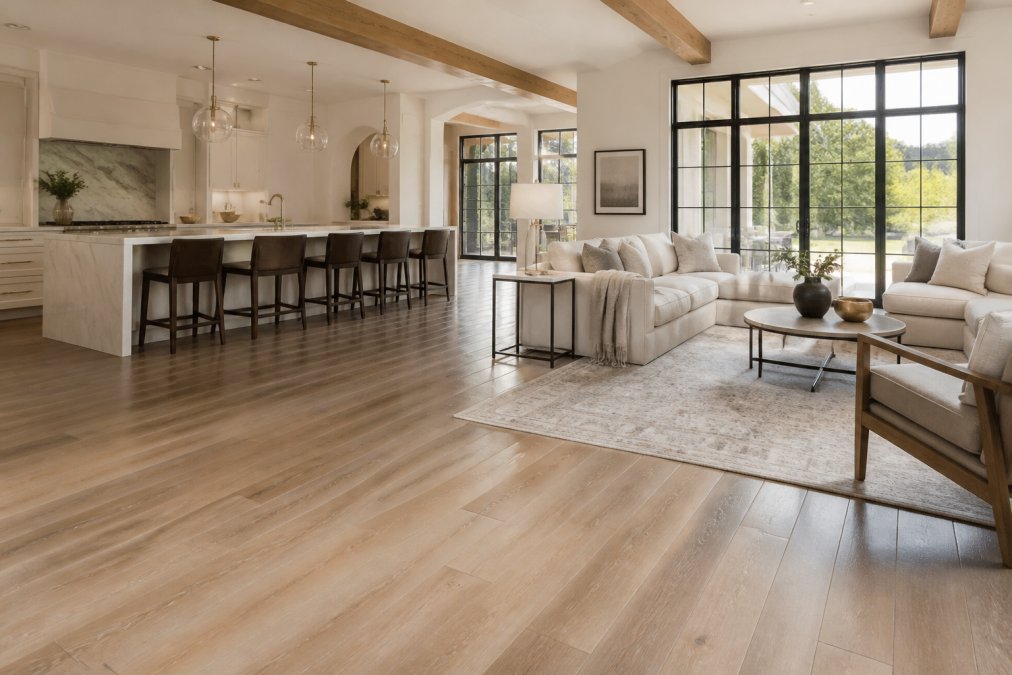
French Oak and Northern White Oak are the two species dominating high-end custom homes in 2026, according to Hardwood Designs' 2026 wide-plank trend report. Both deliver the tight grain and warm undertone that designers now favor over the gray palettes of the past decade.
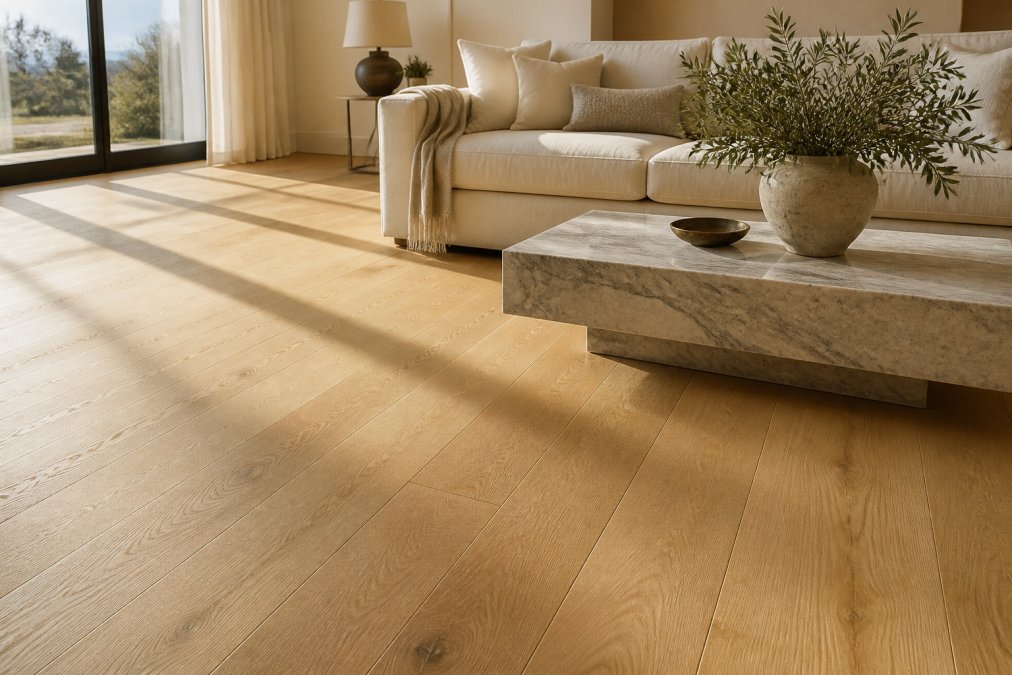
Why these two? French Oak offers subtle color variation across planks; Northern White Oak reads cleaner and more uniform. Both accept matte and satin finishes beautifully, which matter because high-gloss is fading fast in luxury interiors.
Pros: timeless grain, strong resale appeal, works with radiant heating when engineered. Cons: premium pricing, sensitive to moisture swings in coastal homes.
2. Engineered Hardwood and Wide-Plank Formats for Dimensional Stability
Engineered hardwood is real wood flooring built with a plywood core and a hardwood top layer, which gives it far greater dimensional stability than solid wood. That stability is why engineered planks resist cupping and warping in humid coastal conditions.
Wide-plank formats now range from five to nine inches across, per America's Finest Carpet's 2026 luxury trend roundup. Wider boards show more natural grain and create a cleaner aesthetic, but they demand a flatter subfloor. Golden State Floors documented glue-down engineered hardwood installations in luxury residences that improved structural stability compared with solid wood.
3. Natural Stone Flooring: Marble, Travertine, and Limestone
Natural stone remains the signature choice for entry halls, primary baths, and formal spaces, but the reason has less to do with looks than with thermal mass. Stone is dense, so it absorbs and releases heat slowly. That property is exactly why stone pairs so well with radiant floor heating: the slab or tile holds warmth long after the boiler cycles off, which is why most practitioners specify stone in primary baths and foyers that sit over hydronic systems.
Marble delivers veined drama and reads as the most formal option. Calacatta and Statuario carry bold, high-contrast veining; Carrara is softer and grayer. Marble is calcium carbonate, which means it is acid-sensitive. Citrus, wine, vinegar, and even some household cleaners etch the surface permanently. That is a chemistry problem, not a cleaning problem, and it is why marble is a poor fit for kitchens and mudrooms regardless of price point.
Travertine is a form of limestone formed by mineral springs. Its natural voids and earthier tones hide wear better than marble and pair well with the warm palettes dominating 2026 interiors. Unfilled travertine shows the pits; filled travertine is grouted smooth. Honed and tumbled finishes are the norm in coastal homes because salt air and tracked sand dull a polish quickly.
Limestone is the quietest of the three. It is uniform, matte, and forgiving of the soft, monochromatic schemes designers now favor. It is also the most porous of the group and needs sealing more often.
Finish selection matters more than most buyers expect. Polished stone shows scratches and etch marks almost immediately in high-traffic zones. Honed, brushed, and leathered finishes scatter light instead of reflecting it, which hides wear and adds grip underfoot. In coastal homes, a honed or matte finish is the default for a reason.
Pros: one-of-a-kind appearance, extreme longevity, high resale value, excellent radiant-heat compatibility, strong acoustic mass. Cons: high maintenance, acid-sensitive (marble), slippery when polished and wet, requires professional installation and periodic sealing.
A note on acoustics: stone is one of the loudest hard surfaces in a home. In open-plan layouts, stone in the foyer and kitchen should be balanced with area rugs or soft goods in adjacent rooms, or the echo becomes noticeable during showings.
4. Porcelain and Ceramic Tile: Durable Hard Surface Options
Porcelain tile has closed in on stone aesthetically while beating it on practicality. Modern porcelain replicates marble and travertine convincingly, and it resists moisture, staining, and heavy foot traffic.
For high-traffic areas like mudrooms and laundry rooms, porcelain is the workhorse. Ceramic costs less but is softer and better suited to walls or low-traffic zones. Both offer radiant heating compatibility, a real advantage in cooler months.
Pros: water-resistant, easy to clean, wide design range. Cons: hard and cold without heating, grout lines need upkeep.
5. Carpet and Flat Weave Rugs: Comfort and Acoustic Performance
Carpeting is the most popular flooring type across all price-point categories, including luxury, per Home Innovation Research Labs' 2024 single-family home analysis. That surprises people who assume high-end homes are all hardwood.
The reason is acoustic performance. Carpet and flat weave rugs absorb sound in a way hard surfaces cannot, which matters in open-plan luxury layouts and upstairs bedrooms. Flat weave rugs add texture and define zones without wall-to-wall commitment.
6. Luxury Hardwood Flooring Trends: Patterns, Textures, and Finishes
Luxury hardwood flooring trends in 2026 favor pattern and texture over uniformity. Herringbone layouts are a top trend for creating a timeless statement, per Flooring America's 2026 trend report, while chevron and inlay designs signal bespoke craftsmanship.
Hand-scraped textures add depth and hide wear in high-traffic areas. Finishes have shifted toward matte and satin, with gray increasingly viewed as dated in favor of warmer natural colors, according to Garrison Collection's 2026 design forecast.
| Trend | What It Looks Like | Best For |
|---|---|---|
| Herringbone | Zigzag plank layout | Formal living and dining rooms |
| Chevron | Angled planks meeting in a V | Entry halls and feature walls |
| Hand-scraped | Textured, rustic surface | High-traffic family spaces |
| Matte finish | Low-sheen, natural look | Whole-home cohesion |
7. Best Flooring for Living Room: Balancing Aesthetics and Durability
The best flooring for a luxury living room balances three variables most guides ignore: durability under furniture and foot traffic, acoustic performance in open-plan layouts, and compatibility with radiant floor heating. Aesthetics sit on top of those, not underneath them.
For most high-end living rooms, the answer is engineered wide-plank oak in a matte finish, layered with a flat weave rug over high-traffic zones. Here is why that combination wins on each variable.
Durability. Living rooms take furniture movement, foot traffic, and direct sunlight. Engineered hardwood handles all three better than solid wood because the cross-ply core resists the seasonal expansion and contraction that causes solid planks to cup and gap. A matte or oil finish also hides the micro-scratches that a high-gloss finish amplifies.
Acoustic performance. This is the variable luxury buyers notice first and competitors rarely mention. Hard surfaces reflect sound; soft surfaces absorb it.
On resale: engineered hardwood, luxury vinyl plank, laminate, and modern carpet are all cited as flooring investments that can support resale value, per Rite Rug's 2026 resale value guide. But some experts warn that even expensive flooring can lower a home's value if it reads as a poor-quality choice for the property. The pattern that holds up best in luxury resale is consistent material across adjoining spaces, a finish that matches the home's architecture, and acoustic balance that buyers feel rather than see.
Frequently Asked Questions
What flooring choices do homeowners most regret?
Homeowners often regret choosing trendy gray-toned floors that quickly look dated, or selecting luxury vinyl plank (LVP) for ultra-luxury homes where it fails to meet material expectations. According to 2026 design reports, gray flooring is increasingly viewed as dated, and experts warn that certain synthetic floors can lower resale value if perceived as poor quality. High-end homes typically avoid these missteps by investing in timeless materials like French oak or natural stone.
What flooring is on trend in 2026?
In 2026, patterned hardwoods like herringbone and chevron are top trends, along with warmer, toasty color palettes replacing cool grays. French and Northern White Oak dominate the high-end market, and wide-plank formats (5 to 9 inches) showcase natural grain. Matte, satin, and textured finishes are preferred over high-gloss. These trends reflect a shift toward timeless elegance and natural materials in luxury interiors.
Do high-end homes use LVP flooring?
Luxury vinyl plank (LVP) is gaining popularity for its durability and moisture resistance, especially in coastal or high-traffic areas. However, there is ongoing debate about whether it meets the aesthetic and material expectations of ultra-luxury properties. Some experts caution that LVP can lower market value if it looks out of place. In high-end homes, LVP is often used in basements or rental units, while primary living spaces typically feature hardwood or stone.
Which flooring material offers the best resale value for luxury properties?
Engineered hardwood, luxury vinyl plank (LVP), laminate, and modern carpet are cited as the primary flooring investments for increasing home resale value in 2026. Real wood floors are particularly favored: two-thirds of consumers would choose them for their dream homes. For luxury properties, French oak and natural stone offer strong returns, but proper installation and subfloor preparation are critical to avoid value-lowering mistakes.