 Ultimate guide
Why Choose Low VOC Flooring for Nurseries: 2026 Guide
Table of Contents
- What VOCs Are and Why They Matter in a Nursery
- Health Risks of Off-Gassing Where Babies Crawl
- Best Low VOC Flooring Materials for Nurseries
- GREENGUARD Gold Certified Flooring: What the Label Proves
- How to Reduce Off-Gassing in Nurseries
- Installation Risks: Adhesives, Finishes, and Subfloor Prep
- How Long Off-Gassing Lasts and What It Costs to Go Low VOC
- Frequently Asked Questions
Last Updated: September 18, 2026
What VOCs Are and Why They Matter in a Nursery
Volatile organic compounds (VOCs) are carbon-based chemicals that evaporate into the air at room temperature, and they are the single biggest reason nursery flooring deserves more scrutiny than flooring anywhere else in the house.
Health Risks of Off-Gassing Where Babies Crawl
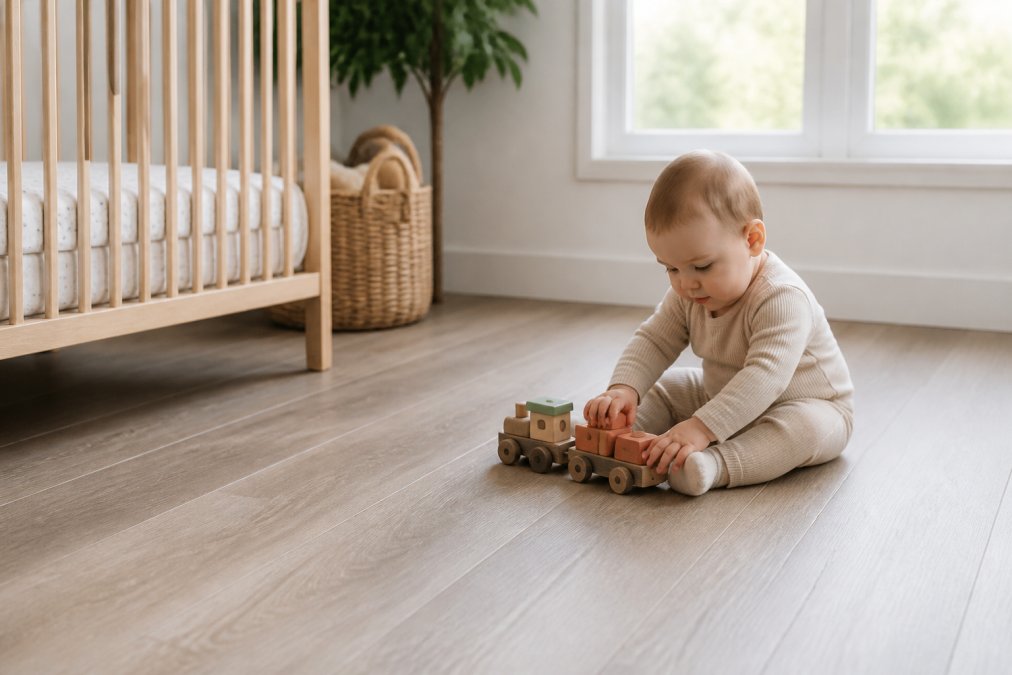
Off-gassing is the release of trapped VOCs from a material over time, and in a nursery the risk concentrates in the lowest 30 centimeters of the room, exactly where a crawling baby spends most of their waking hours.
Best Low VOC Flooring Materials for Nurseries
The best low VOC flooring for a nursery is cork, solid hardwood, or a GREENGUARD Gold certified engineered product, because each minimizes or eliminates the binders and adhesives that drive most emissions.
| Material | VOC Profile | Best For | Watch Out For |
|---|---|---|---|
| Cork | Naturally low; minimal binder | Crawl zones, warmth underfoot | Needs sealing against moisture |
| Solid hardwood | Low when finished with water-based sealant | Long-term durability | Site-finish fumes during install |
| GREENGUARD Gold engineered | Certified low-emission | Budget-conscious families | Certification must be verified |
| Laminate | Varies widely by core | Quick installs | Formaldehyde-based cores |
| Vinyl (PVC) | Higher off-gassing risk | Wet areas only | Phthalates in backing |
| Traditional carpet + padding | Padding is the main offender | Sound dampening | Adhesives and stain treatments |
Cork, Hardwood, and Natural Materials
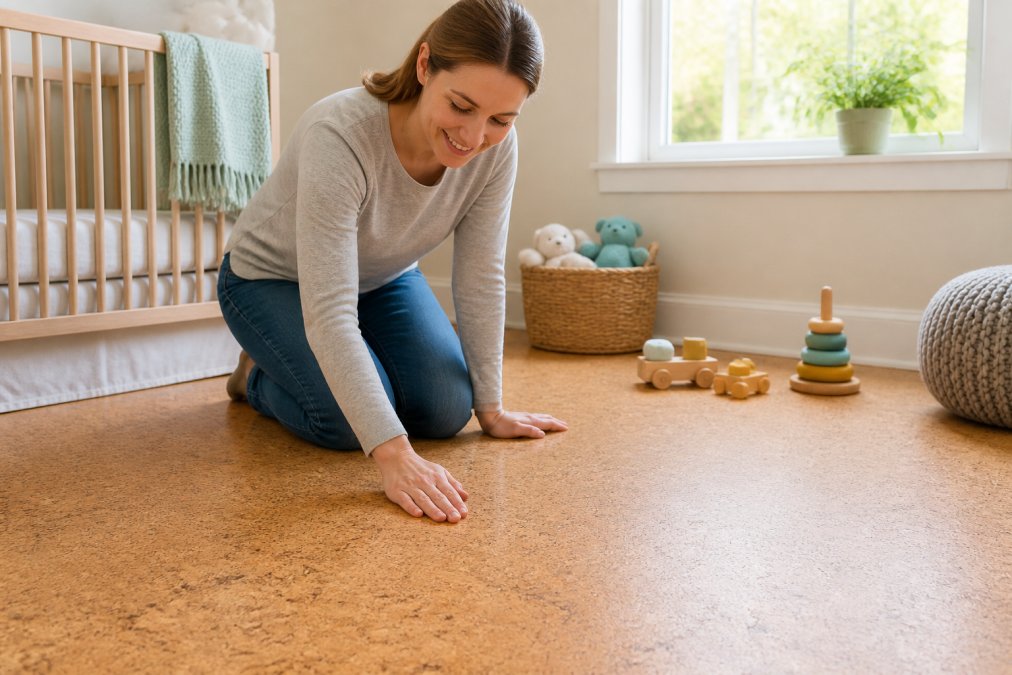
Cork earns its reputation. It is harvested without felling trees, it is naturally antimicrobial and allergen-resistant, and it has a slight give that makes it slip-resistant and forgiving for early walkers. Solid hardwood finished on site with a water-based sealant performs similarly well once cured, though the install itself is the fume-heavy part.
Laminate, Vinyl, and Carpet Padding: What to Avoid
Carpet padding is the most overlooked offender in a nursery. The padding, not the carpet face, is typically where adhesives and stain treatments live, and it sits directly beneath a crawling baby. Laminate and vinyl range from acceptable to risky depending on the core: some engineered products are genuinely low-emission, while others rely on formaldehyde-based binders.
GREENGUARD Gold Certified Flooring: What the Label Proves
GREENGUARD Gold certified flooring is a product tested by UL Solutions against strict emissions limits for total VOCs and individual chemicals including formaldehyde, and it is the certification most worth checking for a nursery because its thresholds are tighter than the standard GREENGUARD mark.
The certifications worth knowing, and what each one tests
- GREENGUARD Gold (UL Solutions). Tests for total VOC emissions plus individual chemicals of concern, including formaldehyde, with limits set to protect sensitive populations such as children and the elderly. The Gold tier is stricter than the base GREENGUARD certification, so a product labeled only "GREENGUARD" is not the same claim.
- FloorScore (SCS Global Services). A flooring-specific certification tied to the California Section 01350 emissions standard. It covers hard-surface flooring and is widely used by manufacturers who want a flooring-only mark rather than a general indoor-air mark.
- Cradle to Cradle Certified. A broader multi-attribute standard that scores material health, reusability, renewable energy, water, and social fairness. A product can earn Cradle to Cradle at different levels, so the level matters as much as the mark.
- Green Label / Green Label Plus (CRI). Carpet and adhesive programs run by the Carpet and Rug Institute. Green Label Plus is the stricter tier and covers carpet, cushion, and adhesives separately, which matters because a low-emission carpet face says nothing about the pad under it.
How to verify a certification in about five minutes
- Get the exact product name and SKU. Brand-level claims are marketing. Certifications attach to specific products and sometimes specific production runs.
- Open the certifier's public database. UL Solutions maintains a searchable GREENGUARD product guide; SCS Global Services publishes a certified-products directory; the Carpet and Rug Institute lists Green Label Plus products. Search the manufacturer and product line there, not on the brand's own site.
- Confirm the certificate is current. Certifications expire and are renewed. An expired listing is not a current claim.
- Check the scope line. Confirm the listing covers the product category you are buying, flooring, adhesive, underlayment, or finish, because those are often certified separately.
- Ask for the certificate number in writing. A reputable supplier can produce it. If they cannot, treat the claim as unverified.
What the label does not prove
A certification confirms low emissions under standardized test conditions. It does not confirm the absence of every chemical additive, and it does not cover what happens when the product is installed with a high-VOC adhesive or finished on site with a solvent-based sealer. Treat certification as a strong filter for the material itself, then apply the same scrutiny to everything that touches it during installation.
UL Solutions GREENGUARD certification product guide
SCS Global Services certified products directory
How to Reduce Off-Gassing in Nurseries
You can reduce off-gassing in a nursery by airing out new flooring before the baby's arrival, choosing water-based adhesives and finishes, and running ventilation during and after installation.
A practical sequence:
- Install flooring at least 2-4 weeks before the due date or move-in
- Specify water-based adhesives and low-VOC sealants in writing
- Ventilate the room daily with windows open and a fan moving air
- Run a HEPA and activated-carbon air purifier during the first weeks
- Wash the floor with a mild, fragrance-free cleaner before the crib goes in
- Keep the room warm to speed curing, then cool it before occupancy
Installation Risks: Adhesives, Finishes, and Subfloor Prep
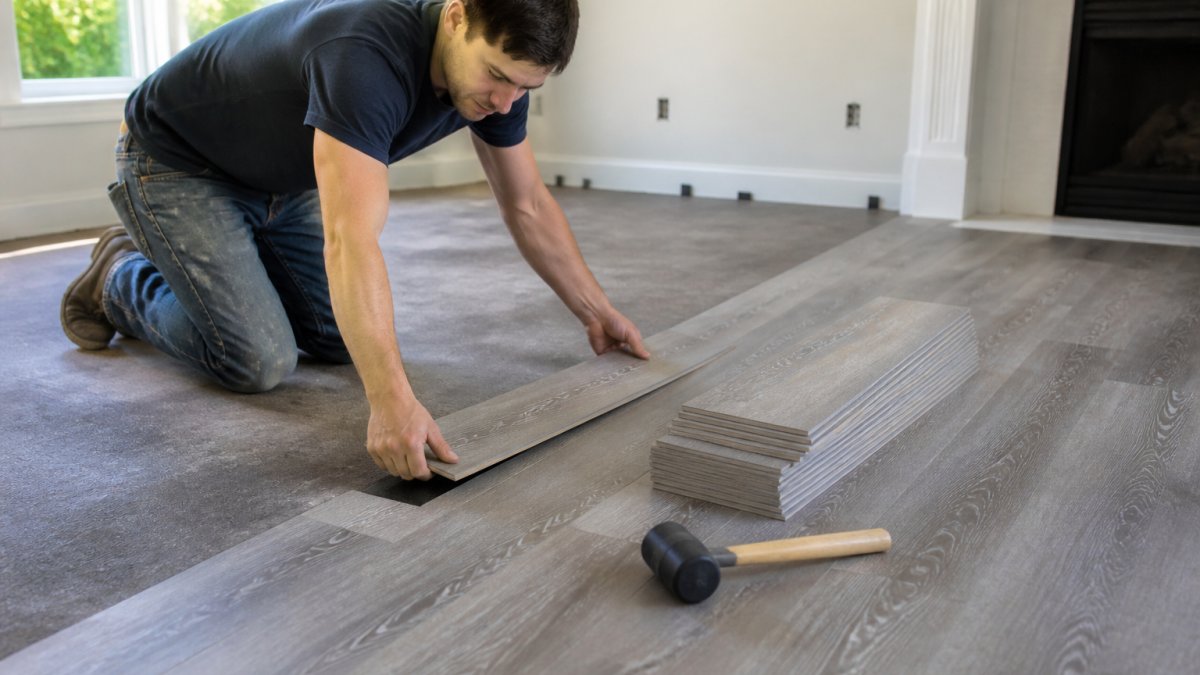
The installation materials, not the flooring itself, are the most common source of nursery VOC problems, and they are also the part of the job most homeowners never see quoted.
The four installation layers that emit
- Adhesives. Urethane and solvent-based construction adhesives cure by releasing solvents. Water-based and modified-silicate adhesives cure with far lower emissions. For a nursery, specify a low-VOC, water-based adhesive and ask for the product data sheet, not just the name.
- Seam sealers and edge sealants. Used on sheet vinyl and some resilient floors, these are small in volume but applied in the room and often overlooked in the spec.
- Leveling and patching compounds. Older subfloors, or any floor that has been previously sealed or has height variation, usually needs a self-leveling or patching compound. Many of these are cementitious and low-emitting once cured, but some contain latex or polymer additives that off-gas during drying. Ask which product is being used and how long it needs to cure before flooring goes down.
- Site-applied finishes. Site-finished hardwood is the highest-emission scenario in a nursery because the sealer and topcoat are applied in the room. Water-based polyurethane and waterborne finishes cure faster and emit far less than oil-modified or solvent-based finishes. If you are refinishing existing hardwood, this is the single biggest decision.
Underlayment and subfloor: the layer nobody quotes
Underlayment sits between the subfloor and the finished floor and is often chosen by the installer, not the homeowner. Foam underlayments can contain residual blowing agents; rubber underlayments can carry odor; and some "moisture barrier" products are bonded with adhesives. For a nursery, specify a cork, felt, or certified low-emission underlayment and confirm it is included in the quote rather than assumed.
What to put in writing before installation
- Adhesive: low-VOC, water-based, with product data sheet attached to the quote
- Finish: water-based sealer and topcoat, or factory-finished product
- Underlayment: specified by product name, not "standard"
- Leveling compound: named product and cure time before flooring goes down
- Moisture test performed and results documented
- Ventilation plan during and after install, including window and fan schedule
- Curing window before the crib and mattress go in the room
A note on timing
Even a fully low-VOC installation benefits from a buffer. Schedule the install so the room has at least two to four weeks of ventilation before the baby arrives or before the crib is assembled, and keep the door closed to the rest of the house during the highest-emission days so the rest of the home is not exposed.
How Long Off-Gassing Lasts and What It Costs to Go Low VOC
Most flooring off-gassing drops sharply within the first few weeks and continues at declining levels for months, with some products emitting trace amounts for a year or longer.
Frequently Asked Questions
What is the best flooring for a nursery with low VOC levels?
Cork, solid hardwood, and wool carpet with a natural backing are the most common low VOC choices for nurseries because they use fewer synthetic binders and finishes. Whatever material you pick, check for GREENGUARD Gold or FloorScore certification, and confirm the adhesive and finish are water-based rather than solvent-based. The installation products often emit more than the plank or tile itself.
How do I identify GREENGUARD Gold certified flooring in a showroom?
Ask for the certification number, not just the logo on the sample tag. GREENGUARD Gold is issued by UL Solutions and sets stricter emission limits than the base GREENGUARD mark, which is why it has become the go-to check for nursery flooring. Look the product up in UL's public SPOT database to confirm the exact SKU is listed. Certifications cover the tested product, so a matching underlayment or adhesive may not be included and needs its own verification.
How long does off-gassing typically last in new flooring?
Most of the emission happens in the first few days to weeks after installation, then drops sharply. Some products continue releasing low levels of volatile organic compounds for months, particularly engineered and vinyl floors with layered construction. Ventilation, low humidity, and warm indoor temperatures all affect the timeline. If you can, install nursery flooring several weeks before the baby arrives and keep windows open and air moving through the room during that window.
Does low VOC flooring cost more than standard options?
Certified low VOC products often sit at a higher price point than uncertified equivalents, mainly because of testing costs and better binders and finishes. Pricing depends on material, square footage, subfloor condition, and removal of the old floor. Cork and solid hardwood usually land at the top of the range, while some laminate and WPC lines offer lower-cost certified options. Request a written quote that lists material, adhesive, underlayment, and labor separately so nothing appears later.