 Ultimate guide
Why Commercial Flooring Maintenance Matters
Table of Contents
- Why Commercial Flooring Maintenance Matters for Your Business
- Extending Flooring Lifespan Through Preventative Maintenance
- Workplace Safety and OSHA Floor Safety Requirements
- Cost Savings and ROI from Proper Floor Care
- Commercial Floor Cleaning Schedule Best Practices
- Creating a Commercial Flooring Maintenance Checklist
- Sustainability and Modern Technology in Floor Maintenance
- Conclusion
Last Updated: August 16, 2026
Why Commercial Flooring Maintenance Matters for Your Business
Commercial flooring maintenance is the systematic care and upkeep of floor surfaces in business environments, retail spaces, offices, warehouses, and hospitality venues. At Hamptons carpet one floor and Home, we understand that flooring represents one of the largest capital investments most businesses make, yet it's often treated as an afterthought until problems become costly.
Floors experience constant assault from foot traffic grinding abrasive particles into surfaces, moisture seeping underneath, and dirt accumulating in seams and edges. Without structured maintenance, degradation accelerates exponentially. What starts as minor wear becomes surface damage, then structural failure, then premature replacement.
Commercial flooring maintenance directly impacts three critical outcomes: how long your floors last, how much you'll spend on them, and whether your facility meets safety and hygiene standards. A floor that should last 10 years might fail in 5 without proper care. Conversely, disciplined maintenance can extend flooring life by 40% or more while reducing emergency repairs that disrupt operations.
Extending Flooring Lifespan Through Preventative Maintenance
The single most important principle in commercial flooring maintenance is this: prevention costs far less than replacement. A floor's lifespan is determined almost entirely by how aggressively you prevent degradation.
Without preventative maintenance, foot traffic introduces grit and debris that acts like sandpaper, abrading the protective coating. Once that finish breaks down, moisture penetrates to the substrate, causing swelling, cracking, or delamination. At that point, repair costs spike dramatically, often exceeding preventative care costs by 10 to 1.
Preventative maintenance interrupts this cycle. Daily sweeping and vacuuming remove abrasive particles before they damage the finish. Regular damp mopping addresses moisture at the surface. Periodic deep cleaning removes embedded dirt. Burnishing and recoating restore the protective layer before visible wear appears.
The key insight most facilities miss: consistency matters more than intensity. A basic daily cleaning routine performed without fail outperforms an aggressive deep-clean program done sporadically. Floors respond to steady, predictable care.
Material type determines specific preventative approaches. Tile and stone benefit from sealing to prevent moisture penetration and staining. Carpet requires regular vacuuming to prevent fiber matting and color fading. Vinyl and luxury vinyl plank need moisture barriers to prevent cupping and warping. Hardwood demands humidity control and finish maintenance. Each material has different vulnerabilities requiring matched strategies.
A floor maintained properly from day one will outlast an identical floor left to degrade by 50% or more. For a business replacing flooring every 15 years instead of 10, that's a massive cost advantage.
Workplace Safety and OSHA Floor Safety Requirements
Slip-and-fall incidents are among the most common workplace accidents, and floor condition is often the culprit. This is a regulatory and liability issue that directly affects your business.
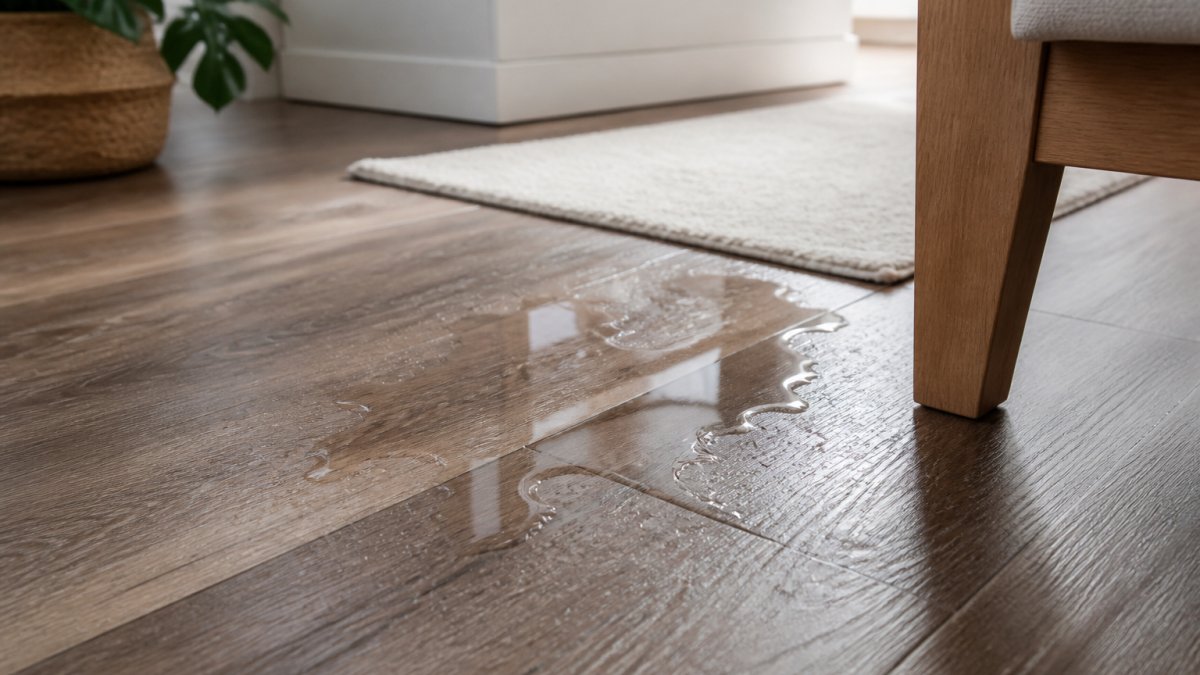
The Occupational Safety and Health Administration (OSHA) requires that workplaces maintain floors free from hazards that could cause injury. Cracked tiles, raised seams, moisture accumulation, and uneven surfaces all create slip-and-fall liability.
A structured commercial flooring maintenance program directly addresses these requirements. Daily cleaning removes moisture and debris that cause slips. Regular inspection catches damage before it becomes a hazard. Proper finish maintenance ensures surfaces maintain appropriate slip resistance. Documentation of a consistent maintenance program provides critical protection if incidents occur.
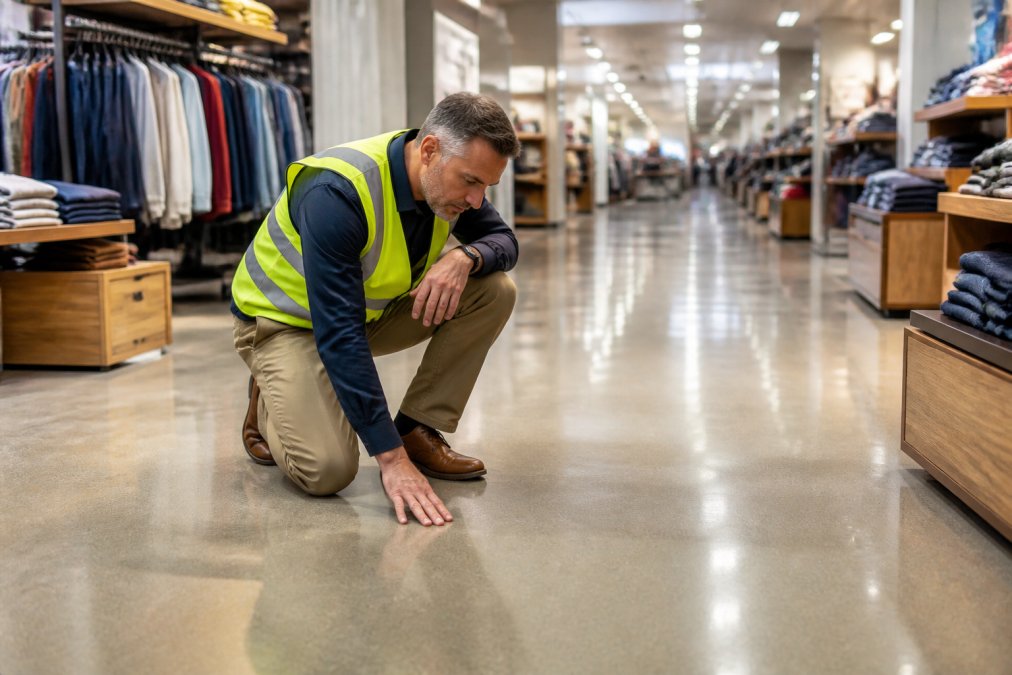
Slip-and-fall settlements are expensive. A single serious injury claim can cost tens of thousands in medical expenses, legal fees, and settlements. A maintenance program that prevents these incidents is one of the most cost-effective risk management tools available.
Different floor materials present different safety profiles. Polished concrete can become dangerously slippery when wet. Carpet provides grip but can hide moisture underneath. Tile is durable but prone to cracking. Vinyl offers good slip resistance when maintained. The maintenance approach must account for the material's inherent safety characteristics.
Documentation matters. Facilities that maintain written records of maintenance activities demonstrate due diligence, which becomes invaluable if a slip-and-fall incident occurs.
Cost Savings and ROI from Proper Floor Care
The financial case for commercial flooring maintenance is straightforward: spending a small amount regularly prevents spending a large amount suddenly.
A basic daily maintenance routine costs roughly 15 to 25 cents per square foot annually. Compare that to full floor replacement, which typically runs several dollars per square foot. For a 5,000-square-foot retail space, preventative maintenance costs perhaps $750 to $1,250 per year. Replacement costs $25,000 to $50,000 or more.
The ROI appears in multiple forms. First, extended lifespan: a maintained floor lasts 40-50% longer than a neglected one. Second, reduced emergency repairs: a maintained floor fails gradually, allowing planned replacement during slow periods rather than sudden failure requiring expensive emergency work. Third, lower insurance costs: facilities with documented maintenance programs and lower incident rates pay lower premiums.
When a floor fails suddenly, your business stops. A retail space closes for replacement. An office loses workspace. A warehouse halts shipping. These disruptions carry hidden costs in lost sales, reduced productivity, and customer frustration. Planned maintenance avoids these disruptions entirely.
Maintenance is relatively inexpensive operational spending (OPEX), while replacement is large capital spending (CAPEX) that often requires financing. Most businesses prefer spreading costs across many years through maintenance rather than absorbing a large replacement cost in a single year.
Commercial Floor Cleaning Schedule Best Practices
A successful commercial flooring maintenance checklist starts with understanding the relationship between foot traffic and cleaning frequency.
Daily cleaning is the foundation. Every commercial space should have a routine that includes:
- Vacuuming or sweeping to remove loose debris and grit
- Spot cleaning visible spills and stains
- Damp mopping high-traffic areas
- Emptying trash and wiping down entryways
Weekly deep cleaning adds another layer with thorough vacuuming, wet mopping with appropriate cleaning solution, spot treatment of stubborn stains, and attention to edges and seams where dirt accumulates.
Monthly maintenance goes deeper. For tile and stone: grout cleaning and resealing if needed. For carpet: extraction cleaning to remove embedded dirt. For vinyl and LVP: deep cleaning with appropriate products. For hardwood: polishing and finish inspection.
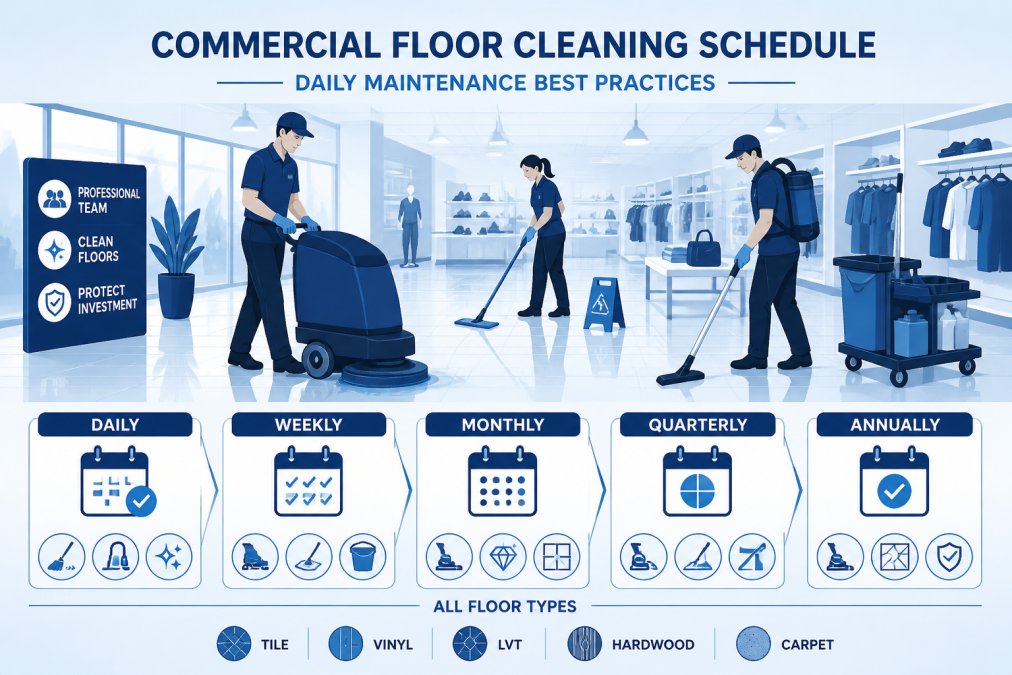
Quarterly and annual tasks address finish and protection through strip and wax, burnishing, resealing, deep extraction cleaning, and professional inspection.
The specific schedule depends on traffic volume, material type, and business type. A retail space with constant foot traffic needs more aggressive cleaning than an office with moderate use. Consistency matters more than intensity. A facility performing basic maintenance daily will have better results than one doing intensive cleaning once monthly.
Creating a Commercial Flooring Maintenance Checklist
A functional maintenance checklist is specific, measurable, and tied to actual facility conditions. It should identify what gets done, when, and who's responsible.
Start by documenting your floor inventory: what materials do you have, what areas experience high traffic, what areas are prone to moisture, and what's the age and condition of each floor section. Assign clear responsibilities so maintenance doesn't happen by accident.
Daily tasks should be simple enough that any staff member can perform them:
- Sweep or vacuum all areas
- Damp mop high-traffic zones
- Spot clean visible spills
- Empty trash at entryways
- Wipe down entry mats and transition areas
Weekly tasks typically require more skill:
- Deep vacuum all carpet areas
- Wet mop all hard floors
- Clean grout lines (tile)
- Inspect for damage or hazards
- Document any issues found
Monthly tasks often require specialized equipment:
- Deep extraction cleaning (carpet)
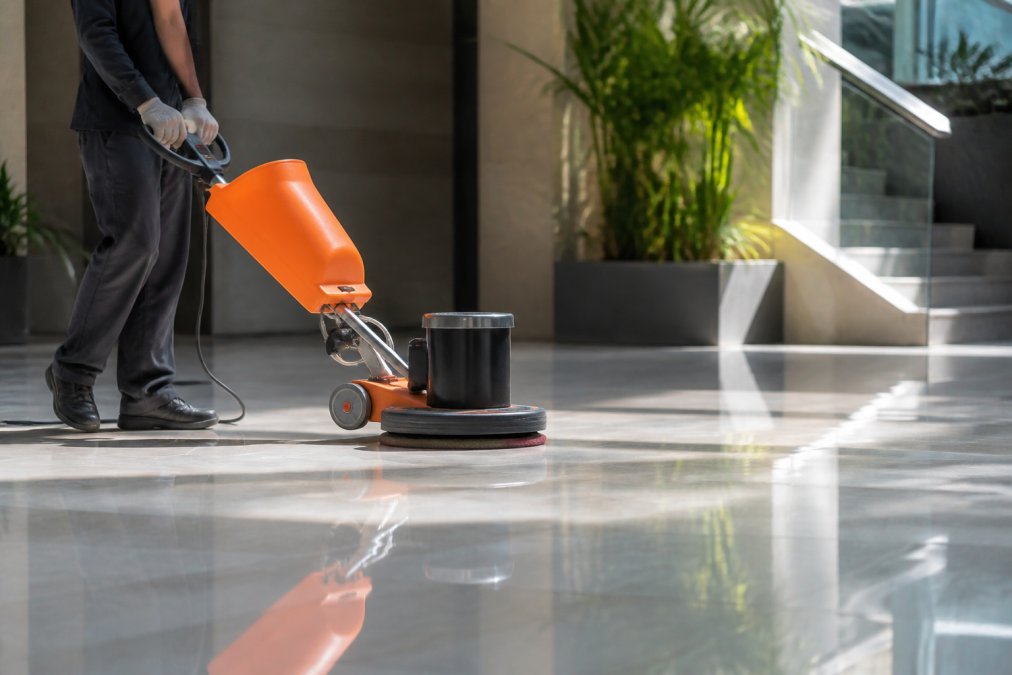
- Burnishing (hard floors)
- Grout sealing (tile)
- Stain treatment (all materials)
Quarterly and annual tasks are typically outsourced to professional services:
- Strip and wax (if applicable)
- Professional deep cleaning
- Finish recoating
- Sealing (stone, tile)
- Full facility inspection
Build in a documentation system. A simple log noting what was done, when, and any issues observed creates accountability and provides evidence of diligent maintenance. Include thresholds for when professional services are needed, such as: "If staining appears despite daily cleaning, schedule professional extraction."
Sustainability and Modern Technology in Floor Maintenance
Modern facility management increasingly incorporates sustainability and technology into maintenance approaches. This matters both for environmental responsibility and operational efficiency.
Sustainable floor maintenance starts with material selection. Some flooring materials are inherently more durable and longer-lasting, reducing replacement frequency and waste. Maintenance practices affect sustainability: aggressive stripping and rewaxing uses harsh chemicals and creates waste, while gentler maintenance extends floor life and reduces chemical use.
Eco-friendly cleaning products are increasingly effective. Many facilities have successfully switched from harsh chemical cleaners to plant-based alternatives without sacrificing cleanliness. These products are safer for staff, better for indoor air quality, and reduce environmental impact.
Water usage is another consideration. Microfiber mopping systems use 90% less water than traditional wet mopping while delivering better cleaning. For facilities concerned about water conservation, this shift reduces both environmental impact and operational costs.
Technology is beginning to influence floor maintenance through IoT sensors that monitor floor condition in real-time, robotic cleaning systems that handle routine cleaning in large facilities, and predictive maintenance software that optimizes schedules. For most commercial spaces, these advanced technologies aren't yet cost-justified, but they're worth monitoring for large facilities.
The practical sustainability approach for most businesses is straightforward: maintain floors properly so they last longer, use gentler cleaning methods that reduce chemical and water use, and choose eco-friendly products when available at reasonable cost premiums.
Proper commercial flooring maintenance is the difference between a floor that fails prematurely and one that serves your business reliably for years. The investment required is modest: a structured daily cleaning routine, regular inspections, and periodic professional care. The returns are substantial: extended floor life, reduced emergency repairs, improved workplace safety, and lower total cost of ownership.
If you're ready to develop a maintenance program tailored to your facility's specific needs, Hamptons carpet one floor and Home can help. We work with businesses throughout the region to assess current conditions, identify material-specific maintenance requirements, and establish schedules that keep floors performing at their best. Contact us for a facility evaluation and maintenance recommendation.
Frequently Asked Questions
What are the main benefits of regular commercial flooring maintenance?
Regular commercial flooring maintenance protects your flooring investment by preventing premature wear from foot traffic and grit accumulation. It reduces slip-and-fall liability, maintains indoor air quality by removing bacteria and contaminants, and keeps your facility looking professional. Proper maintenance also identifies damage early, preventing costly repairs and extending your floor's lifespan by years. Businesses that implement a structured maintenance program typically see significant reductions in facility replacement costs over time.
How does a commercial floor cleaning schedule improve workplace safety?
A consistent commercial floor cleaning schedule reduces slip-and-fall hazards by removing moisture, debris, and contaminants that cause accidents. Daily cleaning removes tracked-in sand and salt, while deep cleaning addresses buildup in high-traffic areas. OSHA emphasizes that maintaining clean, dry floors is essential for workplace safety compliance. Regular maintenance also prevents bacteria growth and improves indoor air quality, creating a safer environment for employees and customers. Facilities with formal cleaning schedules report fewer injury claims and lower liability exposure.
What should be included in a commercial flooring maintenance checklist?
A comprehensive commercial flooring maintenance checklist should include daily tasks like vacuuming and spot cleaning, weekly deep scrubbing of high-traffic zones, and monthly burnishing or strip-and-wax treatments depending on floor type. Inspect for damage, moisture issues, and surface degradation. Check entryway systems and walk-off mats to reduce debris entering the facility. Schedule quarterly professional deep cleaning and annual floor assessment. Document all maintenance activity to track wear patterns and plan preventative repairs before they become expensive problems.
How can proper floor maintenance reduce long-term facility costs?
Preventative maintenance costs far less than emergency repairs or premature floor replacement. Regular cleaning prevents abrasion and surface degradation caused by grit and foot traffic, extending your flooring investment by 5-10 years. Addressing small issues early avoids costly substrate damage. Reduced slip-and-fall incidents lower liability and insurance costs. Professional facility management programs optimize cleaning schedules to balance cost and effectiveness, and modern eco-friendly maintenance methods reduce chemical and water expenses. Businesses that invest in structured maintenance typically recover their investment within 2-3 years through avoided replacement and repair costs.
This article was written using GrandRanker